

Part 1: The Question
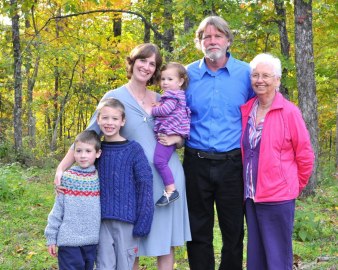
It is October,
the veil is thin
the year is waning
the leaves are turning
I am trying to say goodbye
to my grandmother
she is dying.
I do not know what to say.
The leaves are red
the sky is blue
I saw a crow in the tree
behind the house.
The threads of this year
are becoming thinner.
The threads of her life too
are becoming thinner
What do I say to the one
who breathed life into my father
who wove his cells into being
who cradled him as a baby
who wept into his hair.
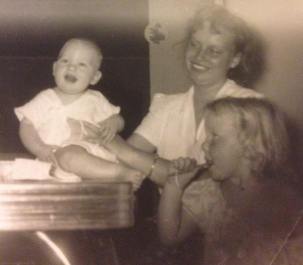
Carrying the cells
of the generations
The chain of life
continuing to spiral
through time, and place,
and distance
and falling leaves.
What do I say as life thins,
as breath fades
What do I say
when all that remains
is the space between us
What do I say
when I catch a glimpse
of the swift unraveling of time
the wrinkles in eternity
What do I say
as time folds in on itself
and now it is me in the bed
and my son, gray-haired, blue-eyed
is reading to me in a quiet voice
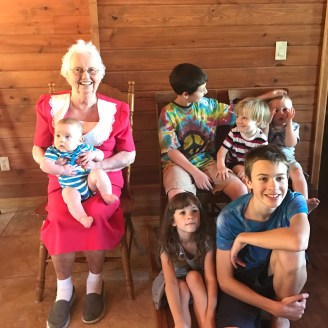
as the chapter comes to a close.
Part 2: The Answer
That night,
I dreamed of my grandmother
she shrank to the size of a small child
I picked her up and held her against my body
We looked in the mirror cheek to cheek
and smiled together
I kissed her face and told her:
“You are wonderful.”
Then we danced around the room together
her head against my shoulder
I kissed her again on her white hair
and no more words were needed.
Part 3: The Memorial
At this time last year, as the leaves fell and the wheel of the year dipped into darkness, my last grandparent died. I recognize that I am fortunate in having reached nearly forty while still having a living grandmother, but there is still such a sensation of finality and ending in saying goodbye to the final grandparent. Twyla was my paternal grandmother and I was not as close to her as I was to my maternal grandmother who died in 2013, but she is the woman who wove my father’s bones into being, and her death left a hole in our family and a sensation of an ended section in the tapestry of generations.
After the dream I write of above, I went back to see her a final time, five hours before she took her last breath. This time, I sat with her alone. I kissed her on her white hair and told her she was wonderful. I played her a song (Beyond the Gates by T. Thorn Coyle and Sharon Knight). I spoke to her of her good work in the world, that she had done it, that she’d finished her work, and that she had given so much and done so well. As a mother myself, the sensation of how powerful it is to have seen all your babies through to adulthood and into grandparenthood themselves filled the room. My dad, her second child and only son, has teenage grandchildren now himself. My grandmother’s youngest child of her five children is in her mid-fifties (and also a grandmother to teenagers). Sitting in the darkened room, listening to the song play, I was staggered by the magnitude of having seen each of your own children through their lives and into grandparenthood. While there are many ways to leave a legacy and it is not a “failure” by any means to not see all of your children into grandparenthood or to not have children yourself, what a gift it must be to bear witness to these generations if it does, in fact, unfold in that way, and to see your own tiniest baby have grandchildren of her own. This is something I hope to see for myself.
I then had the blessing, the honor, the privilege of being asked to prepare a memorial service for my grandmother. Five years ago, I was also asked to facilitate the memorial ceremony for my other grandmother. The unique, uncommon blessing of fulfilling this role for both of my grandmothers is not lost on me, as I know no one else who has had the experience of serving both sides of their family of origin in this way. I felt so honored to be trusted to help guide my family through both of these experiences of loss and grief. I spoke to my husband of how humbled, grateful, and fortunate I feel that I have a family who would let me do this, not just for one grandma, but for both of them, and he said, “you know, honey, maybe we should all be grateful to you that you’re willing to do this for us.” So, I received that recognition into my heart with appreciation as well.
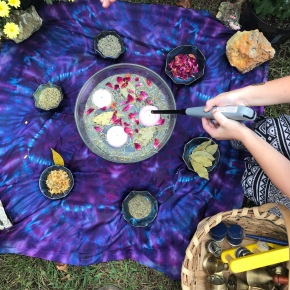
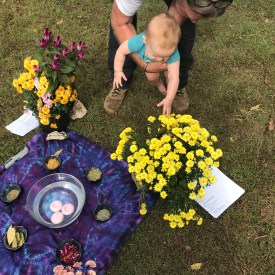
It is powerful to create ceremonies that acknowledge transitions within the life of your family. During this ceremony for my grandmother we each had time to speak of her, I had poems I had written, and readings to share. We had a centerpiece with flowers, floating candles, and photos of her, and we each held handfuls of herbs that we offered into the bowl of water as we shared our stories and memories. Each person took time to do so and spoke with care, tenderness, love, and laughter. Sharing this time and space together and creating a container for people to be heard in their grief and love rather than participating in the type of “canned” or impersonal memorial service that may be more commonly offered by religious groups, was what we needed to say goodbye to this woman who wove a part of our souls. My aunt said: this is the kind of send-off that everyone needs, and that felt very true and real.
My extended family is not pagan or liberal or alternatively religiously minded and as I planned the memorial I was conscious of not wanting it to be “too much” for them. As I typed my outline, I’d first included a song and other practices common to other rituals and retreats I lead and when I heard that my aunts and cousins were coming, I’d removed the song and some ritual elements, fearing making them uncomfortable. They then said they weren’t coming, so I added the singing back in. On the day of the memorial, they did in fact come, and I decided we would sing anyway, whether 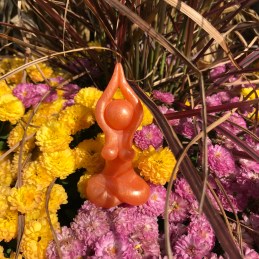 comfortable and familiar or not. We sang the same song to begin and to end the memorial (“We Are a Circle”) and when I looked around the circle the second time we sang and saw that everyone there holding hands, their faces wet with tears, were all singing too, I knew that it had worked.
If you have the opportunity to create ceremonies and rituals of personal meaning for your own family, please do it. It holds so much value, such life and power and love, in a way that is difficult to create by someone outside of the family. A small group of people who really care and who are willing to connect with each other in a meaningful, connected, vulnerable way, births so much real magic together. This container can be created by you, for you, and for the ones you love the most.
“Everyone can do the life-changing, world-renewing work of magic…the Dalai Lama said, 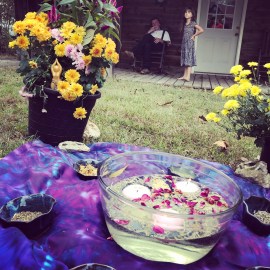 ‘It’s not enough to pray and meditate; you must act if you want to see results.’ We are called to offer real service to others, to the Goddess. That service may take many forms: mopping the floor after the party, priestessing rituals, healing, planning, teaching, carrying the heavy cauldron from the car, sitting with a dying friend, writing up the minutes for a neighborhood meeting, organizing a protest to protect a sacred place from development, writing letters to Congress, training others in nonviolent civil disobedience, growing food, or changing the baby’s diapers. All of these can be life-changing, world-renewing acts of magic…”
—Starhawk and Valentine, The Twelve Wild Swans
There is a companion audio recording available about this memorial service preparation, the death of my grandmother, and about how to weave a strong “ritual basket” to carry a ceremony. The first part is an audio ritual for my online circle with thoughts about claiming your magic, fear of the label of witch, etc., so if you want to skip past that only to the memorial information and ritual theory, skip to 16:20 in the audio:
Molly has been “gathering the women” to circle, sing, celebrate, and share since 2008. 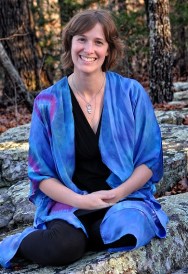 She plans and facilitates women’s circles, seasonal retreats and rituals, mother-daughter circles, family ceremonies, and red tent circles in rural Missouri and teaches online courses in Red Tent facilitation and Practical Priestessing. She is a priestess who holds MSW, M.Div, and D.Min degrees and wrote her dissertation about contemporary priestessing in the U.S. Molly and her husband Mark co-create Story Goddesses, original goddess sculptures, ceremony kits, and jewelry at Brigid’s Grove. Molly is the author of Womanrunes, Earthprayer, and The Red Tent Resource Kit and she writes about thealogy, nature, practical priestessing, and the goddess at Patreon and at Brigid’s Grove.
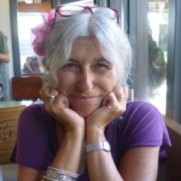 Donna Henes, familiarly known as “
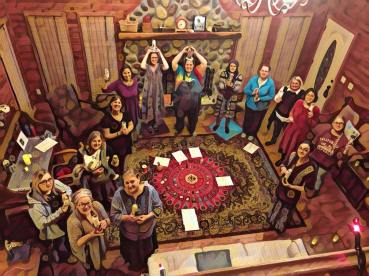 As a practicing priestess, one of the dynamic dances that I engage in is with the power of story. I both find that women’s stories are the vital lifeblood of conscious engagement and power-building with one another and that they can be one of the elements that bogs down a ritual and makes it lose power and magic. This is partially because the dominant culture may teach us to bond using stories in a way that actually drain our energy through “venting,” swapping complaints, trading to-do lists, and through describing behavior, motives, and character of other people. In women’s ritual space, I encourage people to dig deep, but also to share a here-and-now connection of shared experience rather than a there-and-then rendition of past experiences.
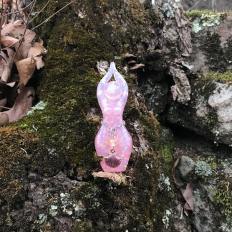 storying and re-storying our lives and that seeing our lives, and the lives of others, through a mythopoetic lens, can have a radically transformative impact on our experiences and our relationships. I have written about
 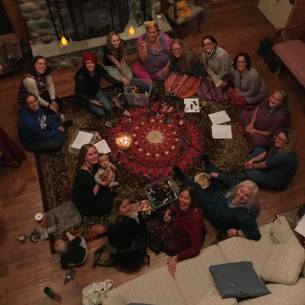 weird. Stories are instructive without being directive or prescriptive. It is very easy to take what works from stories and leave the rest because stories communicate personal experiences and lessons learned, rather than expert direction, recommendations, or advice. Stories can also provide a point of identification and clarification as a way of sharing information that is open to possibility, rather than advice-giving.
 Note: there is a detailed audio exploration of the themes of this post available
  Last week, I had the incredible privilege of sitting vigil with a friend in hospice in her final hours on this earth. She slept for most of the time I was there, but her waking moments were lucid, if brief. She whispered how good the fresh juice tasted (it had been made for her by a friend), and she seemed to prefer having my hands on her back to pain medication. In the last hour I was with her before leaving, a
  When you read this dear FAR family, it will be December 22, the day after the winter Solstice.
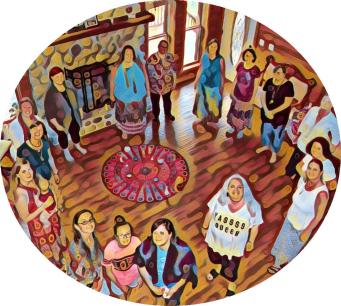 tapestries, their faces are turned towards me, waiting expectantly. We are here for our first overnight Red Tent Retreat, our women’s circle’s second only overnight ceremony in ten years. We are preparing to go on a pilgrimage. I tell them a synopsis version of Inanna’s descent into the underworld, her passage through seven gates and the requirement that at each gate she lie down something of herself, to give up or sacrifice something she holds dear, until she arrives naked and shaking in the depths of the underworld, with nothing left to offer, but her life.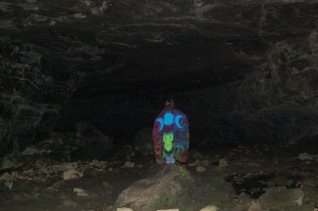
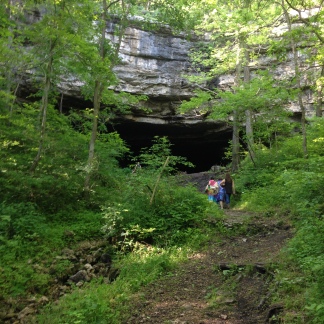 using handspun wool yarn until the yarn releases, taking our burdens with them. Suddenly, we hear the sound of tires on the gravel. Slamming doors. The sound of loud men’s voices. The smell of cigarette smoke. A ripple of uncertainty passes through us. We are once again tentative and we feel a current of unease. What should we do? we whisper to one another. The voices draw nearer, there are calls and hoots. My friend looks at me and says: this is where we make our stand. We hold hands in a line at the edge of the cave roof, gazing out into the horizon. A hawk wheels overhead. We sing. The approaching voices quiet. We sing louder.
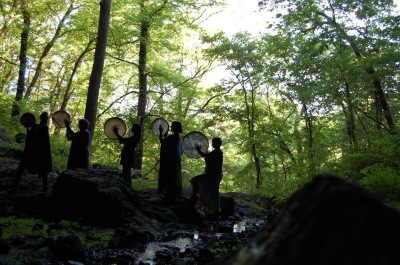 carvings of priestesses carrying drums as, “women carrying cakes to their husbands.”
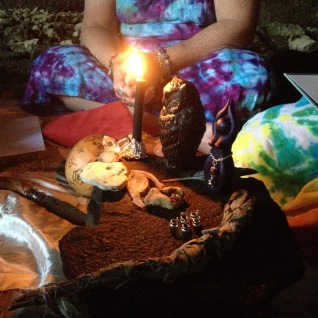 within which women try out what they want the macrocosm, the ‘big universe’ or real world to be. Within the safety and protected space of the cast circle, women create their idea of what the world would be like to live in under matriarchal/Goddess women’s values…The woman who in the safety of the cast circle designs the world as she would like it to be takes that memory of creation and success out into daily life…By empowering women through the microcosm of the ritual’s cast circle, change becomes possible in the macrocosm real world.” (p. 2-3)
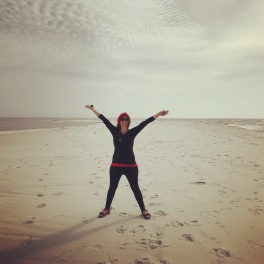 Molly has been “gathering the women” to circle, sing, celebrate, and share since 2008. She plans and facilitates
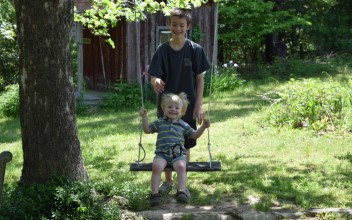 for our daughters coming of age. What about our sons? Where are their ceremonies and welcomes into manhood? Where are their stories in the desert? Is it a mother’s job to provide the container for those stories? Can I call the circle for my son and then step back? I know what it means to be a girl reaching into womanhood. I know what it means to circle with other women. Does it have to be different for boys and men?
 what I found. The circle was called, held at dusk, and each person was instructed to bring a rock for the newly fledgling boy. They were to go around the circle and share what they learned, what they were imbuing into the stone…so far, so good, right?…and then, throw it into the darkness and say, “find it for yourself.” When I read this, I had an epiphany. If this was a ceremony for girls, we each would have handed her the stone and welcomed her into the circle with our wisdom, we would have made sure she knew that she was strong, powerful, and capable, but also that part of that power meant that we were standing with her and offering our wisdom in support. She would not have to crawl in the darkness alone looking for rocks, because we’re there. And, that is the core message of most women’s circles and ceremonies for girls. We’re there. You are not alone. So, then I knew…a ceremony for a boy need look no different. Maybe I do not know the stories from the men’s desert, but I do know what it is like to celebrate someone for their unique gifts and strengths, look them in the eye and affirm their power, and sing to them with love of my support of their dreams. This is not a gendered thing, this is humanity. How do we want to welcome boys into the world of adults? By casting away our wisdom and telling them to search in the darkness for themselves? Or by standing next to them, shoulder to shoulder, hand in hand, and offering all that we have, all that we are, in support, and trust, and honor of their evolving selves?
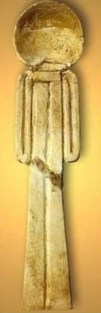 Over the years I have seen the image of the amulet called the Knot of Isis but in all honesty, never paid it much attention. I am on the organizing committee for our annual Goddess Festival here in Austin this year and we have chosen Isis as our Goddess to honor. The intent is to reclaim the Sacred Name of Isis and celebrate Her power, especially for women.
 Feminism and Religion