Role Play: In Search of the Authenticity of My Being by Elise Edwards

Elise Edwards“I stood in the authenticity of my being: Black, preacher, Baptist, woman. For the same God who made me a preacher made me a woman, and I am convinced that God was not confused on either account.”
– Reverend Dr. Prathia Hall

These words came across my Facebook feed on Sunday in celebration of International Women’s Day. Reconciling Ministries Network put the statement on its Facebook page, along with a picture of Prathia Hall preaching from the pulpit, in remembrance and honor of women leaders who contributed to the US Civil Rights Movement. This past Sunday, March 8, when the quote was displayed, marked the 50th anniversary of Selma’s Bloody Sunday. Prathia Hall was a leader in the Student Non-Violent Coordinating Committee (SNCC) and one of the activists on the Edmund Pettus Bridge who were attacked as they began to march from Selma to Montgomery, Alabama. Later in her life, she became an ordained minister, professor, and womanist theologian.

For me, this past weekend was about remembrance through many forms. While there were many events commemorating Selma and the important events that unfolded there 50 years ago, my family and I were focused on a more intimate form of remembrance. On Saturday, we held a dinner and informal memorial service for my godfather who passed away last month. I got the news of his death on a day when I’d been doing some deep soul-searching and reflecting about the image I present to the world and its correspondence with who I am and desire to be. Just a few days prior, I’d spoken to my godfather about his health and subsequently, I had been questioning how I might be more connected to him. We lived several states apart, and I wondered how I could be a good goddaughter to him despite the distance. Those questions are left unanswered in the wake of his death. Continue reading “Role Play: In Search of the Authenticity of My Being by Elise Edwards”

Education, Anti-Semitism, a Counter Narrative and a Different World by Ivy Helman

meblogIt’s pretty common knowledge that education changes lives. It opens doors, improves health, promotes gender equality, decreases poverty, promotes civic involvement and has many other benefits. This is true for basic literacy campaigns as well as sex education, access to school for girls and institutions of higher education. Yet, what is taught in addition to how it is taught matters a great deal.

In a few days, I’ll begin a new semester teaching “The Jewish Experience in Central Europe” for Anglo-American University in Prague. As a scholar, a Jew and a feminist who recently moved to Prague (in the heart of Central Europe), this course hits home.   It is also timely given rising anti-Semitism in Europe. Coincidentally, this is also the first time I’m teaching a course solely on Jewish history. Continue reading “Education, Anti-Semitism, a Counter Narrative and a Different World by Ivy Helman”

The Work of Justice-Making by Xochitl Alvizo

Incarnation, Goddess spirituality, Xochitl Alvizo, god became fleshWritten two weeks ago on December 5, 2014, but offered still as some food for thought:
I’m supposed to be writing my dissertation. Hand on the plow, no looking back. I have even left town for the whole month of December in order to minimize the everyday distractions that are part of my life in Boston and increase my focus on writing. I’ve set up shop in my friends’ living room, surrounded by multiple windows, perfect natural lighting, and festive Christmas decorations. But, two days in, and I have yet to get into my dissertation writing groove.

So I am writing this blog post instead in an effort to work my way back to the dissertation. I read somewhere that writing is thinking – which is why dissertations, and every other kind of writing project, often change direction along the way. If writing is thinking, then, I’m hoping that writing this post will help me think my way back to the dissertation, because at the moment, all I can of think is, I can’t breathe, I can’t breathe, I can’t breathe. Continue reading “The Work of Justice-Making by Xochitl Alvizo”

“Justice, Justice You Shall Pursue:” Finding Hope in Justice-Seeking Movements. by Ivy Helman

20140903_180423For the past few weeks, there has been a lot of discussion about racism in the United States and rightly so. It is clear from the lack of charges and the repetition of similar crimes across the United States by different members of various law force communities that some people because of the color of their skin are immune to the consequences of their actions and others, also because of the color of their skin, are often the victims of such actions. Criticism, here, in the forms of protests, federal inquiries and outrage are essential.

I am reminded of oft-quoted part of the Torah: Devarim (Deuteronomy) 16:20, one that I saw on some of the signs Rabbis carried with them in the protests. “Justice, justice shall you pursue, that you may thrive and occupy the land that the Lord your God is giving you,” (from the JPS translation). G-d tells those early Israelites that justice is a requirement not just for their survival in the Promised Land, but also if they want to have good, long lives. Later tradition, from the Talmud to Rashi and beyond, interpret this passage as a call for a just court system within Jewish society.  Likewise, all who use the system should have the principle of justice in mind.  There is also a lot of conjecture as to why justice is said twice. Many modern scholars call attention to the way in which religion and state were considered one in same for this time period and much of human history. Continue reading ““Justice, Justice You Shall Pursue:” Finding Hope in Justice-Seeking Movements. by Ivy Helman”

Awake! Awake! A Reflection on the Awakening of Conscience and Advent by Elise M. Edwards

Elise Edwards‘Tis the season to be…?

For me, this has not been a season to be jolly. I teach at a university, and again, I’m in the midst of the most hectic time of year of grading and exams and wrapping up projects due at the end of the calendar year. There have been moments of joy and rest. But I’ve been more reflective and sorrowful. This year, my heart and mind and soul have been opened up in new ways and I feel more urgency and need for social change. I’ve been experiencing “conscientization” during the time of year many Christians refer to as Advent.

I was introduced to the concept of conscientization in the work of Christian feminist and womanist ethicists like Beverly Wildung Harrison and Stacey Floyd-Thomas. Other feminist and liberationist thinkers had already convinced me of the vital role that critical thinking, consciousness-raising, and action occupy in ethical reflection and social change. In a chapter on “Feminist Liberative Ethics” in a textbook on liberative approaches to ethics, Michelle Tooley explains the meaning of conscientization:

“Activists speak of conscientization as waking up to the injustice in the world—or seeing it for the first time. It is not that the injustice is beginning; it is that you encounter oppression, injustice, violence yourself or you see it in a person or situation. You may have seen the same situation many times before, but for some reason you begin to connect the event with a deeper recognition that the injustice is wrong.”

(p. 185, Ethics: A Liberative Approach, Miguel A. De La Torre, Editor)

I was conscientized the night I heard that a grand jury did not indict Darren Wilson for killing Mike Brown, an unarmed black man. I was horrified to learn that this police officer doesn’t even have to stand trial for his violent and deadly act. Now it wasn’t like before grand jury’s decision I thought that black lives were given equal value in the US justice system. After all, for months I have been researching and preparing a paper called “When the Law does not Secure Justice or Peace” about artistic and religious responses to the dishonoring of black male personhood. I have been mourning the loss of Trayvon Martin and others as I write. But this decision left me sobbing in a hotel room as I watch the events unfold in Ferguson, Missouri. I gained a deeper social awareness about the depths to which the demonization and disregard of the lives of black women, men and children are entrenched in American life and the institutions within it.

I gained deeper self-awareness too. One reason the tragedy of the grand jury’s decision became so palpable to me is that just hours prior, I witnessed former president Jimmy Carter address the American Academy of Religion. He spoke passionately about the proliferation of violence, mistreatment of women, climate change, and other social concerns. To put it plainly, I was floored to see a white man in his 90s who was raised in Georgia and was a Southern Baptist until his 70s state without any qualms that people in power intentionally misinterpret religious texts to support the domination of women and nonwhites because those they do not want to lose their privilege. Yet he also called himself, like Archbishop Desmond Tutu, a “prisoner of hope.” He believes that things will change, and draws from his Christian convictions to sustain hope and motivate his work to fight injustice.

I was electrified by his words. I, too, had hope. In the days prior, I had gotten a break from my daily life, connected with friends, and conversed with like minds. I had been thinking about art and love. I had learned strategies for de-centering dominant narratives in the classroom and I was hopeful that I could use them to make a difference in my students’ lives. But mere hours later, while watching the news, the self-awareness I came to is that my hope is more fragile than I wish it to be. Futility consumed my hope.

A few weeks later, I can assert that my faith in God is not shaken, but my hope in humanity’s goodness has as much stability as a house of cards. In my present state of mind, I’m grateful that we are at a point in the church year that provides me with an opportunity to mourn the brokenness of our world. Christmas is approaching, but that doesn’t mean I have to sing merry carols. Advent is a season when Christians reflect on why the world needs God’s miraculous action and what it means to wait for light to emerge in the darkness. In the church calendar, it is a time when Christians re-enact and re-experience the anticipation of Jesus’ coming. Advent songs have a different character than Christmas carols. Many of them have a haunting tone or an eerie, sad, or mysterious sound. The lyrics of these songs place exhortations to “Rejoice!” next to pleas of “O come, o come, Emmanuel!” Emmanuel, also spelled Immanuel, means “God with us.” Christians draw this name from the Hebrew prophecies in Isaiah that are cited in the Gospel of Matthew’s account of Jesus’ birth. Matthew describes Jesus’ birth as the fulfillment of prophecy.

My conscientization allows me to hear these prophecies anew. They are familiar to me, as they are repeated often this time of year in Christian settings, but I hear them in new ways. I hear Isaiah 9:6 quite differently: For to us a child is born, to us a son is given, and the government will be on his shoulders. And he will be called Wonderful Counselor, Mighty God, Everlasting Father, Prince of Peace.

“The government will be upon his shoulders” likely means that this child will have authority. But as I hear those words this year, I imagine the Prince of Peace in the choke-hold of a law enforcement officer. I think of a little baby who are welcomed into the world with joy but who grows up only to be killed at a young age by threatened authorities and crowds of supporters. This is the story Christians tell about the God who is with us, the God who is also fully human. And this is the story we tell about Michael Brown, Eric Garner, Tamir Rice, Alesia Thomas, Aiyana Stanley-Jones and far too many others.

This Advent, I’m making a real effort to hold hope and despair together. I don’t want to become hopeless. I don’t want to think that my work in the classroom, in my church, in my community, on this site and in the printed page have no meaning. Hope is what sustains us to work for justice. I want to believe in that transformation of hearts and minds and souls is possible and immanent even when it emerges through sorrow and struggle. Suffering, sorrow, and killing without consequences must not be acceptable. With my new eyes, I see just how terrible they are.

Elise M. Edwards, PhD is a Lecturer in Christian Ethics at Baylor University and a graduate of Claremont Graduate University. She is also a registered architect in the State of Florida. Her interdisciplinary work examines issues of civic engagement and how beliefs and commitments are expressed publicly. As a black feminist, she primarily focuses on cultural expressions by, for, and about women and marginalized communities. Follow her on twitter, google+ or academia.edu.

The Cop on the Beat is Not Ice-T, the Prosecutor Is Not Sam Waterston, and Mariska Hargitay and S. Epatha Merkerson Are Not in Charge, by Carol P. Christ

carol at green party 2014 croppedI have watched every episode of Law and Order and Law and Order SVU, and most of them more than once. Though there is police violence on these programs, it is usually investigated, and viewers are given the sense that it is not OK. Not living in black America or even in the United States, I guess I was under the illusion that police forces are no longer primarily white and male, that police reforms advocated decades ago have had some effect, and that cops cannot get away with murder.

This despite the fact that I knew that inmates in US prisons are far more likely to be black than their numbers in the population warrant, and that I knew that stop and frisk and arresting black men for petty crimes are ordinary police policies.

For readers who don’t watch MSNBC as avidly as I do, stop and frisk, now banned in New York City, is the policy of searching (primarily) young black men hanging around on street corners to see if they have illegal drugs or weapons on their persons. This policy can lead to the incarceration of young black men for having one or two marijuana cigarettes intended for personal use in their pockets. Stop and frisk is not a policy on college campuses, where police are just as likely to find young white men and women in possession of illegal drugs. Why? Because college authorities and parents of white college students simply would not allow it. Continue reading “The Cop on the Beat is Not Ice-T, the Prosecutor Is Not Sam Waterston, and Mariska Hargitay and S. Epatha Merkerson Are Not in Charge, by Carol P. Christ”

On Believability, Oppression and Ferguson by Sara Frykenberg

Sara FrykenbergLast week, Amina Wadud wrote an important post,Justice for Mike Brown,” discussing Mike Brown’s death in light of Brown vs. The Board of Education, Plessy vs. Ferguson and the injustice faced by African American Communities, particularly in the US legal/ criminal justice system. She highlights the dehumanizing practices that lead us to criminalize black bodies, beginning in childhood.

Considering her post and many, many other articles and news reports over the past several months, and particularly this last week, since the Grand Jury failed to indict Darren Wilson, I felt compelled to speak about a certain quality of kyriarchal oppression: that of rendering the oppressed “unbelievable.” I will not recount the details of the case here (please see the link above for links to court documents through NPR), nor will I try to “speak for” African American communities– nor can I. However, I think it is important that we bloggers and readers at feminismandreligion.com continue to consider the recent verdict and the critical justice issues it raises, as well as remember the tragedy of Mike Brown’s death, and so many men and women like him.

Actor and activist Jessie Williams, who many know from the popular TV show Grey’s Anatomy, gave a passionate and salient interview on CNN’s “State of the Union,” back in August after Michael Brown was killed. You can watch most of the interview with Williams, LZ Granderson and Tara Wall here; you can watch here for the clip I mention below.  Like Wadud, he too discusses the criminalization of black bodies, drawing from the everyday experience of Black men in the United States to make his case. At the end of the interview, Williams powerfully asserts, “We’re not making this up.” Continue reading “On Believability, Oppression and Ferguson by Sara Frykenberg”

Justice for Mike Brown? by amina wadud

amina - featureI was born the year the Supreme Court of the United States of America began to hear Brown v. Board of Education of Topeka; a case that ought to be known to all as a matter of US history. Here is a precise, but telling history of how that case came into being. This historical account lacks hyperbole, perhaps because one feature of legal-eeze carries the technical title (and appropriately so) of being a brief.
In case blog readers don’t do background research or follow footnotes, I raise these salient points: The Declaration of Independence states “all men (sic) are created equal.” At the same time as it was written and signed into law, the legal enslavement of Africans was in full practice. This incongruence required further legal action to change that in the form of 13th Amendment to the US Constitution which made slavery illegal.

It should be no surprise that “equality” did not result from this and thus the 14th and 15th Amendments attempted to address inequities in more specific terminology. All of these Amendments were ratified the 19th century.

The last decade of the 19th century, Plessy v. Ferguson reached the Supreme Court. Plessy was an unsuccessful challenge, attempting to point out how manifest inequality– the “separate but equal” doctrine in practice across the United States– violated the constitutional notion of equality before the law. Judge Brown sums up the majority opinion which went against Plessy:

The object of the 14th Amendment was undoubtedly to enforce equality of the two races before the law, but in the nature of things it could not have been intended to abolish distinctions based upon color, or to endorse social as distinguished from political, equality..if one race be inferior to the other socially, the Constitution of the United States cannot put them upon the same plane

It would take more than half a century before Brown v. Board of Education brought out the many subtle ways, over the century since the legal end of slavery, that the racial divide had been enforced. It started very early in life, in the form of separate educational systems that only perpetuated the impossibility of constitutional consistency and equality before the law.

We still have a long way to go. Continue reading “Justice for Mike Brown? by amina wadud”

Fannie Lou Hamer’s Commitment to Life by Elise M. Edwards

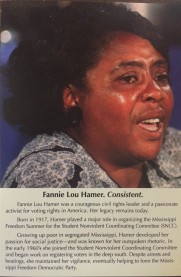
Elise EdwardsA few weeks ago, I came across a postcard that I was given at a conference last year. I got the postcard (advertisement?) because it has a picture of Fannie Lou Hamer on it, and in my home and office, I like to display images and quotes from inspirational women, especially black women. Hamer was a sharecropper from rural Mississippi who became a leader within the civil rights movement in the United States. I was happy to have something with her likeness on it. It was only later that I looked at the text on the front and back of the card, which read in part, ”Often called the ‘spirit of the Civil Rights Movement,” Hamer worked tirelessly on behalf of the rights of others—including the unborn. [She said,] ‘The methods used to take human lives such as abortion, the pill, the ring, etc. amounts to genocide. I believe that abortion is legal murder.’” I realized then that the card was distributed by an organization called Consistent Life, who, in support of a “consistent ethic of life,” is “committed to the protection of life threatened by war, abortion, poverty, racism, capital punishment and euthanasia.”

I was conflicted about the ushamere of Hamer’s image for this organization’s purposes. It is true, Hamer did have those views about abortion and birth control. But I did not know if her image and story was being manipulated for a particular political and religious agenda—one I do not align myself with. I put the card in a box of other images and quotes. I didn’t display it, but I didn’t throw it away, either, which is why I came across it again a couple weeks ago as I was cleaning and decorating my home office. I had the same misgivings about the image as before, and I set it aside again. Continue reading “Fannie Lou Hamer’s Commitment to Life by Elise M. Edwards”

“The White Privilege Media Bucket Challenge” @blackgirldang

Sara FrykenbergRecently Michele Stopera Freyhauf posted an important blog about the ALS Ice Bucket Challenge and parallel challenges that are making use of this medium; including Orlando Jones’ reimagining of this challenge, in which he dumped a bucket of bullet shell casings over his head to “bring attention to the disease of apathy.” In her blog, Michele asks us to critically consider the way a person’s privilege may impact one’s response to such campaigns. She proposes that we use good stewardship in our enacting of a given challenge, highlighting ways in which charitable giving must be a product of deliberate, liberative praxis.

I agree with Michele: deliberate praxis (action + reflection!) is essential to justice making. And justice-making, solidarity and allyship are all kinds of work that take continual action and reevaluation. In light of such discussions of privilege and solidarity, I would like to use this blog to lift up another important reimagining of the ice bucket challenge: Mia McKenzie’s BGD White Privilege Media Bucket Challenge!

Mia McKenzie is the creator of Black Girl Dangerous (BGD), a reader supported, “grassroots arts and media project,” designed to “amplify the voices of queer and trans* people of color.” Articles on the website, www.blackgirldangerous.org, discuss a wide range of topics related to justice-making in the face of particular oppressions (and their intersections), practical strategies for breaking down privilege and standing in solidarity, queer and trans identity, and a great deal more. Some recent titles include: “All Grown Up Under Hip Hop,” “Four Person-to-Person Things I Do to Address Anti-Blackness con Mi Gente,” and “What HIV Testing is Like When You Are Queer, Black and Undocumented.”  Continue reading ““The White Privilege Media Bucket Challenge” @blackgirldang”