The Cop on the Beat is Not Ice-T, the Prosecutor Is Not Sam Waterston, and Mariska Hargitay and S. Epatha Merkerson Are Not in Charge, by Carol P. Christ

carol at green party 2014 croppedI have watched every episode of Law and Order and Law and Order SVU, and most of them more than once. Though there is police violence on these programs, it is usually investigated, and viewers are given the sense that it is not OK. Not living in black America or even in the United States, I guess I was under the illusion that police forces are no longer primarily white and male, that police reforms advocated decades ago have had some effect, and that cops cannot get away with murder.

This despite the fact that I knew that inmates in US prisons are far more likely to be black than their numbers in the population warrant, and that I knew that stop and frisk and arresting black men for petty crimes are ordinary police policies.

For readers who don’t watch MSNBC as avidly as I do, stop and frisk, now banned in New York City, is the policy of searching (primarily) young black men hanging around on street corners to see if they have illegal drugs or weapons on their persons. This policy can lead to the incarceration of young black men for having one or two marijuana cigarettes intended for personal use in their pockets. Stop and frisk is not a policy on college campuses, where police are just as likely to find young white men and women in possession of illegal drugs. Why? Because college authorities and parents of white college students simply would not allow it. Continue reading “The Cop on the Beat is Not Ice-T, the Prosecutor Is Not Sam Waterston, and Mariska Hargitay and S. Epatha Merkerson Are Not in Charge, by Carol P. Christ”

On Believability, Oppression and Ferguson by Sara Frykenberg

Sara FrykenbergLast week, Amina Wadud wrote an important post,Justice for Mike Brown,” discussing Mike Brown’s death in light of Brown vs. The Board of Education, Plessy vs. Ferguson and the injustice faced by African American Communities, particularly in the US legal/ criminal justice system. She highlights the dehumanizing practices that lead us to criminalize black bodies, beginning in childhood.

Considering her post and many, many other articles and news reports over the past several months, and particularly this last week, since the Grand Jury failed to indict Darren Wilson, I felt compelled to speak about a certain quality of kyriarchal oppression: that of rendering the oppressed “unbelievable.” I will not recount the details of the case here (please see the link above for links to court documents through NPR), nor will I try to “speak for” African American communities– nor can I. However, I think it is important that we bloggers and readers at feminismandreligion.com continue to consider the recent verdict and the critical justice issues it raises, as well as remember the tragedy of Mike Brown’s death, and so many men and women like him.

Actor and activist Jessie Williams, who many know from the popular TV show Grey’s Anatomy, gave a passionate and salient interview on CNN’s “State of the Union,” back in August after Michael Brown was killed. You can watch most of the interview with Williams, LZ Granderson and Tara Wall here; you can watch here for the clip I mention below.  Like Wadud, he too discusses the criminalization of black bodies, drawing from the everyday experience of Black men in the United States to make his case. At the end of the interview, Williams powerfully asserts, “We’re not making this up.” Continue reading “On Believability, Oppression and Ferguson by Sara Frykenberg”

Justice for Mike Brown? by amina wadud

amina - featureI was born the year the Supreme Court of the United States of America began to hear Brown v. Board of Education of Topeka; a case that ought to be known to all as a matter of US history. Here is a precise, but telling history of how that case came into being. This historical account lacks hyperbole, perhaps because one feature of legal-eeze carries the technical title (and appropriately so) of being a brief.
In case blog readers don’t do background research or follow footnotes, I raise these salient points: The Declaration of Independence states “all men (sic) are created equal.” At the same time as it was written and signed into law, the legal enslavement of Africans was in full practice. This incongruence required further legal action to change that in the form of 13th Amendment to the US Constitution which made slavery illegal.

It should be no surprise that “equality” did not result from this and thus the 14th and 15th Amendments attempted to address inequities in more specific terminology. All of these Amendments were ratified the 19th century.

The last decade of the 19th century, Plessy v. Ferguson reached the Supreme Court. Plessy was an unsuccessful challenge, attempting to point out how manifest inequality– the “separate but equal” doctrine in practice across the United States– violated the constitutional notion of equality before the law. Judge Brown sums up the majority opinion which went against Plessy:

The object of the 14th Amendment was undoubtedly to enforce equality of the two races before the law, but in the nature of things it could not have been intended to abolish distinctions based upon color, or to endorse social as distinguished from political, equality..if one race be inferior to the other socially, the Constitution of the United States cannot put them upon the same plane

It would take more than half a century before Brown v. Board of Education brought out the many subtle ways, over the century since the legal end of slavery, that the racial divide had been enforced. It started very early in life, in the form of separate educational systems that only perpetuated the impossibility of constitutional consistency and equality before the law.

We still have a long way to go. Continue reading “Justice for Mike Brown? by amina wadud”

Fannie Lou Hamer’s Commitment to Life by Elise M. Edwards

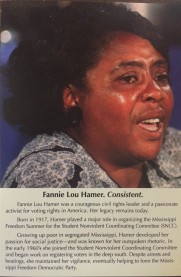
Elise EdwardsA few weeks ago, I came across a postcard that I was given at a conference last year. I got the postcard (advertisement?) because it has a picture of Fannie Lou Hamer on it, and in my home and office, I like to display images and quotes from inspirational women, especially black women. Hamer was a sharecropper from rural Mississippi who became a leader within the civil rights movement in the United States. I was happy to have something with her likeness on it. It was only later that I looked at the text on the front and back of the card, which read in part, ”Often called the ‘spirit of the Civil Rights Movement,” Hamer worked tirelessly on behalf of the rights of others—including the unborn. [She said,] ‘The methods used to take human lives such as abortion, the pill, the ring, etc. amounts to genocide. I believe that abortion is legal murder.’” I realized then that the card was distributed by an organization called Consistent Life, who, in support of a “consistent ethic of life,” is “committed to the protection of life threatened by war, abortion, poverty, racism, capital punishment and euthanasia.”

I was conflicted about the ushamere of Hamer’s image for this organization’s purposes. It is true, Hamer did have those views about abortion and birth control. But I did not know if her image and story was being manipulated for a particular political and religious agenda—one I do not align myself with. I put the card in a box of other images and quotes. I didn’t display it, but I didn’t throw it away, either, which is why I came across it again a couple weeks ago as I was cleaning and decorating my home office. I had the same misgivings about the image as before, and I set it aside again. Continue reading “Fannie Lou Hamer’s Commitment to Life by Elise M. Edwards”

“The White Privilege Media Bucket Challenge” @blackgirldang

Sara FrykenbergRecently Michele Stopera Freyhauf posted an important blog about the ALS Ice Bucket Challenge and parallel challenges that are making use of this medium; including Orlando Jones’ reimagining of this challenge, in which he dumped a bucket of bullet shell casings over his head to “bring attention to the disease of apathy.” In her blog, Michele asks us to critically consider the way a person’s privilege may impact one’s response to such campaigns. She proposes that we use good stewardship in our enacting of a given challenge, highlighting ways in which charitable giving must be a product of deliberate, liberative praxis.

I agree with Michele: deliberate praxis (action + reflection!) is essential to justice making. And justice-making, solidarity and allyship are all kinds of work that take continual action and reevaluation. In light of such discussions of privilege and solidarity, I would like to use this blog to lift up another important reimagining of the ice bucket challenge: Mia McKenzie’s BGD White Privilege Media Bucket Challenge!

Mia McKenzie is the creator of Black Girl Dangerous (BGD), a reader supported, “grassroots arts and media project,” designed to “amplify the voices of queer and trans* people of color.” Articles on the website, www.blackgirldangerous.org, discuss a wide range of topics related to justice-making in the face of particular oppressions (and their intersections), practical strategies for breaking down privilege and standing in solidarity, queer and trans identity, and a great deal more. Some recent titles include: “All Grown Up Under Hip Hop,” “Four Person-to-Person Things I Do to Address Anti-Blackness con Mi Gente,” and “What HIV Testing is Like When You Are Queer, Black and Undocumented.”  Continue reading ““The White Privilege Media Bucket Challenge” @blackgirldang”

What Feminists of Color Taught Me In the Wake of the Michael Brown Shooting by Grace Yia-Hei Kao

Like many others, I’ve been following the aftermath of the recent shooting death of an 18-year old black teenager by a police officer in Ferguson, Missouri with a mixture of shock and horror. Mainstream news coverage and my Facebook newsfeed have been appropriately flooded with commentary about systemic racism, racial profiling, civil unrest, and the militarization of the police. As several African American thought leaders have noted, Brown’s death was not an aberration but “just the most recent example of police officers killing unarmed black men.” Continue reading “What Feminists of Color Taught Me In the Wake of the Michael Brown Shooting by Grace Yia-Hei Kao”

Systemic Violence and the Killing of Michael Brown by Xochitl Alvizo


Xochitl
Photo by Chris Pinkham

Oppression is systemic. Injustice is systemic. It pervades the whole – it seeps into everyday actions and becomes habits and patterns that function as default. As a result, the actions that fall within these patterns hardly need justifying. If anything, the questioning of them is what is put on the defensive. And those who stand against injustice must usually do so in the face of militarized policing, before vast forces that serve to preserve the status quo.

I can’t help but see the similarities between the everyday existence of young black men, of boys in this country, and that of women. The lack of safety in public places; the need to always be aware of one’s surroundings; the lack of trust in the intentions of another; living with the knowledge that people like you experience violence at much higher rates than others. It is a racist, violent, patriarchal world we live in. And, yes, it is also other things, good and beautiful things, but sometimes the hard reality of everyday life blocks out that light. Continue reading “Systemic Violence and the Killing of Michael Brown by Xochitl Alvizo”

Donald Sterling, Racism, the Social Construction of REALITY, and the Power of WORDS by Paula L. McGee

My dissertation: The Wal-Martization of African American Religion and much of my work talks about the social construction of identity, racism, sexism and the power of brand®ed identities and celebrity.  I keep seeing images and hearing those WORDS or sound bites of Donald Sterling—owner of the Los Angeles  Clippers. His “racist” WORDS kept playing over and over in my head. Donald Sterling, the owner—or maybe the former owner—now banned for life—fined 2.5 million dollars—alleged adulterer—and an alleged racist.

Paula, you have to write about this and add to your literary and scholarly canon.  Then suddenly, like the burning bush in the Exodus narrative and the call of Moses, I started asking questions of myself and whether I am worthy to write these words. Dr. McGee, “What WORDS are academic, yet popular enough? “ More importantly, “How does this fit into your research?”  You want your blog to be on the top of a Google search tomorrow, when the thirty-something and under crowd find the right combination of WORDS to pull you into the browser of their lives.  Your last blog was about Preachers of LA.  How perfect. Your second blog, Reverend McGee will be about billionaire racist WORDS, alleged mistresses, rich ex-wives, and black basketball players. WORDS, WORDS, WORDS, WORDS!  Continue reading “Donald Sterling, Racism, the Social Construction of REALITY, and the Power of WORDS by Paula L. McGee”

From the Archives: I Believe Anita! by Marie Cartier

Moderator’s Note: This has been posted on FAR twice, originally on April 7th, 2014 and then again on

Marie Cartier

During the past week I attended a Los Angeles premiere of a new documentary Anita: Speaking Truth to Power (Dir: Freida Lee Mock USA, 2013). The screening was sold out and I had great seats saved for me– sitting with a friend who works at Samuel Goldwyn, the distributor of this fine film.

In 1991, Anita Hill provided testimony she hoped would serve to dissemble the nomination of Clarence Thomas as a Supreme Court justice. Although the vote would end up being close (52-48) Hill’s testimony did not serve to dissuade the decision — Clarence Thomas’ nomination was confirmed and he was appointed to a life term on the Supreme Court four days after Hill’s testimony concluded. Here is an outline of the debate.

Continue reading “From the Archives: I Believe Anita! by Marie Cartier”

Musings on Reification by Sara Frykenberg

Sara FrykenbergThe following is a bit of a messy and meandering blog: a kind of a ‘brain train,’ that starts with a question of reification and eating disorders, and moves into a sense of the literal ‘consuming’ nature of oppression.   So I will start with a ‘thank you’ to readers who will meander with me and with gratitude to the teachers whose thoughts I am wandering with along the way.

Reification is the process by which those created ideas that we externalize into institutions, concrete objects, or social principles then become so real to us that we tend to think of them as a separate reality or a thing/ life in and of itself.[1] I teach this concept in my ethics classes when we discuss the way in which actions and choices are connected to what we often consider to be external forces like “the government,” or “the economy,” when in fact, we are in relationship to and often, actively play a role in maintaining these realities (even when only playing a small role). Reification can subversively undermine our understanding of response-ability because it is a way of making the structures that form our society “other” than ourselves.

My students definitely struggle with this concept and often express the fear that they are too small as individuals to see any real change happen. (I too, often struggle with this fear when thinking about the reified ‘monsters’ of oppression and hate.) Dealing with this discouragement in class, I (and we) switch gears by emphasizing praxis and recognizing its successes. I ask my students to consider what can be done and what choices/changes I, they, or we are capable of making while re-membering changes already being made. As Gustavo Guiterrez says: “Pessimism comes from reality because reality is tragic, while optimism comes from action because action can change reality.”[2] Continue reading “Musings on Reification by Sara Frykenberg”