Living Liminality: Of Thresholds and Dwelling Places by Marcia W. Mount Shoop

Sometimes I think it happened gradually.  Other times it feels like sudden change.  Either way I find myself in an in-between space that is my life.

With apologies to Victor Turner and his cultural anthropological appropriation of liminality as a threshold space, I have come to view my liminal living as a more permanent dwelling place these days.  Turner’s category of liminality locates subjects in the betwixt and between as they move from one manifestation of identity in community to a new kind of integration or role in community.   I am starting to wonder, however, if the thresholds are actually dwelling places for some of us in this world.

I don’t know if that means I am actually more marginal than I am liminal.  The margins are margins because they remain on the outskirts and they help define the boundaries.  Margins are permanent.  Am I marginalized if I live at the edges of the communities and identities I use to occupy, perhaps never to return to the bosom of the center? I hesitate to make such a claim mostly because I still occupy privileged spaces not the least of which are those constructed from how whiteness grants access and authority in this world. Continue reading “Living Liminality: Of Thresholds and Dwelling Places by Marcia W. Mount Shoop”

The Need for a Positive Counter-Narrative of Religious Involvement in Feminism by Ivy Helman

I’ve admired JC for years.  That’s Joan Chittister, OSB the Benedictine nun of course.  I first saw her speak when I was in graduate school and she visited Yale.  I’ve also read a number of her books.    Her life is an example of how religious people support feminist ideals.    There is a story in Beyond Beijing: The Next Step for Women: A Personal Journal that I would like to share with you

Chittister began her historic journey on the Peace Train to the UN Conference on Women in Beijing in 1995.  As she  entered a conference room to register as a Peace Train participant, she was handed a large manila envelope.  To her surprise it was filled with condoms. At first, she thought that the woman who handed them to her meant to hand them to someone else.  However, Chittister was told (quite emphatically according to her) that she should distribute the condoms to the health workers she encounters while on the train and in the small towns she visits along the way to Beijing.  Eventually after much thought, Chittister decided to do just that and stuffs the manila envelope into her backpack.  Trying to find some humor in what she considered an awkward situation for a nun to be in she remarked, “Now all I have to do is to try not to die in front of some bishop with condoms in my backpack.”

My first reaction to this story is to laugh along with her.  I am also struck by her thoughtfulness to share the story publicly.  She could have been given the envelope, quietly distributed the condoms and then never told a soul.  But, no.  She includes the account of this feminist action she undertook in her book for the world to read.  What an amazing amount of courage and integrity this woman has! Continue reading “The Need for a Positive Counter-Narrative of Religious Involvement in Feminism by Ivy Helman”

It is the Best of Times. It is the Worst of Times: An Athlete Looks at Her Life and Title IX By Paula McGee

I expect 2012 to be a great year. Not only do I plan on graduating in May with a Ph.D., but I will also receive one of highest honors in sports. On Sunday, February 19, 2012 in the USC Galen Center during halftime of the USC and UCLA women’s basketball game, USC will retire the jerseys of my twin sister and I.  Most people in my women’s studies and theology world do not really know that I have a twin sister, nor do they fully appreciate that about twenty-five years ago, my sister and I played on one of the most prominent teams in women’s basketball and in women’s sports. We won two back-to-back national championships in 1983 and 1984. We were also the first NCAA national champions (previous women’s teams were American Intercollegiate Association for Women (AIAW) championships). My sister and I played with Cynthia Cooper and Cheryl Miller. Our team was one the first women’s teams to get mainstream acceptance in the larger sports world. We were not just “girls” that happened to play a sport; we were “real” athletes. We received the same media attention and acceptance of any sports team during that period.

Most of my feminist friends—the preachers, scholars, and theologians—have no idea of what it means for a university to retire a jersey. In the sports world, retiring an athlete’s jersey means that no other person in that sport will ever wear that number at that university. The retired athletic jersey hangs in the rafters of the sports facility forever. This honor for an athlete is synonymous to a scholar receiving a named endowed chair in the academy. What is exciting for me is that my jersey will not only be hanging with my sister’s—that alone would be enough to celebrate. USC is one of the few institutions in the country in which the majority of the retired jerseys are the jerseys of women: Cheryl Miller, Lisa Leslie, Cynthia Cooper, and now Pam and Paula McGee. Cheryl and Cynthia are also members of the Naismith Hall of Fame, and Lisa is sure to join them  with that honor very soon. Continue reading “It is the Best of Times. It is the Worst of Times: An Athlete Looks at Her Life and Title IX By Paula McGee”

A Next Wave of Scholarship By Kwok Pui Lan

I came to the United States in 1984 to begin my doctoral studies at Harvard Divinity School. It was an exciting time to do feminist theology and religious studies. Womanist ethics just began to emerge, as Dr. Katie Geneva Cannon has just completed a dissertation on the subject at Union Theological Seminary in 1983. I count it as a blessing that she was teaching at the Episcopal Divinity School, just on the other side of the Cambridge Common.

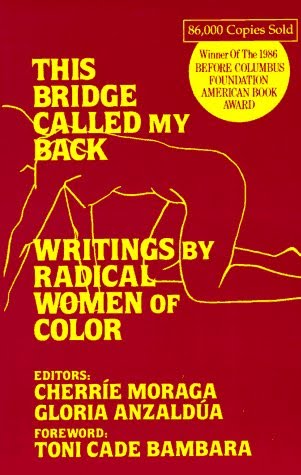
The mid-1980s saw the paradigm shifts in feminist studies in religion, as womanist, mujerista/Latina, Asian and Asian American women began to articulate their own theological understanding. If Womanspirit Rising (1979) was a reference text for our field, which contained essays by white women, we had the first reader by radical women of color, This Bridge Called Our Back(1981).

We began to discuss multiple oppressions and multiple identities, and the need to integrate race, class, and gender into our analyses. We challenged white women who have universalized their middle-class, white experience as if women were all the same. Continue reading “A Next Wave of Scholarship By Kwok Pui Lan”

What Does It Mean to Say that All White Feminists Are Racist? (Questions Posed to White Women/Myself about Our Part in the Dialogue with Women of Color) By Carol P. Christ

Carol P. Christ, a founding mother in the study of Women and Religion and Feminist Theo/a/logy, has been active in anti-racist, anti-poverty, anti-war, feminist, pro-gay and lesbian, anti-nuclear, and environmental causes (in that order) for many years.  All of these issues have informed her teaching, her scholarship, and her politics.

The recent posting of Mary Daly’s letter to Audre Lorde on the Feminism and Religion blog is a correction of a piece of feminist history that is important in its own right and because of the way Lorde’s letter has shaped feminist discourse and politics up to the present day.  Knowledge of the existence of Daly’s letter and the facts surrounding Lorde’s distortion of history has been in the public domain since the 2004 publication of Alexis DeVeaux’s Warrior Poet, but when I searched the internet for a copy of “Mary Daly’s letter to Audre Lorde” a few days ago, what came up was Lorde’s letter to Daly — not Daly’s letter to Lorde.

I often hear younger feminists say that “all white feminists” of the older generations “were racist.”  Sometimes Mary Daly is mentioned.  Setting the record straight about Mary Daly is one step in retelling the history of feminism in a more complex way.  Continue reading “What Does It Mean to Say that All White Feminists Are Racist? (Questions Posed to White Women/Myself about Our Part in the Dialogue with Women of Color) By Carol P. Christ”