“If You Allow Gay Marriage…” by John Erickson

“We need to start examining the underlying questions of counter-cultural relationships that view one man marrying many women to be hip because we begin to see that although a polygamist idea of marriage may be sexy from a popular culture standpoint, the thought of legally recognized gay marriage always then gets likened to bestiality.”

… you have to allow polygamy, bestiality, and everything else!” The title for my post this week is a quote from an individual I used to associate with.  This individual, haling from a conservative evangelical background, tried to explain to several others and myself the reasons why gay marriage would eventually lead to the repeal of anti-polygamy and bestiality laws across the United States.

The problems that I have with this particular argument are conflating gay marriage with religious freedom.  Activists and scholars can draw comparisons to anti-polygamy cases such as the 1878 U.S. Supreme Court case Reynolds v United States and the 1882 Edmunds Act and 1887 Edmunds-Tucker Act that disfranchised and led to the imprisonment of Mormon polygamists. But in the end, gay marriage is not about religious freedom but rather human rights.

I often feel that there is this need both within and outside religious communities to promulgate the idea that LGBTQ individuals want to get married within the sanctified walls of “the church” just as much as heterosexual couples do.  Although I do not want to disqualify those who desire to see LGBTQ equality within their faith based communities, buying into a heternormative ideal of what traditional marriage should look like needs to result in LGBTQ individuals asking why marriage should be performed in sacred spaces in the first place The normative traditions that have often defined marriage have also served as shackles keeping LGBTQ couples in the mindset that to achieve fully marriage equality with their heterosexual counterparts is to fully immerse themselves within the same traditions and practices. Continue reading ““If You Allow Gay Marriage…” by John Erickson”

Body, Nature, Ancestors by Carol P. Christ

Some years ago, womanist theologian Karen Baker–Fletcher asked about ancestors following a lecture I gave on the body and nature.  I have since come to realize that ancestors are a missing link between the two:  we cannot speak adequately of embodiment and interdependence in the web of life without recognizing the ancestors whose lives made ours possible.  Our mothers quite literally gave us our bodies.  All of our ancestors gave us their genes.  Care and callousness with origins going back longer than conscious memory was imprinted on the psyches of our parents and grandparents and transmitted to us.  All of our ancestors give us connections to place.  While many black people in America can recite oral histories that begin with slavery in the United States, I come from a family where stories of origin for the most part were not valued or told.  Both of my father’s parents lost their fathers when they were very young, and my father, who was raised Catholic at a time when Catholics were discriminated against, preferred to think of our family as “American now.”  Like the hero of the film Lost in America, most members of my family dreamed of “melting right into that pot.” In the process we lost stories we need to help us to understand ourselves and the complex realities that “becoming American” involved.   Continue reading “Body, Nature, Ancestors by Carol P. Christ”

Son of Man: An Updated Gospel Story of Jesus Set in South Africa by Michele Stopera Freyhauf

January 12, 2012

Son of Man is an updated story of the life of Jesus set in the fictional State of Judea that is modern day South Africa – complete with warlords and child soldiers.    It could easily be mistaken for modern day Rwanda or Darfur with its modern issues and political overtonesRoger Ebert stated, “The secret of the movie is that it doesn’t strain to draw parallels with current world events – because it doesn’t have to.”  The director draws parallels between the gospels and 21st century Africa.  According to Dartford-May, “we wanted to look at the Gospels as if they were written by spin doctors and to strip that away and look at the truth.”  The director “captures the rhythms of African life in both rural settings and sprawling townships.”  “Feather-clad young angels offer an eerie echo and reminder of Africa’s lost generations.”

The movie also sticks with what Eric Snider calls “Traditional African trial music, dance, and costumes” as a type of worship or or allusion to Jesus’ godhood.  Judea is in flux; warlords and corruption take center stage.  Poverty, violence, and oppression affect the all of the people.  The key idea is that Jesus is a freedom fighter – one that fights injustice and oppression.  The director does not emphasize “Jesus’ divinity so much as his leadership, good sense and compassion.”  Jesus is not violent and his followers, most of whom were former child soldiers, are encouraged to respond non-violently, which goes against their upbringing and training. Continue reading “Son of Man: An Updated Gospel Story of Jesus Set in South Africa by Michele Stopera Freyhauf”

A Next Wave of Scholarship By Kwok Pui Lan

I came to the United States in 1984 to begin my doctoral studies at Harvard Divinity School. It was an exciting time to do feminist theology and religious studies. Womanist ethics just began to emerge, as Dr. Katie Geneva Cannon has just completed a dissertation on the subject at Union Theological Seminary in 1983. I count it as a blessing that she was teaching at the Episcopal Divinity School, just on the other side of the Cambridge Common.

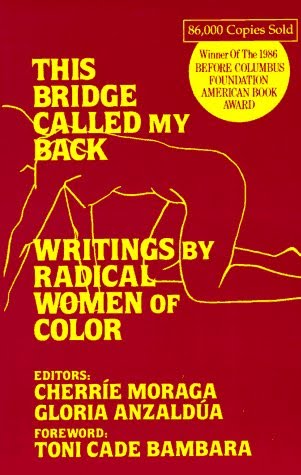
The mid-1980s saw the paradigm shifts in feminist studies in religion, as womanist, mujerista/Latina, Asian and Asian American women began to articulate their own theological understanding. If Womanspirit Rising (1979) was a reference text for our field, which contained essays by white women, we had the first reader by radical women of color, This Bridge Called Our Back(1981).

We began to discuss multiple oppressions and multiple identities, and the need to integrate race, class, and gender into our analyses. We challenged white women who have universalized their middle-class, white experience as if women were all the same. Continue reading “A Next Wave of Scholarship By Kwok Pui Lan”

The Chispa* Carrier: Rosemary Radford Ruether By Renny Golden

The following is a guest post written by Renny Golden, Professor Emerita, Northeastern Illinois University.

The Chispa* Carrier: Rosemary Radford Ruether by Renny Golden

What kind of voice is breaking silence, and what kind of silence is being broken? Adrienne Rich

She came to prison with hidden keys. The way forward,

she said, is behind us. With only a spoon of history she

gutted a tunnel that ran below the plazas of Prince after Prince.

We sat waiting behind bars: mouldy histories, slop theologies

in mush bowls shoved under cell doors. Eat this or starve.

We prayed for deliverance we could not name.

We imagined her walking through deserts, our prophet

searching the sand for bones, pouring through ancient scripts,

gospels, archeologies, the dank stacks of basement libraries,

reliquaries with their throb of real blood, archives.

We rattled the bars with questions: Can she pick locks? Continue reading “The Chispa* Carrier: Rosemary Radford Ruether By Renny Golden”

Mary Daly: Radical Elemental Feminist and Sinner By Gina Messina-Dysert

While some argue that Mary Daly was too radical, I have been greatly influenced by her contributions to the field of feminism and religion.  I can still remember the first time I read a piece of her work.  It was during my undergraduate career at Cleveland State University in a course entitled “Women and Religion.”  I was immediately impacted and wanted to know more about this bold, strong and courageous woman, and although I had already considered myself a feminist, it was in that moment I recognized the existence of patriarchy in religion.  Shortly thereafter I applied to a graduate program in religious studies and became better acquainted with Daly’s work and the intersection of feminism and religion.

While I must admit that I am troubled by some of Daly’s claims and disagree with some of her contentions, I have also been significantly influenced by her foundational work in feminist theology, her demand for women’s liberation and Spinning of new tales and new ideas.  Daly called for women to have the courage to be, to experience a new fall out of patriarchal systems and into a new being that allows women to discover their capabilities, the dynamic power women possess within themselves.

According to Mary E. Hunt, co-founder and co-director of the Women’s Alliance for Theology, Ethics and Ritual (WATER), “Her contributions to feminist theology, philosophy, and theory were many, unique, and if I may say so, world-changing. She created intellectual space; she set the bar high. Even those who disagreed with her are in her debt for the challenges she offered…She always advised women to throw our lives as far as they would go. I can say without fear of exaggeration that she lived that way herself.”[1]

While I never had the opportunity to meet Mary Daly, I have no doubt been inspired by her brilliance, courage, wit, and spirit.  My feminist and theological views have been shaped through her influence. I have been able to spiral into freedom and rename and reclaim my own experiences; I have found my own creative power.  Thank you for having the courage to sin big Mary Daly.

“There are and will be those who think I have gone overboard. Let them rest assured that this assessment is correct, probably beyond their wildest imagination, and that I will continue to do so.” – Mary Daly