Gratitude and Sharing: Two Fundamental Principles of Goddess Spirituality by Carol P. Christ

carol p. christThe more I practice the spirituality of the Goddess, the more I understand that earth-based spiritualities are rooted in two fundamental principles:  gratitude and sharing.  We give thanks to the earth for the gift of life. As we recognize our interdependence and interconnection in the web of life, we are moved to share what has been given to us with others. *

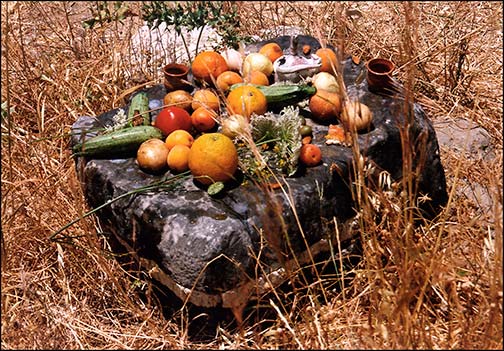
When I first began to lead Goddess Pilgrimages in Crete, I was inspired by a line in Homer to begin a pilgrimage tradition of pouring libations of milk, honey, water, and wine on ancient stones. At first I knew the form, but not its deeper meaning.  It gradually dawned on me as I thought about the large number of pouring vessels in the museums, the altar stones, and the Procession Fresco from Knossos, that an important part of Minoan rituals involved processions in which people offered first fruits back to the Mother whose body had produced them, and poured libations on altars.
kernos stone kay keys

Over twenty years of performing the ritual of pouring libations has convinced me that this was not “a” but “the” central Minoan ritual.  Its purpose is to thank Mother Earth for the bounty She has bestowed on us. Continue reading “Gratitude and Sharing: Two Fundamental Principles of Goddess Spirituality by Carol P. Christ”

Brigid, Goddess of Healing, Poetry, and Smithcraft by Judith Shaw

judith Shaw photoBrigid, the Celtic Goddess of Healing, Poetry, and Smithcraft, begins her reign on Imbolic, February 2, the midpoint between winter solstice and spring equinox. On this day the ancient Celts held their Fire Festival in honor of Brigid and the growing light. In Scotland, as recently as the mid-twentieth century, houses were cleaned and the hearth fires rekindled on February 2, to welcome in  Brigid.  Remnants of this festival are found in America today on Groundhog Day.

Like the Cailleach, She existed in many places and  was known by many names.  The Irish called her Brighde; she was Bride in Scotland,  Brigantia in Northern Britain, and Brigandu in France.  Some called her Brid, Brig or Brighid.  Later she was transformed by Christianity into Saint Bridget.  Her older name was BREO SAIGHEAD.   Her name has various interpretations, many relating to fire – “Power,” “Renown” “Fiery Arrow of Power ” “Bright Arrow”, “The Bright One”, “The Powerful One”, “The High One” and “The Exalted One”.

Brigid, Celtic Goddess Continue reading “Brigid, Goddess of Healing, Poetry, and Smithcraft by Judith Shaw”

Epona, Celtic Horse Goddess by Judith Shaw

judith shaw photoEpona, Celtic Horse Goddess was worshipped by the Gauls (the Celtic French). Her worship spread to Britain and Rome from Western Europe. Hundreds of statues and shrines dating from between the first and third centuries CE have been found in France alone.

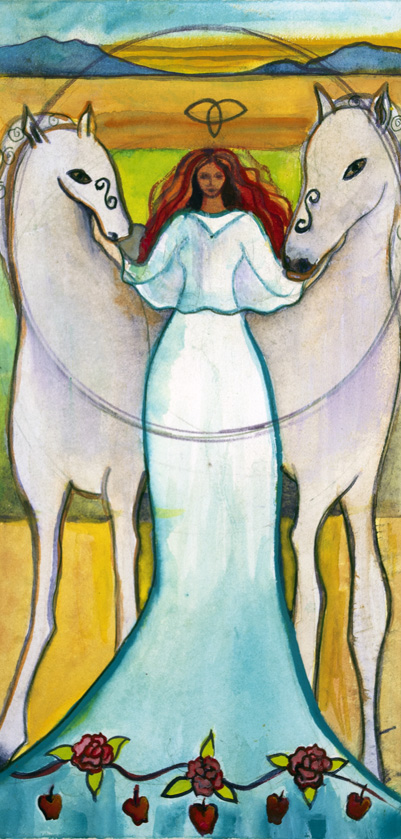
Today we can understand Epona mainly from her images, as few stories of her have survived.  She is often shown either riding a white horse side saddle or standing or sitting between two horses.  Many images show her feeding mares and foals from a cornucopia or a basket of fruit.

Epona, Celtic Horse Goddess Continue reading “Epona, Celtic Horse Goddess by Judith Shaw”

Three Sisters by Deanne Quarrie

From time to time I dive into the idea of seeing the Triple Goddess as Sisters rather than Mother, Maiden, Crone.  I have to confess that the idea of Sister Goddesses, complete in their familial connectedness, representing unity, connection, and interdependency, is very appealing.  We, who practice Goddess Spirituality, strive in our relationships to reflect this in our work together.  Shared power!

If I were to look at the sisterhoods individually, I enjoy the Ananke and the Moirae from Greek mythology.  I like them because they represent a balance.  One side setting the standards and the other, enforcing them!  A perfect example of the laws of cause and effect! Continue reading “Three Sisters by Deanne Quarrie”

Embody the Sacred – Engaging Through the Senses by Deanne Quarrie

The human body is designed to utilize all senses. We, human beings, have drifted away from our natural state through which, at one time, we engaged with all of life through our natural senses, including the intuitive.  This change has come about through our active, stress filled lives in which we seldom slow down to even appreciate what is around us.  We have ignored much of our sensory ability due to a change-over from right brain functioning, which is more imaginative, creative and intuitive, to left brain functioning, which is linear and analytical. Two of our senses are developed out of proportion to the others.  Many people grow up in an environment lacking in exposure to the natural world.  With television, computers and video games we have become residents of an indoor and often sedentary world.

In early civilization, humans and all other animals depended on finely tuned sensory awareness for survival.  We walked the Earth, using those senses for protection, to find food and to move around.  We did not just see and hear our way around but we felt, touched, tasted and smelled in order to survive. Continue reading “Embody the Sacred – Engaging Through the Senses by Deanne Quarrie”

Death of a Priestess by Geraldine Charles

Dusk was falling and mist rising as I drove sadly across the Somerset Levels – a liminal place which once formed the huge marshy lake out of which the Isle of Avalon majestically rose.  When I rounded a bend to see a large swan walking straight up the centre of the road in the same direction I was going, my first thought was for its safety.  I expected it to take flight or veer off at any moment, but the swan continued on its path, seemingly determined to walk just where it was. The road was narrow and all I could do was respectfully follow until it widened a little, eventually managing to squeeze carefully past before starting to flash my headlamps at oncoming traffic to warn them of the swan’s unlikely presence.

Only later that evening did I remember the last time I saw such a stately walk in front of a moving vehicle – when a formally-dressed funeral director led off the hearse which carried my father from his home and on his last journey in this world.  I was thunderstruck. Could the swan be marking this new loss, making me mindful and slowing me down? Continue reading “Death of a Priestess by Geraldine Charles”

Reading Plato’s Allegory of the Cave as Matricide and Theacide by Carol P. Christ

When I read Plato’s allegory of the cave as an undergraduate, I was told it had something to do with the idea that the “form” of a table is more “real” than the table itself. I must confess that I had no idea what this could possibly mean.

As a graduate student, I struggled with philosophical and theological ideas rooted in Platonism.  Rosemary Radford Ruether named the flawed worldview created by a “classical dualism” that separates mind from body, spirit from the world, rationality from emotion, and male from female.  Her ground-breaking essay “Mother Earth and the Megamachine” clarified the difficulties I was having.

Western philosophy, described by Alfred North Whitehead as a series of footnotes to Plato, had gotten off on the wrong foot. At its very beginnings, western philosophy had attempted to sever mind from the body and nature, alleging that “man’s true home” was not life in the body on planet earth. Continue reading “Reading Plato’s Allegory of the Cave as Matricide and Theacide by Carol P. Christ”

Why a Goddess Pilgrimage? by Carol P. Christ

What is a Goddess Pilgrimage and why are so many US, Canadian, and Australian women making pilgrimages to ancient holy places in Europe and Asia?  The simple answer is that women are seeking to connect themselves to sources of female spiritual power that they do not find at home.

Traditionally pilgrims leave home in order to journey to a place associated with spiritual power.  “Leaving home” means leaving familiar physical spaces, interrupting the routines of work and daily life, and leaving friends and family behind.  For the pilgrim, “home” is a place that has provided both comfort and a degree of discomfort that provokes the desire to embark on a journey.  The space of pilgrimage is a “liminal” or threshold space in which the supports systems of ordinary life are suspended, as Victor Turner said.  A pilgrim chooses to leave the familiar behind in order to open herself to the unfamiliar—in hopes that she will return with new insight into the meaning of her life.  Continue reading “Why a Goddess Pilgrimage? by Carol P. Christ”

Goddess as Love: From Experience To Thealogy by Carol P. Christ

If theology is rooted in experience, how do we move from experience to theology? In my life there have been a number of key moments of “revelation” that have shaped my thealogy. One of these was the moment of my mother’s death.

In 1991 my mother was diagnosed with cancer. While she was being treated, I realized that I had never loved anyone as much as I loved her. When I wrote that to her, she responded that “this was the nicest letter” she “had ever received” in her life and she invited me to come home to be with her and my Dad.

My mother died only a few weeks after I arrived, in her own bed as she wished. She was on an oxygen machine, and I heard her call out in the dark of early morning. When my Dad got to the room, he tried to turn up the oxygen, but it didn’t help. Then he called the doctor who reminded him that my mother did not want to go to the hospital under any circumstances.

My Dad then sat by my mother’s bed and held her hand.  As my mother died, I felt that the room was” filled with love.” I sensed that my mother was “going to love.” Continue reading “Goddess as Love: From Experience To Thealogy by Carol P. Christ”

Through Body and Space: A Glimpse into Women Worshippers of Aadhi Parashakthi by Amy Levin

Once what happened was after people started believing someone around also started believing in this temple and one person kept a statue on their steps. Her Aunty she believed and she is very much interested in small things. So she started decorating it up. And what happened was the statue starting getting bleeding, like monthly monthly. And the dress which the statue wore during those periods was stained with red bleeding. So they asked Guruji about what is this and he said that the shakti has come into the statue. So if you keep this in the home it will turn into a temple so go and leave it outside. This was followed by entry of snakes, king cobras, so what they did was they went and left it in the sea, after which her grandmother had a dream that you have left me in the water but still I am with you. I am the temple opposite here,  put a lamp everyday at that place. So they started putting it out there, and now there is an earthen Kali which as come up in that place by nature.  –Interview with Premila, March 18, 2008 Continue reading “Through Body and Space: A Glimpse into Women Worshippers of Aadhi Parashakthi by Amy Levin”