Star Trek: Discovery Season Two: On Characters, Action, and Faith by Ivy Helman.


Season two of Star Trek: Discovery incorporates religion differently than season one.  While there are religious overarching themes running throughout, like how actions to shape the future and faith not as convictions but as empowerment, a more fitting and interesting way of addressing religion throughout this season is to look at the individual characters and what their stories have to stay about religion.  

Captain Pike knows and understands religion.  He also often believes.  Michael is the persistent skeptic.  The Red Angel plays many roles: an illogical mystery, a revelation, a savior or a intentional sign. Saru is the convert, physically transformed with a newfound confidence and power, while Hugh is the reincarnated, whose bodily existence begets loneliness and struggle.  Spock is the logic wrestler, who as Pike says asks “amazing questions.”  Finally, not a character per se, episode two, entitled “New Eden,” represents a typical Western understanding of organized religion, replete with sacred writings and a church.  

Like season one, religion is present in the opening scene of the season, this time in the form of mythology, as Michael tells a tale of an African girl who threw embers from a fire into the air creating the Milky Way.  Michael says that she left a message in the stars if one was willing and open to receiving it.  

Continue reading “Star Trek: Discovery Season Two: On Characters, Action, and Faith by Ivy Helman.”

Yes, there are Goddesses in the Bible, Part 4 by Janet MaiKa’i Rudolph

This is the 4th in a series of blog posts about finding goddesses in the bible who had been hidden away through translation or denigration or other means. In my last blog post I discussed Lilith as a Great Goddess symbolized by both tree and bird. You can see it here

Today I continue with the topic of trees along with an examination of reversals and how many of beautiful, female pagan symbols were changed or removed from the texts. Perhaps the most obvious and pernicious has been that Eve “caused the fall” of humankind through a sinful act. Thus, the logic goes, it was Her action that has created the “grand curse” that we have labored under ever since. As I wrote in my last blog post, Lilith is another example, being portrayed as a demon in order to denigrate her Great Goddess roots. Lilith originally embodied both bird and tree energies. In my last blog post I showed one image of the Goddess in the tree which was a common theme in ancient Levantine cultures. The image today shows the goddess breast in the tree, which is identified as Isis suckling the future pharaoh Tutmose III. These images show the “Goddess in the Tree” as freely bestowing Her gifts and nurturing (not cursing) humankind. Continue reading “Yes, there are Goddesses in the Bible, Part 4 by Janet MaiKa’i Rudolph”

Yes There are Goddesses in the Bible, Part 3

This blog post is the 3rd in a series of looking for female deities in the bible who have been translated out of easy reach or otherwise hidden within its words. In my last blog post I discussed bird imagery and the bible. It is available here
 You can’t complete a discussion about birds without also bringing up Lilith. She appears by name only in one place in the bible; Isaiah 34:14. Isaiah uses the word liyliyth as a feature in a hellish landscape. Although it is also a name, liyliyth is treated as a common noun. The most prevalent translation is “screech owl” although others have included such names as night creature, night monster, night hag, and she-vampire. Continue reading “Yes There are Goddesses in the Bible, Part 3”

Yes, There are Goddesses in the Bible – Part 2 by Janet Maika’i Rudolph


As I wrote in my last blog post, there are female deities and goddesses sprinkled all throughout the bible. They just aren’t obviously in plain sight.

One example is the Goddess and Her association with birds. Many ancient creation myths have stories about life emerging from a cosmic egg and the Goddess who carries and/or lays that primordial egg-of-life. Like the bird, women carry the eggs of life’s creation within our bodies. This has given rise to numerous cultural symbolisms that have come down to us associating the Goddess with birds. The dove is Venus’ hallmark. Mother Goose is the keeper of our cultural stories. It is the stork who brings us babies. As I will show below, divinity, or the biblical LORD is sometimes depicted as a bird, making this biblical description of god a female. Continue reading “Yes, There are Goddesses in the Bible – Part 2 by Janet Maika’i Rudolph”

An Outrageously Strange, Bizarrely Weird, Completely True Tale by Janet Maika’i Rudolph

The word apocalypse keeps coming up when I talk to friends about how our present times feel. We’ve all noted how cracks in our society are tearing open and fault-lines are rising to the surface. It is disorienting yet also potentially transforming. I realized I’ve felt this way before:

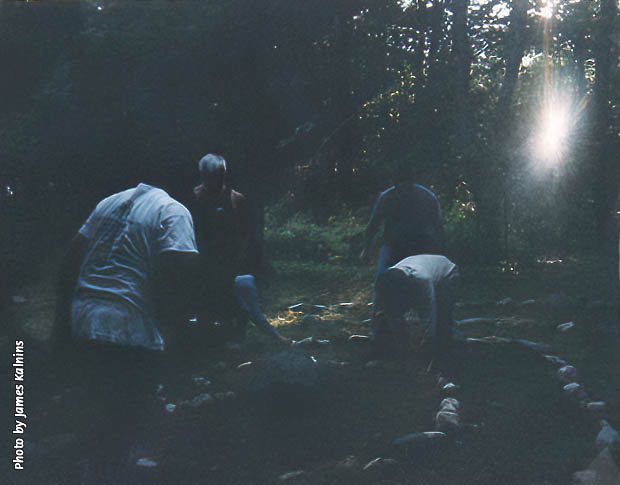
In January 1997, I became an apprentice to a husband and wife shaman team. They ran an old-style mystery school with regular weekend workshops in Maine and a 4-day in the summer. In August 1997, we met on forested private property that was far from any “civilization.”

Regular weekend meetings began after dinner which gave our small NYC area contingent plenty of time for a leisurely drive up the coast. In August, our teachers wanted us to arrive earlier. We arranged to take the Long Island Sound ferry to Connecticut to avoid the time-consuming drive around the city. About ½ way through our 1 ½ hour ferry ride, a shocking event happened. An elderly woman sitting near us dropped like a rock to the ground. Her daughter began screaming. No one could rouse her. The ferry returned to NY where an emergency crew tried and failed to revive her. She had literally died at our feet. By this time, I was not only thoroughly rattled, I was also deep into contemplating issues of life and death. Because of our delayed arrival in Conn, we began hitting evening rush hour along the major cities of our route. We did not arrive in Maine until well after dark. Continue reading “An Outrageously Strange, Bizarrely Weird, Completely True Tale by Janet Maika’i Rudolph”

The Serpent and the Goddess by Judith Shaw

judith shaw photoThe otherworldly energy of Snake – it’s vitality, its uncanny ability to sense danger, and its ability to shed its skin and reappear as if reborn must have invoked feelings of awe in our ancestors. All across the pre-historic world one finds depictions of Snake and the spiral or meander as Snake’s symbols.

Continue reading “The Serpent and the Goddess by Judith Shaw”

Hare Spirit Guide – Fertility and Renewal, by Judith Shaw

judith shaw photoHare, important to humans since our early days, is known everywhere as a symbol of fertility, balance, and transformation. Although rare, cave paintings of Hare have been found. With Hare comes the Spring promise of the eternal renewal of life. 


Continue reading “Hare Spirit Guide – Fertility and Renewal, by Judith Shaw”

Death is a Gift, and Christ is a Hag by Trelawney Grenfell-Muir

My father is dying, and I am haggard with grief and exhaustion. Over a month of frantically arranging child care, driving to the ICU in the middle of the night, fighting to protect my Dad from neglect and malpractice, chasing case managers, begging doctors, negotiating with nurses, sensitive, depleting, agonizing family debates about hospice and DNR, and hour after hour sitting and holding my Dad’s hand, singing, comforting, soothing, reassuring. Washing his face. Massaging salve into his feet and legs. Continually checking to see if he is too cold, too warm, in pain, breathing ok. Weeping as I drive home through snow and rain and dark, watching car accidents happen just one lane over, trying to soothe my frazzled and anxious little children, support my husband in his degree program, and not lose my own career entirely.

So when my daughter asked me, “Mummy, why does Grampy have to die?” I felt dizzy for a moment with my exhausted, overwhelmed, haggard inability to have an instant, perfectly formulated response to provide comfort and meaning for my child. Finally, I said, “Because, darling, if no one died, no one could live. All of us, our bodies are made from the food we eat, which is made from plants, which is made from dirt, which is made from everything that has died. Death is the only way for life to exist. Death allows life, births life, IS life. Death is our only path and connection to eternity.”  Continue reading “Death is a Gift, and Christ is a Hag by Trelawney Grenfell-Muir”

Elen of the Ways and the Antlered Goddess (Part 1 of 2) by Deanne Quarrie

Kingdom of the Deer Concept by Wang Rui

Why would a goddess have antlers when only male deer have antlers? These ancient goddesses come from a time when people were closely connected with reindeer.  They were hunter gatherers and followed the Deer trods of the reindeer in their migratory patterns. They depended on the reindeer for food, shelter, warm clothing. They survived because of the reindeer.

Both male and female reindeer grow antlers. The antlers begin to grow on males in March or April, for females it is May or June. The male loses his antlers at the end of rutting season (late fall) and the females keep theirs until they calf in the spring.  They both grow new antlers every year and each year they grow in bigger. Continue reading “Elen of the Ways and the Antlered Goddess (Part 1 of 2) by Deanne Quarrie”

Jewish Folklore and Women’s Clothing: When Things are the Text by Jill Hammer

Two weekends ago, I had the pleasure of visiting the Jewish Museum on Fifth Avenue in Manhattan.  The Jewish Museum has long been a favorite museum for me.  My wife and I took our daughter to this particular exhibit because we knew she’d like it.  The exhibit is entitled “Veiled Meanings: Fashioning Jewish Dress from the Collection of the Israel Museum, Jerusalem.”  It consists of many, many garments created and worn by Jews, from Moroccan wedding clothes to German prayer shawls to Yemenite amuletic (meant to protect the wearer) dresses.  Accompanying the garments were placards explaining the folk traditions giving rise to the various garments.  What I realized (again) after viewing the exhibition was how much I could learn about the culture of Jewish women, and Jewish culture in general, by looking at things, not texts.

The sacred texts and laws central to Jewish life, while they certainly discuss Jewish women, tend not to be created by or for Jewish women.  This means many aspects of how Jewish women thought or acted (before the present day) are obscured. However, these garments were created by and often for Jewish women, and their shapes and symbols tell a great deal.  For example, the Moroccan Jewish wedding clothes I mentioned were embroidered with spirals, representing (according to the accompanying written material) the spiral of life.  These spirals were also found on Jewish tombstones. The spirals resembled, to me, the spirals I’d seen carved on stone at Newgrange and Knowth in Ireland—the ancient symbols of life and journey.  I was amazed to see them in a Jewish context.  Another dress that mixed Sephardic and Moroccan style also had spirals featured prominently.

Continue reading “Jewish Folklore and Women’s Clothing: When Things are the Text by Jill Hammer”