Mother Blues: Interfaith Somatic Reflections on Support Systems, Chronic Pain, Tension Relief, and Supporting Oneself by Chaz J

I have had a weird relationship with my stomach or core BEFORE birth. 

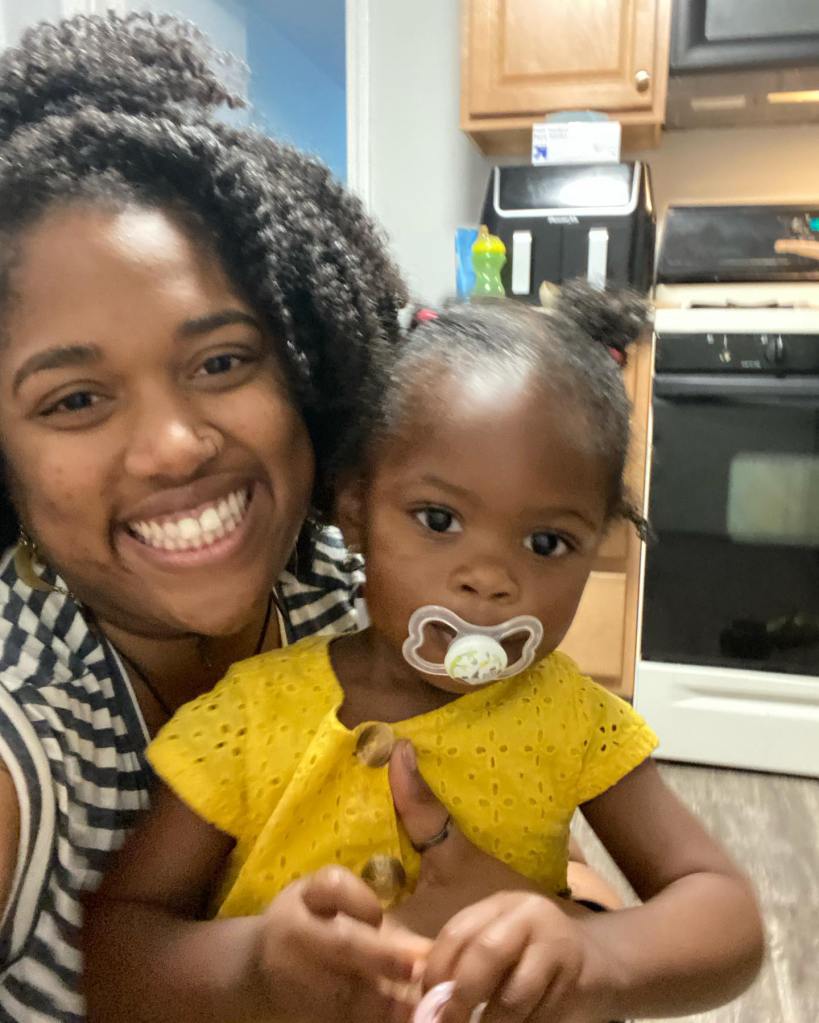
My back has been hurting since giving birth.

I’ve carried fragments of my birth story like heirlooms,
passed down in murmurs from my mother and family.
They say she went into labor at home,
a warm plate of food in her hands,
My aunt Akami recalls she refused to leave for the hospital
until every bite was finished.

I came into the world under sudden urgency—
an emergency C-section,
my first act a quiet rebellion:
I had soiled the waters before taking my first breath.

My mother remembers it in a haze,
“I was pregnant, went to sleep…
when I woke up, there was a baby in the corner.”

I do not know if every detail is true,
but the outline fits—
the origin of a loneliness that has followed me
like a shadow that never unhooks from the heel.
Continue reading “Mother Blues: Interfaith Somatic Reflections on Support Systems, Chronic Pain, Tension Relief, and Supporting Oneself by Chaz J”

I Am Wicked by Chaz J.

*When I refer to Black women, I am referring specifically to descendants of African peoples that were forced to experience the dehumanization of chattel slavery in the United States.  I refer to those who would build the foundation of the country, uncredited. Those whose descendants continue the legacy of fighting for liberation.  

When a sister-friend invited me to see Wicked, I was hesitant. I’d never seen the show, and my attention span hadn’t even allowed me to finish The Wizard of Oz or The Wiz (the Black rendition). However, seeing the wicked witch, Elphaba, portrayed as a Black woman changed everything. It felt deeply personal; a reflection of my own life as a Black woman in predominantly white environments. As a womanist theologian, centering Black women’s experiences is central to my daily and theological framework, and this felt like a powerful synchronicity and spiritual experience aligning with my newly entered villain era!

Continue reading “I Am Wicked by Chaz J.”

Deconstructing and Reconstructing Love by Chasity Jones

Note: This is based on a podcast which can be heard here.

“Black love exists and Black women deserve love that does not require pain.”

What is love? What’s love got to do with pain and suffering? Are they related? Pain and love? Must one always be present with the other? In this blogpost I explore pain and suffering through a womanist perspective (centering the perspectives and lived experiences of Black women) and discuss how to live into wholeness and wellness. This is especially important because the Black community/women in particular’s experience in the US (and globally) has been and continues to be defined by pain and suffering. What are the theological implications?

How have Christian frameworks at associating love with sacrifice and pain justified the pain and suffering of Black women? How can we decolonize love so that liberated Black women are empowered to embrace a love that does not hurt first with false promises of rewards later in life or afterlife? Black women, pain does not equal love.

Continue reading “Deconstructing and Reconstructing Love by Chasity Jones”

An ode to the old me: An ode to Roe v. Wade by Chasity Jones, M. Div 

Greetings Feminism and Religion family! It has been soooo long and I have missed you so much!!

I have been working on a few projects that were rudely interrupted by a heartbreaking divorce, decisions of survival, and the subsequent recovery that followed this period. I have spent the past at least 6 months healing from the shame, guilt, pain, and blame that was placed in my lap for the collapse of the marriage. Needless to say, that shit is heavy and it kept me in an endless and perpetual night- not the beautiful mysterious, infinite, expansive darkness that I have come to know but the night that I was afraid of when I was young. No one could save me from the ways that I tormented myself or questioned my womanhood, motherhood in particular. Even more, no one could save me from being an emotional punching bag from my ex-spouse, who also torments himself.

That being said, I am on the mend and am settled in my own apartment furnished with peace, wholeness, and healing for myself and my daughter. As an earth sign, stable ground and a comfortable home in which I can be myself means the world to me. I am a spiritual advisor at a recovery center in Massachusetts and therefore have studied the art of recovery in many ways. Recovery from loss and recovery of self are two procedures that I address in my upcoming book, Black Gold: The Road to Black Infinity!!

Continue reading “An ode to the old me: An ode to Roe v. Wade by Chasity Jones, M. Div “

Advancing Our Feminist and Womanist Theologies by Xochitl Alvizo

I recently completed a chapter for a book on Latinx theologies; it’s the second edition of the Wiley-Blackwell Companion to Latino/a Theology, edited by Orlando O. Espín, but this time with the slightly changed title of Companion to Latinoax Theology—aiming to be more inclusive in its umbrella term. The project has 35 contributors and covers everything from interreligious dialogue and care for creation, to race, racism and latinoax cultures, as well as chapters on such subjects as Christology, the bible, and ecclesiology. My particular chapter was about the intersection of gender, feminisms, and Latinoax theologies—not surprising. But what I loved in the process was a particular emphasis that emerged—decoloniality, like a thread woven throughout the chapter as it evolved; and this I now see as a necessity for Christian theologies. Let me explain.

Continue reading “Advancing Our Feminist and Womanist Theologies by Xochitl Alvizo”

Strength by Chasity Jones Selenga

To be transparent, these last four weeks have unintentionally flown by and have been filled with great pain, sorrow, depression, loss, and grief to be honest. I can feel my own spirit at the beginning of a long healing process and have a feeling that these words kept between you and I will be a tremendous part of my healing. Healing in itself is an essential aspect of Womanism and how I found my way to it. I have been privileged to develop spiritual practices that encourage and assist with healing in emotional, physical, mental, and wisdom ways!

Today, I acknowledge the Africana Womanism (Clenora Hudson-Weems) characteristic of strength. I must admit I have a strained relationship with the word as a Black woman. I was raised by strong women to be strong in an environment in which we will always have to strong. As a result, being soft is interpreted as weak. I mourn that Black women rarely find spaces in which they can turn off their survival mode- fight or flight nervous system responses and relax while being soft. It is so foreign. At this point in my life softness is so inconvenient and also something that I don’t even know how to maintain consistently.

Continue reading “Strength by Chasity Jones Selenga”

We are Not Oppressed Because We Remember Part 2 – Diaries of a young black woman by Chasity Jones

Read Part 1 here.

One of the 18 characteristics of Africana Womanism is being a self-definer. This piece is a sliver of my process to do and be exactly that.

I am striving to be a whole Black woman. I have an awareness that I am a whole person and transcend the role that Amerikkkan* society has given black women. Wholeness is justice and justice/liberation is wholeness. We are unaware of the full extent that racism has impacted Black women psychologically and emotionally. I’m saying racism constricts us in exhausting ways- the results have been wearing on our mental and sexual health, senses, nerves, physical health for years. And it still is.

Continue reading “We are Not Oppressed Because We Remember Part 2 – Diaries of a young black woman by Chasity Jones”

Grown Little Girl, Grow Little Girl by Chasity Jones Selenga


I have newly found myself a wife and in the throes of motherhood. In many feminist circles, I have encountered anti-family and anti-wifehood sentiments. The understanding is that to be a wife, and, to be a wife that chooses to start a family, is an oppressive position to occupy as well as the antithesis of the feminist movement. Though I am not typically a fan of tough physical, emotional, soulful labor, these two positions have been the highlights of my life so far.

My daughter embodies both my husband and me, physically. However, she is and will become her own person-soul. She is so young, but her soul is eternal, and has experienced eternity. I am here to help her navigate remembering who she is. She inhabits the intersection of Blackness, divinity, femininity, and infinity. Motherhood has greatly increased my capacity of appreciation for women and what women are capable of doing. Especially from the intersection of Blackness and woman-ness. From the capacity to create, labor, and deliver life to the task of raising Black children in a country that would have them annihilated, emotionally traumatized, and made to accept they are inferior.

Continue reading “Grown Little Girl, Grow Little Girl by Chasity Jones Selenga”

The Gathering: A Womanist Church BOOK REVIEW by Mary Ann Beavis

Book title: The Gathering: A Womanist Church—Origins, Stories, Sermons, and Litanies

Authors: Irie Lynne Session, Kamilah Hall Sharp and Jann Aldredge-Clanton

Publisher: Wipf & Stock, 2020

Womanist theology is a form of theological reflection that centers on Black women’s experience, sensitive to issues of race, class and gender. It originated in the United States in the mid-1980s and has grown in scope, sophistication and influence, but until recently there has been no expressly womanist church. This book charts the founding and development of a womanist church from the perspectives not only of its pastors (Irie Lynne Session and Kamilah Hall Sharp) but also of its ministry partners (Jann Aldredge-Clanton and others). Continue reading “The Gathering: A Womanist Church BOOK REVIEW by Mary Ann Beavis”

Octavia Tried to Tell Us: Parable for Today’s Pandemic by Monica Coleman

In national quarantine and sheltering-in-place or is it “safer-at-home,” all I could think about was that we were living in a scene from the late Afrofuturist writer Octavia Butler’s book Parable of the Sower. So I texted my friend, Afrofuturist writer Tananarive Due and said: hey let’s do a webinar on this.  And this turned into weekly – then monthly – free webinars on the wisdom we can glean from Octavia Butler as we live through these political days.

Here, I share a recent workshop and dialogue that lifts up Octavia’s Parable of the Sower and highlights themes of prophecy, dystopia, theology and a way forward in times like these.

If you are interested in engaging more intimate work centered on Octavia’s work, visit OctaviaWebinar.com for more information.


Dr. Monica A. Coleman is Professor of Africana Studies at the University of Delaware.  She spent over ten years in graduate theological education at Claremont School of Theology, the Center for Process Studies and Lutheran School of Theology at Chicago. Coleman has earned degrees from Harvard University, Vanderbilt University and Claremont Graduate University. She has received funding from leading foundations in the United States, including the Ford Foundation, the Andrew W. Mellon Foundation, and the Woodrow Wilson Fellowship Foundation, among others.

Answering her call to ministry at 19 years of age, Coleman is an ordained minister in the African Methodist Episcopal Church and an initiate in traditional Yoruba religion.

Dr. Coleman offers workshops, lectures and books for your organization, university or church. She warmly connects with people as she shares principles for growth and liberation. Read her story here.