May Sarton: Leaping the Waterfalls (1912-1995 American Woman Writer), part 2 by Marie Dintino

Part 1 was posted yesterday.

That richness of self may be what May chased her entire life: for herself to be enough. Eight years later in Journal of a Solitude, May further explores her relationship with solitude:

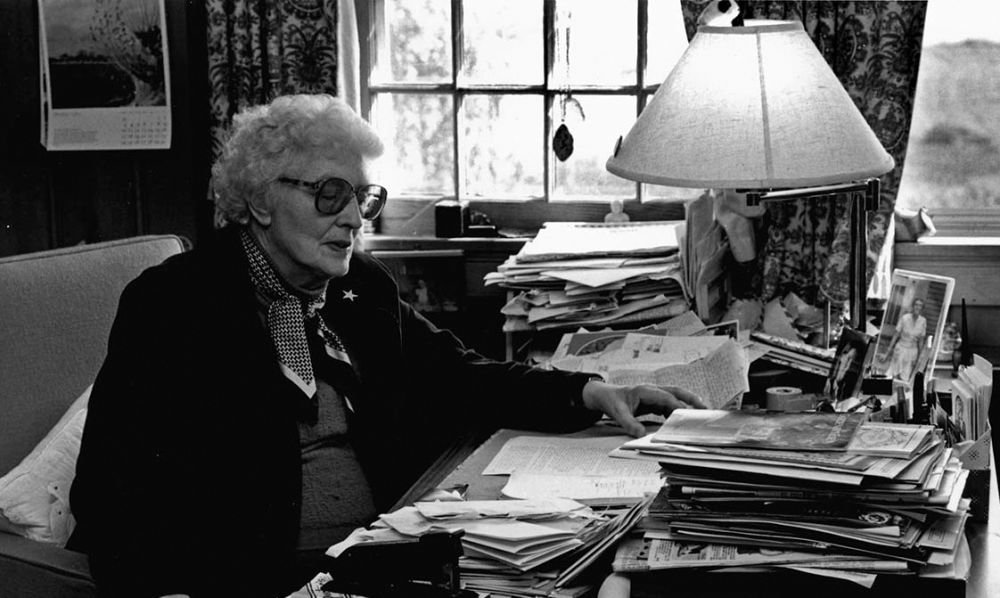
May’s house in Nelson, NH

“Later on in the night I reached quite a different level of being. I was thinking about solitude, its supreme value. Here in Nelson I have been close to suicide more than once, and more than once have been close to a mystical experience of unity with the universe. The two states resemble each other: one has no wall, one is absolutely naked and diminished to essence. Then death would be the rejection of life because we cannot let go what we wish so hard to keep, but have to let go if we are to continue to grow”(57).

But May knew the drill, and wrote such to a friend, “I came to see that my loneliness (acute and awful) was really a loneliness for myself”(Peters 279).

In Journal of a Solitude, May reveals the challenges surrounding the writing of Mrs. Stevens in 1965, the guts it took, the mission she had in mind:

“On the surface my work has not looked radical, but perhaps it will be seen eventually that in a “nice, quiet, noisy way” I have been trying to say radical things gently so that they may penetrate without shock. The fear of homosexuality is so great that it took courage to write Mrs. Stevens, to write a novel about a woman homosexual who is not a sex maniac, a drunkard, a drug-taker, or in any way repulsive; to portray a homosexual who is neither pitiable nor disgusting, without sentimentality; and to face the truth that such a life is rarely happy, a life where art must become the primary motivation, for love is never going to fulfill in the usual sense.

“But I am well aware that I probably could not have “leveled” as I did in that book had I had any family (my parents were dead when I wrote it), and perhaps not if I had had a regular job. I have a great responsibility because I can afford to be honest. The danger is that if you are placed in a sexual context people will read your work from a distorting angle of vision. I did not write Mrs. Stevens until I had written several novels concerned with marriage and family life”(91).

The need to mask in life and art, the patience to slowly roll out the truth, in a “nice, quiet, noisy way.”

Margot Peters weighs in on Mrs. Stevens in May’s biography:

“While Hilary Stevens might outrage those who believe that women artists are not deviants, her claim that women must find their own language and subjects in the dominant world of men’s literature was a radical concept in 1965. Mrs. Stevens’s idea of “woman’s work” also goes far to explain the puzzle of May Sarton’s own oeuvre: how such an aggressive, volatile, and violent person could produce novels and poems that ultimately transcend conflict. Like Hilary Stevens, May believed that her creative demon was masculine, her sensibility feminine”(254).

Mrs. Stevens Hears the Mermaids Singing was a novel before its time. In coming years, as the gathering momentum of the feminist, gay, and civil rights movements raised America’s consciousness and women’s studies departments sprang up on campuses across the nation, Mrs. Stevens brought its author a fame she had sought all her life”(259).

While living in Nelson, May received letter upon letter from women envying her seemingly ideal situation, but May wanted to set the record straight, that her living alone in a small rural town in New Hampshire was not the panacea so many imagined.

“No partner in a love relationship (whether homosexual or heterosexual) should feel that he has to give up an essential part of himself to make it viable. But the fact is that men still do rather consistently undervalue or devalue women’s powers as serious contributors to civilization except as homemakers. And women, no doubt, equally devalue their own powers. But there is something wrong when solitude such as mine can be “envied” by a happily married woman with children.

“Mine is not, I feel sure, the best human solution. Nor have I ever thought it was. In my case it has perhaps made possible the creation of some works of art, but certainly it has done so at a high price in emotional maturity and in happiness. What I have is space around me and time around me. How they can be achieved in marriage is the real question. It is not an easy one to answer”(Journal 123).

Make no mistake, although May was living alone, she was not alone. She had frequent visitors and was often off lecturing, leading workshops and teaching seminars. Nelson was an attempt to extract, one met with mixed results.

May Sarton grappled with life’s intangibles while living as close as possible to tangible pleasures; she struggled with darkness in the greatest sense and basked in full-on light in the intimate moments, where she found peace. Nothing was meaningless; everything was meaningless. She bared her soul and her heart, revealed her gifts and vulnerabilities in a way not many dare.

“Rage is the deprived infant in me but there is also a compassionate mother in me and she will come back with her healing powers in time”(Peters 339). How accurately May’s sums herself up here; for all her crossness and fire, she was generous to a fault, gifting thousands of dollars to friends every single year.

May became a gardener, as was her mother. In Nelson, she planted, weeded, harvested and displayed vibrant, oh-so-necessary flowers. It became a true labor of love, for even if she wasn’t up to doing such work, she forced herself out of doors to commune with the rocky soil, the scent of dirt and plants, the distinct hope of growth and blossoms. This seemed the antidote to starving for love and light:

“For a long time, for years, I have carried in my mind the excruciating image of plants, bulbs, in a cellar, trying to grow without light, putting out white shoots that will inevitably wither. It is time I examined this image. Until now it has simply made me wince and turn away, bury it, as really too terrible to contemplate.”(Journal 57).

May lamented in a letter to a friend,

“My rage and woe come from great and prolonged suffering that the critics have never never given the poems a break. I see the mediocre winning and I suppose to keep going I have to get mad…better than committing suicide. It is a fight to survive somehow against the current. I am a salmon leaping the waterfalls”(Peters 279).

Thank you for passionately and patiently swimming against the current, May.

May Sarton is a #NastyWomanWriter.

(Here’s the post about May’s resting place in the Nelson cemetery: The Phoenix Takes Its Rest: Visiting May Sarton’s Grave.)

©Maria Dintino 2019

Works Cited:

Peters, Margot. May Sarton: a Biography. New York: Alfred A. Knopf, 1997.

Sarton, May. Journal of a Solitude. New York: W.W. Norton & Company, Inc., 1973.

Sarton, May. Mrs. Stevens Hears the Mermaids Singing. New York: W.W. Norton & Company, Inc., 1965.

May Sarton: Leaping the Waterfalls (1912-1995 American Woman Writer), part 1 by Marie Dintino

Moderator’s Note: This piece is in co-operation with The Nasty Women Writers Project, a site dedicated to highlighting and amplifying the voices and visions of powerful women. The site was founded by sisters Theresa and Maria Dintino. To quote Theresa, “by doing this work we are expanding our own writer’s web for nourishment and support.” This was originally posted on their site on July 13, 2021. You can see more of their posts here. 

Spending summer 2021 in New Hampshire, I drive through Nelson quite often these days. Each time I do, I think of May Sarton, her years here, who she was, her art, and all she accomplished. I always glance down the road at the cemetery where she now rests.*

This post is one I wrote about May two years ago and it feels right to run it again since I feel so close to her these days. Enjoy!

May Sarton: Leaping the Waterfalls

I’d been duped. The gray-haired writer who moved to the small town of Nelson, New Hampshire in 1958 was not who I imagined. I only discovered this when I began work on this post. Far from the tranquil woman in my mind, May Sarton was an enigma, even to herself.

At forty-six, May Sarton purchased her first and only house, attempting to extract herself. In a destructive relationship, struggling to reign herself in, she sought to settle, to live where only those she wanted to see or those who really wanted to see her would visit. Plus, the dramatic move would provide fresh writing material.

May, high school graduation, Cambridge, MA 1929

Continue reading “May Sarton: Leaping the Waterfalls (1912-1995 American Woman Writer), part 1 by Marie Dintino”

We Don’t Have to Live Like This by Trista Hendren

A Tribute to Carol P. Christ’s Legacy of Peace

Rawan Anani, The Melody of Freedom, Gaza Palestine

Carol P. Christ was a feminist scholar and thealogian I deeply admired from afar for many years. That changed when I read her post in Feminism and Religion describing “washing wet clothes cast off by refugees who crossed the Sea of Death.”[1]

In that moment, she became a woman I connected with on a soul level. What could be more profound than washing and folding the clothing of tiny dead children? What other metaphor could be more vivid for how desperately we need to change the world?

“A tiny pink long-sleeved shirt with a boat neck, for a girl, size 3 months. 

A pair of leggings with feet, grey with pink, orange, brown, white, and blue polka-dots, to be worn over diapers.” 

The week before, she asserted that “the only ‘solution’ to the problem of people leaving their homes in fear for their lives is TO END WAR.” She continued, “No one takes this suggestion seriously enough to engage it.”[2]

I remember sitting inside the Idean cave with our Goddess Pilgrimage group when Carol read, “We Need a God Who Bleeds Now” by Ntozake Shange. I knew the poem well, but hearing Carolina read it so forcefully shook something deep inside me.

While I have had the privilege of having several wonderful female pastors, they were never particularly affirming of my womanhood—or my divinity. They certainly never celebrated my period.

Continue reading “We Don’t Have to Live Like This by Trista Hendren”

SheSpeaks! Eve by Janet Maika’i Rudolph

Author’s Note: I have begun a project called She Speaks! Women of the Bible Have Their Say. As part of this project, I have done five films with some very dedicated actors (friends of mine) who have dubbed themselves the SheSpeaks!Ensemble. I showed 4 of the films at the recent Yerusha Symposium. Based on the comments and reception, the project is now expanding. I am looking to create longer films that include story arcs. The first one will be of Eve. Below is the script for Eve along with the link to the video.

EVE speaks:

Why hello I don’t get visitors very often! Welcome. Come, come sit under my tree, let’s share some tea. I have the most wonderful and flavorful herbs here in my garden.

Look around at my most marvelous paradise. It is all filled with magical treasure. I’ll tell you a secret, the treasure I care for spans both the heavens and the earth. You see, we are at the place where spirit, breath and matter intersect. Where the living beings of earth and the animating forces of the divine join in harmony.

It is so hard to look at your holy book. I can’t imagine why I keep getting blamed for . . .well . . . just about everything.  It’s strange that your world wants to connect me with curses as I am the giver of life. In fact, did you know that my name Eve means life. I don’t understand what has become of you, my children. It is said that I brought a curse to humanity. Do you see life as a curse?  Let me tell you a bit about myself. Perhaps then you will see me differently.

Continue reading “SheSpeaks! Eve by Janet Maika’i Rudolph”

Long Live Queer Nightlife! by Amin Ghaziani – Book Review by Marie Cartier

I was invited to be on a panel for the Pacific Sociological Association (PSA) in San Francisco this past March for a new book by Amin Ghaziani, Long Live Queer Night life (Princeton University Press, 2024).

Since I wrote Baby, You Are My Religion – Women, Gay Bars, and Theology Before Stonewall and have discussed aspects of this work here I thought the FAR family would also enjoy this conversation on where queer nightlife is now.

The book is interspersed with visits to club nights, something Ghaziani says helps widen the possibilities for communities—different communities can have their own nights and these chapters where he visits these various hot spots are exciting and first person.

Continue reading “Long Live Queer Nightlife! by Amin Ghaziani – Book Review by Marie Cartier”

Presenting Feminine Courage by Cheryl Petersen

Madam C.J. Walker was born Sarah Breedlove in 1867, to sharecroppers who had been slaves before the American Civil War. Sarah married at age fourteen. Six years later Sarah was a widow with a daughter. For income, Sarah did laundry and cooked. In 1905, she remarried and became Madam C.J. Walker. With little more than a dollar, she began her own line of hair products for African American women and prospered humanity beyond imagination or expectation.

Nearly two decades back, I read “On Her Own Ground: The Life and Times of Madam C.J. Walker,” by A’Lelia Bundles. The author describes Walker’s journey from desperation to inspiration. The narrative impressed me with an exacting respect for the womanhood that embraces other women.

Continue reading “Presenting Feminine Courage by Cheryl Petersen”

Journey to Freedom: Harriet Tubman Still on the Move, part 2 by Maria Dintino

Part 1 appeared yesterday

Additional Developments

Although there’s a significant dearth of statues depicting real women in our country, Tubman’s image and legacy have done much to address this gap and put a serious dent in the bronze ceiling.

There are said to be at least 9 full-figure sculptures of Tubman with others in the works, along with plaques, busts,  parks and museums named in her honor. Also, three commemorative coins have been released, each depicting a particular phase in Tubman’s life.

Speaking of currency, the plan to replace President Andrew Jackson’s image with that of Harriet Tubman’s on the twenty-dollar bill is still in the works. It’s an important endeavor that’s taking far too long. Annie Linskey with The Philadelphia Tribune explains:

“There has never been a Black person on the U.S. currency, nor has there been a woman on a bill in the modern era, despite repeated attempts to diversify the currency.”

Continue reading “Journey to Freedom: Harriet Tubman Still on the Move, part 2 by Maria Dintino”

Journey to Freedom: Harriet Tubman Still on the Move, part 1 by Maria Dintino

Moderator’s Note: This post is brought to you by a collaboration by FAR and Nasty Women Writers written and hosted by Maria and Theresa Dintino. This post originally appeared on their website on Feb. 20,2024. It has been updated to reflect recent events. the post is subtitled: Nasty Women Writers: Breaking the Bronze Ceiling – Statues of Real Women in Public Spaces

It’s quite fitting that the 9-foot bronze statue of Harriet Tubman, named Journey to Freedom is still on the move, as was Tubman for much of her life.

Since 2020, the statue has traveled around the country. It’s currently on Hilton Head Island, South Carolina, in Historic Mitcheville Freedom Park. The monument will remain on Hilton Head through April 2025 and from there be transported to Vienna, Virginia.

Continue reading “Journey to Freedom: Harriet Tubman Still on the Move, part 1 by Maria Dintino”

Priestess or Goddess? The Real Morgan le Fay by Kelle ban Dea

Morgan le Fay is a popular figure for goddess-women and those interested in depictions of female spirituality, as well as a role model for some witches and pagans. Entire modern spiritual traditions such as the Avalonian tradition in Glastonbury have been created around her. She’s been portrayed in various ways in popular media and culture, and for many is more beloved than her mythical contemporaries, Arthur and Merlin. Which is interesting, because she’s a wholly fictional character, first encountered in the medieval Vita Merlini. Or is she?

While Morgan herself is, indeed, a fictional creation, many have seen echoes of ancient Celtic myth in her story. She’s a healer and magic worker, living on an Otherworldly island, sometimes with her eight sisters, guardian of Avalon with its magical apples and mists. In later iterations she’s a darker figure, an enemy of her brother Arthur, a witch and a seductress. A story we’ve all heard before.

Continue reading “Priestess or Goddess? The Real Morgan le Fay by Kelle ban Dea”

From the Archives: “Shemot: Women’s Misbehaving and Disobeying as the Key to Liberation.”

Author’s Note: This blog was originally published five years ago to the day (12 January 2020). It rings as true then as it does today.

Shemot will be read in synagogues on 18 January 2025.

This week’s Torah portion, or parshah, is Shemot (Exodus 1:1-6:1).  This parshah sets the scene for the liberation of the Israelites from slavery both by introducing main characters and elaborating on just how difficult life was for the Isrealites under Pharoah’s rule.  The parshah contains many noteworthy aspects: the death of Joseph and the multiplication of the Isrealites in Egypt; the increasing wrath of the Egptians; the birth and adoption of Moses; Moses’ encounter with the Divine in the form of a burning, yet unconsumed, bush; the revelation of the divine name, G-d’s plan for Moses’ role in the liberation of the Israelites from slavery; Moses’ attempts to get out of his assigned role; and Moses’ first confrontation with Pharoah.   

In addition, there are many women, who are integral to the salvation of the Israelites, in this parshah.  For the most part, Jewish tradition has acknowledged their part when it comes to discussions of this parshah, especially Shifra and Puah.  Yet, their role is often overshadowed by Moses’ varied miracles, the mighty power of the divine, the revelation of the Torah, the wanderings in the desert, and so on.  However, the Israelites’ liberation from slavery would have looked quite different without women.  

Continue reading “From the Archives: “Shemot: Women’s Misbehaving and Disobeying as the Key to Liberation.””