I am so frustrated that we are still fighting to affirm women’s place in leadership. I’ve been thinking about this struggle in the context of church ministries (especially preaching) and social activism, seeing a stark contrast between the way institutional churches and universities promote and subvert women’s authority and the ways movements like Black Lives Matter do.
Particularly, I’ve been struck by the ways that more radical movements employ language and practices that are based in spirit more than hierarchical authority. I have found a theme emphasizing equality in humanity’s access to spirit in both historical and contemporary movements and writings about religious experience. I’m certainly not the first one to notice or discuss how appeals to Spirit have empowered those excluded from dominant systems of power to challenge constrictive social structures, but I would like to share how this dynamic has become more visible to me so that, together, we might find encouragement, inspiration, and food for thought.
One in three women worldwide experience Domestic Abuse at some point in their lives; I am one of them. There are many terms to describe what we experience: Gender Based Violence (GBV); Domestic Violence (DV); Wife Battering; Violence Against Women and Girls (VAWG); I’ve opted to use the term Domestic Abuse because it covers many of the behaviours women, and men, experience. Firstly, domestic describes the running of the home, or family relations, and is synonymous with private; private or intimate relationships are the grounds for this abuse.
I use ‘abuse’ instead of violence because it covers physical violence, sexual abuse, financial abuse, emotional and psychological abuse, power and controlling behaviour, isolation, and spiritual abuse. Some victims experience some of these behaviours, many experience all of them. Women and men experience abuse differently. For one thing, men are more likely to murder their partners than women are, and women generally have full responsibility for the care of children. With that in mind, my focus in this piece will be on women. Continue reading “Reclaiming Yourself From Domestic Abuse by Kitty Nolan”
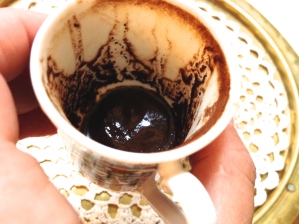
In my lifetime of researching women’s ritual dances in Greece and the Balkans, I have often come across related practices of divination or healing. One of these is the custom of coffee divination, the art of interpreting patterns in the fine grounds left in the cup after drinking Greek or Turkish coffee. The practice is found in Greece, the Balkans, Asia Minor, the Caucasus and the Middle East, and all over the world where people from these regions have emigrated. It is practiced mainly by women, particularly older women.[1]
Kafemanteía is related to much older techniques of divination and ritual, including the libations or liquid offerings which were an integral part of prayer in ancient Greece.[2] Sometimes, after the libation was poured, ‘the empty cup was examined for signs of oracle.’[3] The Old Testament mentions Joseph’s skill in divination by use of a cup,[4] while Istustaya and Papaya, the spinning and weaving pre-Hittite goddesses of destiny, divined using bowls of liquid akin to vessels used for scrying in many cultures.[5] The humble coffee cup can thus be seen as belonging to a long tradition of ceremonial vessels used in divination.[6]
Female figure in stance of invocation, with miniature votive shrines, pillars and cups or bowls for offerings. 5000 BCE, Netafim spring, Eilat, Israel.
In antiquity, Joan Breton Connelly makes clear, ‘religious office presented the one arena in which Greek women assumed roles equal and comparable to those of men,’ a fact which despite abundant evidence ‘has, until recently, been ignored by modern commentators or, worse yet, denied’.[7] In ancient Germanic, Celtic, Canaanite, Mesopotamian, and Anatolian cultures, ‘it was primarily women who were regarded as able to interpret signs and omens and to foretell the future’.[8]
Women who read cups today tend to view their ability either as a divine gift or as a talent learned or inherited from their mother, grandmother or aunt. The concept of inherited oracular or shamanic talent is an ancient one, according to Barbara Tedlock, who suggests that intuition as an ‘unconscious cognitive process’ may be ‘genetically determined in its structure and function.’[9]
In her 2005 book The Woman in the Shaman’s Body, Tedlock describes what she calls ‘the primacy of women in shamanism’, stating that ‘women’s bodies and minds are particularly suited to tap into the power of the transcendental.’[10] Her assertions have important implications for the discussion of kafemanteía as a women’s art, but also reignite feminist controversy about biological ‘essentialism’ and ways that theories about differences between the sexes have been used to justify oppression based on gender.
As an in-depth discussion of essentialism is not possible here, I highly recommend Carol P. Christ’s excellent posts on the topic for those who wish to think more deeply about these questions. As Christ shows, the assumption that ‘if there are sex differences they must inevitably determine behaviour’ is a flawed syllogism. Christ invites us to discuss these issues in a more open-minded way: ‘I think our feminist conversations would be richer if we could find ways to talk about sex differences without immediately jumping to the conclusion that it is regressive or anti-feminist to do so.’[11] In our discussion of kafemanteía, I suggest we remain open to the possibility that neurological and biological differences may have significance, though not in a deterministic way. Men can also be readers of coffee grounds and tea leaves, but the fact remains that most readers of cups are women. Why might this be?
The social component of kafemanteía is very important, offering comfort and company to both reader and querent. According to neurologist Louann Brizendine, women have both a greater need and greater capacity for the positive emotional interaction of this social relationship. Neurologically, the female brain contains more mirror neurons than the male brain, giving women an advantage in establishing emotional connection and triggering production of the anti-stress hormone oxytocin.[12] Rather than ‘fight or flight,’ female stress responses follow a behavioural pattern known as ‘tend and befriend,’ based on the maintenance of social networks that increase bonding and decrease stress.
Reading the patterns
The intuitive response when reading the patterns in a cup often comes from what we call ‘gut feelings,’ which, as neuroscientific research reveals, ‘are not just free-floating emotional states but actual physical sensations that convey meaning to certain areas in the brain.’‘ [13] As Brizendine shows, areas of the brain that track gut feelings are larger, more sensitive, and more active in women’s brains; thus ‘the relationship between a woman’s gut feelings and her intuitive hunches is grounded in biology.’ [14] A further element to consider is the fact that neurological activity in most men is left-brain dominant, while women’s brain function tends towards a more even balance between left- and right-hemisphere activity.
Finally, Barbara Tedlock presents fascinating information on protein and collagen matrices embedded in connective tissues in the human body, ‘composed of liquid crystals and biopolymers that behave as electronic conductors, storing large amounts of cognitive information.’ [15] Given that these matrices can be seen as the biological structure in which ‘somatic consciousness’ resides, I would venture to ask whether the greater proportion of fat cells in women’s bodies may enable greater cellular conductivity for storing and transmitting intuitive and cognitive information. I would love to see further research in connection with the biological tendency of women to accumulate more fat cells post-menopause, and the image of the older wise woman or crone considered in many cultures to have oracular or divinatory powers.
I have had my cup read many times on my travels, and have often been astonished by the accuracy of information offered by the reader, including precise personal details which she could not have possibly known. This remains a mystery. Although I support further study into kafemanteía, I acknowledge that in essence it appears to defy conclusive rational explanation and therefore may remain permanently impenetrable to the scholarly mind. Perhaps all we can do is to simply increase our awareness of, and respect for, this living divinatory art, and the older women who keep it alive worldwide. I would be interested to hear from others about their experiences!
This post is drawn from a much longer article I have recently written, ‘Kafemanteía: coffee divination as women’s prophetic art in ancient and modern times.’ It appears in the current issue of Walking the Worlds 3:2 (2017): 52-68, available from www.walkingtheworlds.com
Laura Shannon has been researching and teaching traditional women’s ritual dances since 1987. She is considered one of the ‘grandmothers’ of the worldwide Sacred / Circle Dance movement and gives workshops regularly in over twenty countries worldwide. Laura holds an honours degree in Intercultural Studies (1986) and a diploma in Dance Movement Therapy (1990). She has also dedicated much time to primary research in Balkan and Greek villages, learning songs, dances, rituals and textile patterns which have been passed down for many generations, and which embody an age-old worldview of sustainability, community, and reverence for the earth. Laura’s essay ‘Women’s Ritual Dances: An Ancient Source of Healing in Our Times’, was published in Dancing on the Earth. Laura lives partly in Greece and partly in the Findhorn ecological community in Scotland
References:
Barber, Elizabeth Wayland. The Dancing Goddesses. New York: Norton, 2013.
Brizendine, Louann. The Female Brain. New York: Morgan Road Books, 2006.
Christ, Carol P. ‘What If There Are Sex Differences But Biology Is Not Destiny?’ FAR February 16, 2015.
Christ, Carol P. ‘Has the Vatican Discovered that Women Should Be Running the World?’ FAR February 9, 2015.
Connelly, Joan Breton. Portrait of a Priestess. Princeton: Princeton University Press, 2007.
Green, Marian. “Wise Women Counsellors: Popular Methods of Divination.” In World Atlas of Divination, edited by John Matthews, 81-87. Boston: Little, Brown, 1992.
Karcher, Stephen. The Illustrated Encyclopedia of Divination. Shaftesbury, Dorset: Element, 1997.
Miller, Guldjin. The Secret Art of Coffee Reading. Australia: Guldjin Miller, 2015.
Seremetakis, C. Nadia. The Last Word. Chicago: The University of Chicago Press, 1991.
Shannon, L. ‘Kafemanteía: coffee divination as women’s prophetic art in ancient and modern times.’ Walking the Worlds 3:2 (2017): 52-68
Stone, Merlin. “Inner Voice: Intuition.” In Merlin Stone Remembered, edited by David B. Axelrod, Carol F. Thomas, and Lenny Schneir. Woodbury, MN: Llewellyn Books, 2014.
Tedlock, Barbara. The Woman in the Shaman’s Body. New York: Bantam Dell, 2005.
Tedlock, Barbara. “Toward a Theory of Divinatory Practice.” Anthropology of Consciousness 17:2 (2006): 62-77.
Walker, Charles. The Encyclopedia of the Occult. New York: Crescent Books, 1995.
Winkelman, Michael. Shamanism: A Neural Ecology of Consciousness and Healing. Westport, Conn.: Bergin and Garvey, 2000: 243-44. Quoted in Tedlock (2006):70.
I saw an interesting headline the other day entitled: “Olympic Gymnast Hits Back at Body-Shaming.” I immediately thought, “Wow not again.” The fact that body-shaming is even an expression is a disheartening commentary on the society we live in today. Women’s bodies have long been the subject of casual objectification in our culture and in the media. The fact that people think it’s ok to comment on a woman’s body, in whatever fashion pleases them, blows my mind. Not only is it disrespectful, but it comes from the problematic way society equates a woman’s worth with her beauty.
People have diverse ideas of beauty, and different cultures value different physical qualities, but this does not mean that those who don’t live up to the ideal should be shamed. In the article, Gymnast Aly Raisman relates an experience at an airport where a female employee recognized her and mentioned one of the reasons was “because of her muscles.” A male colleague then stated “Muscles? I don’t see any muscles” and “continued to stare” making Raisman feel uncomfortable. She then took to twitter to relay the events stating: “I work very hard to be healthy and fit. The fact that a man thinks he can judge my arms pisses me off. I am so sick of this judgmental generation.” Continue reading “Tall Order by Sarah Kiefer”
Welcome to the resistance, Feminism and Religion family. This month is Gay Pride Month in many cities, including mine—Long Beach, California—where we just celebrated our 34th gay pride parade and our annual “Dyke March.”
This blog is primarily a photo essay of those events and past pride events I have been in—a celebration of pride and gay family during the spring months which commemorate the first televised gay uprising against police harassment by the gay and lesbian and transgender family on June 28, 1969 at the Stonewall inn in New York City, NY. Continue reading “Gay Pride and Gay Resistance by Marie Cartier”
We all remember the protests—and the pink knitted caps with the pussy ears—that filled the streets of our major cities after the inauguration of the Troll-in-Chief. Some members of this FAR community went to those marches and wrote about their thoughts and feelings in this space. I don’t go to marches and demonstrations anymore, mainly because it would be majorly inconvenient if I had an asthma attack right in the middle of when other people are trying to do important things. But I always send my thoughts.
And so I have recently been thinking about a feminist hera who can inspire us resisters. (Note that “hera” is not only the name of the queen of the Olympians, but it’s also the feminine form of “hero.” I’ve heard some women say “shero.” I guess that works, but it’s an ungainly word. Let’s call our courageous women heras and superheras. But I digress.) I’ve been thinking about Wonder Woman since the election. Here’s what I wrote about her in my book Pagan Every Day. (Note that I’m expanding what I wrote in 2003.)Continue reading “Do We Need Wonder Woman Today? by Barbara Ardinger”
Like many other thousands of Americans, I watched the newest offering from the Star Wars legacy last autumn and was re-inspired to be an active part of the rebellion against oppression. Viewing the movie through my feminist lens I was cheered on by the choice of actors and actresses in lead roles and was reminded of Margaret Mead’s famous quote,“Never doubt that a small group of thoughtful, committed, citizens can change the world. Indeed, it is the only thing that ever has.”
It may be easy to compare the new president to Lord Vader because he is an easy target who encourages mockery and ridicule. However, tyranny, violence, and power trips have long been a part of world societies, for centuries. It is as evident as ever that we must continue to stand against such debilitating realities. We must stand together.
And, like millions of other people across the world, I had the privilege to participate in a Sister March to the Women’s March on Washington; shoulder to shoulder with passionate and caring people determined to make a difference. The experience generated feelings of elation, hope, and unity. I was most impressed by the kindness radiating from every person I came in contact with. Even though spaces were packed with people the overall atmosphere was conscientious, polite, and caring. Peaceful activism is critical to progress.
I also listened intently to the speeches made at the marches; especially by the women well known in popular culture. Gloria Steinem, a cornerstone of the modern feminist movement, spoke words that I believe reflect the change in values that I visualize in the form of a river current. “God may be in the details, but the Goddess is in connections. We are at one with each other, we are looking at each other, not up.” Women’s work is the creation of the web; the tapestry of connections between us all and the building of momentum in the stream bed.Continue reading “Join the Rebellion by Jessica Bowman”
“You may not remember, but let me tell you this,
someone in some future time will think of us.”
—Sappho
I put on my boots and jeans, grab my priestess robe, pack a basket of ritual supplies, and meet four close friends in a nearby cave. We feel a little nervous about holding ritual on unfamiliar land, but we decide to push our boundaries and do it anyway. The land needs us, says my friend. The other people who come here are meth-heads and vandals.
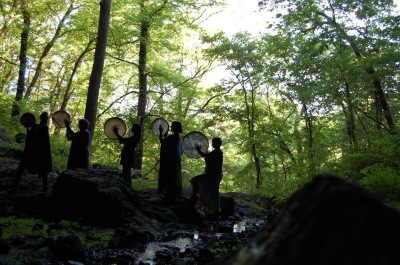
We take our drums and climb to the top of the cave, singing as we find our way up the steep hillside. On top, looking out across the country, we sing: cauldron of changes, feather on the bone, arc of eternity, ring around the stone. We laugh and practice some more songs, some hearty, some tentative and new. We tie up small bundles of our symbolic burdens with stones and let them down over the edge using handspun wool yarn until the yarn releases, taking our burdens with them. Suddenly, we hear the sound of tires on the gravel. Slamming doors. The sound of loud men’s voices. The smell of cigarette smoke. A ripple of uncertainty passes through us. We are once again tentative and we feel a current of unease. What should we do? we whisper to one another. The voices draw nearer, there are calls and hoots. My friend looks at me and says: this is where we make our stand. We hold hands in a line at the edge of the cave roof, gazing out into the horizon. A hawk wheels overhead. We sing. The approaching voices quiet. We sing louder.
I am a strong woman, I am a story woman, I am a healer, my soul will never die.
We project our voices and yell: we are the witches, back from the dead!
The voices stop. We wait. We hear doors slamming. The sound of tires on gravel. We are alone once more.
We descend into the cave singing a song composed on the spot: Deeper, deeper. We’re going deeper. Deeper, deeper. Deeper still.
We strike a pose based on the carvings described in the classic book, When the Drummers were Women. Archaeologists described carvings of priestesses carrying drums as, “women carrying cakes to their husbands.”
We shout: “we’re not carrying cakes!”
I stand on a rock in the center of the cave and sing: she’s been waiting, waiting, she’s been waiting so long, she’s been waiting for her children to remember to return. My friends join the song and we move deep into the darkness where we face the “birth canal” at the back of the cave, listening to the small stream within trickle, laugh, and bubble as it emerges from the dark spaces deep within the heart of the earth. We begin to sing:
Ancient mother we hear you calling. Ancient mother, we hear your song. Ancient mother, we hear your laughter…
Just as we sing the words, ancient mother, we taste your tears, droplets of cave water fall on our faces, splashing our eyelids.
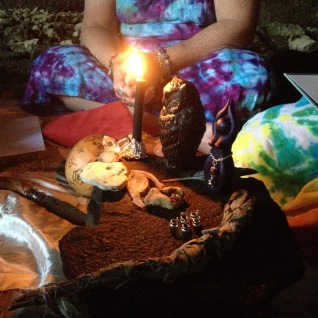
It might seem simple on the surface, but gathering the women and calling the circle is a radical and subversive act. A revolutionary act. In my work with women’s circles and priestessing, I am repeatedly reminded that gathering with other women in a circle for ritual and ceremony is deeply important even though it might just look like people having fun or even being frivolous, it is actually a microcosm of the macrocosm—a miniature version of the world we’d like to see and that we want to make possible.
In the book, Casting the Circle, Diane Stein observes that women’s rituals, “…create a microcosm, a ‘little universe’ within which women try out what they want the macrocosm, the ‘big universe’ or real world to be. Within the safety and protected space of the cast circle, women create their idea of what the world would be like to live in under matriarchal/Goddess women’s values…The woman who in the safety of the cast circle designs the world as she would like it to be takes that memory of creation and success out into daily life…By empowering women through the microcosm of the ritual’s cast circle, change becomes possible in the macrocosm real world.” (p. 2-3)
It starts with these private ritual and personal connections and then, as Stein explains, “A group of five such like-minded women will then set out to clean up a stream bed or park in their neighborhood; a group of twenty-five will join a protest march for women’s reproductive rights; a group of a hundred will set up a peace encampment. The numbers grow, the women elect officials to government who speak for their values and concerns. Apartheid crumbles and totalitarian regimes in Eastern Europe end, disarmament begins, and laws to control polluters are enforced. Homes, foods, and jobs are opened to the world’s homeless, and often begins in the microcosm of the Women’s Spirituality ritual circle” (p. 3)
“Feminism catches fire when it draws upon its inherent spirituality. When it does not, it is just one more form of politics, and politics never fed our deepest hungers.”
–Carol Lee Flinders (in The Millionth Circle)
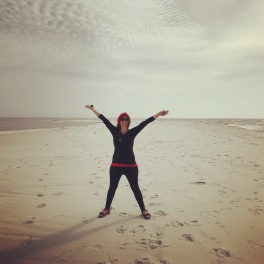
Molly has been “gathering the women” to circle, sing, celebrate, and share since 2008. She plans and facilitates
women’s circles, seasonal retreats and rituals, mother-daughter circles, family ceremonies, and red tent circles in rural Missouri and teaches online courses in Red Tent facilitation and Practical Priestessing. She is a priestess who holds MSW, M.Div, and D.Min degrees and finished her dissertation about contemporary priestessing in the U.S. Molly and her husband Mark co-create Story Goddesses, original goddess sculptures, ceremony kits, and jewelry at Brigid’s Grove. Molly is the author of Womanrunes, Earthprayer, and The Red Tent Resource Kit and she writes about thealogy, nature, practical priestessing, and the goddess at Brigid’s Grove.
This continues my reflections on the Devidasis in Part 1.
The overall picture that emerged from the documentary “Sex, Death and the Gods” was that, in its current form, there were many layers to the Devadasi system. For one, the most heartbreaking of all, there were the helpless, underage girls protesting such an existence, pleading that they would rather be in school, instead of being trapped in what was essentially a form of sexual slavery. But then we also see the older Devadasis, women who had been dedicated as children themselves.
Within this latter bracket, there were two groups.Those that viewed the practice as evil, and those that saw it as empowering – they earned their own income and they didn’t have a man or mother-in-law to lord over them; in short, they were in-charge of their own households. To them, married life was akin to a life of servitude, sex was something they enjoyed, and they may have shared a more or less equal relationship with the men who were their customers, men who enjoyed their company and preferred being with a Devadasi rather than with spouses they never chose or couldn’t get along with. In the words of one Devadasi – “I am the boss.” Continue reading “Sex, Death and the Gods (Part II) by Vibha Shetiya”


 I am so frustrated that we are still fighting to affirm women’s place in leadership. I’ve been thinking about this struggle in the context of church ministries (especially preaching) and social activism, seeing a stark contrast between the way institutional churches and universities promote and subvert women’s authority and the ways movements like Black Lives Matter do.
 One in three women worldwide experience Domestic Abuse at some point in their lives; I am one of them. There are many terms to describe what we experience: Gender Based Violence (GBV); Domestic Violence (DV); Wife Battering; Violence Against Women and Girls (VAWG); I’ve opted to use the term Domestic Abuse because it covers many of the behaviours women, and men, experience. Firstly, domestic describes the running of the home, or family relations, and is synonymous with private; private or intimate relationships are the grounds for this abuse.


 I saw an interesting headline the other day entitled: “Olympic Gymnast Hits Back at Body-Shaming.” I immediately thought, “Wow not again.” The fact that body-shaming is even an expression is a disheartening commentary on the society we live in today. Women’s bodies have long been the subject of casual objectification in our culture and in the media. The fact that people think it’s ok to comment on a woman’s body, in whatever fashion pleases them, blows my mind. Not only is it disrespectful, but it comes from the problematic way society equates a woman’s worth with her beauty.
 Welcome to the resistance, Feminism and Religion family. This month is Gay Pride Month in many cities, including mine—Long Beach, California—where we just celebrated our 34th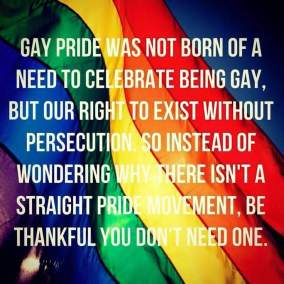
 Like many other thousands of Americans, I watched the newest offering from the Star Wars legacy last autumn and was re-inspired to be an active part of the rebellion against oppression. Viewing the movie through my feminist lens I was cheered on by the choice of actors and actresses in lead roles and was reminded of Margaret Mead’s famous quote,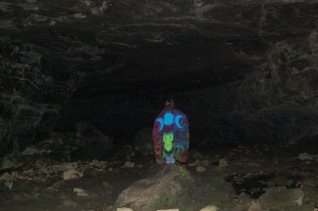
 using handspun wool yarn until the yarn releases, taking our burdens with them. Suddenly, we hear the sound of tires on the gravel. Slamming doors. The sound of loud men’s voices. The smell of cigarette smoke. A ripple of uncertainty passes through us. We are once again tentative and we feel a current of unease. What should we do? we whisper to one another. The voices draw nearer, there are calls and hoots. My friend looks at me and says: this is where we make our stand. We hold hands in a line at the edge of the cave roof, gazing out into the horizon. A hawk wheels overhead. We sing. The approaching voices quiet. We sing louder.
 carvings of priestesses carrying drums as, “women carrying cakes to their husbands.”
 within which women try out what they want the macrocosm, the ‘big universe’ or real world to be. Within the safety and protected space of the cast circle, women create their idea of what the world would be like to live in under matriarchal/Goddess women’s values…The woman who in the safety of the cast circle designs the world as she would like it to be takes that memory of creation and success out into daily life…By empowering women through the microcosm of the ritual’s cast circle, change becomes possible in the macrocosm real world.” (p. 2-3)
 Molly has been “gathering the women” to circle, sing, celebrate, and share since 2008. She plans and facilitates
 This continues my reflections on the Devidasis in
  Feminism and Religion