I’ve been thinking about willful women and feminist killjoys—two main guiding images in feminist scholar Sara Ahmed’s book Living a Feminist Life (Duke University Press 2017).
The idea of the willful woman (or willful girl, or willful person) is something I can easily get behind. The way I understand it, it has to do with women getting in touch with our own wills and being willing to speak and act and live out of our wills. Particularly if these wills turn out to exist in opposition to the things other people might will for us.
It’s about learning to stand up for ourselves, learning to affirm our full humanity in a world that often expects…less. It’s a way of consciously, intentionally being willing to be called “willful” as a negative thing—as in, stubborn, selfish, antagonistic, difficult—because the affirmation of our own wills is worth it.
I like all of this and find it helpful. Be willful. Expect pushback and penalties for it. Be willful anyway.
How ‘at one’ are you with your body, and what reasons might there be if your body-sense got separate(d) from your soul-sense?
This piece starts with the difference between feminine and masculine spirituality, and introduces a few reasons why living in a physical body isn’t always easy.
It then invites a shift to the beloved body and how we can start to re-instate our body as a sacred place and love it from within.
A few weeks back, author and historian Jemar Tisby tweeted that an acquaintance of his “described their general experience with white evangelicals as ‘people who don’t have any questions.’ I immediately knew what they meant.” The tweet gained some traction, with 62.1k “likes” at the time I’m writing this. The next week, Tisby followed up with a thoughtful reflection piece, expanding on his own experience with white evangelicals needing to have answers to every question, from “How old is the earth?” to “How should Christians vote?” Tisby unpacks the dangers of this kind of arrogant certainty, inviting Christians instead to embrace mystery, curiosity, and learning.
I resonate with many of Tisby’s observations and reflections. From my experience (including thirteen years in evangelical churches and a Master of Divinity degree from an evangelical seminary), I wouldn’t say these things are true of every single white evangelical—but they’re definitely true enough of the movement as a whole that they are very much worth naming, engaging, and challenging. I appreciate Tisby’s work.
A Modern Pilgrimage to the Isle of Lewis & Harris, Part 2
In the previous post of October 14th, I introduced my recent pilgrimage to meet the Goddess, honour the physical and psychological changes that have happened inside me recently. I described the different mountain ranges that resembles the bodies of sleeping women, and an ancient well dedicated to the Celtic goddess Brighde.
If I was traveling over the body of the goddess, the Callanish Standing Stones would be her navel. It seems as if energy is flowing out from there to all edges of the island. The shape of the site resembles a Celtic cross. Unusual is that the site consists of one large, central standing stone, surrounded by 13 stones, and with stone avenues to the cardinal directions. With its solar alignment, paraphrasing Jill Smith, the configuration looks like a cosmic dancer who juggles the sun from east to west. The “arms” are aligned exactly with the sunrise and sunset at this time of year.
Model of the Standing Stones as seen from above, in Callanish Visitor Centre
Callanish 1, the main stone circle, is connected to 11 other sites across the island, some circles, some solitary standing stones. Together they are called the Callanish Complex. I visited Callanish 1 many times that week, and I was lucky to spend the Autumn Equinox there.
I’ve never come across stones that were so alive and expressive. Light would bounce off differently at different times of the day, accentuating irregularities, dulling, or sharpening edges, emphasising different aspects. I saw lion and wolf heads, young maidens, hooded wanders, gargoyle and dragon-like creatures, dolphins and even a Horned Dancer… Most importantly, it felt like in each of the stone circles in the area (Callanish 1, 2, 3, 4, and 8), there was at least one stone resembling a woman’s body, and I came to think of them as the Grandmother Guardians. They had a real living presence, that became even stronger as the day-visitors disappeared.
Usually there were 2-5 people there, sometimes I found myself alone. The sunset of the Equinox, however, drew many more people. There were about twenty tourists, who were taking snapshots of this magnificent light show, leaning, or pushing against the stones, talking, and giggling. Several professional photographers tried to capture a magical moment. And there were 5-7 fellow pilgrims, whom, like me, would stay long into the night. Everyone was so focused on the sunset, was I the only one who noted the rainbow in the east?
The below images were literally taken a minute apart – rainbow to the east, sunset and silhouettes to the west.
Rainbow during the Sunset at Callanish 1, on the Autumn Equinox, September 22, 2022Sunset at Callanish 1, on the Autumn Equinox, September 22, 2022
Eventually the tourists and photographers disappeared, and the rest of us gathered at the heart of the circle, in the remains of an ancient burial mound. With African and shamanic drums, a whistle, a singing bowl, an old man tapping his walking stick to the bottom of his tin mug, and some rattles, we improvised a rhythmic invocation to the spirits of the stones. With the rain becoming heavier, I soon found myself alone with the stones. Now I could finally sing, dance, weave between the stones without disrupting anyone, lean into the stones, close my eyes, and pray.
I felt very aware of the ‘balance’ in the year, the point of equally long days and nights. I asked for guidance on balance in my own life: between work and leisure, between doing and resting, between the first and second half of my life, between gathering wood for the fire and sharing it, between birth and death, and how I can better look after my body and energy living with an invisible auto-immune condition in these fast and demanding times.
After the rain departed, the clouds tore open, revealing the clearest and most brilliant night sky I’ve ever seen. The silhouettes of the stones reaching up into the night was truly magnificent. Moving, weaving, pausing, I made my way clockwise around all the 13 stones in the circle. I stood at either side of the stones, outer and inner, and took my place in between them, as if I was a moving stone myself. I reflected on centre and circumference, on axis, on direction, on the wheel of life, turning, turning, turning, turning… and felt connected to similar circles across Europe lighting up in the darkness, as a radiant hub of energy-places.
Photo Collage: Impression of Night Sky, by Eline Kieft October 1, 2022
After having completed my weaving of the circle, by which time I had enjoyed half of my ginger tea for a warm kick, I decided to return to our cottage – also an act of balance. Having a cold already, I did not quite have the proper gear to stay out in the windy and rainy night. My lovely bed was calling! On my way home I saw three deer next to the road. I stopped the car and could be with them for several moments before they wandered off.
I had been so attuned to the rhythms that I woke up well before the alarm. I laid in the comfortable darkness, until it was time to return to the stones to witness the sunrise. My mom came along this time. Again, there were several photographers ready for ‘the moment’ (no tourists at this hour!). I just HAD to dance, and chose my spot at the far western end, out of line of any cameras. A dance of ground, earth, mountain, honouring the mother and my mother, weaving the light, the turn of seasons, changing, praying, calling, giving thanks, celebrating, welcoming, and letting go. Strong, soft, vibrant, still…
Both Images of Sunrise at Callanish 1, on the Autumn Equinox, September 23, 2022
Standing against the central menhir, looking east, we finished the last of the ginger tea. So special to be able to share this together. Mother and daughter in a circle of ancient Grandmother Guardians, witnessing the sun rise on a new day. Sacred land, ongoing cycles of time, and a modern-ancient pilgrimage…
It will take many moons to fully digest and integrate the richness of this journey, but I already know this precious experience seeped deep into my bones.
May the magic of the land touch you too, wherever you are.
Mother and Daughter – this photo was in fact taken at another moment, against another stone, mid-afternoon on 22nd…
I’d love to invite you for my series of Embodied Spirituality Masterclasses that are going to start today, 21st October! Have a look if you’re interested in reconnecting body and spirit, re-anointing the body as sacred, nature as a temple, contemporary ceremony and much more… You can still join until Christmas, so don’t worry if you can’t make the first session live, it will be available in replay!
Jill Smith is a deep well of goddess lore on Lewis:
Mother of the Isles (2003)
The Callanish Dance (2000)
Bio
Eline Kieft danced from a young age, including rigorous classical and contemporary training to become a professional dancer. She then studied anthropology, deepening her fascination with worldwide similarities between indigenous traditions regarding intangible aspects of reality and other ways of knowing, including embodied epistemologies and shamanic techniques.
She completed her PhD in dance anthropology at Roehampton University, trained in depth with the Scandinavian Centre for Shamanic Studies and the School of Movement Medicine. Eline worked at the Centre for Dance Research (C-DaRE) at Coventry University for five years, where she created a Somatics Toolkit for Ethnographers, and pioneered soulful academic pedagogy. Her recent book Dancing in the Muddy Temple: A Moving Spirituality of Land and Body was well received as a unique blend of theory and practice and a medicine for our times.
She is now a full-time change-maker and facilitates deep transformation through coaching and courses both online and in person. Her approach The Way of the Wild Soul offers a set of embodied, creative, and spiritual tools to re-connect with inner strength and navigate life’s challenges with confidence.
A Modern Pilgrimage to the Isle of Lewis & Harris, Part 1
For a long time, I felt a soft but insistent tug to go to the Isle of Lewis & Harris, on the west coast of Scotland. Third time lucky, because the trip got cancelled twice due to Covid-19. Even this time was a challenge, with flights being pulled, and airport strikes causing last minute changes. It was as if the Goddess was asking me, “how serious are you about this, daughter?”
Eventually I managed to get to Edinburgh on time, all the way by train from our small sleepy village in France, to catch the connecting flight to the island.
In this post (Part 1), I write about meeting the Triple Goddess in the Land. Part 2: The Stones, focuses on my Equinox ceremony in the Callanish Stone Circle.
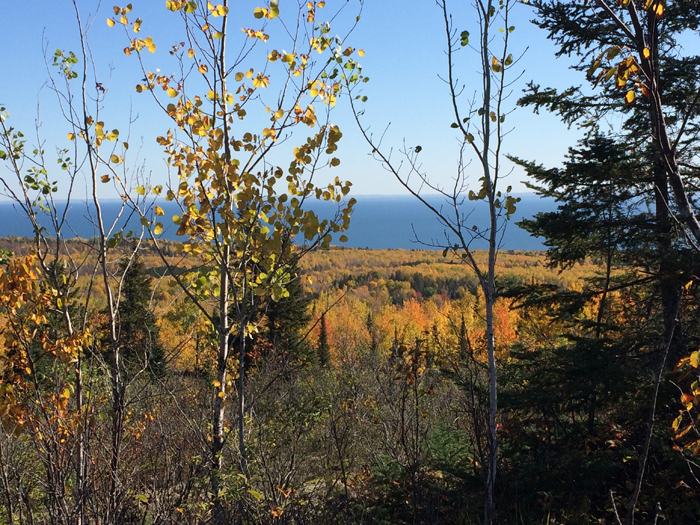
The leaves have finally begun to turn. I’ve been longing for the trees to reveal their true beauty in all their colorful array, and am glad for this beginning. Soon the woods will be filled with the golden, amber, scarlet, and orange glow of the maples, aspen, birch, and oaks of the northern forest.
Hawk Ridge
It is the time of year I would take my Women and Spirituality students to a sacred spot on a ridge high above Lake Superior to explore their spiritual connections with the earth. They would share a particular way they felt a connection to the natural world – often a lake, or a place from their childhood, a tree they loved to climb, their dog, or a stone they carried. We would circle the large pine and invoke Starhawk’s “Open-Eyed Grounding” practice.[i] They would read and comment on their favorite passages from the readings – selections from Susan Griffin’s Woman and Nature and Carol Christ’s “Rethinking Theology and Nature.”[ii] Then they would disperse across the ridge for their solo encounters with nature, before gathering together again, each returning with something they had discovered during that time. Then we would talk about the changing colors of the leaves surrounding us and talk about how these were the true colors of the leaves, finally emerging now that the chlorophyll that had disguised them in green was beginning to wane. Taking our cue from the leaves, we would talk about authenticity – about their coming into their own true colors. For that is the work of spiritual growth and transformation — to emerge as our own true selves. Yet, how often our unique and precious beings are taught to mask our true color, blend in — be “green” like everyone else. What a vivid and beautiful world when we come into our own and share our unique gifts and being with the world.
Twelve years ago, I published my novel Daughters of the Witching Hill, drawn from the true story of the Pendle Witches of 1612. The story of these wisewomen and healers still haunts and enchants me to this day.
This post started as a comment to Annie Finch’s part 1 of Abortion As A Sacrament post. Realizing it was a story that was getting too long, I’m sharing it here as a reiteration of the practical significance of ritual, and finding our way through the no-longer-charted territories of being a female human — in the sense that if we were a female of any other animal form, we would still know exactly how to navigate all the challenges.
I had a years-long pregnancy-related experience in which ritual was the only thing to finally bringing closure, though the real issue was more the other being’s feelings or intent than mine. About a year after the birth of my only child, still nursing full time and using what should have been sufficient birth control, I became pregnant and aborted at Planned Parenthood. I had been well along, not having suspected anything because my menses hadn’t yet returned.
At the time, there was no debate in my mind, if I had added another responsibility to my already excessive load, I would have failed at everything, the most important being my daughter.
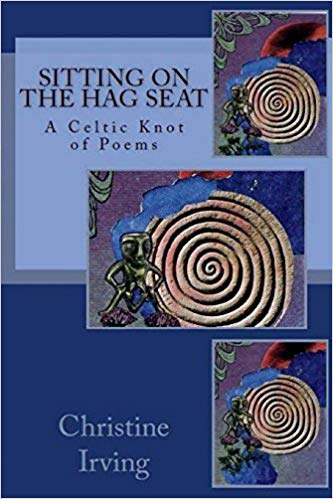
My book Sitting on the Hag Seat carries the blue cover I designed. Buried in the blue, riding the spiral Wheel of Return, stands a small Sheela-na-gig. The Sheela’ s origins remain unknown and controversial. It sometimes seem to me that the less explanation exists for a mysterious object or occasion, the more emotional attachment accrues to the opinions of diverging theorists. However, no matter what symbolism is ascribed to Sheela-na gig, her frequent placement above church doors or in the walls of cities, castles and watch towers, does seem to support a protective aspect not necessarily at odds with other attributions.
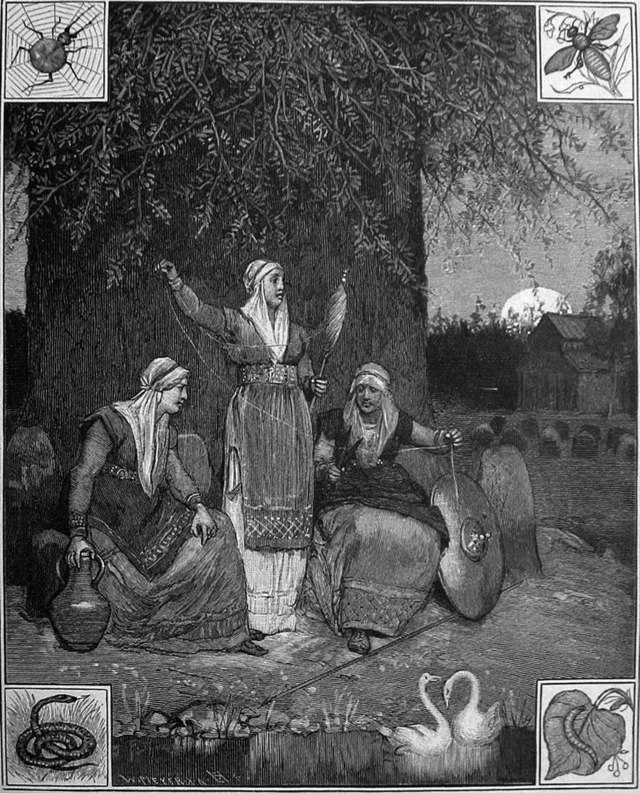
Part 1 was posted yesterday. You can read it here. The Norns were explaining the mess they had made when they got drunk at a Valhalla party.
The Norns looked at me with sadness. “We knocked over one of our looms/templates/arrangements”
Their tone changed, they looked at each other and I thought I could see emotion churning. They were arguing and then they stopped. They turned toward me and looked sheepish, that is if divinities can look sheepish. “It was a disaster/calamity/debacle.”
“Tell me then,” I was growing impatient.
Verdandi: “Well you see the loom we knocked over was . . .”
“What?” I almost shouted at them.
Urd: “It was the loom holding the pattern from Salim/Jerusalem.”





 Feminism and Religion