I have recently watched one of these real life entertainment documentaries. This one was on plastic surgery. A woman went under the knife to enlarge her breasts. The female presenter, wearing sterile white, peeped into the operation theatre and, facing the camera, said excitedly: “This operation might be life-changing!”
I thought: “Yes, precisely.” The money that the patient spent on breast implants could have bought – what? A trip to a strange land. A course for her to improve her employment prospects or to broaden her horizons. Art supplies for her to create something. A water pump to provide clean water in a village somewhere in the world where children die from preventable diseases caused by dirty water. Part of a salary for a teacher who works in a school for girls somewhere in the world where girls need extra help getting education.
Life-changing.
What we choose to spend money, or indeed any resources (time, energy) on depends on our story of life. What is life for us: a race to the unattainable ideal of glossy magazine covers or a spiritual journey we share with every other creature on earth? Continue reading “Stories vs. What Is by Oxana Poberejnaia”
“Let the beauty we love Be what we do
There are hundreds of ways to kneel and kiss the Earth.”
–Rumi
Introductory note: At the end of 2016, my parents purchased a piece of land about one mile from where I already live (they live one mile further away than that). In addition to woodland and meadow, this land has two springs, three creeks, a cave, and ¼ mile of river access. While I have been deeply connected to the land of my birth, the Missouri Ozarks, for a long time, and have written about that connection in multiple past posts for FAR, this new-to-us land has offered a new opportunity: the chance to get to know another section of land “from scratch,” deeply, wildly and well, and to become wise stewards of it for the time in which it is in our care. It is also the first time I have been able to so closely and intimately observe the origin source of a body of water. Previously not giving it much thought, I now have the daily privilege of observing the source of the flow as I watch water emerge directly from the ground. First, there is simply none and then, suddenly, a deep blue pool constantly bubbling as water rises to the surface and flows away on its long, long journey to the sea. This essay is a series of three vignettes as I spend this year immersing myself in relationship with this land.
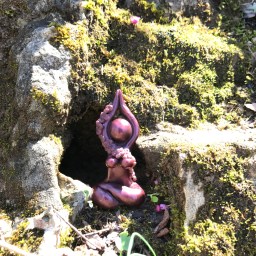
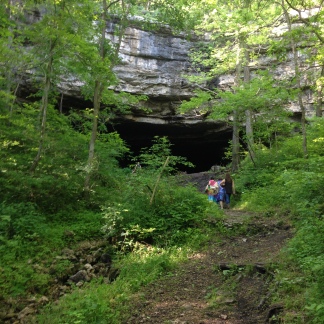
We walk along the nearly vertical hillside hanging onto small trees for support. Finally, though we almost miss it, we spy the opening to the cave nestled behind several mossy stones. The sun is still on the rise above the tree line and the rays filter through the trees so one ray is pointing directly at the cave entrance. We crawl inside, bumping our heads and scraping our backs as we wiggle into this womb in the earth. Once inside, the chamber enlarges so we can stand up. Unlike other caves we have experienced in this area, the only human signs we find are a single bottle cap, a glass bottle, and two sets of initials carved into a rock. In the dark silence we hear the sound of water dripping steadily. I make my way further into the cave, acutely aware that this is living cave and being careful not to step on the fresh, wet, cervix-shaped beginnings of new stalagmites on the floor. At the back of the cave, I find her. A Madonna-like stone column, glistening with water. In the silence of the cave, I quietly sing Ancient Mother to her, as tears well in my own eyes.
I am of this earth for this earth and by this earth.
We skirt carefully along the bank of the creek, making our way to the largest spring. Over three million gallons of water a day flow effortlessly from this small, deep pool nestled quietly in the middle of the woods. I am stunned by the magnitude of this flow as I stand there with my husband, my head resting on his shoulder, hawks wheeling overhead, redbud trees in full bloom. It has never seemed more clear to me how very “small” we are, but a blink of an eye to this spring and its countless years and countless gallons of water, not caring whether it is witnessed in its work or not, but simply, continually, creating and producing. I try to explain this feeling aloud, but words fail me. It is a humbling sensation, not a depressing one. The actual emergence of the water at this origin point of the river is nearly invisible, the continuous gentle, small popping of bubbles on its surface, the only sign that something significant is happening here that distinguishes this body of water from a pond or pool. Yet, those never-ending bubbles rapidly expand to a wide, swift-moving creek, which joins the river and another smaller spring-fed creek to continue to make their way southward across the state. We smell something sharp and see a dead armadillo by the roots of a giant sycamore. We hear a shrill cry and look up to see two bald eagles riding the currents of air high above us. We are so small. So many thousands of years of water have passed, but we are here right now.
Unfathomable eons
Glacier time
I am just a blink of an eye
But I can sit, and watch, and wonder.
We scramble along the uneven terrain on the rocky and wooded hillside, slipping, laughing, and looking. I am exhilarated by the simple thrill of exploring the world right here in front of me. We find tiny flowers. I kneel by the roots of fallen trees. We stop to admire moss on stones. We find gigantic black snake napping in the sun. A complete turtle shell. A shed antler. Each moment feels like a new opportunity to “kiss the earth.” I sing Reclaiming’s song-version of the Rumi quote over and over and as I kneel in each spot to see what it has to show me, in each, I kiss my fingers and press them to the earth. I see all the kissing going on around me…the sun filtering through branches, the fiddlehead ferns kneeling to kiss the earth, the roots wound through rocks, the trillium and bloodroot blooms pushing up between leaves, the water seeping out of the ground and flowing down the hill, the dogwood blossoms opening to the sun, the moss covering stones, the fallen trees stretched along the slope.
“And that is just the point…how the world, moist and beautiful, calls to each of us to make a new and serious response. That’s the big question, the one the world throws at you every morning. ‘Here you are, alive. Would you like to make a comment?’”
–Mary Oliver
We emerge from our walk to find morels growing alongside the path (morels are wild, edible mushrooms found for about two weeks in Missouri each spring and considered a delicacy by many). The afternoon suddenly becomes even more rewarding and we stoop and peer through fallen oak, sycamore, and elm leaves looking for the telltale conical form of these forest treats. We quickly discover that we must tune in and “listen” for the mushrooms, so to speak, or we’ll walk right by them, none the wiser. The moment I start thinking about anything else, I stop finding any. Once I settle into my body and the moment and really look at the world again, there another morel will be.
“I think this is how we’re supposed to be in the world … present and in awe.”
–Anne Lamott, Bird by Bird: Some Instructions on Writing and Life
Molly has been “gathering the women” to circle, sing, celebrate, and share since 2008. She plans and facilitates women’s circles, seasonal retreats and rituals, mother-daughter circles, family ceremonies, and red tent circles in rural Missouri and teaches online courses in Red Tent facilitation and Practical Priestessing. She is a priestess who holds MSW, M.Div, and D.Min degrees and finished her dissertation about contemporary priestessing in the U.S. Molly and her husband Mark co-create Story Goddesses, original goddess sculptures, ceremony kits, and jewelry at Brigid’s Grove. Molly is the author of Womanrunes, Earthprayer, and The Red Tent Resource Kit and she writes about thealogy, nature, practical priestessing, and the goddess at Brigid’s Grove.
This saying is one of those that sound a bit curious to a Western ear. It is almost as if the Buddha was against fun or humour. However, we all are familiar with the Buddha’s depictions where he smiles. The canonical texts also bear witness to the Buddha’s smiling.
It has become clear to me that the Buddha points here at the preciousness of the limited time we have in this human life. In short, he was saying that suffering is not a laughing matter, and life is not a joke.
Time is running out – the message that is even more relevant today, as it relates now not only to each of us individually, but to all of us as a species.
“You may not remember, but let me tell you this,
someone in some future time will think of us.”
—Sappho
I put on my boots and jeans, grab my priestess robe, pack a basket of ritual supplies, and meet four close friends in a nearby cave. We feel a little nervous about holding ritual on unfamiliar land, but we decide to push our boundaries and do it anyway. The land needs us, says my friend. The other people who come here are meth-heads and vandals.
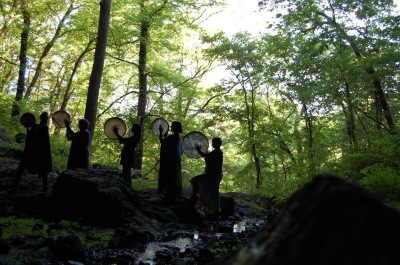
We take our drums and climb to the top of the cave, singing as we find our way up the steep hillside. On top, looking out across the country, we sing: cauldron of changes, feather on the bone, arc of eternity, ring around the stone. We laugh and practice some more songs, some hearty, some tentative and new. We tie up small bundles of our symbolic burdens with stones and let them down over the edge using handspun wool yarn until the yarn releases, taking our burdens with them. Suddenly, we hear the sound of tires on the gravel. Slamming doors. The sound of loud men’s voices. The smell of cigarette smoke. A ripple of uncertainty passes through us. We are once again tentative and we feel a current of unease. What should we do? we whisper to one another. The voices draw nearer, there are calls and hoots. My friend looks at me and says: this is where we make our stand. We hold hands in a line at the edge of the cave roof, gazing out into the horizon. A hawk wheels overhead. We sing. The approaching voices quiet. We sing louder.
I am a strong woman, I am a story woman, I am a healer, my soul will never die.
We project our voices and yell: we are the witches, back from the dead!
The voices stop. We wait. We hear doors slamming. The sound of tires on gravel. We are alone once more.
We descend into the cave singing a song composed on the spot: Deeper, deeper. We’re going deeper. Deeper, deeper. Deeper still.
We strike a pose based on the carvings described in the classic book, When the Drummers were Women. Archaeologists described carvings of priestesses carrying drums as, “women carrying cakes to their husbands.”
We shout: “we’re not carrying cakes!”
I stand on a rock in the center of the cave and sing: she’s been waiting, waiting, she’s been waiting so long, she’s been waiting for her children to remember to return. My friends join the song and we move deep into the darkness where we face the “birth canal” at the back of the cave, listening to the small stream within trickle, laugh, and bubble as it emerges from the dark spaces deep within the heart of the earth. We begin to sing:
Ancient mother we hear you calling. Ancient mother, we hear your song. Ancient mother, we hear your laughter…
Just as we sing the words, ancient mother, we taste your tears, droplets of cave water fall on our faces, splashing our eyelids.
It might seem simple on the surface, but gathering the women and calling the circle is a radical and subversive act. A revolutionary act. In my work with women’s circles and priestessing, I am repeatedly reminded that gathering with other women in a circle for ritual and ceremony is deeply important even though it might just look like people having fun or even being frivolous, it is actually a microcosm of the macrocosm—a miniature version of the world we’d like to see and that we want to make possible.
In the book, Casting the Circle, Diane Stein observes that women’s rituals, “…create a microcosm, a ‘little universe’ within which women try out what they want the macrocosm, the ‘big universe’ or real world to be. Within the safety and protected space of the cast circle, women create their idea of what the world would be like to live in under matriarchal/Goddess women’s values…The woman who in the safety of the cast circle designs the world as she would like it to be takes that memory of creation and success out into daily life…By empowering women through the microcosm of the ritual’s cast circle, change becomes possible in the macrocosm real world.” (p. 2-3)
It starts with these private ritual and personal connections and then, as Stein explains, “A group of five such like-minded women will then set out to clean up a stream bed or park in their neighborhood; a group of twenty-five will join a protest march for women’s reproductive rights; a group of a hundred will set up a peace encampment. The numbers grow, the women elect officials to government who speak for their values and concerns. Apartheid crumbles and totalitarian regimes in Eastern Europe end, disarmament begins, and laws to control polluters are enforced. Homes, foods, and jobs are opened to the world’s homeless, and often begins in the microcosm of the Women’s Spirituality ritual circle” (p. 3)
“Feminism catches fire when it draws upon its inherent spirituality. When it does not, it is just one more form of politics, and politics never fed our deepest hungers.”
–Carol Lee Flinders (in The Millionth Circle)
Molly has been “gathering the women” to circle, sing, celebrate, and share since 2008. She plans and facilitates
women’s circles, seasonal retreats and rituals, mother-daughter circles, family ceremonies, and red tent circles in rural Missouri and teaches online courses in Red Tent facilitation and Practical Priestessing. She is a priestess who holds MSW, M.Div, and D.Min degrees and finished her dissertation about contemporary priestessing in the U.S. Molly and her husband Mark co-create Story Goddesses, original goddess sculptures, ceremony kits, and jewelry at Brigid’s Grove. Molly is the author of Womanrunes, Earthprayer, and The Red Tent Resource Kit and she writes about thealogy, nature, practical priestessing, and the goddess at Brigid’s Grove.
Recently I have cultivated a meditation practice. I only meditate for about 20 minutes, usually taking a comfortable position on a sunlit patch of carpet near an open window in the late afternoon when no one is home. My meditation is simple. It just consists of being aware of my breath, feeling my body, and a chant. The chant for this week is what I would like to share. It is a chant of help and self-compassion that may nourish you as it has me.
Camakam is a Vedic chant that comes from one of the four Vedas, Yajurveda, meaning prose mantra (yajus) and knowledge (veda). I have come to knowledge of a portion of it through Nicolai Bachman’s audio Chants Asking for Help. It is a prayer for the fulfillment of wishes, the description to this one says. Below is a sample with the translated lyrics in italics:
Om
[. . .] śam ca me[. . .] and peace to me,
mayaśca meand delight to me,
priyam ca meand love to me,
‘nukamaśca meand proper desire to me,
kamaśca meand desire to me,
saumanasaśca me and positive thoughts to me,
bhadram ca meand a blessing to me,
śreyaśca meand the best for me,
vasyaśca meand better (things) for me,
It may seem arrogant or selfish to express these thoughts. But this is not a situation of wanting power-over or to boost the ego. I don’t feel individualistic or prideful when I pray these wishes in meditation. It is more of a feeling of healing, being courageous enough to speak good into the universe for myself, being a supportive mother to myself. Continue reading “Chants of Help and Self-Compassion to Heal the World by Elisabeth Schilling”
“Earth is a mystery school complete with initiations and discoveries that you only experience by living with your feelings, touching the earth, and embracing the fullness of your humanity.”
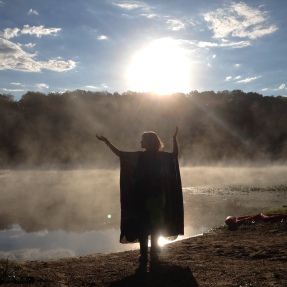
On Samhain morning, I wake early and mist is rising out of the forest and dancing through the field and out of the trees. I have a moment of sheer awe to see it…the veil was literally thin.
Over the weekend, I visit the nearby river to connect in personal ceremony in appreciation before the park closes for the year and also symbolically to those at Standing Rock. This river eventually meets the Missouri River. I run my hands through the water. I anoint my brow, neck, and hands. I whisper my prayers into the ripples. I sing: “I am water. I am water…I am flowing like the water, like the water I am flowing, like the water.”
I am hurrying outside to get some work done. I feel tight and hurried with the length of my to-do list and my superhuman plans for the day. The bright red flame of a bloom on my pineapple sage plant catches my eye and then…the perfection of a bright yellow butterfly alighting on one slender stamen. My breath catches and I stop in wonder. I smell the flower and it smells of pineapple, just as the leaves do. I can hardly believe this treasure and the tightness melts into nothing. The rest of the day is full of joy.
About twenty feet outside my house, there is a small building with a little porch and a peaked roof. Inside, there is red carpet and a purple wall, goddess tapestries draped from floor to ceiling, and goddess sculptures in abundance. In this building I write, work, create, and hold small rituals with a circle of friends. I call it my Tiny Temple and it is the proverbial, “room of one’s own” described by Virginia Woolf in 1929. Having a dedicated work and ceremony space in the midst of a home-based life, which includes a home business shared with my husband, and four homeschooled children, has changed my life profoundly. In the tiny temple, I feel most wholly myself: connected, powerful, free, authentic, and completely alive.
One morning, as I walk to the temple, this beautiful rose makes me drop to my knees with delight. Yes. This right here. This is a beautiful moment. As I kneel beside the rose, the Body Prayer song* wells out of me until I have tears in my eyes.
“We may need to be cured by flowers.
We may need to strip naked and let the petals fall on our shoulders, down our bellies, against our thighs. We may need to lie naked in fields of wildflowers. We may need to walk naked through beauty. We may need to walk naked through color. We may need to walk naked through scent. We may need to walk naked through sex and death. We may need to feel beauty on our skin. We may need to walk the pollen path, among the flowers that are everywhere.
We can still smell our grandmother’s garden. Our grandmother is still alive.”
–Sharman Apt Russell, in Sisters of the Earth
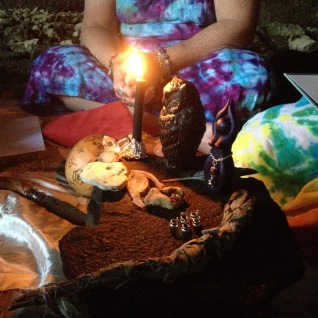
I create personal ritual almost every day in my tiny temple, sometimes simple, sometimes elaborate, sometimes tearful, sometimes joyful, sometimes hurried, sometimes leisurely, sometimes distracted, sometimes astonished at the wonder of it all. The week of my rose worship experience, I smudge the temple with sage I grew in the flowerboxes by my front porch. I ring my bell 13 times. I sing “I Am Fire.” I lay out cards and tiny goddesses and create a mandala out of fallen leaves. I leave an offering of flowers from the herbs and let rose petals drop from my fingers. Ritual captivates all the senses…in this sacred space, I invoke my own senses of smell, touch, sight, sound, and wonder and the result is magic.
“Through ceremony we learn how to give back. When we sing, we give energy through our voice; when we drum, we allow the earth’s heartbeat to join with our own; when we dance, we bring the energy of earth and sky together in our bodies and give it out; when we pray, we give energy through our hearts; when we look upon our relations, we give blessings through our eyes. When we put all these activities together, we have a ceremony, one of the most powerful forms of gift-giving we humans possess.”
–Sun Bear and Wabun Wind
May we each be healed by flowers, time to ourselves to sit on the earth and sing, and the simple, every day beauties and miracles that surround us each day.
Notes:
Several years ago I wrote a poem called Body Prayer, which is included in the Girl God’s Mother Earth book as well as in my own Earthprayer poetry collection. I was so touched when a Goddess Magic Circle sister, Angelique, shared a chant she created from the last stanza this poem. I started waking up in the mornings singing it, or sitting by flowers and singing it, and it delights me. It also brings my mind back to self-care, an ever-present issue it feels like for women. Here is a recording of my small study group singing it in the Tiny Temple.
Related past post about earth-centered spirituality: Stoneflower
Molly has been “gathering the women” to circle, sing, celebrate, and share since 2008. She plans and facilitates women’s circles, seasonal retreats and rituals, mother-daughter circles, family ceremonies, and red tent circles in rural Missouri and teaches online courses in Red Tent facilitation and Practical Priestessing. She is a priestess who holds MSW, M.Div, and D.Min degrees and finished her dissertation about contemporary priestessing in the U.S. Molly and her husband Mark co-create Story Goddesses, original goddess sculptures, ceremony kits, and jewelry at Brigid’s Grove. Molly is the author of Womanrunes, Earthprayer, and The Red Tent Resource Kit and she writes about thealogy, nature, practical priestessing, and the goddess at Brigid’s Grove.
In late August, I wrote an article about the Tjet or the Knot of Isis, also called the Blood of Isis. I thought it a good idea to come back and write about the festival, now ended. We gathered in the live oaks and ashe-juniper trees, just outside of Dripping Springs, Texas. It is private land where we could be free in our choices of clothing, or not. The Festival of the Goddess is in its 24th year and going strong. We had close to 100 women and 28 little girls. Our Goddess this year was Isis, Goddess of 10,000 names. We came with the intent to reclaim Her name from the hatred and violence perpetrated by those the media calls by Her name. Friday night, I served as co-priestess in the opening rite which amazingly elevated every woman there. We called the Quarters, invoked the Elements and tied the Knot of Isis, with nine-foot-long, red sashes, on to bamboo poles cut with a cross bar, made to resemble ankhs. Each woman invoked her Element and the Power and Magic of Isis to guard and protect the space where we were gathered. We then called to Isis to join us. With doumbeks playing, Isis – yes, a real live Isis – walked into our Circle. She had two escorts who assisted Her up onto a platform where She spoke to everyone present.
She was dressed, as you can imagine, in Egyptian robes with Her regal crown of horns and sun. On Her arms were Her beautiful wings. They were made by sewing men’s ties together with the small ends flapping in the breeze at the back. They stretched from Her shoulders to Her finger tips. Every woman and maiden there was able to come forward to receive a blessing from Isis. Many were enfolded in Her wings. Our Isis was a beautiful African American woman with long black hair, braided in knots. She completely embodied the spirit of Isis. This was her first time to ever come to a Goddess festival and I am sure when she agreed to her role in the ritual she thought it was going to be like a theatrical performance but she truly aspected Isis. It was amazing. I talked to her later and she told me that she never anticipated the intense emotional experience she had.
Once the blessings were completed, the women at the Quarters brought their Tjet-tied, bamboo poles to the center where a large piece of fabric was tied at the corner of each pole and then lifted to be carried over Isis as they processed up the hill to the Temple where She then moved to sit on Her throne.
We placed a basin of water at Her feet in which were the Waters of the World and asked for the blessings of Isis to purify and bless all of our waters, so polluted by mankind and to help all become more mindful of how important it is for our waters to be clean. From there we installed the four poles, knotted with the Blood of Isis, to stand guard at the Temple.
Everyone went from there to the large fire circle for drumming and merriment. (I went to bed.) Later, in the dark of night when no one was in the Temple, a life sized Isis was placed on the Throne. She was made with a wire frame, stuffed and dressed. Her Styrofoam head was painted to have dark skin and her hair and headdress were identical to those of our “live” Isis. She was amazing!
The next day I offered a Croning Rite, to mark that Passage for eight women, ready to be known as Crones. I was assisted in the ritual by the women who were serving as Crone Guardians for the weekend. I took them on a spiral of their lives from Girlhood, to Maiden, to Mother and to Crone. We all cried together with all the memories shared! That afternoon I did two workshops, back-to-back. The first was Yoni Printing and the other, to share what the Tjet means, as well as to teach women how to tie it. There were many other workshops – Intuitive Tarot – Breast Casting – Sacred Dance – Tara Dancing, to name just a few.
Once my part of the day was completed, I sat with good friends in the Crone Camp to enjoy the beautiful land, the shade and cool breeze – and to rest. My old bones were tired!
Saturday night was the big talent show. This festival started out 24 years ago for women to come together and share their talents – artistic (as vendors) singers, dancers and musicians – to perform for their Sisters in a safe and beautiful environment. When we first started this it was held on a piece of property owned by Genevieve Vaughn who gifted the use of the land to us. It was an incredible space that even had indoor accommodation for women who needed beds. All of the performances Saturday night were wonderful. I will have to say that I enjoyed what the maidens offered the best of all. Such amazing talent – and those little girls up on the stage – fearless!
Sunday, I once more served as co-priestess to offer a closing ritual in which we honored all Women’s Blood Mysteries by asking Maidens who started their moon cycles this past year to come forward for a blessing. Then all who had carried a child in the past year and finally all who had stopped bleeding.
We offered our gratitude to all who had organized and made this festival such a success. It certainly does take a village! One of the women on the Planning Circle made a small ceramic Knot of Isis made into a necklace with cording, for every woman who came to the festival.
My own part, in addition to what I did on-site, was to take all incoming email messages with questions and respond with answers. I organized the first Crone Camp ever. We offered a tent already in place as well as cots to sleep on. It was the first time since we moved from Stonehaven that beds were offered. Our Crone Guardians helped by erecting and taking down our large tent. They were also there to help when needed. I also got to be the one who took care of all the women seeking scholarships. I told everyone that I definitely had the best job in the Planning Circle as I got to speak to so many marvelous women! I came home with new friends and a happy glow from being surrounded by so much love.
Deanne Quarrie. D. Min. is a Priestess of the Goddess. She is the author of five books. She is the founder of the Apple Branch where she teaches courses in Feminist Dianic Witchcraft, Northern European Witchcraft and Druidism. She mentors those who wish to serve others in their communities. She is also an Adjunct Professor at Ocean Seminary College and is the founder of Global Goddess, a worldwide organization open to all women who honor some form of the divine feminine.
Recently I have come across several stories of women’s fringe spiritual movements or practices. This made me think about the role of outsiders’ or minority views in religions and society.
Patriarchy pushes women and their issues to the margins of society and religion. It seems that there women sometimes invent their own spiritual practices. These allow women to stand their own ground in religious matters, to preserve self-respect and to keep the hope of the highest spiritual attainment.
Quite often these beliefs and practices seem shocking in their bizarreness and their stubbornness not to accept orthodox norms.
This is a continuation of Molly’s piece from Wednesday, 10 August 2016. You can read Part 1 here.
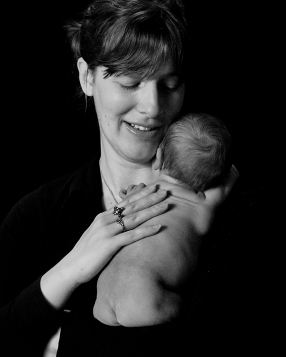
After explaining that the homebirth of her second son was her, “first initiation into the Goddess…even though at that time I didn’t consciously know of Her,” Monica Sjoo writing in an anthology of priestess essays called Voices of the Goddess, explains:
The Birthing Woman is the original shaman. She brings the ancestral spirit being into this realm while risking her life doing so. No wonder that the most ancient temples were the sacred birth places and that the priestesses of the Mother were also midwives, healers, astrologers and guides to the souls of the dying. Women bridge the borderline realms between life and death and in the past have therefore always been the oracles, sibyls, mediums and wise women…
…the power of original creation thinking is connected to the power of mothering. Motherhood is ritually powerful and of great spiritual and occult competence because bearing, like bleeding, is a transformative magical act. It is the power of ritual magic, the power of thought or mind, that gives rise to biological organisms as well as to social organizations, cultures and transformations of all kinds… (page unknown).
I have been a childbirth educator since 2006 and I have given birth five times. Each birth brought me the gift of a profound sense of my own inherent worth and value. It was the shamanic journey through the death-birth of my tiny third child, however, that ushered in a new sense of my own spirituality and that involved a profound almost near-death experience for me. After passing through this intense, initiatory crisis, the direction and focus of my life and work changed and deepened. Shortly after the death-birth of my third son, I wrote: Continue reading “Priestess as Shamanic Path – Part 2 by Molly Remer”
It is late autumn, 2009. I am 30 years old and pregnant with my third baby. He dies during the early part of my second trimester and I give birth to him in my bathroom, on my own with only my husband as witness. The blood comes, welling up over my fingers and spilling from my body in clots the size of grapefruits. I feel myself losing consciousness and am unable to distinguish whether I am fainting or dying. As my mom drives me to the emergency room, I lie on the back seat, humming: “Woman am I. spirit am I. I am the infinite within my soul. I have no beginning and I have no end. All this I am,” so that my husband and mother will know I am still alive.
I do not die.
This crisis in my life and the complicated and dark walk through grief is a spiritual catalyst for me. A turning point in my understanding of myself, my purpose, my identity, and my spirituality.
It is my 31st birthday. May 3rd. My baby’s due date. I go to the labyrinth in my front yard alone and walk through my labor with him, remembering, releasing, letting go of the stored up body memory of his pregnancy. I am not pregnant with him anymore. I have given birth. This pregnancy is over. I walk the labyrinth singing and when I emerge, I make a formal pledge, a dedication of service and commitment to the Goddess. I do not yet identify myself verbally as a priestess, but this is where the vow of my heart begins.
I do not know at the time, but less than two weeks later, I discover I am in fact pregnant with my daughter, my precious treasure of a rainbow baby girl who is born into my own hands on my living room floor the next winter. As I greet her, I cry, “you’re alive! You’re alive! There’s nothing wrong with me!” and feel a wild, sweet relief and painful joy like I have never experienced before.


 I have recently watched one of these real life entertainment documentaries. This one was on plastic surgery. A woman went under the knife to enlarge her breasts. The female presenter, wearing sterile white, peeped into the operation theatre and, facing the camera, said excitedly: “This operation might be life-changing!”
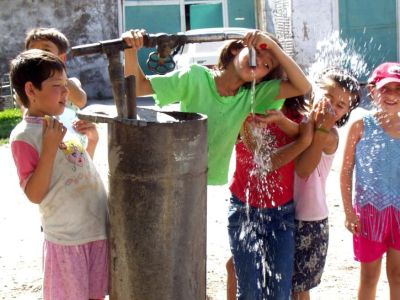 I thought: “Yes, precisely.” The money that the patient spent on breast implants could have bought – what? A trip to a strange land. A course for her to improve her employment prospects or to broaden her horizons. Art supplies for her to create something. A water pump to provide clean water in a village somewhere in the world where children die from preventable diseases caused by dirty water. Part of a salary for a teacher who works in a school for girls somewhere in the world where girls need extra help getting education.
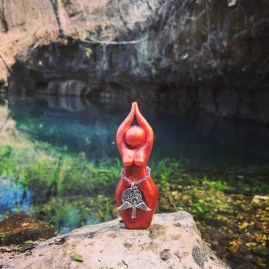 live (they live one mile further away than that). In addition to woodland and meadow, this land has two springs, three creeks, a cave, and ¼ mile of river access. While I have been deeply connected to the land of my birth, the Missouri Ozarks, for a long time, and have written about that connection in multiple
 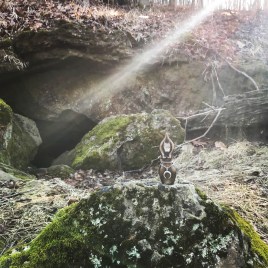 spy the opening to the cave nestled behind several mossy stones. The sun is still on the rise above the tree line and the rays filter through the trees so one ray is pointing directly at the cave entrance. We crawl inside, bumping our heads and scraping our backs as we wiggle into this womb in the earth. Once inside, the chamber enlarges so we can stand up. Unlike other caves we have experienced in this area, the only human signs we find are a single bottle cap, a glass bottle, and two sets of initials carved into a rock. In the dark silence we hear the sound of water dripping steadily. I make my way further into the cave, acutely aware that this is living cave and being careful not to step on the fresh, wet, cervix-shaped beginnings of new stalagmites on the floor. At the back of the cave, I find her. A Madonna-like stone column, glistening with water. In the silence of the cave, I quietly sing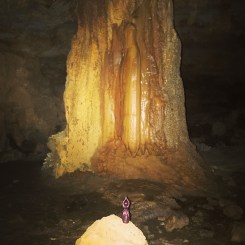
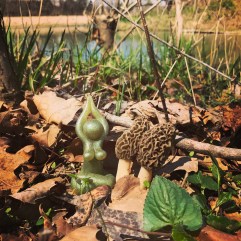 about two weeks in Missouri each spring and considered a delicacy by many). The afternoon suddenly becomes even more rewarding and we stoop and peer through fallen oak, sycamore, and elm leaves looking for the telltale conical form of these forest treats. We quickly discover that we must tune in and “listen” for the mushrooms, so to speak, or we’ll walk right by them, none the wiser. The moment I start thinking about anything else, I stop finding any. Once I settle into my body and the moment and really look at the world again, there another morel will be.
 Molly has been “gathering the women” to circle, sing, celebrate, and share since 2008. She plans and facilitates women’s circles, seasonal retreats and rituals, mother-daughter circles, family ceremonies, and red tent circles in rural Missouri and teaches online courses in
  This saying is one of those that sound a bit curious to a Western ear. It is almost as if the Buddha was against fun or humour. However, we all are familiar with the Buddha’s depictions where he smiles. The canonical texts also bear witness to the Buddha’s smiling.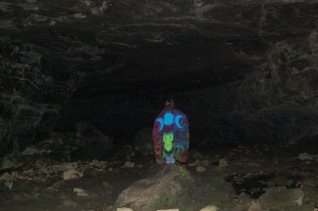
 using handspun wool yarn until the yarn releases, taking our burdens with them. Suddenly, we hear the sound of tires on the gravel. Slamming doors. The sound of loud men’s voices. The smell of cigarette smoke. A ripple of uncertainty passes through us. We are once again tentative and we feel a current of unease. What should we do? we whisper to one another. The voices draw nearer, there are calls and hoots. My friend looks at me and says: this is where we make our stand. We hold hands in a line at the edge of the cave roof, gazing out into the horizon. A hawk wheels overhead. We sing. The approaching voices quiet. We sing louder.
 carvings of priestesses carrying drums as, “women carrying cakes to their husbands.”
 within which women try out what they want the macrocosm, the ‘big universe’ or real world to be. Within the safety and protected space of the cast circle, women create their idea of what the world would be like to live in under matriarchal/Goddess women’s values…The woman who in the safety of the cast circle designs the world as she would like it to be takes that memory of creation and success out into daily life…By empowering women through the microcosm of the ritual’s cast circle, change becomes possible in the macrocosm real world.” (p. 2-3)
 Molly has been “gathering the women” to circle, sing, celebrate, and share since 2008. She plans and facilitates
 living with your feelings, touching the earth, and embracing the fullness of your humanity.”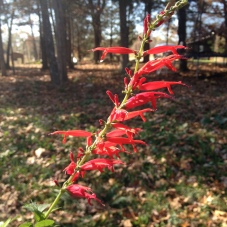
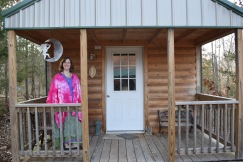 In this building I write, work, create, and hold small rituals with a circle of friends. I call it my Tiny Temple and it is the proverbial, “room of one’s own” described by Virginia Woolf in 1929. Having a dedicated work and ceremony space in the midst of a home-based life, which includes a home business shared with my husband, and four homeschooled children, has changed my life profoundly. In the tiny temple, I feel most wholly myself: connected, powerful, free, authentic, and completely alive.
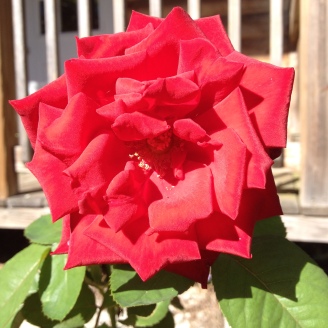 “We may need to be cured by flowers.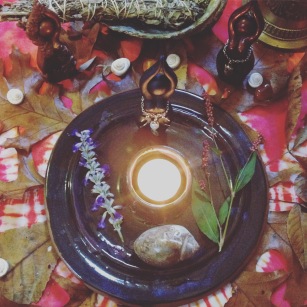
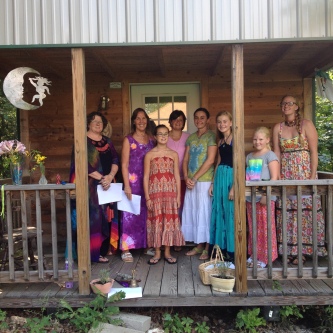
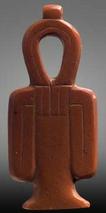 Friday night, I served as co-priestess in the opening rite which amazingly elevated every woman there. We called the Quarters, invoked the Elements and tied the Knot of Isis, with nine-foot-long, red sashes, on to bamboo poles cut with a cross bar, made to resemble ankhs. Each woman invoked her Element and the Power and Magic of Isis to guard and protect the space where we were gathered. We then called to Isis to join us. With doumbeks playing, Isis – yes, a real live Isis – walked into our Circle. She had two escorts who assisted Her up onto a platform where She spoke to everyone present.
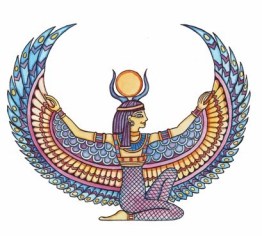 She was dressed, as you can imagine, in Egyptian robes with Her regal crown of horns and sun. On Her arms were Her beautiful wings. They were made by sewing men’s ties together with the small ends flapping in the breeze at the back. They stretched from Her shoulders to Her finger tips. Every woman and maiden there was able to come forward to receive a blessing from Isis. Many were enfolded in Her wings. Our Isis was a beautiful African American woman with long black hair, braided in knots. She completely embodied the spirit of Isis. This was her first time to ever come to a Goddess festival and I am sure when she agreed to her role in the ritual she thought it was going to be like a theatrical performance but she truly aspected Isis. It was amazing. I talked to her later and she told me that she never anticipated the intense emotional experience she had.
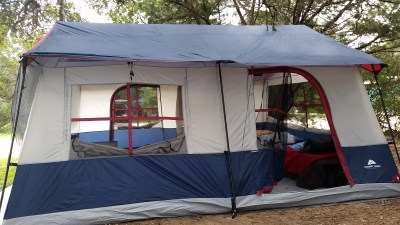 My own part, in addition to what I did on-site, was to take all incoming email messages with questions and respond with answers. I organized the first Crone Camp ever. We offered a tent already in place as well as cots to sleep on. It was the first time since we moved from Stonehaven that beds were offered. Our Crone Guardians helped by erecting and taking down our large tent. They were also there to help when needed. I also got to be the one who took care of all the women seeking scholarships. I told everyone that I definitely had the best job in the Planning Circle as I got to speak to so many marvelous women! I came home with new friends and a happy glow from being surrounded by so much love.
 Goddess, explains:
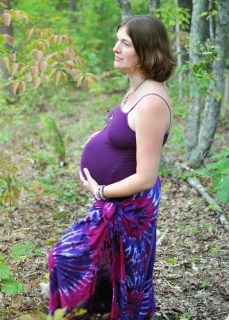 part of my second trimester and I give birth to him in my bathroom, on my own with only my husband as witness. The blood comes, welling up over my fingers and spilling from my body in clots the size of grapefruits. I feel myself losing consciousness and am unable to distinguish whether I am fainting or dying. As my mom drives me to the emergency room, I lie on the back seat, humming: “Woman am I. spirit am I. I am the infinite within my soul. I have no beginning and I have no end. All this I am,” so that my husband and mother will know I am still alive.
 Feminism and Religion