Hawaiian Adventure Shamanism by Janet Maika’i Rudolph

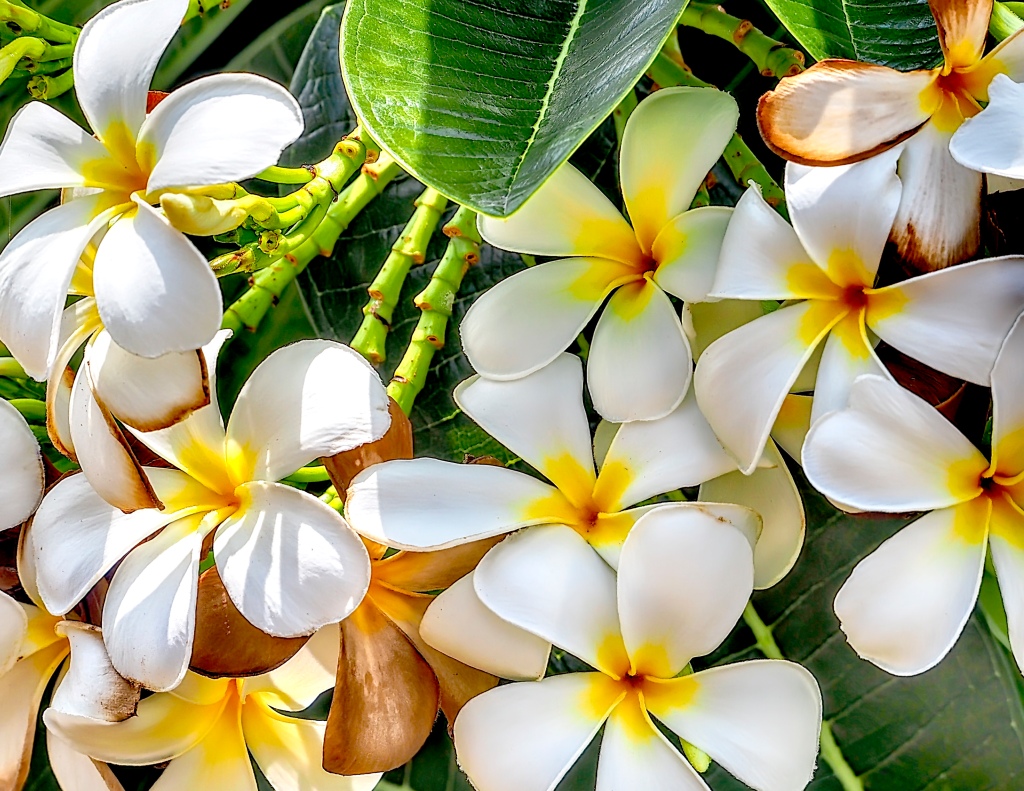
Plumeria, one of the fragrant flowers often used in leis.

While my experience of Hawaiian spirituality isn’t explicitly feminist, I am attracted to it because of its loving and gentle nature. It doesn’t feed the patriarchy. It is a philosophy that doesn’t use dogma but rather principles. It doesn’t work as a top-down power system but rather as an internal power extending to the external world. This is reflected in one of our principles: “all power comes from within.”

I was ordained as an alaka’i (spiritual guide) in October 2016 by Serge Kahili King the founder of Aloha International. He teaches Hawaiian Adventure Shamanism or Huna for short. Huna means secret. It isn’t a secret in the sense of something that can’t be shared but rather something that is esoteric or hard to see. You can think of it like the mists of the sea, hard to distinguish and even harder to hold on to. But all real nevertheless.

Continue reading “Hawaiian Adventure Shamanism by Janet Maika’i Rudolph”

Is Sin An Antiquated Concept? by Rev. Dr. Karen Tate

I believe many could and would characterize abuse and exploitation as varying degrees of sin, from gossip and verbal intimidation on one end of the spectrum to murder, rape or thievery on the other. Yet, while we’ve normalized some acts that we recognize fall into the categories of abuse and exploitation, if you asked someone if society has normalized sin, I suspect most people would say “of course not.” I believe that cognitive disconnect is proof we’ve become numb and acculturated to many forms of abuse. The concept of sin, and what constitutes sin along with redemption, purification and penance are not on the minds of people today as they once were, despite the rampant abuse and exploitation, aka sin. We accept it like we’ve come to believe greed is good when it once was one of the Seven Deadly Sins. I think prosperity gospels too need to be evaluated for the anti-Jesus message these teachings perpetuate that does little to advance an evolved and compassionate humanity. 

Continue reading “Is Sin An Antiquated Concept? by Rev. Dr. Karen Tate”

Crawl Across the Sacred Circle and Take My Hand by Caryn MacGrandle

On Winter Solstice, I hosted a Return of the Sun event at the local healing arts center where I do my Circles. We had offerings and presentations all night long. It was the first time I have ever done anything that large or public, so it was a stretch for me.

At the end of the night, a friend said, ‘Oh my, I needed this. Let’s do it once a month.’

And I thought, ‘yea, right.’

And then I thought, ‘Yea. Right.’

I’ve already started thinking about ways we could do it better and things we could change.

I feel a bit like when I first started hosting Circles nine years ago. I’m tired and judging whether or not it was worth the stress and effort.

But this time around I know it’s worth the stress and effort.

Continue reading “Crawl Across the Sacred Circle and Take My Hand by Caryn MacGrandle”

Return to the Grandmothers and 2 Other Poems by Annelinde Metzner

 This past summer, my family and I lovingly carried my brother’s ashes to a favorite spot of his, in the woods at our grandparents’ Catskill farm.  My mind was on the simple, beautiful ritual, each of us stating memories and scattering some of the ashes around the tree, and singing a few songs. It had slipped my mind that this tree grew at the entrance of the very meadow where, at age 11, I felt urgently compelled to create a ritual for myself, just at puberty, where I connected with the Grandmothers of the four directions. No one had taught me this, and I am still in wonder at what we carry with us, undoubtedly from prior lives. I feel that this poem was my self initiating myself into the world of the Goddess, and preparing for my own future.

In this poem, the Grandmothers are speaking to me, with a bit of disdain and fond teasing.

Continue reading “Return to the Grandmothers and 2 Other Poems by Annelinde Metzner”

“Our Lady of the Shards”: Icons for the Buried and Rising by Lauren Raine MFA

Our Lady of the Midwives (2019)

When I became a feminist, I realized that somebody had to write all about this women’s art that was out there being totally ignored, and it was going to be me. And of course the ideas and the discoveries about what women’s art was……. I look at it for the information it gives me about women’s imagery, women’s psyches, women’s lives, and women’s experience.” 

 Lucy Lippard in Talking about Art Since 1976

I have been making art, masks, and theatre about “surfacing” for a very long time. As a child I was always digging at the roots of trees, fascinated by their interwoven strength, wondering how far down they went. That fascination never really left me. Sometimes it occurs to me that I and most of my colleagues are “spiritual archeologists”, sorting through artifacts and the mythic overlay of the past to re-discover and re-vitalize the present. I joined many of those colleagues for over 20 years:  un-earthing, re-inventing, and animating stories of the Great Goddess throughout world culture with the Masks of the Goddess Project (1999-2019), among other collaborations.  I am not religious, so much as I am a mythologist, following archetypal trails of myth back and back, seeking the sacred source they often reveal.

Continue reading ““Our Lady of the Shards”: Icons for the Buried and Rising by Lauren Raine MFA”

Deconstructing and Reconstructing Love by Chasity Jones

Note: This is based on a podcast which can be heard here.

“Black love exists and Black women deserve love that does not require pain.”

What is love? What’s love got to do with pain and suffering? Are they related? Pain and love? Must one always be present with the other? In this blogpost I explore pain and suffering through a womanist perspective (centering the perspectives and lived experiences of Black women) and discuss how to live into wholeness and wellness. This is especially important because the Black community/women in particular’s experience in the US (and globally) has been and continues to be defined by pain and suffering. What are the theological implications?

How have Christian frameworks at associating love with sacrifice and pain justified the pain and suffering of Black women? How can we decolonize love so that liberated Black women are empowered to embrace a love that does not hurt first with false promises of rewards later in life or afterlife? Black women, pain does not equal love.

Continue reading “Deconstructing and Reconstructing Love by Chasity Jones”

We Endure Abuse to Survive, Part 2 by Karen Tate

Part 1 was posted on December 18. You can read it here.

But what was the straw that broke the camel’s back in my case? What hurled me into that dark abyss I described earlier? The paranoia, the anxiety, the nightmares and sleeplessness. Not opening my closet in three years or not caring about much of anything. The fear of being alone in a place or in a crowd of strangers.  Fear of going to unfamiliar places. Of driving myself across town. Did it start with the collective trauma and abuse mentioned earlier? I can’t be sure, but therapy definitely points to my attack by an inebriated young woman wielding a stun gun. She looked to be college age. One would never have guessed her capable of such a senseless assault. I told few people about it but it was years before I realized how that event stifled my voice. Yet “they” – the authorities in society – say if we don’t talk about assault right away it must not be true. Or we’ve waited too long to talk. They want us to talk on their timetable about damage done to us when there might not be visible wounds or we even understand the psychological scars that might not have surfaced yet. It was a few years after the attack that I finally sought the help of a therapist and was diagnosed with the PTSD or post traumatic stress disorder that changed my life. 


Continue reading “We Endure Abuse to Survive, Part 2 by Karen Tate”

We Endure Abuse to Survive, Part 1 by Karen Tate

I considered myself savvy and educated and an advocate for peace, fairness and equality.  I thought abuse was something that happened to others, not me.  But it was happening to me.  It had happened to me and I didn’t see the danger signs as my life careened off the road.  I became aware abuse and the resulting trauma can happen to anyone.  I came to realize we have to examine all aspects of our lives for both blatant and insidious abuse.  We must recognize it and take steps to eradicate abuse from our lives and society.  That’s where I’ve been on for the last five years and I’m only now able to begin to share that journey.  To write a new book, Normalizing Abuse, and bring my radio show, Voices of the Sacred Feminine, back on the air after a long hiatus.

Part One

If you knew me before my unraveling, you might remember I was the hostess of the Voices of the Sacred Feminine podcast for more than a decade where I had the privilege of interviewing some of the most prominent thought leaders in spirituality, politics and academia. I’d published six books, gave talks at the Parliament of World Religions, the Academy of Religion and various other public and private associations. I had done dozens of interviews and was all over YouTube. I was out there and then gradually I wasn’t. I faded away and became a shadow of my former self.  And for a time I don’t think I cared if I ever came back. I had no motivation or inspiration.  I didn’t open my closet for three years. I didn’t care if I bathed or brushed my teeth. I was dreaming someone was trying to push me into a dark hole in the wall of a building. I’d hear floorboards creaking and feared the foundation of the house I was living in would collapse. I’d wake up with heart palpitations because the latest dream was one where our home had no ceiling or roof. I’d think cars slowly driving by my house were surveillance. 

Continue reading “We Endure Abuse to Survive, Part 1 by Karen Tate”

Carol P. Christ: Weaver of Visions by Beth Bartlett

Author’s Note: Today’s post is the 4000th FAR blog post!  I first became aware of the Feminism and Religion blog when participating in a symposium honoring the life and work of Carol P. Christ in October 2021. I was inspired to write a piece on Christ’s contribution to ecofeminism, that was posted in the FAR blog a year ago today. I wanted to post another piece on Christ on the anniversary of that first post. I’m delighted that it is the 4000th, and so fitting that it is written in honor of Carol Christ, who was such an important part of the FAR blog.

A while ago, a friend asked me what spiritual reading I’d been doing lately. I told him that I’d been revisiting classics from the past. When he asked me who specifically, the first name I mentioned was Carol Christ. Even though he was a minister, he had never heard of her. Sadly, I suspect the same would be true for the vast majority of ministers, priests, rabbis, theologians, and other religious leaders. Yet, I can think of no one who has had a greater influence on my religious and spiritual thought and beliefs.

Continue reading “Carol P. Christ: Weaver of Visions by Beth Bartlett”

Willful Women, Feminist Killjoys, and Jesus: Reflections on Sara Ahmed’s Living a Feminist Life by Liz Cooledge Jenkins

I’ve been thinking about willful women and feminist killjoys—two main guiding images in feminist scholar Sara Ahmed’s book Living a Feminist Life (Duke University Press 2017).

The idea of the willful woman (or willful girl, or willful person) is something I can easily get behind. The way I understand it, it has to do with women getting in touch with our own wills and being willing to speak and act and live out of our wills. Particularly if these wills turn out to exist in opposition to the things other people might will for us.

It’s about learning to stand up for ourselves, learning to affirm our full humanity in a world that often expects…less. It’s a way of consciously, intentionally being willing to be called “willful” as a negative thing—as in, stubborn, selfish, antagonistic, difficult—because the affirmation of our own wills is worth it.

I like all of this and find it helpful. Be willful. Expect pushback and penalties for it. Be willful anyway.

Continue reading “Willful Women, Feminist Killjoys, and Jesus: Reflections on Sara Ahmed’s Living a Feminist Life by Liz Cooledge Jenkins”