Thrice-Born Athena, Pt. 3 by Barbara Ardinger

Note: If you’ve been reading Athena’s story for the past two days (link to Part 2 here), you know what’s happened to her before her third birth. You’ve read her version as I heard it in my mind and wrote it down. Part 3, here, is mostly speculative, based on hints in books I’ve read during the past twenty-plus years. If you’ve read The Greek Myths by Robert Graves (who is said to be The Authority), you’ve met Medea in the context of the yarn about the Golden Fleece, but I’m leaving Jason out of this story. I’m also leaving Theseus (also associated with Medea) out. These boys have no role in Athena’s story of her meeting and her shamanic rebirth at the hands of the great Medea, who is sometimes called a sorceress. Read on.

Athena

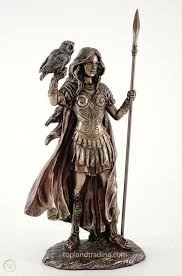
And so with the help of the great Hera, who remembered how I had once loved her (and she still loved me), I left Zeus’ stony kingdom. Hera helped me depart, though I soon forgot her help. I suppose she is still there. After all, her own lands had been taken long before, her own throne stolen long ago, her temples and altars supplanted. I suppose she has nowhere to go now. For all I know, great Hera remains at the declining god-king’s side, where poets still deprecate her and laugh at her and call her a nagging wife. A god-king as impotent as he is now needs such a strong wife, does he not? I regret that I no longer know her.

But I could find no other kingdom that would give me charity or honor, found no other king or god who would wed me or let me speak for him, and so I become disillusioned with kings and gods and epic tales. I put down my spear and shield and abandoned my armor and helmet, though I always kept my owl (who often flew above me) and my ragged plume.

And so, twice homeless, twice born and twice dead, friendless and scorned by the men I had so harshly judged, I wandered through the world, and all anyone saw was a woman, a gray, anonymous woman carrying a stick and a drooping feather. I walked up and down in the world and had no home. I had neither friends nor sisters nor protégées to honor me, neither priestesses nor queens to love me. I had no one at all. I had nothing at all. I wandered alone through all the lands around the wine-dark sea, alone in the lands around the central sea, alone in the lands along the ocean sea and the northern sea. For uncounted years I wandered alone, stopping here and there, but never staying anywhere, searching for what I never found and no longer remembered. I went in a plain gray cloak with my stick in my hand, my sad plume in a pouch at my belt. Sometimes I ate, but more often I went hungry. Up and down upon the earth I walked, and so my pride and anger began to be worn away.

Continue reading “Thrice-Born Athena, Pt. 3 by Barbara Ardinger”

Thrice-Born Athena: A Secret History (Part 1) by Barbara Ardinger


Note: Inspired by Mary Sharratt’s excellent post on February 13 about the heroine’s journey and by Elizabeth Cunningham’s beautiful novel
The Wild Mother (who is Lilith), I took a dive into my archives and found this story about Athena, which I first wrote back in the late 1980s. That was about the time the Goddess rapped me on the head, so to speak, and said, “Pay attention.” The story is based on research I did at the time. I’ve now done some rewriting for FAR. Read on and hear the voice of Athena not as a player in the usual Greek myths but as a goddess of wisdom who is one-unto-herself.

  Athena

My first birth was in the dark continent to the south of the Black Sea, always described by Homer (who invented much of what you take as true in his two long stories) as the wine-dark sea. That is, I was born in what is now Libya in northern Africa. I was born in a many-chambered palace beside a clear lake and received into the world by a tribe of strong women. I was the first-born child of Metis the Wise. You may have read that Metis was the daughter of Oceanus and a Titaness of great cunning; that’s what the “traditional wisdom” says about her. Not true. Metis was one-unto-herself, the queen of a great tribe, holder of the sacred serpents, and painter of wild scenes on tall red cliffs that exist into your day. I was the daughter of daughters from the beginning of the earth, whom some have called Amazons. I knew nothing of that name, however, for I was simply a much beloved child of a thousand thousand foremothers and a hundred living mothers.

Continue reading “Thrice-Born Athena: A Secret History (Part 1) by Barbara Ardinger”

Feminist Holy Week Vaginal Christology Daily Devotional — Part 2 by Trelawney Grenfell-Muir

See here to read Part I of the Devotional.

Friday:

Thought for the day:

The Roman authorities executed Jesus for sedition because he posed a threat to their hegemony: their wealth and their oppressive, imperial domination system of exploiting others for profit. Jesus spoke out against their injustice, and his message resonated with the 99%. People were beginning to listen; momentum was growing. So the Empire snuffed out that “Rebel Scum” in their most excruciating, punishing, degrading form of execution. According to the logic of imperial domination, Jesus’ death should have been a humiliating, final defeat.

Instead, his movement lived on and on, grew and grew. The symbol of Imperial execution — the cross — should have symbolized the wrongness, the lack of Divine sanction, the complete Divine rejection of Jesus’ ideas, according to Empire. Instead, the Jesus Movement reclaimed the cross from an Imperial symbol of shame and turned it into a symbol of victory. Paul, the feminist liberationist prophet most responsible for the survival and spread of the Jesus Movement, repeatedly wrote that the Jesus Movement follows Christ Crucified. Paul’s message seemed scandalous and confusing— lifting up a symbol of horror, death, and defeat as proof of victory? Why? How?

Continue reading “Feminist Holy Week Vaginal Christology Daily Devotional — Part 2 by Trelawney Grenfell-Muir”

An Untitled Poem for Unanswerable Questions by Eva Espinoza

Thinking about the discourse between spiritualists and victims of harm
Thinking about accountability and prison abolition
Thinking about how white supremacy tells us people are disposable
That they–that we, don’t matter
Thinking about “don’t speak ill of the dead”
Thinking about “honor your ancestors”
Thinking about what else is possible beyond prisons, cages, and borders
Thinking about abusers who refuse to take accountability
Thinking about where that leaves us when we die
Throat’s closed
Stories Untold
Thinking about how death is possible for the living
Thinking about how redemption is possible for the dead
Thinking about, what the fuck even is Salvation, anyway?
Thinking about binaries and how exhausting it is to think of these two things as mutually exclusive to each other
Thinking about how many of us are dissociating because cognitive dissonance is hell on earth
Thinking about the waging of war and how it lives in the body
Thinking about how rage turned inwards is depression
Thinking about the will to live and the will to die
Thinking about the sleep of death and the dreams that come from dying
Thinking about regret
Thinking about when an abuser becomes an ancestor
Thinking about where the guilt goes in the afterlife
Thinking about hell
Thinking about eternal suffering
Thinking about conversations of the reconciliation that is possible between an abusive ancestor and those they’ve abused
Thinking about who the hell said this shit was tied to the land of the living

This poem is a birthing after months of sitting in grief circles and bible studies and with the ancestors.This poem is short but holds so many wrestlings. It holds the wrestling between me and my daddy, now an ancestor, who I could never come out to while he walked this earth. It holds the waiting for my biological father’s passing to reconcile the ways in which he harmed me and my mother and my sister, the ways in which he abandoned and neglected us. It holds the wrestlings of iconizing Kobe Bryant after his death while also naming and recognizing him as the sexual predator he was. It holds the wrestlings of what happens in the afterlife, blending theologies of indigeneity and christianity.

Continue reading “An Untitled Poem for Unanswerable Questions by Eva Espinoza”

Toadwise: A Tale for a Life Lover – Part II by Sara Wright

Read Part I here

In the Americas I found more recent Indigenous mythology on the Toad as Goddess. Tlaltecuhtli is a Pre–Columbian (1200–1519) goddess belonging to the Mexica. Although Tlaltecuhtli’s name is masculine modern scholars interpret this toad figure as female because she is squatting giving birth. Some see her as crouching under the earth, mouth open waiting to devour the dead. Since the Aztec culture was a warring male dominated Patriarchal one I think it’s perfectly reasonable to assume that the Earth Goddess/Toad was seen as masculine to the Mexica.

In Mesoamerica we find Toad widely represented in art, often with feline or other non-naturalistic attributes, including jaguar claws and fangs. These images can be regarded as versions of Tlaltecuhtli. In contemporary Mexico, as in Guatemala, and throughout South America toads play a role in myth, sorcery, shamanism, and in curing/healing. Continue reading “Toadwise: A Tale for a Life Lover – Part II by Sara Wright”

Toadwise: A Tale for a Life Lover – Part I by Sara Wright


Last night I was thinking about the giant western toad that is living in my garden when I had a peculiar thought: Write a story about the Toad and an Old Woman and call it A Tale for a Life Lover. At this very moment I heard my toad’s rasping guttural cry outside my window. I was so shocked I got up and went out on the porch, hoping to hear the call again, but the toad only spoke once. Afterwards, I wondered if I had imagined it.

When the giant western toad appeared in my yard last week I had been in a state bordering on despair over baffling health issues and the ravages of Climate Change. Maybe it is no longer possible for me to separate the two? After the visitation I sensed that the toad’s abrupt appearance meant something beyond the amazing fact that I had met a giant toad who apparently had been living here all along. Continue reading “Toadwise: A Tale for a Life Lover – Part I by Sara Wright”

Breathe with me by Trelawney Grenfell-Muir


Breathe with me.

I know. I know. I understand.
Breathe with me anyway.
It hurts. It’s scary. It’s horrible. It’s relentless. I know.
Just breathe.
Every time we breathe out, our bodies release things we do not want.
So breathe it out. All of it. Let it go.
Deep breath. However you prefer—mouth, nose—just breathe.
What do you need to let go?

For me right now, there’s rage.
All the people refusing the masks, refusing the vaccine, even friends of mine who have watched me suffer with post-COVID syndrome for almost a year, still blaming me somehow for my illness.
Breathe. Let it out. Don’t have to carry it anymore.
There’s fear, too — friends, family, fighting COVID, or taking dangerous, unnecessary risks.
Long, slow breaths. Release. Into the loving matrix of Creation-Life-Love. I can’t hold this anymore. I release it.

There’s grief. Loss. Suffering. Isolation. Pain. Oh, breathe, let the tears flow, let the breaths and the tears just be what they are.
Stress. So much stress. We’re all frayed, so far beyond our limits. Breathe it out. Breathe it out again. Deep breaths – make noise if you want. Moan.
She cradles us in breath, the Divine Womb. She is the Source of our breath, and She is always cradling us, always breathing with us.
Breathe again. Close your eyes. Let your Holy Spirit bathe you in its healing power.
But it doesn’t fix anything, doesn’t DO anything!
I know. But it is enough. Just let it be. Be breath breathing itself.
What if you deserve to let go?
What if you deserve to be cradled in healing Love?
What if you deserve just to be?

Breathe. It sometimes feels so nice. Breath in, breath out.
Your body is letting go of anything you do not want.
You can release it now. Breathe it out. It’s ok.
Anywhere you want to feel your breath is ok. Wherever you want it to go, just breathe it there, and then release.
There’s no way to do this wrong. It’s your breath. It’s your breathing. A gift your body has, a magical, powerful, simple, holy gift. Breathe however feels good and right to you.
No rush. Take your time. As long as you want. As often as you want.
What if you deserve compassion?
What if you deserve to be bathed in healing Love?
What if you deserve to rest in your breath?
Breathe, darling. Close your eyes if you like. With every breath, you are holy.

In my Methodist tradition, which focuses heavily on the Holy Spirit, we sing a breathing hymn I love. Here is my rewritten version:

Breathe on me, Breath of Love,
fill me with Life anew,
restore my soul with ev’ry breath,
to do what Love wouldst do.

Breathe on me, Breath of Love,
so shall I rest, secure,
cradled in Love’s bright healing peace,
and held in compassion pure.

Breathe on me, Breath of Love,
till I am wholly thine,
till body, spirit, all of me,
glows with thy Fire divine.

Breathe on me, Breath of Love,
until my heart is free,
and I perceive my ev’ry breath
is thine Eternity.

—Edwin Hatch (1878), revised.

Our world is so frayed right now. We are all at the end of our rope. We feel the same way most new mothers feel in capitalist patriarchies, in which motherhood means financial strain (or poverty), isolation, anxiety, constant demands, an inability to meet basic physical and mental health needs, and no escape from continuous, relentless emotional and physical labor. Women are expected to embrace this level of self-sacrificial stress in motherhood, as part of our female slave role in capitalist patriarchy, which defines our unpaid, unvalued labor as a natural extension of our biological sex. The burden on women is higher than ever these days, with women and even girls taking the lion’s share of extra household duties so that boys and men can continue in their education and careers. Women are suffering 100% of job losses as well.

In times like these, I keep turning to my faith for comfort and strength. In my tradition, the Holy Spirit is the Divine Breath, the Source of Life, which animates all living things and all Creation as sacred. It comes originally from the Hebrew “ruach,” a feminine noun. So when I take time just to breathe, that is sacred time, allowing my true, divine self to feel its divinity (as Methodism’s founder John Wesley might say). I do not take breathing for granted. After my COVID experience, how could I ever take it for granted again? So, for me, breathing time is holy — “set apart” as a communion, a Eucharist of Grace: life-giving, healing, restorative, and liberative. Almost every night for the past eleven months, I have spent time lying in bed just breathing: feeling the breath of the trees behind me in the woods, allowing their wellness to enter me, breathing out to them whatever I want to let go. In breathing this way, I am able to understand bodily that my breath is Goddess. Goddess who is ever birthing Love and Liberation. The Divine Source of All, who is every justice, every healing, every restoration. My breath is fair economies and safe respected female bodies; it is just relationships and female thriving. This is my breath. This is the Source of the Healing that rebirths every death into Life. This is Goddess.

So, breathe with me, sisters. And brothers. She is here, and we are the ones who breathe her. What if we deserve to be bathed in Healing Love? She knows. She understands.

Just breathe.


Trelawney Grenfell-Muir teaches courses about Sex, Dating, Marriage, and Work in the Religion and Theological Studies Department at Merrimack College and about Cross Cultural Conflict in the Department of Conflict Resolution, Human Security, and Global Governance at the University of Massachusetts, Boston. A Senior Discussant at the Religion and the Practices of Peace Initiative at Harvard University, she holds an M.Div. from the Boston University School of Theology with a concentration in Religion and Conflict, and a Ph.D. in Conflict Studies and Religion with the University Professors Program at Boston University. She currently writes articles, book chapters, and liturgical resources about feminist, nature-based Christianity.

The Gathering: A Womanist Church BOOK REVIEW by Mary Ann Beavis

Book title: The Gathering: A Womanist Church—Origins, Stories, Sermons, and Litanies

Authors: Irie Lynne Session, Kamilah Hall Sharp and Jann Aldredge-Clanton

Publisher: Wipf & Stock, 2020

Womanist theology is a form of theological reflection that centers on Black women’s experience, sensitive to issues of race, class and gender. It originated in the United States in the mid-1980s and has grown in scope, sophistication and influence, but until recently there has been no expressly womanist church. This book charts the founding and development of a womanist church from the perspectives not only of its pastors (Irie Lynne Session and Kamilah Hall Sharp) but also of its ministry partners (Jann Aldredge-Clanton and others). Continue reading “The Gathering: A Womanist Church BOOK REVIEW by Mary Ann Beavis”

The Abuser was Someone I Loved by Sara Wright

Dedication: I dedicate this writing to all animals, women, children who have been violated, brutalized or murdered by men.

I will never forget
the look in her eyes
when he kicked her
the ugly brown shoe
smashing the domed
brown skull –
the daze – vacant
uncomprehending
falling to the floor
her eyes glazed
still find mine
“What did I do?”

Is death stalking us both
Will she die?

I scoop her in
my arms
and flee
slamming a door
to get away
from him –
my terror – her fright
a matrix of confusion Continue reading “The Abuser was Someone I Loved by Sara Wright”

Rescuing Purity from Patriarchy — With Candlemas Vagina Candles by Trelawney Grenfell-Muir

 I was invited to give a Dharma Talk at a Buddhist temple service in Hawai’i recently. Last time these folks invited me to speak, I explained my Christian feminist theory of Christ the Cosmic Vagina, so I was glad they invited me back! But that was the classroom – for temple service, I decided to talk about Candlemas. 

This Buddhist community chants a beautiful prayer together every week:  

“I am a link in Amida Buddha’s Golden Chain of Love that stretches around the world. I must keep my link bright and strong. I will try to be kind and gentle to every living thing and protect all who are weaker than myself.

I will try to think pure and beautiful thoughts, to say pure and beautiful words, and to do pure and beautiful deeds, knowing that on what I do now depends not only my happiness or unhappiness, but also that of others.

May every link in Amida’s Golden Chain of Love be bright and strong, and may we all attain perfect peace.”

Continue reading “Rescuing Purity from Patriarchy — With Candlemas Vagina Candles by Trelawney Grenfell-Muir”