

“Earth is a mystery school complete with initiations and discoveries that you only experience by 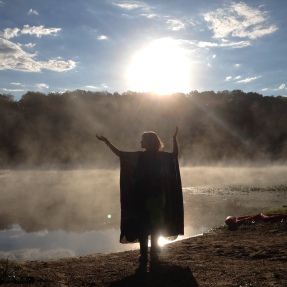 living with your feelings, touching the earth, and embracing the fullness of your humanity.”
–Queen Guenivere
On Samhain morning, I wake early and mist is rising out of the forest and dancing through the field and out of the trees. I have a moment of sheer awe to see it…the veil was literally thin.
Over the weekend, I visit the nearby river to connect in personal ceremony in appreciation before the park closes for the year and also symbolically to those at Standing Rock. This river eventually meets the Missouri River. I run my hands through the water. I anoint my brow, neck, and hands. I whisper my prayers into the ripples. I sing: “I am water. I am water…I am flowing like the water, like the water I am flowing, like the water.”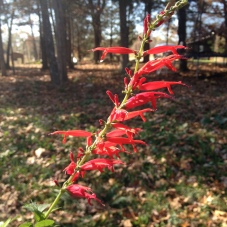
I am hurrying outside to get some work done. I feel tight and hurried with the length of my to-do list and my superhuman plans for the day. The bright red flame of a bloom on my pineapple sage plant catches my eye and then…the perfection of a bright yellow butterfly alighting on one slender stamen. My breath catches and I stop in wonder. I smell the flower and it smells of pineapple, just as the leaves do. I can hardly believe this treasure and the tightness melts into nothing. The rest of the day is full of joy.
I am once again healed by flowers.
About twenty feet outside my house, there is a small building with a little porch and a peaked roof. Inside, there is red carpet and a purple wall, goddess tapestries draped from floor to ceiling, and goddess sculptures in abundance. 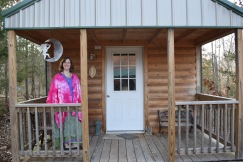 In this building I write, work, create, and hold small rituals with a circle of friends. I call it my Tiny Temple and it is the proverbial, “room of one’s own” described by Virginia Woolf in 1929. Having a dedicated work and ceremony space in the midst of a home-based life, which includes a home business shared with my husband, and four homeschooled children, has changed my life profoundly. In the tiny temple, I feel most wholly myself: connected, powerful, free, authentic, and completely alive.
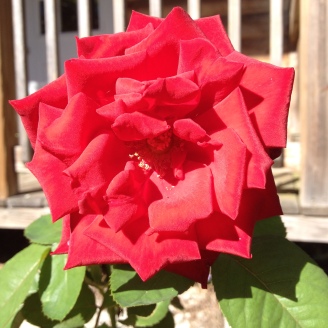
One morning, as I walk to the temple, this beautiful rose makes me drop to my knees with delight. Yes. This right here. This is a beautiful moment. As I kneel beside the rose, the Body Prayer song* wells out of me until I have tears in my eyes.
 “We may need to be cured by flowers.
We may need to strip naked and let the petals fall on our shoulders, down our bellies, against our thighs. We may need to lie naked in fields of wildflowers. We may need to walk naked through beauty. We may need to walk naked through color. We may need to walk naked through scent. We may need to walk naked through sex and death. We may need to feel beauty on our skin. We may need to walk the pollen path, among the flowers that are everywhere.
We can still smell our grandmother’s garden. Our grandmother is still alive.”
–Sharman Apt Russell, in Sisters of the Earth
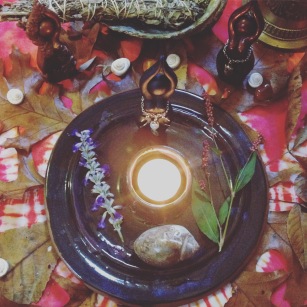
I create personal ritual almost every day in my tiny temple, sometimes simple, sometimes elaborate, sometimes tearful, sometimes joyful, sometimes hurried, sometimes leisurely, sometimes distracted, sometimes astonished at the wonder of it all. The week of my rose worship experience, I smudge the temple with sage I grew in the flowerboxes by my front porch. I ring my bell 13 times. I sing “I Am Fire.” I lay out cards and tiny goddesses and create a mandala out of fallen leaves. I leave an offering of flowers from the herbs and let rose petals drop from my fingers. Ritual captivates all the senses…in this sacred space, I invoke my own senses of smell, touch, sight, sound, and wonder and the result is magic.
“Through ceremony we learn how to give back. When we sing, we give energy through our voice; when we drum, we allow the earth’s heartbeat to join with our own; when we dance, we bring the energy of earth and sky together in our bodies and give it out; when we pray, we give energy through our hearts; when we look upon our relations, we give blessings through our eyes. When we put all these activities together, we have a ceremony, one of the most powerful forms of gift-giving we humans possess.”
–Sun Bear and Wabun Wind
May we each be healed by flowers, time to ourselves to sit on the earth and sing, and the simple, every day beauties and miracles that surround us each day.
Notes:
- Several years ago I wrote a poem called Body Prayer, which is included in the Girl God’s Mother Earth book as well as in my own Earthprayer poetry collection. I was so touched when a Goddess Magic Circle sister, Angelique, shared a chant she created from the last stanza this poem. I started waking up in the mornings singing it, or sitting by flowers and singing it, and it delights me. It also brings my mind back to self-care, an ever-present issue it feels like for women. Here is a recording of my small study group singing it in the Tiny Temple.
- Related past post about earth-centered spirituality: Stoneflower
- Brigid’s Grove is offering a Worldwide Solstice Circle event online this year. Companion resources, journal prompts, a detailed free ritual packet as well as a collection of digital gifts will also be available in our new Creative Spirit Circle companion classroom. You are cordially invited to join us!
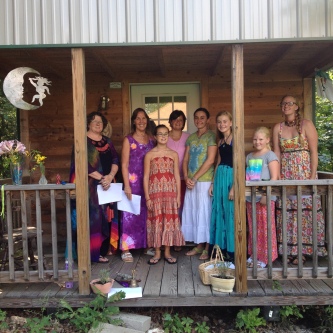
Molly has been “gathering the women” to circle, sing, celebrate, and share since 2008. She plans and facilitates women’s circles, seasonal retreats and rituals, mother-daughter circles, family ceremonies, and red tent circles in rural Missouri and teaches online courses in Red Tent facilitation and Practical Priestessing. She is a priestess who holds MSW, M.Div, and D.Min degrees and finished her dissertation about contemporary priestessing in the U.S. Molly and her husband Mark co-create Story Goddesses, original goddess sculptures, ceremony kits, and jewelry at Brigid’s Grove. Molly is the author of Womanrunes, Earthprayer, and The Red Tent Resource Kit and she writes about thealogy, nature, practical priestessing, and the goddess at Brigid’s Grove.
 Like many others, I too have been thinking of this election the past month or so. A lot has been said about the repercussions a Trump presidency will have on immigrants, women, the LGBTQ community, non-Whites…the list is endless. But in this post, I would like to talk about personal matters, and what it meant for a first-time voter like me to vote in the US elections. I have been living in the United States for over seventeen years, but only recently – in April this year – did I apply for citizenship.
 This continues my reflections on the Devidasis in
  When my students read about the Buddhist concepts of non-resistance, non-attachment, and living in the present, one of the first protests I end up addressing is how these ideas seem to negate progress, goal-setting, or success. What my students don’t yet see is how clinging to a particular end can hinder creativity and the pleasure of the journey to a degree that sometimes compromises success.
 Goddess, explains:
 Autumn of 1977. The faculty wives have come together in the modest University Heights home of a physics professor. Their Aquanet hair is sprayed to the heavens and at significant risk of igniting from lipstick-stained cigarettes that are resting precariously in the cradle a heavy crystal ashtray. Their business is serious. They are putting together a cookbook. The Faculty Wives Cookbook of 1977, to be precise. It is a noble task. They will cook from it for their young families, for their husbands, that is, the faculty. Even more, they will use each other’s recipes. Martha will cook Mary’s chili; Margaret will lose weight on Donna’s diet cabbage stew. It is an achievement that will be smugly displayed on bookshelves for decades. It will yellow, and the black plastic spiral binding will wear and crack. The Kinko’s heavy card stock cover will be ringed with coffee marks. And, one day, daughters-in-law will decide whether to keep it or to pitch it out.
 History offers few instances of women helping create scripture. Hinduism’s sacred Rigveda may have been partly composed by women, and scholars believe the biblical Book of Ruth was possibly written by a woman, but the evidence for each is wanting. And while Muhammad’s widow was entrusted with the manuscript that would become the Quran, its scribe was a man named Zayd ibn Thabit. The only clear exception to this is the Book of Mormon, which Joseph Smith partially dictated to his wife Emma. The central role of Mormon women in the church was therefore fixed from the start.
 Since beginning her posts for FAR four years ago, Elizabeth has featured an excerpt from my
  I’ve been in the midst of moving for almost a year, yet am still not finished with that onerous task. My youngest son and family recently moved into the place I’ve called home since 1980. I bought a small house in the vicinity and have just settled in after spending four months painting, cleaning, and hauling box after box to my new dwelling. At the same time, I’ve been traveling back and forth to New Mexico busy with painting, cleaning, and remodeling my “retirement house.”
