Author’s note: This post originally published on this website on March 11, 2018. How prescient it is. I live in Prague, about an 8 hour car-ride to the Ukrainian border. Over 300,000 Ukrainian refugees have arrived here, with more arriving daily. They need homes, and this need is overwhelming our small country. Yet, we are doing all we can each and everyday to help those fleeing the war. Yet, this housing is not home, not when war still rages and when families are still separated. We need peace. Everyone deserves a home.
In ancient times, Pesach was one of three pilgrimage holidays, the others being Sukkot and Shavuot. According to the the Torah, Israelite men were required to travel to Jerusalem to bring offerings to the temple. Supposedly, this reconnected these Israelites to their religion, to each other and to the deity. Participating in these pilgrimages brought about a deeper sense of community. In short, three times a year, Jerusalem became a home away from home.
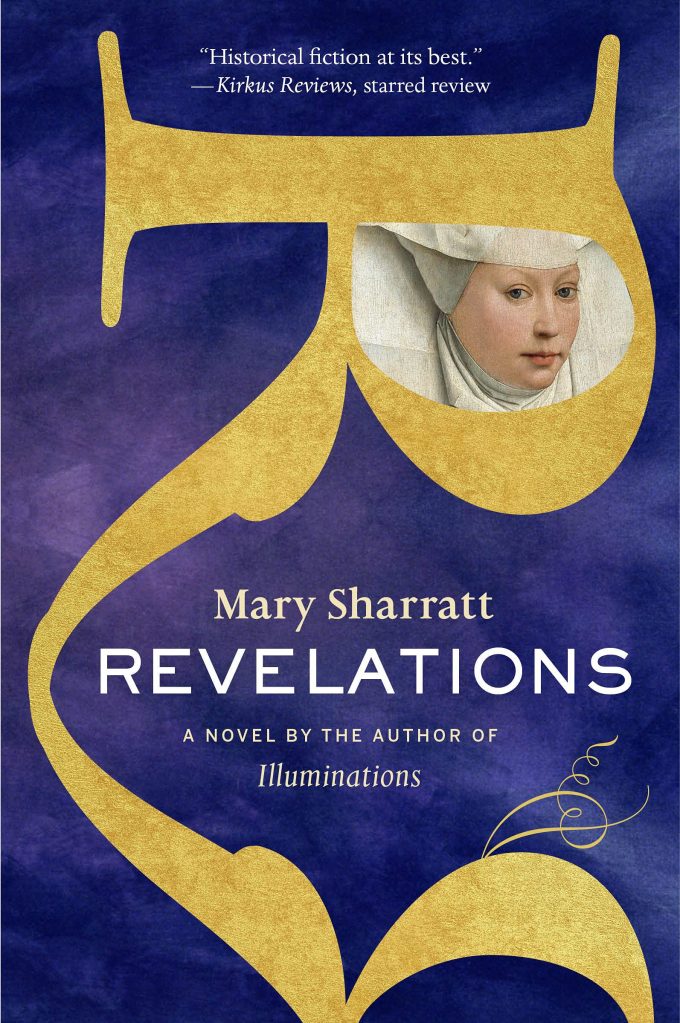
My novel Revelations, based on the intertwined lives of female mystics Margery Kempe and Julian of Norwich, will be released in paperback on April 19. You can order HERE.
“All shall be well, and all shall be well, and all manner of things shall be well.”
These words of Julian of Norwich, taken from her masterpiece of visionary theology, Revelations of Divine Love, seem almost tone deaf against our current backdrop of war and the ongoing pandemic. In a world like ours, with war criminals like Putin calling the shots, it’s so tempting to fall into either hardened cynicism or hopeless despair.
But Julian of Norwich was no naïve simpleton. Although an anchoress who had taken vows as a fully cognizant adult to wall herself into a cell built on to the back of Saint Julian’s Church in Norwich, England, she wasn’t living in some airy-fairy cloistered bubble. Her own age was riven by plague, war, and religious intolerance, which saw the burning of many perceived witches and heretics. Saint Julian’s Church (she took the name of the church, not the other way around) was located in a rough part of town near the river and the stinking tannery district where prostituted women and girls plied their trade.
Far from walling herself off from the world’s woes, Dame Julian had a window in her anchorage wall facing out into the street. Anyone might seek her counsel. She was famous throughout Britain for her sage advice. One of the many who poured her soul out to Julian was a desperate housewife and mother of fourteen children, who had finally plucked up the courage to walk away from an abusive marriage. This woman was none other than Margery Kempe, the heroine of my novel.
Margery had been experiencing sensual, visceral images of the divine for over twenty years. Now she had reached a crossroads in her life. She wanted to walk the mystic’s path and travel as a pilgrim to Jerusalem and Rome. But her choice to leave her family and travel the world as a solo woman was even more controversial and downright dangerous in her age than in ours.
It would have been so easy for a spiritual counselor to parrot the voice of conventional wisdom and tell Margery that her dream of pilgrimage was a self-indulgent folly and that her true calling was to serve her children as a conventional wife and mother.
Instead, Julian did something unheard of. She empowered Margery to trust herself, to trust the voice of spiritual wisdom within her own heart. She told Margery to set all her trust in the divine and not to worry too much what the world thought of her choice–if some people disliked Margery, perhaps that meant Margery was doing something right.
Julian didn’t promise Margery–or us, the readers of Revelations of Divine Love–an easy ride. In one of her searing visions, Julian received the message, “You shall not be overcome.” She wrote in her book, “Our Lord did not say, ‘You shall not be tormented, or troubled, or grieved’ but ‘You shall not be overcome.'”
Julian received her divine revelations around the age of thirty when she was deathly ill and thought she was going to die. Instead, she survived and dedicated the rest of her life to being a living witness to the exquisite divine love she had experienced.
We don’t have to be anchoresses or travel to Jerusalem to experience this deep love and wisdom. The deepest pilgrimage of all is the journey into the depths of our own hearts where divine love dwells eternally, in each one of us, regardless of our faith or spirituality. The sacred inside us can never taken from us.
The heart will always be there for us and it is only from the heart that we can bring peace and justice to our fractured world. By bringing our information-overloaded brains inline with the deep wisdom of the heart. By bringing our speech inline with the heart. By bringing all our deeds inline with the heart.
May we all be witnesses to the Divine Love within us.
“All shall be well and all shall be well, and all manner of things shall be well.”
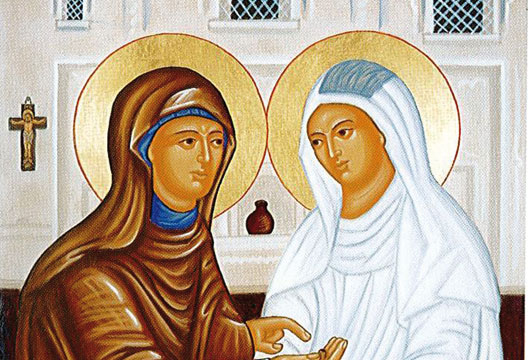
Julian of Norwich (left in her Benedictine habit) counsels Margery Kempe, who dressed all in white to mark her vocation as a mystic and pilgrim.
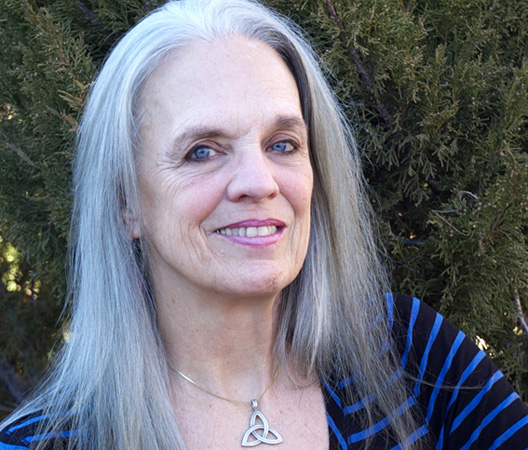
Mary Sharratt is committed to telling women’s stories. Please check out her acclaimed novel Illuminations, drawn from the dramatic life of Hildegard von Bingen, and her new novelRevelations, about the mystical pilgrim Margery Kempe and her friendship with Julian of Norwich. Visit her website.
Trigger Alert: There is discussion of sexual violence.
“I transformed from terrified victim to a courageous survivor . . .Different than an ‘out of body’ experience, this felt more like an ‘in-body’ experience. I stood my ground and did what I had to do to get the hell out of there.” Jean Hargadon Wehner (pg 89).
In 2017, a Netflix documentary came out called The Keepers. It is the story of abuse and torture that was not only allowed but protected by the Catholic Church. Jean was featured in the series as the linchpin who helped to uncover and bring to light the atrocities. Our own Carol Christ watched the seven-episode series when it came out and wrote a blogpost about it. FAR reposted that blog at the end of February to honor Jean who has now written her own book, Walking with Aletheia. In it she describes her own healing journey or as she calls it her “health walk” out of the wreckage of that horror. For more on The Keepers, you can read Carol’s post here (which also includes Jean answering some questions about her story). This book is Jean’s story which, while intricately intertwined with the Church, is ultimately about her own pathway to spirituality and healing.
It’s hard to imagine the emotional weight of the authority figures that bore down on Jean when she was a student at Baltimore’s Archbishop Keough High School in the late 1960s. Not only did two priests torture and abuse her but they drew in other Church officiants as well as the police. The legal system actively turned its collective back to her. It is a great gift that she has survived and a testament to her strength, inner creativity, and the love in her heart that she was able to navigate such an apocalyptic terrain. The instruments of the torture were horrendous including rape, sex trafficking, drugs, and mind control techniques.
Goddess Andraste is the embodied spirit of all of nature in Norfolk, England. We know She must have been a Goddess of Sovereignty to the Iceni tribe because Queen Boudica called on her to protect the people and their lands when they were invaded and brutalised by the Romans in 60AD.
Boudica may have been a Priestess of Andraste, possibly as Queen she was an earthly embodiment of the Goddess, or at least chosen as leader by Andraste. Able to perform ritual, she was probably trained as a Druid.
This blog was originally posted on October 20, 2013. You can read the comments here.
At least since the days of the Desert Mothers in the 4th and 5th centuries CE, there have been women in the Christian tradition (and doubtless other traditions) who have lived lives in religious solitude, whether by choice or circumstance. In Medieval Europe many churches had anchorholds, small enclosures inhabited by men or women dedicated to a life of solitude and prayer. The word anchorhold implies that the presence of the anchoress or anchorite grounded the church community, but the word derives from the ancient Greek verb (pronounced anachōreō) for to retire or withdraw. Anchoress Julian of Norwich is still revered as the author Revelations of Divine Love, possibly the earliest surviving book written by a woman in the English language. Six centuries after her death, her vision of Jesus our Mother continues to challenge, comfort, and inspire.
For those folks in the southern hemisphere who are entering fall as we the northern climates enter spring I offer this next personal narrative.
Every Autumn I buy a smooth skinned crimson pomegranate to celebrate the Fall Equinox. But until this fall I have never intentionally bought a pomegranate to acknowledge the Persephone in me although her cyclic journeys to the underworld have also been my own. I have resisted my alignment with Persephone because I have come to fear my own descents. In the last few years these periods of depression have become more severe.
The September I turned 70 on the last day of the ancient celebration of Persephone’s Eleusinian Mysteries. I spoke out loud as I set my birthday intention. I am aligning myself with Persephone. I held a pomegranate in the open palm of my hand, thinking of the fruit as a symbol of my willingness to take this step. I also saw the beautiful round fruit as the Earth, imagining the ruby –like seeds imbedded in the soft white flesh as Earth’s possibilities. As I surrendered and finally accepted my mythic identity/alignment with Persephone, I experienced a subtle energy shift. I thought about the maiden goddess who becomes Queen of the Dead, and the one who makes predictable cyclic descents into the Underworld. As I breathed through my body I experienced a palpable sense of relief… I recalled the recent dream that informed me that the “Way of the Goddess” was my way, and that I had to choose her again. Not surprisingly within a few days I once again entered a state of profound depression during which time I suddenly remembered my first encounter with a pomegranate…
Is Goddess feminism an old religion or a new creative synthesis? Can it be both? Goddess feminism draws on the feminist affirmation of women’s experiences, women’s bodies, and women’s connection to nature; the feminist critique of transcendent male monotheism as the symbolic expression of male domination of women and nature; and 19th and early 20th century discussions of Goddesses and matriarchy.
Most Goddess and other spiritual feminists have experienced Wiccan rituals, which are often simply called Goddess rituals. For many of us, elements of Wiccan practice strike a chord of knowing, while other aspects seem odd or strange or even just plain weird. What are the roots of Wiccan ritual?
When I first wrote this post in 2014, I said the news was getting me down. A terrorist gang in Nigeria had kidnapped, raped, and “married” two hundred schoolgirls. Kids were even then taking guns to school. What’s better as I rewrite this in March 2022? Not much. The pandemic and idiots still refusing to be vaccinated. Putin’s invasion of a former soviet satellite country. (I think Putin thinks he’s the tsar and wants to rebuilt “his” empire.) Road rage, hate crimes, kids still taking guns to school. I think we can all agree that the news is still awful. The following is what I wrote in 2014.
A couple Saturdays ago, I heard an enormous noise of cawing and shrieking and wings flapping outside my window. It went on for several minutes, so I finally set my book aside (I was trying to ignore Eyewitless News), got up, and looked out into the courtyard. Two huge, noisy crows were chasing a smaller bird. I think it might have been a scrub jay. I have no idea what the jay’s crime had been in the crows’ eyes, but they were chasing it back and forth and up and down until one of them finally speared it with its beak. The jay fell. The crows landed on the roof of the building across the courtyard and strutted back and forth for several minutes. One of them went down for a closer look at the fallen jay. Then they flew away.
This was originally posted on June 24, 2015. You can see the original comments here.
In the ancient Celtic world the Goddess was the One who expressed Herself through the many. Grainne is such a one. She is both Winter Queen/Dark Goddess, nurturing seeds through winter, and Solar Sun Goddess, welcoming the rebirth of spring. She is Aine’s sister or another aspect of Aine. She, like Aine, was honored at the summer solstice and the first grain harvest of early August with bonfires and torchlit processions on top of her sacred hill at Leinster, Ireland. Remnants of these festivals are still found in folk ritual today.
This line from Susan Griffin’s profound investigation into the ways our lives are interwoven through war has been echoing in my mind frequently in recent days, as we find our hearts breaking and outraged by a distant war. In the depths of our compassion, we ache with the suffering of families huddling together in bomb shelters, a birthing woman and her baby dying on a stretcher after a maternity hospital is bombed, the poignant strains of a Chopin etude played by a woman on her piano – the only thing to survive her bombed out home.
This truth of Griffin’s words echoes throughout ancient wisdom traditions — in the indigenous recognition that all our relations — animals, plants, water, earth, stone — are kin; in the African concept of Ubuntu — “I am because we are;” in the Buddhist precept of interdependent co-arising, which Buddhist monk Thich Nhat Hanh called simply “interbeing.” As he described it: