At the outset let me state that this post is mostly a collection of musings, rather than having a definite thesis statement.
I’m currently in India. I had to think hard before coming here for many reasons as you can guess. I finally decided to take the risk especially since there’s no telling how long this situation is going to last. After all, I’ve canceled twice and my parents aren’t getting any younger.
My father is 89, mum 79. When you visit on a yearly basis, that which eludes the daily eye becomes quite obvious in terms of reminding one of parents’ mortality. Wrinkles, aches, pains that develop over months and years seem shocking to the interim visitor, and in recent years, I’ve always left with the hope that I get to see them again.
Imagine this scenario: You agree to meet with some beloved friends or family who are not in your Covid pod. You’re nervous about safety, but you have a detailed discussion beforehand of exactly what Plan you will all follow in order to protect everyone. You decide to meet outside, wearing good quality masks, staying six feet apart. If people want to eat or drink, or remove their masks for any reason, they will go farther from the group, more like 20 feet away. If anyone needs to use the inside space, such as the bathroom, they will be sure no one else is inside and will keep their mask on the entire time.
“We can do this,” you tell yourselves, “We are smart, educated, considerate, careful people who love each other and want to keep us all safe.”
You arrive at the gathering. You greet everyone, masked from the proper distance. You find your seats, six feet from the seats of other pods. Within a minute or two, a beloved friend or relative approaches to give you something, h/er mask hanging down on h/er chin.
The events of sexual harassment I shared with you in Part 1 of this post happened in my first paid-job experience. Just like Margo Robbie’s character in the movie Bombshell, my encounter with Mr. M. was like hitting the wall of the harsh world’s reality. It was a tough welcome to the adult workplace. After my first experience of harassment, I thought that feeling uncomfortable and guilty due to a man’s behavior wouldn’t happen to me again; especially since my second job was in a Christian organization. Bombshell!
I grew up in a very conservative Christian family in the Pentecostal tradition. In my teenage years I was an active member and leader in a church in Bogotá’s downtown. After that, I was a student leader in a Christian group in my university for seven years. After leaving the first job, I was a very-VERY- Pentecostal girl in my twenties, ready to take on the world again! The main requirements for my new job with the Christian organization were to know the Pentecostal culture and to have experience leading groups in peace-building projects. I was proficient in both, so, hurray – welcome job number two into my life! But what I didn’t realize was that this job would require me to welcome this new boss to it too.
I have been re-reading Rebirth of the Goddess reflecting upon my own journey over these past 40 years, remembering how her image appeared to me as a bird goddess the day I first worked with river clay… When I discovered that some of the images I sculpted of bird goddesses mirrored those in Marijia Gimbutas’s The Language of the Goddess I entered an unknown realm. All I understood at the time was that I was being called by some unknown force. I had no idea that this power existed not only without, but within, and that someday I would be able to name both Nature and my Body as the source of that power. And come to understand that they are One.
Born two-hundred years ago in 1821, Mary Baker was raised by a doting mother and strict father. By the age of twenty-eight, she endured personal crises typical to privileged white girls. Lost lovers and unfulfilled dreams. Mary wed her second husband, Daniel Patterson, in 1853, fancying he would make things better. But in 1857, while ill in bed a few weeks, forlornly pining her dead mother, Mary noted in her scrapbook, “My dear dear…Mother waits for me in the far beyond and through the discipline, the darkness and the trials of life, I am walking unto her.”
In 1861, Daniel urged Mary to investigate mind-cure and wrote a letter to practitioner, Dr. Phineas Quimby, to request treatment for Mary’s periodic spinal and emotional challenges.
But the plan was interrupted by another crisis. The American Civil War (1861-1865).
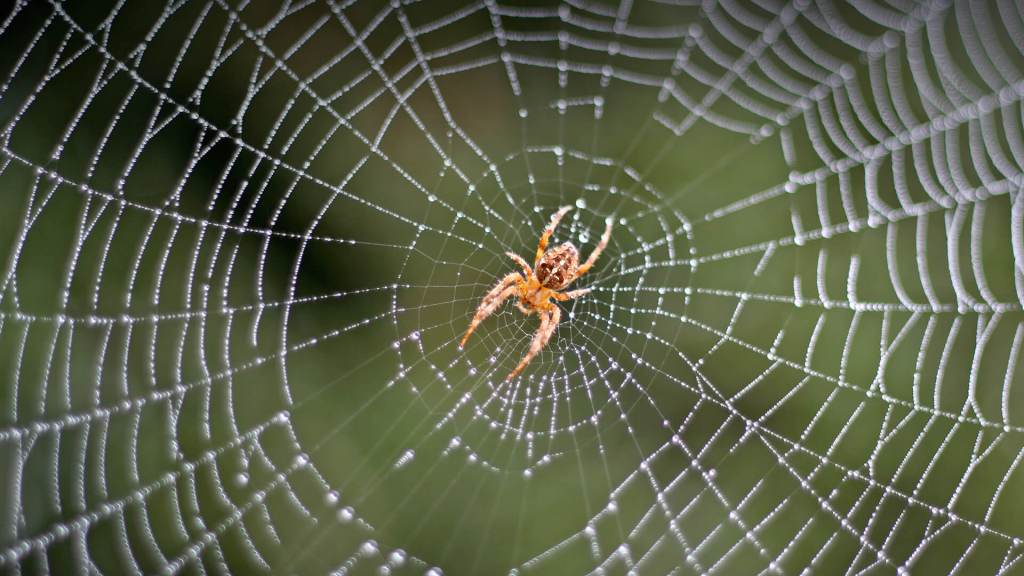
In addition to being viewed as a Creator Goddess and a Destiny Weaver, Spider is associated with many other aspects of life. Some of these aspects fall into what we would consider the light – the good – and others are dark dangers – the dark side of life.
Spider Wisdom by Judith Shaw
Patience, Resourcefulness/Protection, Good Fortune Though spiders have eight eyes they have very poor eyesight. Instead they have infinite patience, waiting quietly in their webs for prey.
Spider is credited with inspiring King Robert the Bruce of Scotland with its patience. A 14th century legend tells of a time when Bruce had suffered various military defeats against the English. While hiding in a cave he observed a spider trying and failing repeatedly to climb its silken thread. But it persevered and eventually reached its web. Bruce was inspired. He decided to persevere in his efforts, came out of hiding, and eventually won Scotland’s independence from England.
Spiders are important to our gardens. They eat more insects than both birds and bats.
Long ago people used spider webs to stop bleeding. Now science has discovered that spider webs contain Vitamin K – a coagulant which stops bleeding.
The Torah recounts a story of how Spider protected David, before he become King of Israel. As King Saul’s soldiers pursued him, David hid in a cave. A spider built a huge web across the cave entrance. The soldiers saw the cave but did not investigate, thinking that no one would crawl through a spider web to gain entrance.
Similarly a story from Islamic tradition depicts Mohammad hiding in a cave from pursuing soldiers. Here also a spider spun a web across the opening, protecting Mohammad.
A Hopi legend about Spider Grandmother tells how she protected a village by spinning a magical web over the whole village, which when doused with water gave protection from being burned down by its enemies.
Spider Woman of Dine (Navajo) mythology helps and protects her people. She helped them to destroy the monsters that roamed the land as they emerged from the third world into this world. She chose the top of Spider Rock in Canyon de Chelly – the Dine ancestral home – as her home. Children were warned that misbehaving would make Spider Woman angry. She would cast her web like a net, as some spiders do, to catch the naughty child, bring him up to her home and devour him. It was said that the top of Spider rock is white because of the bleached bones of those naughty children.
The Celts saw spider as a helper and believed that killing one would bring bad luck.
Spider appears frequently in Chinese legends as lucky beings, bringing happiness and wealth. Spider charms are worn for good luck.
Wisdom, Interconnection, Transformation A Hopi legend tells of Spider Woman helping Tiyo on his journey to the underworld. He begins with a visit to Spider Woman who gives him a serum to subdue his enemies. Then she accompanies him to the ‘Far-Far-Below River’ to offer advice during his trials. With her help Tiyo completes his journey successfully and returns to his people with greater wisdom and knowledge.
Egyptian Creator/Spider Goddess, Neith, often depicted veiled, wove this veil at creation to hide herself from humanity. As humans are not capable of understanding the fullness of divine mysteries the veil offers folds and strands that are thinner, allowing humans a glimpse at divine source and higher understanding.
African and some Native American stories portray Spider as a trickster god whose tales are part of a rich storytelling tradition which convey wisdom and moral lessons.
Spider symbolizes Maya (illusion) in Hindu Mythology. Vedic philosophy characterizes Spider as the weaver of the veil of illusion, hiding the ultimate truth of reality. In addition, Indra’s net, envisioned like a spiderweb with jewels at each vertex, illustrate the belief that all things are connected.
Though spiderwebs are stronger than steel, by weight they don’t usually last very long. Sometimes spiders destroy their own webs. Spider, with it eight (infinity symbol) legs and eyes symbolizes the infinite cycles of transformation as Spider continually creates, destroys and creates again, reflecting the essence of our natural world and its infinite cycles of birth, death and rebirth.
Dark Dangers – cunning, deception, intrigue, death Only a small number of spider species are dangerous to humans with venom that can cause localized pain to a person. Further, there are only about 25 spider species with venom that can cause serious illness in humans. And yet arachnophobia, the fear of spiders, is one of the most common fears worldwide.
Many folktales and myths warn of the dangers associated with Spider.
Athena, Greek Goddess of Wisdom and Handicraft was a skilled weaver. Arachne, a mortal and gifted weaver, got carried away with her talents and boasted that her work was better than that of Athena. Athena was furious and a contest was arranged between the two. Not only was Arachne’s weaving beautiful it also depicted the gods in a bad way. Athena destroyed Arachne’s work in a rage.
Arachne, ashamed to see what her arrogance had wrought, hung herself. Athena took pity on her – turning the rope into a web and Arachne into a spider. Through her death and transformation, Arachne was able to weave her beautiful tapestries for eternity.
Japanese mythology tells of the Spider Princess, Jorōgumo, who transformed into a beautiful woman and entraped men with her deception.
To Christians Spider symbolizes the Devil as the Devil prepares its trap for human souls like the spider prepares its web for prey.
When a spider is finished with its web many species roll it up and consume it.
In ancient Indian tradition Brahma, the creator of all things, was seen as a spider weaving the web that is our universe. Sacred text says that one day she will devour the web – our universe – and then weave another.
Divinatory Spider calls you to transform – to imagine your world anew. A time of creativity is at hand – a time of magic – a time to manifest your true destiny. Spider reminds you that with patience you can best reach your goal.
At the same time Spider calls you to recognize the dark side of life – the ways in which you or others might be deceptive, or engaged in intrigue.
Spider reminds you of the eternal cycles of life, death and rebirth.
Spider awakens your memory of the interconnection of all life, allowing you to integrate problem areas into a more wholistic perspective on life and reminding you of the system of interdependency in which we live.
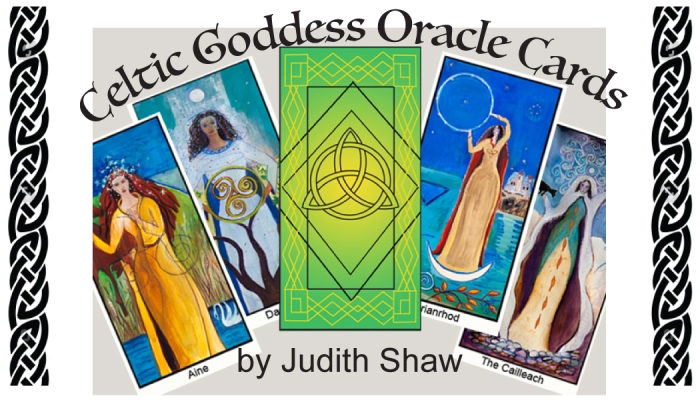
Judith’s deck of Celtic Goddess Oracle Cards is available now. You can order your deck from Judith’s website – click here. Experience the wisdom of the Celtic Goddesses!
Judith Shaw, a graduate of the San Francisco Art Institute, has been interested in myth, culture and mystical studies all her life. Not long after graduating from SFAI, while living in Greece, Judith began exploring the Goddess in her art. She continues to be inspired by the Goddess in all of Her manifestations. She is now working on her next deck of oracle cards – Animal Wisdom. Originally from New Orleans, Judith makes her home in New Mexico where she paints as much as time allows and sells real estate part-time. Give yourself the gift of one of Judith’s prints or paintings, priced from $25 – $3000.
Spider, the eternal weaver of webs, has symbolized creation since people first began storytelling. Cultures worldwide have associated Spider with the Creator Goddess, weaving – and through association with women as they were the weavers who spent endless hours creating the fabric to clothe their communities, and feminine power.
Dear FAR readers – please find photos from a celebration of the 101 anniversary of women’s suffrage, the 19th Amendment, that I attended August 26, 2021. That day marks the end of the 100th year of women having the right to vote.
On our table, the crimson pomegranate seeds my mother had carefully separated from the skin glistened like jewels illumined from within; a pale green jam made from the grated flesh of a gourd, scented with rosewater and studded with thin slivers of blanched almonds, shone with a numinous, interior light. Bowls of black-eyed peas simmered with cinnamon and tomatoes were arrayed beside a delicately-flavored leek omelet, breaded and fried brains, roasted beets, fresh dates, apples, and—best of all—a previously untasted new fruit of the season: usually fresh fig or persimmon or prickly pear.
When I was growing up in my Egyptian Jewish immigrant home, each of the High Holidays was imbued with sacredness, thanks largely to my mother’s efforts to create a meaningful gathering of family and friends. Around a long table, covered with an embroidered white cloth and set with sparkling silver and delicately fluted china, she served at each season the festive meal that made manifest for us the presence of the Divine.
My father, an Orthodox Jewish man, followed the tenets of his faith, praying each morning and attending synagogue each week. But it was my mother who brought to life the seasonal festivals that also characterize Judaism. As a child, I longed to pray with my father and I envied my brother and male cousins who studied and recited the ancient Hebrew; I resented having to polish silver and set the table. But today I’m grateful for my mother’s quiet teachings.
Passover had special meaning for us because our family’s departure from Egypt seemed a reenactment of the ancient Exodus. But Rosh Hashanah, that holy day without explanatory narrative, seemed even purer in its celebration of abundance and blessing, renewal and return. Each year, I looked forward to the new moon in Tishrei that coincided with the arrival of autumn in New York and the beginning of the school year.
The third day dawns under a cloud. Mourning doves spread their wings across leaden skies. I am walking on air. Two restless nights – a huge truck in the yard – Blocked, my stomach lurches. I read Tributes in a daze. Fierce Little Flower Warrior Woman fights a torrent of waves. She is bridging raging waters forging a New Story.
“Weaving the Visions.” Oh, now I remember where it all began.
She hugged a tree. I plant a seed. Listening to rounds of “light and darkness” I let my body lead.
A serpentine path guides me back to Her Garden. Cradled by Ancestors Rooted in Body I shed another patriarchal skin.