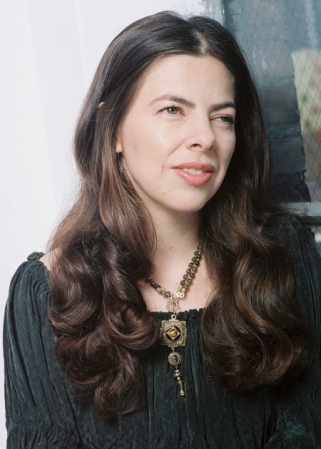
Higher Self and Ego by Vanessa Soriano

I have this morning ritual that goes like this: press snooze 8 times, finally turn off the alarm, oversleep, get up, drink lemon water + celery juice, and then I’m supposed to meditate.  What I really want to do is go directly to the coffee pot, drink the entire thing, and eat a bagel.  When it is meditation time, even after years and years of doing it, I still resist the practice.  My ego convinces me that I have better things to do than to sit on my arse and go within for 20 loooong minutes.  My higher self, on the other hand, gently (yet firmly) reminds me that if I want a slice of peace, an understanding of my feelings (the good, bad, and ugly), and a connection to Loving Guidance, then I better sit my bum down and carve only 20 minutes out of my day to get that medicine.

The yogis have a Sanskrit term called atman which means the inner self/soul.  The atman is inextricably linked to Brahman which is essentially the Divine.  Brahman is all pervasive and transcends notions of masculine/feminine deities because Its’ true nature is infinite, eternal, bliss.  In the Western world, Brahman is usually identified as “Universe” or “Divine” or “Love.”  I assert that most of us need to dissect this huge concept of the Divine into deities/figures that are relatable and accessible which can range from Jesus to Kali to bodhisattvas.  Depending on your spiritual/religious flavor, in meditation, you open the doorway into the Divine of your understanding.  Your higher self (atman) takes the leads into the omniscient, ever-loving presence of Spirit (Brahman).  Along the way, you encounter everything from your deepest fears to your deepest joys. Continue reading “Higher Self and Ego by Vanessa Soriano”

Yes, there are Goddesses in the Bible, Part 5 by Janet Maika’i Rudolph


As I wrote my last blog post, the Great Goddess of the Canaanites, Ashera was honored and worshipped (according to the bible) within and through groves of trees. Ashera and El, the “great bull god” were deeply connected. In fact, in Canaanite mythology, El and Ashera were married.

But before delving into their relationship, I would like to start in a different (but connected) direction – the lovely archetype of the morning star and the evening star. The planet Venus, named for her namesake Goddess (or vice versa), is both the planetary vision of the morning star and the evening star. Whether She be Goddess, planet or evening/morning star, when She appears in one form, She embodies them all. Continue reading “Yes, there are Goddesses in the Bible, Part 5 by Janet Maika’i Rudolph”

October Magic, by Molly Remer

In was in October that my last grandmother died, my last living grandparent. As the leaves turn to red and gold once more, I wake thinking of her each morning. I wake thinking of my maternal grandmother too, who died seven years ago, in springtime as the iris bloomed. I dream of my husband’s grandfather, he stands shoulder to shoulder with my oldest son, white hair and smile flashing as he compares their heights and laughs.

We’ve just returned from a two week long trip to Florida and have arrived back in Missouri to a life in full swing, books to write, projects to plan, new products to develop for our shop, old requests waiting for our attention. But, the leaves will only be this color for a moment. The air will only be this sweet and pleasant for a moment. The sun will only glint across the cedar branches in this way that brings my soul to life right now, the colors of the day so sharp and vivid, clear and bright to my eyes, that it is almost like stepping into another reality. We have only this moment to join hands and slip off into the woods beneath the early morning sun, stepping past pools of slowly dripping water, over sharp and uncertain stones, soft green moss, and carpets of fallen leaves. It is only this moment in which we will hear the hawk’s cry ring out across the trees. Only now in which we will turn over leaves and discover shining mushrooms, gleaming in the October sun.

I stepped into the woods holding memories of my grandmothers next to my heart. The leaves were lit gold from within and below, forming an enchanted tunnel into the trees near where we have built our new work studio. As I moved into the clearing, I heard two crows raise an alarm call. I stood silently and looked, curious about the source of their alarm. They called again sharply, once, twice, and right in front of me a quiet brown deer, previously unseen, lifted its white tail and leaped gracefully away through the trees. It took a breath, a beat of time, for me to realize that it was me, my own small form standing relatively motionless among the trees watching the morning sun illuminate the yellow leaves, that was the cause of the raised alarm, this communication between species, sharing the same ground.

We set off along a stony gully that bisects the land of my parents, pausing by a series of small pools and gazing through the backs of dogwood leaves turning to rich red with veins of green still lightly tracing through their round centers. Suddenly, the scent of cedar filled the air and I crouched beneath the tree to see the ground beneath it littered with small snippets of evergreen, strewn across a thick blanket of brown oak leaves and yellow maple, glowing in a stained glass impersonation in the perfect touch of the sun upon their surfaces. My breath made a fog in the air and I looked up into the tree to see that it, too, was breathing in this cool morning, steam lifting off its trunk and rising into its thin fingered branches. There are small blue juniper berries brightly laid against the wet green moss beneath the tree and I turn to see the peachy-rose globes of persimmons hanging on thin branches against the sky. I have the sensation that they are watching me there, kneeling on the wet ground, caught between rays of sunlight and enchantment.

We continued picking our way carefully across the lichen-laden gray stones until we came to fallen tree, carpeted with a beautiful array of fungus. Small brown knobs that look like new potatoes spring from what was once the top of the trunk and a panoply of beautifully spiraled whorls of turkey tail mushrooms form small cups which hold last night’s raindrops.

As we descended into the gully, the view opened up before us, slabs of stone forming a naturally terraced series of platforms dropping lower and lower into the round stone pools. The trees are yellow here, sun gleaming on the leaves, forming a temple bower of golden branches. I felt full of delight and joy, so pleased that we had chosen to lay aside the to-dos and come on this ramble together. I asked my husband to take a picture of me in the trees and stones telling him with a smile that this is the only moment in which the leaves will be this color and in which I will be this fabulous.

Being in the world, noticing what blooms and breathes and flows around us, is the fullest expression of my spirituality to me. Seeing what emerges, what fades, what rises and falls, this is a living magic. Honoring the passage of time, the turn of the wheel, the cycles of the land, the earth as an ensouled presence, and my own footsteps on her an act of devotion, these are the cornerstones of feminist spirituality for me. Look. Learn. Listen. Feel. Care. Act. Goddess worship and the symbol of the Goddess plays an important role in re-conceptualizing and restructuring the role of women, the value of nature, and the social order. In her book Ecofeminist Philosophy, Karen Warren writes: “Many spiritual ecofeminists invoke the notion of ‘the Goddess’ to capture the sacredness of both nonhuman nature and the human body…the symbol of the Goddess ‘aids the process of naming and reclaiming the female body and its cycles and processes.” Rather than something to dominate and control, the earth becomes the body of the Goddess and is acknowledged as both literal and spiritual home and is something inseparably linked to personal well-being—planetary health and personal health become synonymous—and both are treated with reverence and respect.

I have wondered if I try too hard to make my life be magical, to make it meaningful and then I realize, if you look for evidence that the world is made of magic, for evidence that your life is magical, that you will find it everywhere. This isn’t wrong. This is beautiful and powerful and real. Yes, my life is magical. So is yours. The whole world is magical. We need only step right up to it and look, to see that we are surrounded by magic, woven right into the threads of it.

The stones were slippery with water and moss as we skirted our way carefully to the bottom of the gully, where a wide, curving, bowl-shaped basin has been formed of rock and rain and time. Gazing at it, tranquil and still, gently rippled rocks forming the sides and leaves filling its bowl, I said aloud:  “When I die, you can leave me curled up here and I’ll be happy.” For a crisp moment I could clearly see my own bones lying nestled, smoothed and ivory, across this bed of leaves and sunbeams.

Something bright red caught my eye then, looking at first like the domed half of a large cherry tomato partially covered by brown leaves and I squatted down to discover a burst of crimson mushrooms grouped together and bright against the decaying foliage.

Mark didn’t answer me, but he laid his hand across my hip and together we scrambled like mountain goats past the crimson mushrooms and up the steep slope, the oak leaves giving way to a carpet of pine needles as we climbed, the now bare stems of lowbush blueberries catching on our socks and pants. At the top of the hill, we sat on the stones, chests heaving, breath fast from our ascent, smiling silently as we looked at the sunshine through the pines.


Molly Remer’s newest book of poems, Sunlight on Cedar, was published in March. Molly has been gathering the women to circle, sing, celebrate, and share since 2008. She plans and facilitates women’s circles, seasonal retreats and rituals, mother-daughter circles, family ceremonies, and red tent circles in rural Missouri. She is a priestess who holds MSW, M.Div, and D.Min degrees and wrote her dissertation about contemporary priestessing in the U.S. Molly and her husband Mark co-create Story Goddesses, original goddess sculptures, ceremony kits, mini goddesses, and more at Brigid’s Grove. Molly is the author of WomanrunesEarthprayerthe Goddess DevotionalShe Lives Her Poems, and The Red Tent Resource Kit and she writes about thealogy, nature, practical priestessing, and the goddess at Patreon, Brigid’s Grove, Feminism and Religion, and Sage Woman Magazine.

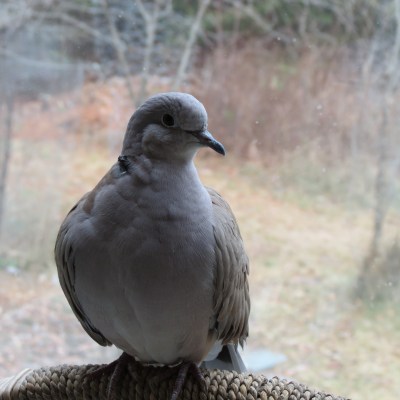
Telepathy, Women, and Birds by Sara Wright

I am a naturalist and ethologist who has studied many animals and birds in their natural habitat; my 15 year study of Maine’s black bears is perhaps the best example of the work I do. I am a dedicated animal advocate and telepathic communication is part of many if not all of my interactions with both tame and wild animals.

I am also an eco-feminist who believes that women have always had a more intimate connection to the natural world, that if developed, will lead to telepathic communication.

A couple of months ago I wrote a story about the telepathic relationship between my dove, Lily B and me. I put it on my blog and every day there after I noted that a number of people read it. At first I didn’t pay much attention but after awhile I couldn’t dismiss the odd sensation that this story was traveling from country to country in a very peculiar way. One day I counted 11 countries whose bloggers just read one article, the story about Lily B. Bloggers continue to read about my dove on a daily basis. This morning, for example, someone from Egypt read it. Continue reading “Telepathy, Women, and Birds by Sara Wright”

“Fertility” and the Regeneration of Life by Carol P. Christ

Prehistoric and indigenous religious traditions are often disparagingly mischaracterized as primitive fertility religions, concerned not with higher morality, but rather with the processes of reproduction of humans, animals, and plants. When these religions feature a Great Mother Goddess, it may be assumed that these religions are primarily focused on birthing human babies. Nothing could be farther from the truth.

Indeed, archaeologist Marija Gimbutas discovered that in the symbol systems of Old Europe, the Goddess is only rarely imaged as pregnant or giving birth. Nor is She portrayed solely in human form. Rather, She is portrayed with a bird head, wings, and a plethora of other animal and plant features. If She is a Great Mother Goddess, She is revered as the Source of Life, not simply as a mother of human babies. Gimbutas states that in Old Europe the Goddess was worshiped in as a symbol of the powers of birth, death, and regeneration in all of life. Gimbutas said these societies were matrilineal and probably matrilocal. Continue reading ““Fertility” and the Regeneration of Life by Carol P. Christ”

Write on Lilith! (Write on Eve!) by Ivy Helman

Over the past few months, I’ve been struggling to write posts.  This month is no different.  I am currently sitting with four different half-drafts on three semi-related topics, none of which I seem to be able to complete.  I’ve gone back to each of them numerous times.  I write.  I erase.  I rewrite.  I copy bits of one into another to save for some other time.  I’m left with one sentence:  this week’s Torah parshah is Bereshit (Genesis 1:1-6:8).  Great.  Glad to know that.  Now what?  

When writing, I often find myself in one of two camps given the current state of the world.  Either, I have so much to say that I have no clear idea where to start, so I write three pages of more or less nonsense.  Or, I find myself just so inundated with information that I don’t know where my opinion begins and another’s ends.  I write another 3 pages of completely different nonsense.  I get fed up with both.  I start praying better thoughts will just write themselves.  They don’t.  

Continue reading “Write on Lilith! (Write on Eve!) by Ivy Helman”

A Deep Ecology of Horse Manure by Mary Sharratt

My recent move from Northern England to the Silver Coast of Portugal has been a radical change on so many levels. Not only am I coming to grips with a different climate and culture and immersed in learning a very challenging new language, I have embraced a completely different lifestyle.

For the first time ever, I can keep my beloved Welsh mare and matriarch, Ms. Boo, at home, along with her companion, the dashing Zinco, a very handsome but sometimes aloof Lusitano gelding. My pet name for him is Mr. Darcy.

I could have taken the easy route and put Boo on a livery yard that did all the care for me, but I wanted to give Boo a lifestyle with daily year round turn out in a big field and none of my local livery yards offered this, though I talked to some very kind and helpful people at these establishments. It’s just a different approach to horse care in Portugal, which prioritizes stabling horses and using their energy for training exercises and riding.

My life now literally revolves around horse care and feeding. As soon as it’s daylight, I’m out bringing them their morning feed before I even have my human breakfast or coffee. I bring them their evening feed some time before sunset. So my writing, intensive Portuguese classes, or whatever else I’m doing is necessarily book-ended by horse care. My “productivity” can suffer as a result. If you have animals or children or other care-taking duties, the care-taking always has to come first. My change in lifestyle prompted me to question precisely why our culture privileges such a narrow view of productivity in terms of working for and selling ourselves to the corporate world rather than caring for the land and beings all around us.

I addition, I poo-pick the field twice daily, a very time-consuming task. I was in a bit of a quandary whether all this meticulous poo-picking was actually necessary. Many UK-based sites insists it is an obligatory part of horse welfare to control both flies and the spreading of parasites. However, my Portuguese farmer neighbor and my farrier both hinted that I could just leave the stuff on the ground and it might actually be better for the soil if I did.

I actually don’t mind poo-picking. It’s good exercise and very meditative, especially in early morning when the sun is rising above the mist and the dew is sparkling on each blade of grass. The other morning I saw a magnificent full moon setting majestically over the Atlantic Ocean on the far Western horizon. It’s so serene and peaceful, just listening to the birds and the horses munching their hay. I feel like I’m entering a slower, more authentic world where time is measured not by smart phones bleeping at you but by the deep cycles of nature, the sun and the moon, and the distant chiming of village church bells.

Breakfast at dawn

I think if certain world leaders got up early to poo pick, they would spend far less time spreading verbal horse sh*t on Twitter.

In many ways this feels like a homecoming, a return to my roots. On both sides of my family, my grandparents were farmers and many of my first cousins and their children are still farmers. Although I’m not an actual farmer, keeping horses at home has made me an accidental small holder.

Alas, the consequence of my poo-picking habit is an ever-growing mountain of a muck heap. What to do with all this manure is a perplexing problem if you don’t have a manure spreader and other fields to spread it on. I offered it to the farmer next door, only to receive a lecture on his view that chicken poo, sheep poo, goat poo, and cow poo are all superior to horse manure! A hierarchy of poo! (It was this gentleman who hinted that I was better off just leaving the stuff where the horses dumped it.)

Nonetheless I have a most imposing muck heap that will only get bigger unless some action is taken. I posted that I had free horse manure to collect on some local gardening sites. So far two people have taken me up on it. Both people took as much manure as they could possibly squeeze into their cars–it hardly made a dent on my manure pile! But from them I learned some valuable tips on composting and have been inspired to dig out the mature stuff at the bottom of the pile to put on my roses and hydrangeas. Hint: if you ever have insomnia, spending a day carting wheelbarrows full of horse manure all around your garden will insure you sleep like a rock.

It’s something sad if horse manure is just viewed as an unwanted waste product instead of being recognized as part of the deep ecology of animal-keeping and gardening. Manure is compost in the making.

In the meantime, my “manure friends” who have collected the stuff for their gardens have gifted me with organic produce and homemade fig jam. I still have a lot to learn but this new life is teaching me so much. Living in harmony with nature isn’t just posting pictures of pretty flowers on Instagram. It’s getting actual dirt under your fingernails.


Mary Sharratt
is on a mission to write women back into history. Her acclaimed novel
Illuminations, drawn from the dramatic life of Hildegard von Bingen, is published by Mariner. Her new novel Revelations, about the globe-trotting mystic and rabble-rouser, Margery Kempe, will be published in April 2021. Visit her website.

This “Columbus Day,” Watch Frozen 2 (Or Watch It Again!) by Tallessyn Zawn Grenfell-Lee

(Yes, this post contains some SPOILERS. It might make you love the movie more, though, which happened to me with this article about Mad Max: Fury Road.)

When I was in high school, in the early 90s, a Methodist pastor I love preached a sermon about Christopher Columbus. She was the first ecofeminist I’d ever known, and she spent her ministry helping to heal racism, sexism, and the Earth, including building lasting community with the indigenous people where we lived. Among other things, she would invite native leaders to come speak to our churches and help the congregation understand their continuing presence and cultures. And she was the first person I knew who recycled, used inclusive language – I’d never even heard of it – or who lamented the wastefulness of convenience.

Continue reading “This “Columbus Day,” Watch Frozen 2 (Or Watch It Again!) by Tallessyn Zawn Grenfell-Lee”

Passionflower Autumn by Sara Wright

I am gazing out the window; an almost bare leafed apple tree’s sap has begun its descent for the winter months. Trees participate in a great round; breathing slows as the tree becomes drowsy. Soon the merciful cold will put her and others of her kind to sleep, not to awaken until life each tree’s life – blood thickens to rise and soar into the highest branches with a warming sun. Only tree roots stay awake throughout the winter searching for nutrients, exchanging carbon and carbohydrates, water, meeting new friends and avoiding foes, their root tips  branching, fusing, glowing – solving problems far more complex than those of humans…

Last night a full white ‘falling leaf moon’ slid unobstructed through apple branches casting shadowy silver arms around our bed. My dogs were restless. I could see the rounded luminous pearl embedded in an ebony sky shining through all the deciduous trees that were dressed in scarlet splendor just a week ago. Last night those trees were bare. Continue reading “Passionflower Autumn by Sara Wright”

Patriarchy as a System of Male Dominance Created at the Intersection of the Control of Women, Private Property, and War by Carol P. Christ


Recently feminist scholar Vicki Noble said this is the best definition of patriarchy she has read–but she hadn’t known of it earlier! I am am republishing it now in hopes that all of you will share it on your social media so that it becomes more widely known. Thanks!

Patriarchy is often defined as a system of male dominance. This definition does not illuminate, but rather obscures, the complex set of factors that function together in the patriarchal system.  We need more complex definition if we are to understand and challenge the the patriarchal system in all of its aspects.

Patriarchy is a system of male dominance, rooted in the ethos of war which legitimates violence, sanctified by religious symbols, in which men dominate women through the control of female sexuality, with the intent of passing property to male heirs, and in which men who are heroes of war are told to kill men, and are permitted to rape women, to seize land and treasures, to exploit resources, and to own or otherwise dominate conquered people.* Continue reading “Patriarchy as a System of Male Dominance Created at the Intersection of the Control of Women, Private Property, and War by Carol P. Christ”