

 I was struggling to figure out a piece for this month’s post and what I kept coming back to is my healthcare journey and the uncertainty of the last year. My childhood does not contain memories of not supported medically. If I was sick as a child, my parents took me to the pediatrician, I went to the dentists bi-annually, and I even got connected to a dermatologist to help figure out my persistent struggle with acne as well as catching a mole before it became skin cancer. But that all changed when first I was kicked off my parents’ insurance plan due to age limit and further pushed into a medical coverage oblivion when I attended graduate school.
When You are Called to Her Service by Deanne Quarrie
 When I came to Goddess, I was in my mid-forties and I suddenly had this huge fire burning in my soul. I felt like I had missed opportunities to practice my “calling” for forty-five years. I finally knew what I was born to do and couldn’t get there fast enough. There was a part of me that felt that, because of my age, I had to hurry up and “get there.” Come to find out, we do not ever “get there!” We are simply always “getting there!”
I wrote this for one of my students, recalling my own “fervor” in the beginning and I offer now it to every woman who has suddenly found Goddess and her burning desire to serve. Continue reading “When You are Called to Her Service by Deanne Quarrie”
In Honor of Spring: A Novel about our Blue Planet by Marie Cartier
 I have written segments of a novel before for the FAR community several times—starting here. What follows are the beginning pages of a new novel (not the one I’ve published segments with FAR before—that one is on hold). I’m sharing this story—of the last surviving mermaid and her fight to save the planet– in honor of spring. You may see more pages in the future—but for now– happy spring equinox and blessings on you and our planet as the wheel turns. Continue reading “In Honor of Spring: A Novel about our Blue Planet by Marie Cartier”
Darkness and Light by Judith Shaw
 “Deep in their roots, all flowers keep the light.” – Theodore Roethke
“Returning violence for violence multiplies violence,
adding deeper darkness to a night already devoid of stars.
Darkness cannot drive out darkness; only light can do that.
Hate cannot drive out hate; only love can do that.”
– Martin Luther King, Jr.
Coexist or Contradict? How about Resist Instead by Katey Zeh
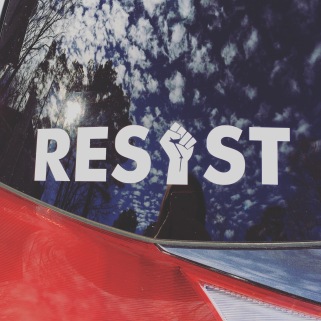
While stopped at a red light on my way home one day I noticed that the two cars immediately in front of me had the same “Coexist” bumper sticker. You’ve probably seen one like it. Each of the letters of is a symbol representing a major religious or spiritual ideology. For example, the “C” is a crescent moon symbolizing Islam, and the “X” is a Star of David symbolizing Judaism.
This was a particularly long traffic light, which gave me time to realize that I was mistaken. In actuality the bumper sticker on the car just ahead of me did not read “Coexist” but “Contradict.” Underneath that it read, “They can’t all be true-John 14:6.” Despite my early days of earnest scripture memorization I couldn’t recall this particular passage, but I had a hunch it was the verse in which Jesus said, “I am the way, the truth, and the life.” I was right.
I’ll admit my eyes rolled back in my head over this display of Christian moral superiority. Continue reading “Coexist or Contradict? How about Resist Instead by Katey Zeh”
Out of the Darkness by Gina Messina
 Today is Spring Equinox in the Northern Hemisphere, a time to celebrate moving into light and abundance after the darker cold winter. While many of us are lucky enough to have shelter and access to food out of season, this is a time that continues to be a resurrection in countless ways. Not only is it a literal shift from darker days to increasing light, but a symbolic time that allows us to reflect on changes, that while seeming to be hopeless can blossom into new life.
I have been consumed in a time of shifting ground and deep darkness as my sixteen year marriage has come to an end. Choosing to divorce rather than remain committed to good times and bad is a frightening and soul crushing event. To walk away from what seems to be stability in favor of a questionable future and to defy one’s foundational understanding of family as dictated by society and religion is beyond terrifying. Continue reading “Out of the Darkness by Gina Messina”
Renewing Our Spirits in the Wilderness of Our World by Carolyn Lee Boyd
 In my garden blooming with native wildflowers, in nearby rivers and woods, across the New England landscape, the Earth is healing Herself. Two centuries ago, New England’s forests had been cleared for farms; myriad species of animals, birds, fish, and plants had disappeared; the network of waterways had been dammed to make power for mills.
Now trees are reclaiming land abandoned by 19th century farmers seeking better soil westward and today’s environmentalists are reintroducing native flora and fauna and hauling away obsolete dams. As a result, species not seen for generations are thriving, most of New England is again heavily forested, and whole ecosystems are reviving. Creation is once more beginning to remake the landscape into a place of wholeness, life, and connection. Continue reading “Renewing Our Spirits in the Wilderness of Our World by Carolyn Lee Boyd”
Puff the Magic Dragon & the Loss of Magic by Susan Morgaine
 Did you believe in magic?
Did you once believe in fairies, leprechauns and and flying dragons? Did you believe that if you climbed a tree to the uppermost branches, you could touch the sky?
Do we need magic?
As the country finds itself reeling from the proclamations of anew administration, I have found myself, like so many others, in need of comfort. One of the places I find comfort is music. There is the music of ritual and meditation, the music of dance, the music of heartbreak. It can energize and uplift; it can soothe the hurt away, it can take you to distant lands.
After the experience of the Women’s March on Washington, I chose the protest music of Peter, Paul and Mary. I found myself listening to “Puff, the Magic Dragon”, an old favorite. I have listened to this song many times through the years, but this time, I understood it in a completely different way. Continue reading “Puff the Magic Dragon & the Loss of Magic by Susan Morgaine”
Join the Rebellion by Jessica Bowman
 Like many other thousands of Americans, I watched the newest offering from the Star Wars legacy last autumn and was re-inspired to be an active part of the rebellion against oppression. Viewing the movie through my feminist lens I was cheered on by the choice of actors and actresses in lead roles and was reminded of Margaret Mead’s famous quote, “Never doubt that a small group of thoughtful, committed, citizens can change the world. Indeed, it is the only thing that ever has.”
It may be easy to compare the new president to Lord Vader because he is an easy target who encourages mockery and ridicule. However, tyranny, violence, and power trips have long been a part of world societies, for centuries. It is as evident as ever that we must continue to stand against such debilitating realities. We must stand together.
And, like millions of other people across the world, I had the privilege to participate in a Sister March to the Women’s March on Washington; shoulder to shoulder with passionate and caring people determined to make a difference. The experience generated feelings of elation, hope, and unity. I was most impressed by the kindness radiating from every person I came in contact with. Even though spaces were packed with people the overall atmosphere was conscientious, polite, and caring. Peaceful activism is critical to progress.
I also listened intently to the speeches made at the marches; especially by the women well known in popular culture. Gloria Steinem, a cornerstone of the modern feminist movement, spoke words that I believe reflect the change in values that I visualize in the form of a river current. “God may be in the details, but the Goddess is in connections. We are at one with each other, we are looking at each other, not up.” Women’s work is the creation of the web; the tapestry of connections between us all and the building of momentum in the stream bed. Continue reading “Join the Rebellion by Jessica Bowman”
Reflections on Trauma, Part II: YOLOCAUST by Stephanie N. Arel
 In light of the recent attacks on Jewish cemeteries —the desecration of Mount Carmel Jewish Cemetery in Philadelphia and the toppling of more than 150 gravestones at Chesed Shel Emeth Cemetery in Missouri — along with my reminiscing that a year ago today (March 1 as I am writing) I was en route to Jerusalem to work with a group of scholars for the Intercontinental Academia on Human Dignity, I wanted to once again confront trauma (building on Part I of this topic). In this case, I consider trauma as an affront to the dignity of ALL bodies and their memories, while simultaneously questioning how those who have not experienced trauma develop respect for its proximity – in individual lives, in sacred spaces, and in memorials.
The desecration of memory alive in the space of the cemetery presses me to repeat what I have said before: that the violation of bodies lies at the heart of traumas caused by human design — even if those bodies are inhumed. Continue reading “Reflections on Trauma, Part II: YOLOCAUST by Stephanie N. Arel”

