 Why bother? It’s a legitimate question. My oldest son, almost 12, announced that he is depressed. He’s got good reasons for it, so I don’t try to talk him out of it. My youngest, almost 8, told me yesterday that life was simpler when he was in my belly. Now, he says school is torture. They won’t just teach something and move on. They have to do “activities,” he says, he’s onto the racket that is known as busy work.
I spoke with an aunt, a cancer survivor, whose progress is steadily monitored. Life, it seems, has become about watching and waiting rather than living. There’s not so much to look forward to, she says wistfully, once you get to a certain age. My friend called in distress. Not one area of life – not work, not kids, not household, not romance – was untouched by significant stress. She said that she could understand how people are okay with their kids moving out. There is a time, she observed baldly, when it will be alright to die. She said, I’m tired.
What do we do with fatigue that becomes soul deep? In my own case, I used to move it around from one place to another, focusing on what I could do as a remedy for the things I could not change. What I have come to realize, though, is that we run out of storage space eventually. There’s no place to hide from this – this question – of meaning or meaninglessness. When I try to assess and work out what’s on my mind, that is, when I feel the fatigue of meaning, I realize that I am dealing with something spiritual in nature.
It’s plain as day, of course, when you give it a second’s thought. But, at first blush, it is not always immediately self-evident that the angry person mouthing “bitch” at me in the crowded parking lot or my frustration at my kids not responding to my third request, were and are, at the root, theological problems. Such things were and are, the things that push the self toward the precipice of spiritual demise.
Why bother, I wonder, when the handsome and seemingly happy couple in line in front of me to see Santa with their little boy turns to me hostilely and threatens me should my own eager child accidentally bump into them again. As I stand on, dazed, still looking at them with something of a smiling admiration on my face, trying to understand what I have just heard, I am yelled down for the look on my face. What is this world, I wonder, while my own joy begins to shift into an anger that I am now tasked with suppressing and rationalizing?
The more I recognize myself in this place, especially as a woman, the more I understand that traditional theology, and specifically traditional Christian doctrine of God, has more or less failed to help me here. It has failed to provide me, specifically as a woman, an adequate way of dealing with the inevitable fatigue of a life lived long enough. What do I mean by this? I find that I have internalized a distorted sense of value and more importantly a distorted sense of self in relationship to others.
In particular, the idea of servanthood, even service as leadership, can be an infectious and distorting delusion whereby one inclines oneself simply to be taken advantage of by others. This happens in family life, work, and even in volunteerism (especially at the Church). Likewise, the insistence on joy, hope, resurrection, loving the neighbor, the new day yet to come – these can become woefully burdensome, even to the very young, because such spiritual dispositions stifle the capacity to experience–honestly and without self-critique–anger, fear, boredom, and disappointment.
As a woman, I find myself to be particularly susceptible to spiritual instruction about service, docility, duty, and self-gift, in ways that I increasingly come to understand are not genuinely relationally intelligent or spiritually wholesome: they are gendered norms for desirable social being. Of course, I know all this stuff as theory. I have for two decades. But, now, now I know it for myself, in my skin, and that is a heavy transition in the soul.
I’m not sure I agree that religion the opiate of the masses, but I do agree that one of the foremost reasons people create religion as a framework for interpreting life is that they are confronted with the profound task of meaning-making out of what often seems to be the unfathomable reach of meaninglessness. Theology is a response to that, as is worship. The older or perhaps wiser or perhaps more reckless I get, the more I understand that is incumbent on each of us to be able to think theologically in ways that are authentic and true to our own experiences and insights.
It is perhaps for these reasons that I have been expanding my own capacity for prayer and ritual by participating in alternative spaces of worship, like the sweat lodge, as well as creating my own, as I have been over the past several on New Year’s Eves, with the invention of a symbolic meal, a structured memorial for the deceased, readings, and a fire ritual at midnight. I feel at times like a syncretistic pagan wannabe, but I set those self-critiques aside in the knowledge that I am exe(o)rcising the spirit.
That phrase, “exe(o)rcising the spirit,” feels laden, and I have yet to unpack its full import, but I know it means both ridding myself of what does not work and claiming the authority to honor what does in ways that are sacramental and meaningful to me and to those in my community of intimates.
Perhaps the best way that I alternatively theologize is through creative writing, through the beckonings of theopoesis, where I find I can speak without the impositions of structure in the quasi-grammarless realm of experiential knowing. It is here that I have discovered freedom to disagree and complain as well as to integrate and praise in a voice that talks to God in earnest, as though God were listening. In preparation, for a solstice sweat, this is what I had to say.
These sides are not
sharp antagonisms
that bring to points
their points of view
but a pond’s surface
under moonlight,
swirling like mercury,
beneath which minnows,
fluid, do
their works of
harmonious disruption.
So, let my prayer be not
please,
for, I fear
I have been
an ungrateful guest.
Sojourning pilgrim,
refugee,
all this life, all will be,
a lesson in how to say
thank you.
Natalie Kertes Weaver, Ph.D., is Chair and Professor of Religious Studies at Ursuline College in Pepper Pike, Ohio. Natalie’s academic books include: Marriage and Family: A Christian Theological Foundation (Anselm, 2009); Christian Thought and Practice: A Primer (Anselm, 2012); and The Theology of Suffering and Death: An Introduction for Caregivers (Routledge, 2013). Natalie’s most recent book is Made in the Image of God: Intersex and the Revisioning of Theological Anthropology (Wipf & Stock, 2014). Natalie has also authored two art books: Interior Design: Rooms of a Half-Life and Baby’s First Latin. Natalie’s areas of interest and expertise include: feminist theology; theology of suffering; theology of the family; religion and violence; and (inter)sex and theology. Natalie is a married mother of two sons, Valentine and Nathan. For pleasure, Natalie studies classical Hebrew, poetry, piano, and voice.


 “The day begins with the sun and ends with the moon and stars; what you do in between is your gift to the world.” – Reyna Craig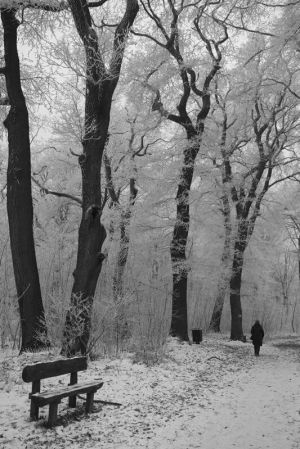
 Although “the” Ramayana is a fluid narrative, scholarship has traditionally recognized the Sanskrit Valmiki Ramayana as the most authoritative of Ramayanas. But recent studies have brought to light the hundreds of regional stories of Rama and Sita which are more popular with the masses. These would include Krittibasa’s Ramayana in Bengal, Kamban’s Tamil Iramavataram in South India, notably in the state of Tamil Nadu, Tulsidas’s Ramcharitamanas among the Hindi-speaking belt of northern India, and so on. But even here, a pattern seems to emerge; all the above-mentioned authors are male. Within this scenario, a rather unique text stands out, and that is Chandravati’s sixteenth century Bengali Ramayana, for its author was a woman. Even more fascinating is the double-toned nature of the narrative – through Chandravati’s own voice and through the voice of its tragic heroine, Sita.
 In the middle of the night in waking sleep, I asked my great-great grandmother
 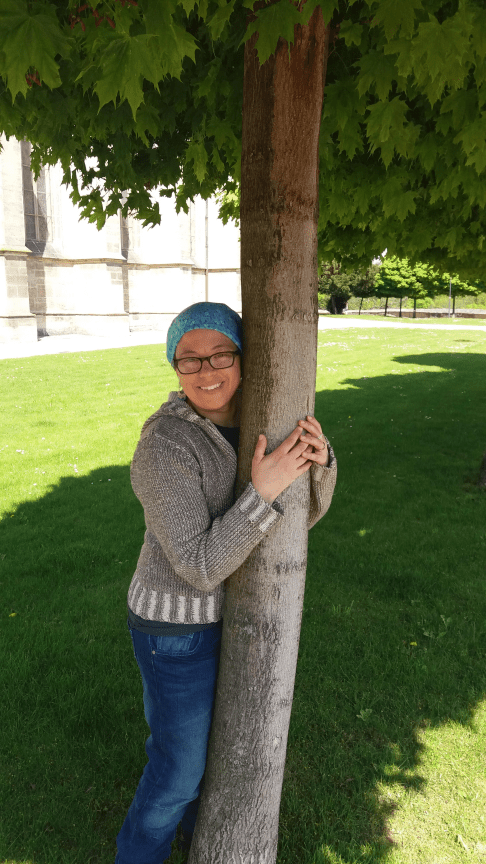 “Why is religion important to ecofeminism?”
 In March of 2011, at a symposium on trauma, healing, and spirituality in Belfast, Ireland, I spoke about shame in the context of war, addressing the experiences of women survivors of rape during the Rwandan genocide, US soldiers returning from war with PTSD symptoms, and cultures, such as those in Belfast and Bosnia, steeped in war and violence. While discussing how theology has a responsibility to examine how the church talks about shame, guilt, and sin to help survivors of war trauma heal, I recognized A. Denise Starkey in the audience, a woman whose work was instrumental in the crafting of my own. Her book,
  Back in August when I was applying for yoga certification, I discovered, in my search for our textbooks, the
  Christmas morning. I don’t usually have Sundays free and our family holiday celebrations lean nontraditional, so I’d come to a special ecstatic dance celebration and brought my 9-year-old daughter with me. As the music started and people all around us began to flow and move, I reached out to touch her hand. As if she’d been doing it for years, she shifted into a beautiful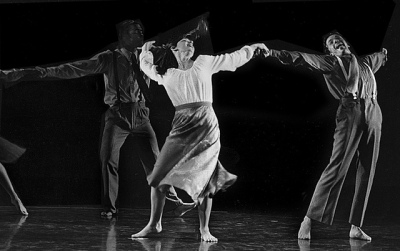
 I am writing this blog on New Year’s Day, so Happy New Year! Today I say these words as both a statement of hope and as invocation. Happy New Year: may it be! My twin sister told me that our horoscope said that 2017 would be a party: we should throw our energies into anything and everything we want to see happen in our worlds because it can and will happen this year—may it be! Because it certainly doesn’t feel like a time for flourishing. I echo the introductory sentiments of
