Grievances Against the GOP from a (former?) Republican Woman by Katie German

I was raised in a conservative, Republican, military family. I support personal freedom and personal responsibility. I support the military. I support a balanced budget. I support individual rights and the constitution. I support small government. But I find myself increasingly separated from the Republican Party, and this is why:
 
I cannot align myself with a party that repeatedly acts to restrict the rights of women, to deny women protection from abuse and violence, and to trample the rights of women to make their own medical decisions. I cannot support a party where individual rights and freedoms are only protected for people with a penis (so long as they are not gay). 
On February 16, 2012, there was a hearing by the Oversight and Government Reform Committee regarding the Affordable Care Act, which concerned the availability for contraception through insurance provided through religiously-affiliated employers. Out of the ten witnesses called, only two were women. When other representatives asked that other female witnesses be called to testify regarding contraceptives, Chairman Darrell Issa refused their request on the grounds that the scope of the committee was limited to the 1st Amendment implications and not to the matter of contraceptives themselves.
 
Republicans in Virginia, Oklahoma, Colorado, Wisconsin and Mississippi have advanced “Personhood” acts/bills declaring that a fetus has the full legal rights of a person, beginning at fertilization. Such laws would make in-vitro fertilization, stem-cell research, the morning-after-pill andall abortions (medically necessary or not) illegal. It could also be interpreted to make standard birth control options such as the Nuva ring, the pill, IUDs, and birth control patches illegal. Democrat Vivian Watts in VA attempted to amend the bill in Virginia to specify that contraception would not be banned under the Personhood bill, but Republicans voted 64-34 against adding this amendment. Any abortion or even cases of miscarriage due to negligence could be charged as manslaughter or homicide. Another attempt at amending the bill was proposed by Democrat Jennifer McClellan on Feburary 13, 2012. Continue reading “Grievances Against the GOP from a (former?) Republican Woman by Katie German”

In memory of Adrienne Rich, Lesbian Poet (1929-2012) by Kittredge Cherry


I light a memorial candle for lesbian feminist poet and essayist Adrienne Rich, who died March 27, 2012 at age 82.

Rich was one of the most influential poets of the 20th century. Her writing was a guiding light to me and countless others, both people of faith and secular readers. The following lines from her poem “Natural Resources” (from The Dream of a Common Language: Poems 1974-1977) became like a creed for many of us:

Continue reading “In memory of Adrienne Rich, Lesbian Poet (1929-2012) by Kittredge Cherry”

My Feminist Perspective of Authority – Part 1 by Elise M. Edwards

I make a distinction between power and authority.  Authority is a personal characteristic based on a relationship of trust between me and a text, a person, or their work.  Power, on the other hand, is operative with or without trust.

This past weekend, I had the honor of participating in a workshop on Living Texts: Celebrating Feminist Perspective and Theo/alogy, Authority, and the Sacred in the Academy.  The workshop was organized for the Women’s Caucus of WECSOR, a regional association of national organizations who study religion.  I was delighted to connect with new friends, mentors and sisters interested in feminism and religion, including some of my co-contributors on this site –Theresa Yugar, Sara Frykenberg, and Corinna Guerrero .  There were two panels that shared our reflections about authority from either student perspectives or diverse professional perspectives.  I shared my experiences as a student.  This workshop was a gathering where women scholars in religion could discuss the challenges and promises of our voices in the academy.  Because our dialogue was so inspiring to me, I thought I’d continue the discussion here. Continue reading “My Feminist Perspective of Authority – Part 1 by Elise M. Edwards”

Breaking Up with Bad Stories by Sarah Sentilles

Writing a memoir meant denying stories about myself that are no longer true.

Note: This post is part of  a Religion Roundtable where the authors of three prominent faith memoirs were asked to write about their views on—and experience of—female spirituality. Check http://www.patheos.com to read the discussion between Jana Riess, Lauren Winner, and Sarah Sentilles on the unique religious questions facing women today.

Dear Jana and Lauren,

Jana writes that “Mormon women don’t yet have the luxury of taking their own voices for granted,” and while I recognize that Mormon women are in a different political/theological position than other women, especially in demonimations that ordain women, I would like to expand her statement: No woman—anywhere, in any tradition, or on the outside of any tradition—has the luxury of taking her own voice for granted.

Jana worries that writing with a political agenda in mind could make our work smack of propaganda, and I think she is right, but I want to propose that all language is propaganda. Especially theological language. Our words about God are shot through with intentions and agendas; they convey people’s purposes and hopes and fears; and they have real effects. Continue reading “Breaking Up with Bad Stories by Sarah Sentilles”

The Legacy of Original Intentions: The Non Violence of Wonder Woman by Nick Pumphrey

What would a superhero comic be without Pow, wham!, Zap, and even a Boom! (insert your own campy sound bites from Batman).  Oddly enough, when psychologist William Marston created the character of Wonder Woman, he did not intend for her to be a violent character.  When villains shot their mere bullets, she simply would deflect them with her indestructible bracelets.  Instead of stooping to the level of her attackers, she would wield the lasso of truth, capture her foes, and force them to admit their malevolent deeds.  Meanwhile, creator William Marston was actually developing the first polygraph using changes in blood pressure as exemplified in Wonder Woman’s lasso.  Wonder Woman was not the first female superhero; however, she was the first non-violent one.  While other writers like Siegel and Shuster (Superman’s creators) were using their religion as inspiration, Marston drew on the women of his life as example.  He intended to have a peaceful, warrior woman, who was more than equal on grounds of “sex,” and could stop the tyranny created by war and hatred (i.e. men) without having to embrace it.  He wanted an example for young girls to idolize and a way for boys to embrace feminine power.   Continue reading “The Legacy of Original Intentions: The Non Violence of Wonder Woman by Nick Pumphrey”

ON NOT GETTING WHAT WE WANT AND LEARNING TO BE GRATEFUL FOR WHAT WE HAVE BY CAROL P. CHRIST

Many women’s dreams have not been realized. How do we come to terms with this thealogically?

Although I am as neurotic as the next person, I am also really wonderful—intelligent, emotionally available, beautiful (if I do say so myself), sweet, caring, and bold. I love to dance, swim, and think about the meaning of life. I passionately wanted to find someone with whom to share my life. I did everything I could to make that happen—including years of therapy and even giving up my job and moving half way around the world when I felt I had exhausted the possibilities at home.

For much of my adult life I have asked myself: What is wrong with me? Why can’t I find what everybody else has? Even though I knew that there were a lot of other really great women in my generation in my position and even though I knew that many of my friends were with men I wouldn’t chose to be with, I still asked: What is wrong with me? Continue reading “ON NOT GETTING WHAT WE WANT AND LEARNING TO BE GRATEFUL FOR WHAT WE HAVE BY CAROL P. CHRIST”

Feminism In Theology By Andrew Tripp

At the outset, I need to name and own my identities as a large white male. I have privilege and voice that makes me hesitant to even write to the audience of this blog. While I consider myself a feminist, I have met some who have told me that as a man I cannot be a feminist. Such folks have told me that I lack the existential knowledge of the systemic pressure put on women, and at best I can be an ally.  With that said, if it was not for feminism in theology, I do not know if I could be a theologian.

When I first began attending church as an adult, I went because I hungered for community, for authentic relationships. My tradition has more female clergy than male clergy, and like many churches, the mothers of the church often have been the true leaders. The church I grew up in had a female board president, a female pastor, and I grew up assuming female leadership was part of religious life. For me, religion was about community and I was far more certain of my salvation through community and relationships than with any kind of doctrinal stance. Then I came to seminary, and saw just how different my experience had been from most folks. Classmates were part of traditions that might ordain women, but wouldn’t provide them with the opportunity for prestigious positions. Professors made blatantly sexist comments, and this was in a “liberal” school. Continue reading “Feminism In Theology By Andrew Tripp”

On Being in the Moment By Ivy Helman

Time.  We mark years, months, days, hours, minutes and seconds. We mark seasons.  We mark life events.  We live our lives in time: both circular and linear.  Time began before we did and time will continue after we cannot experience it any further.   Some say we repeat time with rebirth.  Others suggest that we only have one lifetime of which we should make the most.  Still others suggest there is existence outside of time with concepts like infinity and eternal life.  We sure do write, discuss and ponder time a lot, but do we ever really experience it?  Meaning: what would it be like to live in the moment, to be aware of and completely conscience within an instance of time, not thinking of the past, not worrying about the future, but being fully present in the here and now?

Sci-fi geek that I am, I often recall the Star Trek: The Next Generation movie entitled Insurrection when Captain Picard and Anij discuss experiencing a moment of time.  Anij explains to Captain Picard, “You stop reviewing what happened yesterday. Stop planning for tomorrow. Let me ask you a question. Have you ever experienced a perfect moment in time?”  A few lines of dialogue later, she picks up the topic again by describing what being present is like. ”We’ve discovered that a single moment in time can be a universe in itself. Full of powerful forces. Most people aren’t aware enough of the now to even notice.”  The visual effects show water stopping and a butterfly’s slow flight if I remember correctly.  Captain Picard is obviously caught up in these moments of time as well as being mesmerized by Anij herself.  The power of both the moments of time and Anij herself is palpable. Continue reading “On Being in the Moment By Ivy Helman”

The First Casualty Of War by Daniel Cohen

This is the tale of the first death in the Trojan War.

The Greek army was gathered in Aulis. Its men had come from many towns and islands. Some were there with dreams of glory, some with dreams of gold. Others were there because their chief had demanded their presence, and either loyalty to the chief or fear of him had brought them.

The fleet was waiting and the soldiers were ready to embark. But for weeks now the wind had been blowing from the wrong direction, and the men were getting restless at waiting so long. They were beginning to think of the harvest – they had expected that the war would be won long before harvest time – but that was now so close that many men were making ready to go home, and some had already gone.

Agamemnon, the leader of the Greek army, was fearful that the conquest and glory he sought would escape him if the winds continued contrary. And so he consulted the seer Calchas. After much searching the seer replied, “The goddess Artemis sends you a warning. If you wish to make war against Troy, you will have to kill your daughter.”

So Agamemnon sent for his daughter Iphigenia, pretending to her and her mother that he planned to marry her to the hero Achilles. Continue reading “The First Casualty Of War by Daniel Cohen”

Is Baptism a Male Birthing Ritual? By Michele Stopera Freyhauf

Quite a number of years ago I had a conversation with one of my professors, a feminist theologian, who posed the question “Why do I need a man to purify my baby with the waters of baptism?  Is there something wrong or impure about the blood and water from a mother’s womb – my womb?”  Before you jump and shout the words Sacrament or removal of original sin, this question bears merit in exploring, especially in today’s world where women are taking a serious beating religiously, politically, and socially.  In today’s world, violations and rants are causing women to stand up and say STOP!  This is MY Body.  This outcry was provoked by chants of ethical slurs against women– Slut! Prostitute! Whore!  The cry got even louder when the issue of religion and government was raised in the fight of healthcare coverage of contraception. The cry got even louder with the enactment of the laws in Virginia and Texas (and many other states to follow suit) that forces women to undergo transvaginal ultrasounds in early stage abortions.  The mandatory insertion of a wand into a woman’s vagina (mandated by the government, mind you), is a violation and has women crying RAPE!

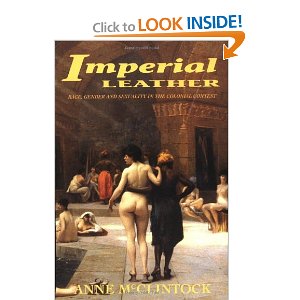
The memory of this conversation did not re-appear by chance, it was prompted by a book I read for my History of Sexuality Class – Imperial Leather: Race, Gender, and Sexuality in the Colonial Context by Anne McClintock who addresses the notion of baptism through origins, property, and power.  So many things are currently being taken away from women and reading McClintock’s assertion regarding male baptism is perplexing.  She believes that male baptism or baptism by a man takes women’s role in child bearing and diminishes it.  These are the same men who historically treated and regarded women as vessels.  She further asserts that this act is a proactive removal of creative agency with respect to a woman’s ability to have the power to name.  That is, the last name of the child belongs to the husband.  A point that supports the notion that patrimony marks the denial of women.  Anyone doing genealogy encounters a perplexing struggle to identify mothers because their names are essentially erased from memory and rarely attached to a child’s name. Continue reading “Is Baptism a Male Birthing Ritual? By Michele Stopera Freyhauf”