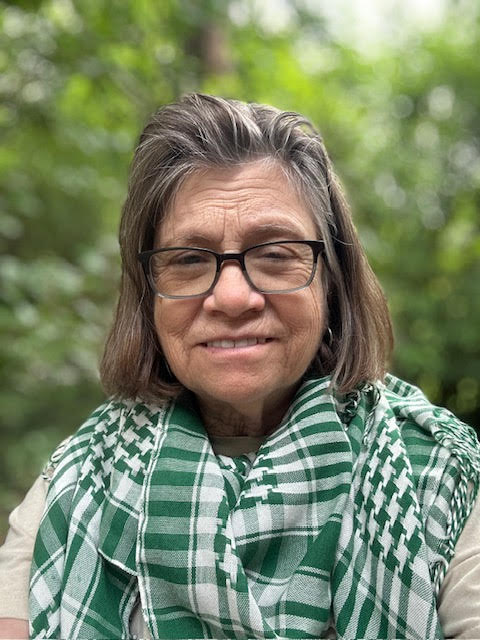
NO Kings Day Protest – Lakewood, CA by Marie Cartier 

Note – usually we have a Carol Christ Legacy post on Mondays. Today we have a post in the spirit of the elections taking place this week across the United States.

October 18, 2025

Largest single day protest in US history- over 7 million people- 2700 + gatherings

P.s. That’s my wife in the inflatable bear costume– NO KINGS and YES ON 50!

Continue reading “NO Kings Day Protest – Lakewood, CA by Marie Cartier “

Samhain and the Goddess by Judith Shaw

The wheel of the year is turning us once again toward the dark half of the year. Here in the United States, the bright, shining days of youth and achievement receive the most attention. Death and darkness are rarely honored and often feared.

But the ancient Celts had a completely different view of their place in the world. With a strong belief in reincarnation, the Celts saw death as simply a point of transition in a very long series of lives. People honored the darkness of both night and winter as starting points. In the Celtic worldview a day began at sunset, not sunrise, and the New Year began on Samhain, October 31—the midpoint between Fall Equinox and Winter Solstice.

Samhain, one of the four great fire festivals of Celtic tradition, might have begun long before the Celts arrived in Ireland under the influence of an ancient goddess, Tlachtga (tclak ta). She was most likely from the time of the Fir Bolgs, (fair bolak) the Bronze Age inhabitants of Ireland from the East, and later incorporated into the Celtic pantheon.

Tlachtga--celtic-goddess-painting-by-judith-shaw
Tlachtga, Celtic Goddess of Sun & Lightning, gouache on paper
Continue reading “Samhain and the Goddess by Judith Shaw”

Dancing for the Ancestors: Ahouache Dance in Southern Morocco by Laura Shannon

This autumn I am once again in southern Morocco, bringing friends and students to experience traditional Berber women’s dance and culture. 

The Berbers or Imazighen* are the indigenous people of North Africa, who have lived for at least 12,000 years in the Maghreb region (Morocco, Algeria, Tunisia, Libya, Mauritania, and Western Sahara). Within this vast area, different Berber tribes follow various forms of social organisation, yet remain linked by language, culture, and a shared sense of identity. 

Among the Berbers, 

The ‘religion’ of women is expressed in the cult of the family, in religious practices performed close to their environment and in the management of clairvoyance and healing within the domain of the traditionally sacred… [The] domain of the sacred is found in the family community as it extends to the village, according to social relations determined by a spirit of collective responsibility. This is found between the living but also with the Ancestors. – Makilam

Even though the Souss Valley and Anti-Atlas mountains of Morocco where we are travelling is far from the Kabylia region of northern Algeria Makilam describes, her comments also apply here.

Continue reading “Dancing for the Ancestors: Ahouache Dance in Southern Morocco by Laura Shannon”

How Women Construct And Are Formed By Spirit: She Who Is Everywhere In Women’s Voices, part 2 By D’vorah Grenn, PhD

part 1 was posted yesterday

 How God is Constructed

During my doctoral research, I worked in the field with a Lemba co-
Researcher who remains a good friend, Dr. L. Rudo Mathivha of Johannesburg and the Northern Province.  When we sat with the women in the village of Hamangilasi, we asked Hanna Motenda, one of the interpreters and a retired schoolteacher, about the women’s concept of God. Throughout the interviews, the women’s conversations both in this village and elsewhere reflected God imaged as male.
I also asked whether the women imagine God as an external force, living in Nature or in Heaven, or as something living within themselves.

Hanna Motenda: Ourselves. God is in us.  They say God is everywhere. 
Even in Nature, when we look at anything, we see God.  Quoting others, she
added, “God is like the wind, He’s everywhere and wherever I am, He’s
there.”

Continue reading “How Women Construct And Are Formed By Spirit: She Who Is Everywhere In Women’s Voices, part 2 By D’vorah Grenn, PhD”

How Women Construct And Are Formed By Spirit: She Who Is Everywhere In Women’s Voices, part 1 By D’vorah Grenn, PhD

I dedicate this article, an excerpt from my dissertation to Rita Rosalind Kolb Grenn, Hanna Eule, Verena La Mar Grenn & their mothers,
Franziska Silberstein, Kaye Schuman and Regina Possony,
and to the Kolb, Berlstein, Bernstein, Mathivha, Sabath, Gruenbaum,
Silberstein, Lawler and Scott female ancestors.

Creator woman by Raphalalani

“She is Creator of the Universe, and of Mankind…She is Creator Woman”
– Meshack Raphalalani, Venda artist describing his sculpture, 2001

The Shekhinah1 is considered an alternative way of thinking about God in the orthodox community… not the major way of thinking about God…
but not heresy at all.  It’s right there in the tradition.
– Blu Greenberg, co-founder, Jewish Orthodox Feminist Alliance, interview, 2001

He created me in his image so he’s inside, within me.
– Hanna Motenda, Lemba translator at Hamangilasi village, 2001

Continue reading “How Women Construct And Are Formed By Spirit: She Who Is Everywhere In Women’s Voices, part 1 By D’vorah Grenn, PhD”

Threshold Time, by Molly M. Remer

Step by step,
we make our way.
Breath by breath,
we choose.
Day by day,
we see where we are.
Let us remember
that we do not really finish anything,
we tumble with the turning
which is right where we belong.

It is now
in this liminal space
between the cauldron
and the cave,
as obligation struggles
to come roaring back
into center,
that we sense what we truly need
whispering beneath the surface
of all that clamors to co-opt our time
and all that howls
to claim our attention.
Stand steady.
Inhabit your own wholeness.
Cast a one word
spell of power: return.
Step into the sacred
right where you are.
Re-collect yourself.
Reclaim your right
to your own life.
Defend your edges.
Give clarity space
to crystallize
and your own knowing
space to emerge.
It is vital,
this work of reclamation.
Hold it holy.
Let the knots unravel.
Set yourself free.

Continue reading “Threshold Time, by Molly M. Remer”

What the Woodpeckers are Trying to Tell Me by Sara Wright

Pileated Woodpecker

Every morning, I awaken to the chirp of woodpeckers. Sapsuckers, downy and hairy woodpeckers are constant visitors climbing up and down the crabapple trees. The chickadees can’t get to the feeder because as soon as one species leaves another arrives.

At first, I enjoyed woodpecker presence and their antics but during the last week I have found the escalating chirps disturbing.  Some days especially around 4 PM a pileated woodpecker joins the other three; this one is drilling a hole in the side of the cabin.

When my pileated friend started drilling on the house, I was forced to acknowledge that undealt with personal issues were being  highlighted by the behavior of these birds, and that someone in me was stuck in denial.

Since my relationship with nature is deeply personal too many sightings of any creature indicate the need to pay closer attention.

Continue reading “What the Woodpeckers are Trying to Tell Me by Sara Wright”

Legacy of Carol P. Christ: MATRIARCHY: DARING TO USE THE “M” WORD

carol-christ

This post was originally published on Feb. 17th, 2014.

For me the word “matriarchy” expresses the certainty that “another world” can exist—a world not based in domination and hierarchy or violence and war. 

The word “matriarchy” makes people’s hair stand on end as they imagine the mirror-image of patriarchy: societies in which women dominate men, beat men, rape men, hold men as slaves, and demand obedience from men.  Some who do not protest very loudly or at all against patriarchy are horrified by the very idea of matriarchy. To be fair, most feminists have also been schooled not to use the “m” word.

Early in my academic career, I read “The Myth of Matriarchy” by Joan Bamberger and learned that the idea of matriarchy gone wrong has been used by men to justify patriarchy. From other academics I learned that in matrilineal societies, uncles have a great deal of power—so therefore there never was a matriarchy.  I was also aware that Jungian and other proponents of a “matriarchal stage” in the development of culture have argued that matriarchy had to be succeeded by patriarchy in order for societies to evolve to a “higher” stage. Unlike many of my colleagues I stubbornly held onto the belief that there must have been “a better way” prior to patriarchy. Continue reading “Legacy of Carol P. Christ: MATRIARCHY: DARING TO USE THE “M” WORD”

God is a Midwife by Halley Kim

It was four in the morning in the north Georgia mountains. A woman labored quietly but powerfully in her home, with her partner at her side. Her watchful midwife hovered nearby. I was a nursing student and a zealous “birth junkie,” tickled pink by the invitation to observe childbirth. At just the right time, the mother delivered her child from her womb to the world. The sun rose with a new soul suddenly among us, and I knew I would never be the same.

Feminist theology has long-invoked the image of God as a laboring mother, and progressive theologian Marcus Borg suggested that humanity is God’s midwife. But less has been written about the opposite metaphor. Imagine that we are in labor, in pain, and God is our midwife. 

The word “midwife” means “with woman,” and that’s what midwives do: they are with birthing people through it all. They empower and guide, safeguard and witness, but they do not save. Midwives facilitate the birth process, but they don’t—they can’t—take the pain away. They don’t deliver babies; that honor belongs to their clients. Like physicians, they monitor the health of parent and baby, and can deftly manage a cord around a baby’s neck or stop a postpartum hemorrhage. But they mostly rely on the power of presence to bring babies earth-side. 

Continue reading “God is a Midwife by Halley Kim”

From the Archives: Matthew Shepard Is a Friend of Mine – Part II…by Marie Cartier

This piece was originally posted on November 2, 2013. Part I published yesterday.

The day after his death, I went to teach Gender Women’s Studies (then Women’s Studies) and I cried in front of my students and then sang to them because I didn’t know what else to do. So in 1998 I sang a 1975 Holly Near  song to my students, “It Could Have Been Me,” about the Kent State massacres and murder of Chilean poet Victor Jara. “And it could have been me, but instead it was you./ So I’ll keep doing the work you were doing as if I were two…/If you can live for freedom, freedom, freedom, freedom! …if you can live for freedom, I can, too.”

Continue reading “From the Archives: Matthew Shepard Is a Friend of Mine – Part II…by Marie Cartier”