

Today the hawk is back, tail feathers lit gold and black by a bright and welcome sun. It stays only a moment before tilting out of the tree and continuing on its way, but this moment is enough to spark a sense of joy and wonder in my chest, the awake kind of glee that fuels and feeds me, that inspires and holds me. This feels like the Year of the Hawk to me, of clear focus and intentional commitment. I watch it glide away between the trees and take a deep breath of release and freedom. I re-center myself into my body and reconnect to the sacred What Is. I am open to clarity. I am open to trust. I am present with this day’s unfolding.
Continue reading “Listening to Our Landscapes, by Molly Remer”Star Beings? by Sara Wright

The well-known writer LESLIE MARMON SILKO has a very interesting idea – that star beings come to earth crossing over occasionally when the membranes of parallel worlds are more permeable than usual. She painted some star beings and they spoke to her without words…. Some were not friendly; most of hers lacked compassion and didn’t care much for human beings.
This made me think about astrology, a very popular cultural belief system that has ancient origins involving divination and was once correlated with the stars in our galaxy and the patterns they created (the stories they might have been telling and others we told about them), but has since split away into a very fixed system that make little sense to me. However, since the 60’s popular astrology has become a kind of religion for some. Perhaps astrology is taking the place of religions of various kinds that are in a state of collapse?
Continue reading “Star Beings? by Sara Wright”Legacy of Carol P. Christ: Body, Nature, Ancestors
This was originally posted on January 23, 2012
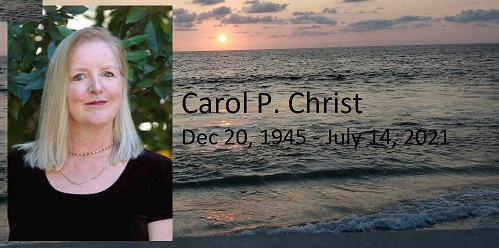
Some years ago, womanist theologian Karen Baker–Fletcher asked about ancestors following a lecture I gave on the body and nature. I have since come to realize that ancestors are a missing link between the two: we cannot speak adequately of embodiment and interdependence in the web of life without recognizing the ancestors whose lives made ours possible. Our mothers quite literally gave us our bodies. All of our ancestors gave us their genes. Care and callousness with origins going back longer than conscious memory was imprinted on the psyches of our parents and grandparents and transmitted to us. All of our ancestors give us connections to place. While many black people in America can recite oral histories that begin with slavery in the United States, I come from a family where stories of origin for the most part were not valued or told. Both of my father’s parents lost their fathers when they were very young, and my father, who was raised Catholic at a time when Catholics were discriminated against, preferred to think of our family as “American now.” Like the hero of the film Lost in America, most members of my family dreamed of “melting right into that pot.” In the process we lost stories we need to help us to understand ourselves and the complex realities that “becoming American” involved.
Continue reading “Legacy of Carol P. Christ: Body, Nature, Ancestors”The Journal Gender a výzkum/ Gender and Research

I would like to introduce this community to Gender a výzkum (in Czech) or Gender and Research (in English), a transdisciplinary, peer-reviewed journal founded in the year 2000 and dedicated to research in Feminist and Gender Studies in the Czech Republic. While the journal’s main focus is work pertaining to Central and Eastern Europe, it is open to a wide range of geographical locations and topics. The journal, which publishes articles in Czech and English, often puts out calls for individuals or groups of people to edit monothematic issues. Past monothematic issues include feminist reflections on Covid, an issue on the use of language concerning sex and gender, gender in popular culture, children, adolescence and sexuality, feminist interpretations of Islam, and postcolonial and decolonial thinking in feminist theory to name just some. If you would like to read them, the journal is available online as well as in print.
Continue reading “The Journal Gender a výzkum/ Gender and Research”Rereading Adrienne Rich’s “Compulsory Heterosexuality and Lesbian Existence” by Xochitl Alvizo

I recently reread the essay titled “Compulsory Heterosexuality and Lesbian Existence,” by late poet and essayist Adrienne Rich, with my students this semester. Published in the summer of 1980, on the heels of the Women’s Liberation Movement, I found that the essay still maintains its relevance and challenges us to remember that feminism is a political movement that itself must be continually interrogated.
The essay (which you can read here, with a foreword from Rich published 23 years after the original) has four sections which are titled only with the roman numbers I-IV. I labeled these sections for my students to try and capture the focus of each: I. Compulsory Heterosexuality – The Groundwork; II. Male Power and the Inequality of the Sexes; III. Lesbian Existence as Political Identity; and IV. Woman-Identification as Source of Power and Energy.
Continue reading “Rereading Adrienne Rich’s “Compulsory Heterosexuality and Lesbian Existence” by Xochitl Alvizo “Is “Barbie” Feminist Media?
Is Barbie a kind of counter-apocalyptic feminism? I am quick to embrace liminal violence in my own theories. Why not liminal joy or fun? Or, is Barbie just product placement?

Lately I’ve been thinking a lot about the idea of feminist media in light of all the hype around the Barbie movie and the backlash over the fact that neither director Greta Gerwig nor Margot Robbie (Barbie) received Oscar nominations. And while America Ferrera did receive a nomination for best supporting actress, a lot of critical attention has gone to the fact that Ryan Gosling (Ken) received a nomination for best supporting actor. I see the point. I understand the feminist critique here: female power is given an “atta girl,” but her creative contribution and leadership is overlooked. All that said: I didn’t really love the movie and the performance of the “I’m Just Ken,” song was my favorite part. Ferrera’s “iconic” monologue fell flat for me. Haven’t I read those words before, all over social media? The Barbie movie leaves me wondering, not for the first time, just what is feminist media?
When Game of Thrones was at its height of popularity, I saw so many online posts about the amazing female power (read feminism) of the show. But, having read the books, I took great issue with this characterization of the HBO blockbuster. Book five of The Song of Ice and Fire features, from what I recall, a double-digit number of sexual assaults against women. Every strong female in the story uses power as violence and dominance, and then of course, they are punished for it (as I wrote about in another blog). HBO’s Girls received similar feminist (and/or “post-feminist”) cred, featuring women who were supposedly friends but clearly seemed to disdain or ignore one another. Carter Hayward’s concept of “alienated power,” runs rampant in these two shows, and we enjoy it, because, as she explains, we have a hard time seeing power as anything else in a patriarchal system.
Continue reading “Is “Barbie” Feminist Media?”Maternal Thinking: Gifts, Mothers’ Bodies, and Earth edited by Sid Reger, Mary Jo Neitz, Denise Mitten, and Simone Clunie; book review by Carolyn Lee Boyd
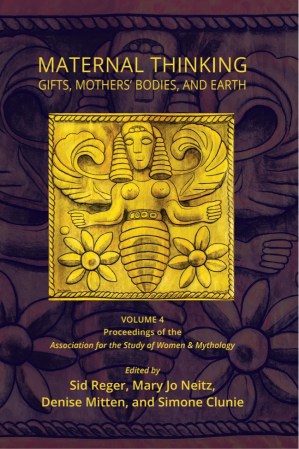
Maternal Thinking: Gifts, Mothers’ Bodies, and Earth, the fourth book of proceedings of conferences held by the Association for the Study of Women and Mythology (ASWM), is an instructional guide to saving ourselves and our planet. Many pre-historic, and even contemporary cultures, especially Indigenous communities, feature “Maternal Thinking.” Such cultures perceive that societies are successful when they center qualities associated with mothering: care, nurturance, cooperation, and meeting everyone’s basic needs while respecting the Earth and reciprocating nature’s generosity. Some 5000 years ago, Maternal Thinking was superseded in many societies by a perspective valuing instead competition, exploitation, and domination, and we and our planet are now facing the catastrophic consequences.
The fifteen contributors and four editors represent myriad disciplines and life experiences. They are academic researchers in wide-ranging fields, artists, activists, a storyteller, a therapist, scientists, educators, and more. This diversity reflects the expansiveness of the book’s vision, including many layers and facets of “mothering,” and the need for as many voices as possible to be heeded if we are to envision and birth a peaceful, just, equitable, compassionate, and environmentally balanced Earth.
Continue reading “Maternal Thinking: Gifts, Mothers’ Bodies, and Earth edited by Sid Reger, Mary Jo Neitz, Denise Mitten, and Simone Clunie; book review by Carolyn Lee Boyd”A Time of Renewal: Brigid Emerges at Imbolc by Judith Shaw
The wheel of the year continues turning and once again we find ourselves at the transition point from winter’s deep sleep to the first awakenings of spring. It is marked by an ancient Celtic festival called Imbolc, also known as Imbolg or Brigid’s day. It is believed to have been celebrated long before the Celts arrived in Ireland and Scotland, probably as far back as Neolithic times.
Continue reading “A Time of Renewal: Brigid Emerges at Imbolc by Judith Shaw”Navigating the Dark by Sara Wright
This morning I read an article about a woman who ‘forgot’ to light one of the candles on the Menorah or what I would call the ‘Tree of Life’ for the Jewish celebration of Hanukkah which takes place over a period of eight nights beginning in December. I was struck by her concern because she had forgotten one of the ‘rules’ and missed a night. Twice over a period of years…
While reading her reflection I noted that she seemed to get close to the underlying meaning behind the lighting of candles (present in every extant tradition) at the darkest time of year – she believed that she was bringing light into the literal darkness of night and kindling the divine spark within herself.
Continue reading “Navigating the Dark by Sara Wright”Legacy of Carol P. Christ: Of Human Life*
This was originally posted on December 30, 2011
Watching the last episode of the Australian series Brides of Christ in which Catherine leaves the sisterhood of the convent because of her disagreement with Humanae Vitae brought me right back to the Yale Roman Catholic chapel and the folk mass I attended regularly. In 1968 just after the publication of Humanae Vitae, priest and co-graduate student Bob Imbelli preached a sermon on the doctrine of conscience, arguing that though it was incumbent on Catholics to think carefully about the papal encyclical on birth control, it was also the responsibility of every Catholic to follow her or his conscience on the matter. In the episode, Sister Catherine encourages a Roman Catholic mother of six who has already self-induced more than one abortion to take the pill, but the woman decides she cannot go against the church’s teachings. Catherine allows an editorial against Humanae Vitae to be published in the school newspaper even though she knows it will probably lead to the expulsion of one of her favorite students.
Continue reading “Legacy of Carol P. Christ: Of Human Life*” Feminism and Religion