Solstice Stories : Fire and Ice by Sara Wright

The winter solstice is almost upon us just as the first heavy snow buries the forest and house under 28 inches of snow. I never look forward to this shift into the cold, ice, and snow, although I do wrap myself in peaceful silence, sitting by the fire dreaming as twilight turns to night. My Norfolk Island pine and tipped balsam wreath shimmer with tiny stars. The scent of balsam soothes my senses and purifies the air. This month above all others is my time to honor the trees… I am keenly aware that Bone Woman and Old Man Winter are rising with the moon, whipped up by Northwest winds.

My scientist and naturalist friend, a member of one of the seven Indigenous Sioux tribes agrees with me that winter solstice is a dangerous time, one of the reasons in the old European way that everyone is masked while acting out winter solstice stories. These tales may vary in content but all have the same root. Shadow is on the move. Masks protect the people, the risk of exposure to danger is minimized in this way.

Continue reading “Solstice Stories : Fire and Ice by Sara Wright”

From the Archives: Why Isn’t Easter Marketable? By Anjeanette LeBoeuf

This as originally posted on March 25, 2018.

A few months ago, a friend and I were having one of our many hundreds of random conversations when we started to talk about the differences in the commercialization of the two major Christian holidays: Christmas and Easter. We started really getting invested it this question and what factors lead to Christmas become the juggernaut that it currently is.

Both holidays are given official status. Christmas is a designated federal holiday due to it being permanently celebrated in the Western Christian community on December 25th. Whereas Easter shifts due to seasonal and lunar changes but is always celebrated on a Sunday, meaning it did not need to be given a designated status as Sundays are recognized by the State as a non-work day. Schools across the globe used to call it Christmas and Easter breaks. In the last 10 years, all schools have adopted the politically correct terms of Winter and Spring Breaks. Yet, they still function around the religious observances.

Christmas, it seems comes more and more early in shops. Decorations, candy, gifts, and marketing can be seen as early as September. Christmas music can start to play on radio stations and coffee houses as soon as early November.

Continue reading “From the Archives: Why Isn’t Easter Marketable? By Anjeanette LeBoeuf”

On The Baby and The Bathwater by Liz Cooledge Jenkins

It wasn’t until seminary—and even then, only sporadically—that I learned that many of the foundational figures in Western Christianity held some incredibly sexist attitudes. Somehow, in all my years of attending church, hearing sermons, participating in (and leading) Bible study groups, reading Christian books, and working in ministry, I had missed this historical reality. I just hadn’t thought about it. And the (mostly white male) Christian leaders who shaped my own faith apparently hadn’t thought about it, either. That, or they didn’t think it was important enough to talk about. Or they intentionally tried to keep it on the down low. Or some combination of these things.

In seminary, when influential theologians’ sexist views came up in class, inevitably someone would say—in a wise-sounding tone—“Well, we don’t want to throw out the baby with the bathwater, do we?”

Continue reading “On The Baby and The Bathwater by Liz Cooledge Jenkins”

The Celtic Cross and the Compassing of the Divine Womb, Part 1 by Trelawney Grenfell-Muir

No one knows why Celtic Crosses have a circle. Guesses include pragmatic utilitarianism (to hold the arms up),1 the sun, Greek laurel wreath, Egyptian ankh, circle of creation,2 the Chi-Ro Greek monogram for Christ,3 the divine light that imbues all creation,4 the “Celestial Sphere” found in earlier Eastern Christianity,5 and a range of fanciful inventions based on modern imagination and pseudo-scholarship about Celtic “paganism.” [Leading scholars of pagan history agree that almost nothing is known about pre-Christian beliefs in Britain and Ireland. The few, conflicting descriptions we have, all come from highly tendentious, frequently incorrect foreigners (such as Julius Caesar, who also claimed that German forests were full of unicorns) or from Christian writers of later periods with strong agendas of their own (such as creating a native pagan history and mythology to rival their snobby Greek and Roman “Classical” neighbors).6] The circles on Celtic crosses remain a mystery.

With that in mind, I do not suggest an historical hypothesis here; rather, I offer a theological insight from a modern Feminist Christian perspective. I ask the invitational question: “What happens when modern Christians allow Celtic Crosses to symbolize the Compassing of the Divine Womb?” 

Continue reading “The Celtic Cross and the Compassing of the Divine Womb, Part 1 by Trelawney Grenfell-Muir”

#SharetheMicNow: Social Justice and Christianity by Laurel E. Brown and Anjeanette LeBoeuf

In the midst of recent events and protests, a social media campaign entitled #sharethemicnow has emerged.  The campaign asked white people and people of influence to use their platforms, quiet their voices, and highlight, heighten, and listen to their Black counterparts. I have been honored and privileged to be a monthly contributor here at FAR for 5 years. This month’s post will be in participation with the #sharethemicnow campaign. This campaign seeks to keep the momentum for the realization and implementation of equality and just treatment for all peoples – regardless of race, religion, gender, or sexual orientation. I asked a dear friend of mine, whom I had the pleasure of working with at Whittier College, to write this post. Dr. Laurel Brown, whose discipline is in Social Work, shares with us some thoughts on Christianity and Social Justice in midst of our current issues.


Continue reading “#SharetheMicNow: Social Justice and Christianity by Laurel E. Brown and Anjeanette LeBoeuf”

I’m That Trump Voter You Hate by Trelawney Grenfell-Muir

There are people in my family who believe Christianity to be so inherently oppressive and harmful, that anyone who identifies as Christian is culpable for all of the harm done by all imperial colonization by Christian empires and nations, all harm done to Native Americans, to LGBTQ people, most slavery, racism, genocide, ecocide, and basically almost every problem the world has had for 2000 years.

Theirs is not an unusual view. I encounter this view regularly here in the Northeast US, though most people assign the blame to religion in general. For parts of my family, Christianity is the true evil because it was so popular, and thus the religion most commonly tied to violent and oppressive political leaders and structures.

I also encounter this attitude from feminists, quite frequently. According to many feminists, I am everything that is anti-feminist and misogynist… precisely, solely because I am Christian.

Continue reading “I’m That Trump Voter You Hate by Trelawney Grenfell-Muir”

Re-Imaging Three Marys by Janet Sunderland

The recent #metoo movement, along with young women entering Congress, has pointed to an important question. Why, in this 21st Century, are these achievements remarkable? Why has it taken so long for women to be recognized as capable for these positions? One possible reason is the Christian mythology around women. However, to recreate the way women are viewed, we must re-imagine the women who have been standard-bearers for two thousand years.


Continue reading “Re-Imaging Three Marys by Janet Sunderland”

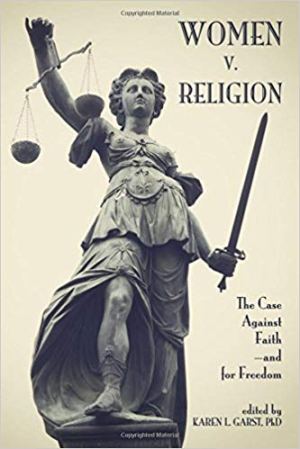
Women v. Religion: The Case Against Faith and for Freedom BOOK REVIEW by Katie M. Deaver

In the book, Women v. Religion: The Case Against Faith and for Freedom, editor Karen L. Garst puts together the voices of women from a variety of backgrounds in an effort to present a case against faith.

While the introduction to the full volume suggests that women ought to turn away from all forms of religion the majority of the individual pieces that the book features focus on the Abrahamic religions: Judaism, Christianity, and Islam.  The included pieces are written from a variety of disciplines and viewpoints, some feature historical facts and timelines, while others are the raw and difficult personal stories of women struggling to leave the religions they were raised within.

Most of the articles dig into many of the traditional critiques of religion.  For example that the Abrahamic faiths are inherently patriarchal, and cannot be redeemed for women.  Others take these traditional arguments against religion a step further and argue that in addition to religion being a tool for female subjugation, religion has in fact inhibited Western progression and is a key reason why the United States has not yet had a female president, and why women continue to have to fight for their bodily and human rights.

Continue reading “Women v. Religion: The Case Against Faith and for Freedom BOOK REVIEW by Katie M. Deaver”

Why Isn’t Easter Marketable? By Anjeanette LeBoeuf

AnjeanetteA few months ago, a friend and I were having one of our many hundreds of random conversations when we started to talk about the differences in the commercialization of the two major Christian holidays: Christmas and Easter. We started really getting invested it this question and what factors lead to Christmas become the juggernaut that it currently is.

Continue reading “Why Isn’t Easter Marketable? By Anjeanette LeBoeuf”

God Says No Moore by Gina Messina

Doug Jones victory in the Alabama Senate election last Tuesday is certainly something to celebrate. Although many claimed God supported Roy Moore for Senate, his defeat says otherwise.

However, it must be noted that this narrow victory ended with 48% of the vote in Roy Moore’s favor. In addition, 80% of white evangelicals cast their votes for Moore. This begs the question, what should our votes be based on, particularly if we are claiming the Christian faith as the foundation of our values? While we should all value the separation of church and state, and it is true that government needs to be protected from religion, sometimes religion also needs protecting from government. Continue reading “God Says No Moore by Gina Messina”