Bible Believing Church Sign by Michelle Bodle

A dear colleague is retiring from ministry this year. As I often do at times of celebration, I think about the most meaningful conversations, questions, and impact that person has offered my life. As I was thinking of this colleague in particular, what came to mind was a statement that made to him that sparked a conversation that has been ongoing between us for almost a decade: “That church is not for me.”

            My friend talked about driving his motorcycle down a well-traveled highway and seeing church after church. If you know churches, you know that church signs can be anywhere from enjoyable to problematic. Some church signs try to convey witty messages, but they often miss the mark. Other times, a church speaks of its beliefs or current sermon series, using insider churchy language that does not hit with those whom the sign may be trying to reach in the first place. But church signs do exist for a purpose – to catch the eyes of travelers, which was undoubtedly the case with my colleague. 

            “I was driving down this road, and the sign that caught my attention said, ‘Bible Believing Church,’ and I’ve been thinking about that repeatedly,” he stated. I replied that I didn’t need to think about that sign; I knew exactly what it was trying to convey—that I was not welcome there. 

Continue reading “Bible Believing Church Sign by Michelle Bodle”

Celibacy Is the Lynch-Pin of Male Dominance according to Matilda Joslyn Gage by Carol P. Christ

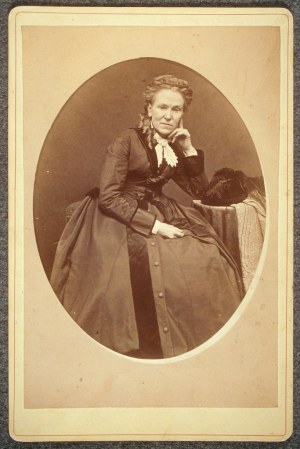
Matilda Joslyn Gage

Matilda Joslyn Gage was an activist in the nineteenth century struggle for women’s rights equal to Susan B. Anthony, and a writer and theorist equal to Elizabeth Cady Stanton. That she is not remembered is due in large part to Susan B. Anthony’s efforts to write her out of history.

Matilda Joslyn Gage was also a scholar of women’s history unrivaled in her time. In Woman Church, and State, Gage argued that “the most grievous wrong ever inflicted upon women was in the Christian teaching that she was not created equal with man.” (page 1) From this it follows that feminists must never lose sight of the role Christian teachings have played and continue to play in the unequal treatment of women.

According to Gage, women’s position in church and state did not improve in the Christian era. To the contrary it declined! Gage proved this thesis in chapters titled: The Matriarchate, Celibacy, Canon Law, Marquette, Witchcraft, Wives, Polygamy, Woman and Work, and The Church of Today. Continue reading “Celibacy Is the Lynch-Pin of Male Dominance according to Matilda Joslyn Gage by Carol P. Christ”

PENTECOST a time to FILL THE WORLD WITH SPIRIT by Mary Jane Miller

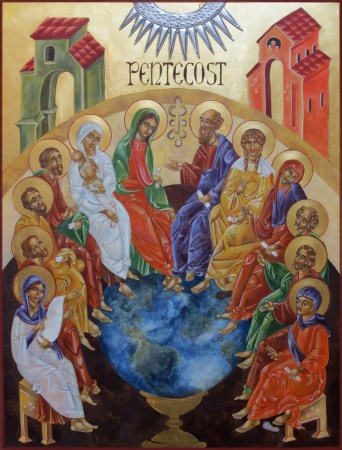
Pentecost is followed by Ordinary time, the longest season of the church year. It gives us plenty of time to think about what happened when the Holy Spirit descended on the Apostles. I have always loved the idea that this one moment changed us, it was and is the fulfillment of God’s promise to pour out the Holy Spirit on all flesh, empowering diverse people to exercise divine power. It is commonly understood that the first to receive the power from on high are the male disciples, “locked in a closed room for fear of persecution.” Apparently these Jewish disciples were not too worried about their wives and children.

After painting several Pentecost Feast Day icons as an artist, iconographer and child of God I cannot remain silent with what I think the icon has taught me. It feels obvious that the great gift of the Holy Spirit was for all of humanity. I want to commemorate an ongoing Pentecost, a time to fill the world with spirit, where women and children are invited into the closed room and given a rightful place at the table. Images have a great deal of influence in opening the heart and the mind. Imagine a new contemporary understanding of divine light touching all human beings as well as the planet.

The Spirit Descending

A half circle of twelve descending rays is commonly found at the top of any Pentecost icon. This representation is critically important for the beginning of our narrative. “Then there appeared to them divided tongues, as of fire, and one sat upon each of them.  And they were all filled with the Holy Spirit and began to speak with other tongues, as the Spirit gave them utterance. (Acts 2:2-4)

Imagine that these rays represent the uncreated energies filling the universe, the same rays any of us might feel when touched by grace. These divine rays envelope us as they come from beyond time and space.

Continue reading “PENTECOST a time to FILL THE WORLD WITH SPIRIT by Mary Jane Miller”

The Power of Love by Marcia Mount Shoop

Love does not create powerful empires or concentrations of wealth or military might. Love is not what fuels the tanks of commerce or political clout or financial success. Many would say that love slows things down, mires us in complication. Love is not the way the successful and the effective move–it’s not fast enough, it’s not ruthless enough, it’s not excellent enough.

It’s no coincidence that women have often been seen as the carriers of love–the mothers of how we are loved and how we wish to be loved. The domain of women has been traditionally seen as “behind the scenes.” Women are the nurturers, the familiar narrative goes. Women are the ones who provide a soft landing after a hard day, an understanding ear for all the stresses of the world “out there.”

The extended narrative is that women will have to become masculinized to “play the game” of public life. Women will have to learn to be “like men” in order to compete, in order to win, in order to make an impact. Underneath these narratives of nurture and impact are the contours of power in patriarchy. Imprinting women with the responsibility to love in a context where love is secondary or even tertiary to things like aggression and competition, means women will often relegate themselves to the margins of public power. Not because we think we should be powerless, but because that’s where we often feel the most at home. And sometimes ceding public power can feel like the price women pay to truly love–to love ourselves, to love who we love, and to love the world around us. The contours of power in patriarchy can distort not just women’s lives, but everyone’s lives in ways that carry the weight of this distortion of love.

These gendered expectations of how and where love gets to live and move and breathe in this world distorts the power that love brings with it. After almost ten years of life working from the margins of institutions (church and academy) as an independent scholar and “freelance theologian” I have felt the push back about love as a respectable methodology and mode of operation enough to recognize it quickly.

Institutions often answer my invitation to a loving attentiveness to bodies, particularly to traumatized bodies, with legalities and anxieties: the language of “boundaries,” “reporting laws,” and “misconduct” can shut down work or conversation. The patriarchal hyper-sexualizing of love makes it a no-no or at least something to be feared as a slippery slope in institutional life. In ecclesial settings, where love is supposed to define our mode of operation, these conversations rapidly find their way to sin and human failure. Love is “in spite of” who people are, not because of who they are. Love is impossible without lots of grace and patience and overlooking the problematic things that people do. Love is, if we’re honest with ourselves in these contexts, a real chore in this iteration of its nature. And people default into feeling like a burden, not wanting to bother anyone with their problems, and feeling ashamed of who they really are.

Love is about trust: trusting a moment, trusting a space, trusting each other. And love struggles in contexts where spaces, moments, and people are not trustworthy. So many with whom I work in consulting, retreats, spiritual direction, and teaching struggle to trust and to love. They struggle to trust and love anything because they have encountered so many untrustworthy spaces along the way. The competitive intensity of doing good work can translate into a diminishing and demeaning cycle of “never enough” and the need to protect and defend.

It is amazing to witness what happens to people when they realize they can trust a space–even if it is just a temporary space, a pop-up beloved community where you can really be yourself and won’t be judged or scrutinized. The conventional standards of excellence might suggest such settings work from the lowest common denominator and the generated “product” will suffer from a lack of competition or lack of scrutiny. On the contrary, I see over and over again the beautiful things people can be and do and say and feel when they are loved and accepted. Art, poetry, unique insights, oratorical wisdom, powerful music, deep healing, a sense of freedom, clarity, creativity, peace, support, friendship, and good work all emerge in startling and potent ways when people encounter trustworthy love.

The academy and the church define themselves as places where people can learn and grow and find community. These institutions were formed by patriarchy, but are they doomed to reiterate the diminishing returns of patriarchy forever? Their aspiration is to help people find their way in the world in the most constructive ways they can. And in the world today, people need trustworthy love to truly find the music of their soul. The power of love can transform the spaces of enlightenment and ecclesia into truly collaborative, supportive, loving places of work. Far from screeching to a halt, these spaces might finally hit their stride.

Marcia Mount Shoop is an author, theologian, and minister. Her newest book, released MMS Headshot 2015from Cascade Books in October 2015, is A Body Broken, A Body Betrayed: Race, Memory, and Eucharist in White-Dominant Churches, co-authored with Mary McClintock Fulkerson. Marcia is also the author of Let the Bones Dance: Embodiment and the Body of Christ (WJKP, 2010) and Touchdowns for Jesus and Other Signs of Apocalypse: Lifting the Veil on Big-Time Sports (Cascade, 2014).  Find out more at www.marciamountshoop.com


It’s All About the Story by Esther Nelson

esther-nelsonEvery August my friend and colleague, Dale, preaches–does pulpit supply–at his local parish (St. Mark’s Episcopal) in our hometown.  He always has something valuable to say so I ventured forth eagerly on a recent Sunday morning to hear him even though “church” is something I gave up years ago.

Dale began his sermon noting that the news he reads online every morning while striving to keep an “ordered” and “routine” life is overwhelming.  Institutionalized racism, poverty, addiction, and lack of healthcare are problems that affect us all.  We live in the “wilderness”–both physically and existentially.  How do we cope?  He asserted that the Bible explores humanity’s response to what we call “the human condition” and then proclaimed, “Darkness does not have the last word.  God does.  Hope triumphs.”  Dale’s sermon reflected a perspective based on the tradition (story) he embraces–Christianity, however, the “particulars” of Biblical stories have universal themes.  One of the functions of religion is to create a “reality” that enables hope.  Dale gave three Biblical examples of “wilderness experience”–examples that included the promise of hope.  Continue reading “It’s All About the Story by Esther Nelson”

A Christian Response to Racism, Sexism, & the Rise of American Terrorism by Trelawney Grenfell-Muir

Trelawney bio pictureAs our country reels in horror at the brutal massacre of nine worshipers at Emanuel African Methodist Episcopal Church, one particularly important detail has emerged: the young man who killed those nine people entered the world of white supremacism after the object of his romantic interest rejected him and dated a black man.

According to his cousin, the experience dramatically changed the young man, led to his obsession with racist hatred, and motivated him to commit the atrocity. In some ways, the event resembles the 2014 Santa Barbara massacre, in which a young white man with strong racist tendencies massacred young women because he felt angry that women generally did not respond favorably to his romantic advances. Other mass murderers have also exhibited violent misogyny. Moreover, our country has begun to notice that most mass shootings are carried out by white males, and to point out that white masculinity may lead young men into feeling like failures if they do not achieve all the trappings of their supposedly superior race and gender identity.

My questions are: how did we, as a society, fail these young men? And how have we, as a church, failed society? And, most important, how can we help heal these diseases that are killing us? Continue reading “A Christian Response to Racism, Sexism, & the Rise of American Terrorism by Trelawney Grenfell-Muir”

This Be My Altar by Lori Tiron-Pandit

LTP Feb2015My grandmother took me to church often when I was a child. It was not my favorite activity. The village church, surrounded by the graveyard, was cold and gloomy, and the priest demanded too much undue reverence, I thought. As a consequence, I used to spend whole days devising plans of sudden sickness and disappearance acts before church time.
One summer, I must have been around seven or eight, my grandmother told me that we would be going to a monastery in a neighboring village, and there was nothing I could do or say to get out of it. I felt betrayed by fate and bereft of hope.

When we reached the Vladimiresti Monastery, I found myself in front of a tall fence of thick, whitewashed walls, over which trailed heavy clematis and morning glory vines. It was a beautiful day, with a perfectly clear sky and balmy weather, and that first image of the monastery was so perfect that it seemed almost fake, like a movie set. Continue reading “This Be My Altar by Lori Tiron-Pandit”

From Evangelical Christianity to Feminist Evangelism by Andreea Nica

AndreeaI always knew I was a feminist, despite my lack of knowledge in the movement and philosophy growing up. I did, however, have the religious support of my family and community to be an Evangelical Christian. I knew all the right words, mannerisms, and behaviors to represent myself as the proper Christian woman. I went on mission trips abroad, wore purity rings, attended sexual purity retreats and church camps, prayed fervently, spoke in tongues (glossolalia), contributed 10 percent of my meager earnings, and above all, fell in love with God.

As a first-generation college student, I was thirsty for knowledge and ready to take on the world. Some of my favorite courses during my undergraduate career included: “Psychology of Women,” “Women, Gender, and Ethnicity,” and “Psychology of Sexuality.” My coursework in gender, sexuality, and the social sciences compelled me to pursue graduate studies in gender, culture, and media at a university abroad. My studies in gender theory and feminist philosophy, and how it intersects with religion and social institutions ignited my spirit.

As a result, my relationship with god suffered. My newfound feminist beliefs were not solely to blame, however. Rather, a variety of reasons contributed to my detachment from god and the Evangelical church which I explain in my post, “Leaving Behind My First Love.” My new feminist identity was the main driver for questioning my relationship with god. Everything from the male-dominated language and rhetoric used in the church, to the discrimination and prohibition of female pastors, to the stringent gender roles expected of congregants. Continue reading “From Evangelical Christianity to Feminist Evangelism by Andreea Nica”

Christian Sex Ain’t So Vanilla by Andreea Nica

Andreea Nica, pentecostalismMy recent literary digests have included memoirs and nonfiction audiobooks on sex, relationships, and non-monogamy. A recent listen, Open: Love, Sex and Life in an Open Marriage by feminist activist Jenny Block, provides insight into the paradigmatic features of open marriage drawing on the personal experiences of a bisexual woman. Currently, I’m musing over my latest read: The Ethical Slut: A Practical Guide to Polyamory, Open Relationships & Other Adventures written by psychotherapist Dossie Easton and author and sex educator Janet W. Hardy. Through my literary adventures, I can’t help but reflect on my own sexual conditioning and upbringing in the Pentecostal church.

The authors of these feminist-friendly, sex-positive books and social movements did not exist in the church I grew up in, and I feel quite saddened by this. While my sexual conditioning in the church was far from liberating, these reads have helped me realize that the religious community wasn’t as mundane as I thought. My early sex education which was conservative consisted of the anatomical and biological basics (Arizona education system, need I say more?) and early conditioning of sex morals and ethics in the church. The latter was more influential to my perception of sex, gender, and relationships. Of course the media and my peers constructed my views of sexual culture and gender norms, but the church had the greatest impact during my childhood and adolescence. Continue reading “Christian Sex Ain’t So Vanilla by Andreea Nica”

Religion: Trapped in Love Through Shame by Andreea Nica

Andreea Nica, pentecostalismI was first introduced to shame in the church. Shame paradoxically drew me closer to God, prevented me from committing sins, and helped me repress certain natural urges. The church I grew up in indoctrinated its congregation to believe that shame would transform us into true and wholehearted believers – that as carnal beings, we needed to feel both guilt and shame in order to be saved and transformed into spiritual entities.

One question that permeated my mind growing up, but I’d never dare to publicly ask:

Why would Jesus die for me when I never asked Him to? Continue reading “Religion: Trapped in Love Through Shame by Andreea Nica”