Fall is here, the leaves are changing color, the days are shortening and our ongoing natural cycle of change and transformation now moves toward the dark, quiet days of winter. Both the idea and the process of transformation have fascinated me my whole life. Blame it on my Scorpio rising. Scorpio is ruled by Pluto, the planet of transformation and regeneration. Diving deep and surfacing has always been my mode.
“Let the beauty we love Be what we do
There are hundreds of ways to kneel and kiss the Earth.”
–Rumi
Introductory note: At the end of 2016, my parents purchased a piece of land about one mile from where I already live (they live one mile further away than that). In addition to woodland and meadow, this land has two springs, three creeks, a cave, and ¼ mile of river access. While I have been deeply connected to the land of my birth, the Missouri Ozarks, for a long time, and have written about that connection in multiple past posts for FAR, this new-to-us land has offered a new opportunity: the chance to get to know another section of land “from scratch,” deeply, wildly and well, and to become wise stewards of it for the time in which it is in our care. It is also the first time I have been able to so closely and intimately observe the origin source of a body of water. Previously not giving it much thought, I now have the daily privilege of observing the source of the flow as I watch water emerge directly from the ground. First, there is simply none and then, suddenly, a deep blue pool constantly bubbling as water rises to the surface and flows away on its long, long journey to the sea. This essay is a series of three vignettes as I spend this year immersing myself in relationship with this land.
We walk along the nearly vertical hillside hanging onto small trees for support. Finally, though we almost miss it, we spy the opening to the cave nestled behind several mossy stones. The sun is still on the rise above the tree line and the rays filter through the trees so one ray is pointing directly at the cave entrance. We crawl inside, bumping our heads and scraping our backs as we wiggle into this womb in the earth. Once inside, the chamber enlarges so we can stand up. Unlike other caves we have experienced in this area, the only human signs we find are a single bottle cap, a glass bottle, and two sets of initials carved into a rock. In the dark silence we hear the sound of water dripping steadily. I make my way further into the cave, acutely aware that this is living cave and being careful not to step on the fresh, wet, cervix-shaped beginnings of new stalagmites on the floor. At the back of the cave, I find her. A Madonna-like stone column, glistening with water. In the silence of the cave, I quietly sing Ancient Mother to her, as tears well in my own eyes.
I am of this earth for this earth and by this earth.
We skirt carefully along the bank of the creek, making our way to the largest spring. Over three million gallons of water a day flow effortlessly from this small, deep pool nestled quietly in the middle of the woods. I am stunned by the magnitude of this flow as I stand there with my husband, my head resting on his shoulder, hawks wheeling overhead, redbud trees in full bloom. It has never seemed more clear to me how very “small” we are, but a blink of an eye to this spring and its countless years and countless gallons of water, not caring whether it is witnessed in its work or not, but simply, continually, creating and producing. I try to explain this feeling aloud, but words fail me. It is a humbling sensation, not a depressing one. The actual emergence of the water at this origin point of the river is nearly invisible, the continuous gentle, small popping of bubbles on its surface, the only sign that something significant is happening here that distinguishes this body of water from a pond or pool. Yet, those never-ending bubbles rapidly expand to a wide, swift-moving creek, which joins the river and another smaller spring-fed creek to continue to make their way southward across the state. We smell something sharp and see a dead armadillo by the roots of a giant sycamore. We hear a shrill cry and look up to see two bald eagles riding the currents of air high above us. We are so small. So many thousands of years of water have passed, but we are here right now.
Unfathomable eons
Glacier time
I am just a blink of an eye
But I can sit, and watch, and wonder.
We scramble along the uneven terrain on the rocky and wooded hillside, slipping, laughing, and looking. I am exhilarated by the simple thrill of exploring the world right here in front of me. We find tiny flowers. I kneel by the roots of fallen trees. We stop to admire moss on stones. We find gigantic black snake napping in the sun. A complete turtle shell. A shed antler. Each moment feels like a new opportunity to “kiss the earth.” I sing Reclaiming’s song-version of the Rumi quote over and over and as I kneel in each spot to see what it has to show me, in each, I kiss my fingers and press them to the earth. I see all the kissing going on around me…the sun filtering through branches, the fiddlehead ferns kneeling to kiss the earth, the roots wound through rocks, the trillium and bloodroot blooms pushing up between leaves, the water seeping out of the ground and flowing down the hill, the dogwood blossoms opening to the sun, the moss covering stones, the fallen trees stretched along the slope.
“And that is just the point…how the world, moist and beautiful, calls to each of us to make a new and serious response. That’s the big question, the one the world throws at you every morning. ‘Here you are, alive. Would you like to make a comment?’”
–Mary Oliver
We emerge from our walk to find morels growing alongside the path (morels are wild, edible mushrooms found for about two weeks in Missouri each spring and considered a delicacy by many). The afternoon suddenly becomes even more rewarding and we stoop and peer through fallen oak, sycamore, and elm leaves looking for the telltale conical form of these forest treats. We quickly discover that we must tune in and “listen” for the mushrooms, so to speak, or we’ll walk right by them, none the wiser. The moment I start thinking about anything else, I stop finding any. Once I settle into my body and the moment and really look at the world again, there another morel will be.
“I think this is how we’re supposed to be in the world … present and in awe.”
–Anne Lamott, Bird by Bird: Some Instructions on Writing and Life
Molly has been “gathering the women” to circle, sing, celebrate, and share since 2008. She plans and facilitates women’s circles, seasonal retreats and rituals, mother-daughter circles, family ceremonies, and red tent circles in rural Missouri and teaches online courses in Red Tent facilitation and Practical Priestessing. She is a priestess who holds MSW, M.Div, and D.Min degrees and finished her dissertation about contemporary priestessing in the U.S. Molly and her husband Mark co-create Story Goddesses, original goddess sculptures, ceremony kits, and jewelry at Brigid’s Grove. Molly is the author of Womanrunes, Earthprayer, and The Red Tent Resource Kit and she writes about thealogy, nature, practical priestessing, and the goddess at Brigid’s Grove.
Last fall, my family took a vacation to Myrtle Beach, South Carolina, where I grew up. As a child, one of my favorite places to visit was Brookgreen Gardens, a wildlife preserve that was once the winter home of Archer and Anna Hyatt Huntington. Anna was a prominent sculptor of the early twentieth century, and decided that part of the property should be sculpture gardens open to the public.
When they purchased the property, many of the trails were lined with live oak trees; Spanish moss still drips like thick honey off twisted and gnarled branches that drape over bricked pathways. As a child in the Low Country, live oaks always symbolized timelessness. They felt eternal and otherworldly, and my memories of visiting the Angel Oak near Charleston on school field trips – of throwing my legs over her lower branches, bark scratching up my scrawny legs – these are memories I still carry with me when I look to what was beautiful about my childhood. Continue reading “Knowing the Live Oaks: Finding the Balance Between Historicity and Inspiration in Neopaganism and Goddess Spirituality by Chris Ash”
Like flower growing from rock the world is full of tiny, perfect mysteries. Secrets of heart and soul and landscape guarded tenderly taking root in hard crevices stretching forth in impossible silence.
Sleeping resting waiting watching knowing that all one needs is a crack in stone and a seed of possibility…
One spring evening during my year-long woodspriestess experiment , I went for a walk through the woods with my husband and daughter and we discovered something that delighted and thrilled me. It was rock with a small, perfect flower growing out of it and it was a powerful symbol of what I learned from my time in the woods. Continue reading “Stoneflower by Molly”
This was not a normal winter. It rained and rained and rained. It was grey, grey, grey. Gale force winds blew in from the ocean, not once but many times. Several of my shutters were shattered. An olive tree fell in my garden. I pruned the dead leaves from its branches and had it hauled away. I am still in the process of pulling out a large number of plants that did not survive an unusual number of very cold days.
The soil is so saturated that streams are running where they have never been seen before, the land gives way, and boulders come crashing down the mountainsides. I have decided to remove all of my traditional shutters rather than repair them–as it is becoming clear that no shutters will survive the winds that will blow over our island in the coming years.
They say that we used to have strong gale winds of about 50 miles per hour once a year. Now we have hurricane force winds of 70 miles per hour several times each winter. I once read that Lesbos has the largest number of sunny days of all the Greek islands. We often sit out of doors wearing light jackets in the middle of winter. This year we did not.
My response to the long winter that has only just begun to give way was to stay inside. Though I said I was mildly depressed, I think deep down I was sad and angry.
Changes in the weather are normal and natural phenomena. But it is becoming increasingly evident that the changes we now experiencing are not. Climate experts tell us that because of the carbon we have released into the atmosphere of our planet, we will experience more and more extreme weather conditions.
I have noticed a decline in bees and butterflies in my garden in recent years. So far this spring there are almost none. This is not the result of global climate change, but of our failure to heed the warnings of Rachel Carson to stop poisoning the environment with pesticides.
The house martins have returned. I hear their liquid chatter as they fly above me. Freesias and irises are about to come into bloom. Pale pink, almost white petaled flowers are opening on the quince tree. Red leaves are budding on the pomegranate trees. The Judas tree burst into deep pink blossom overnight. Spring is a time of rebirth and renewal. This year is no exception.
Spring has also brought an increase in the arrival of refugees fleeing war in Syria and Afghanistan to our island. People discuss what will happen to them, but no one is talking about ending war.
Although spring is coming, it is hard for me to rejoice today. Human beings seem to be hell bent on destroying life. Right now I am holding back tears and screams because I fear that if I let them out, they will not stop.
Postscript: I will find the strength to rejoice in the regeneration of life and to redouble my commitment to save what can be saved–because we must.
The Goddess Gaia is alive In this time and in this space She speaks in sunrises And waves against the shore She sings with the wind She dances in moonlight She holds you close Your heart beats in time with hers A great, grand hope and possibility For this planet…
Over the last two months, I have been listening to a wonderful telesummit about priestesses. I am also a huge fan of the radio show, Voices of the Sacred Feminine. However, as I listen to both, I sometimes find myself wondering if walking a Goddess path is also viewed as synonymous with, “believe everything, question nothing.” Crystal essences, gemstone healing, soul contracts, past lives, spirit guides, astrology, the many realms and dimensions of the occult, mystical, New Age and metaphysical. Is wholesale suspension of logic required to join hands with the Goddess? Is deft management of the tarot essential to the priestess path? Is excavating my “inner masculine” relevant or appropriate? Must I ascribe to “enlightened” tenets like, “you are not your body,” “I am a spiritual being having a spiritual experience” and “we made an agreement to do this work before we showed up in this body at this time and place” in order to move forward? Continue reading “Thealogy of the Ordinary by Molly”
In response to a recent blog on Buddhism and feminism by Oxana Poberejnaia, I stated that while I would agree that “clinging” to an identity is a cause of suffering, I am not in favor of “giving up” identity altogether.
Oxana replied that “if you are not suffering,” then you do not need Buddhism. I responded that for the most part I am not suffering because years ago I gave up “having to have” certain things in my life. I added that I often wondered if that made me “kind of a Buddhist.”
One of the things that I gave up was the notion that I “had to have” a lover and life partner. The other was the notion that I “had to have” the job teaching graduate students in women and religion–for which I was eminently qualified.
Not having these “things” that I thought I deserved (and why not?) caused my younger self a great deal of suffering. In fact, it often seemed to me that a life without a partner and lover simply was not worth living. My suffering was so great that I considered suicide—more than once.
As a result of my first Goddess Pilgrimage to Crete (a story I told in Odyssey with the Goddess), I finally realized that I really could not control all of the conditions of my life–not through hard work, not through desire, not through mental focus, not through magic. This realization led to a major transformation in my life.
Instead of focusing on what I did not have, I began to focus on what I did have. I realized that though I did not have a life partner, I had many good friends who loved me a great deal. And though I did not have the job I thought I deserved, I had the great good luck to have written books that changed the lives of thousands of women.
I recognized that I had given up exactly the kind of “clinging” to ideas about life that Buddhists say create suffering.
At the same time, I was not drawn to the Buddhist path. I could never accept the fact that Buddha considered his wife and child an impediment to his spiritual path. Nor was I ever drawn to give up my “ego” or “identity” altogether. Later, I would write in She Who Changes that all paths of spiritual “rebirth” seemed to me to be based upon “matricide” which I defined as the idea that birth through the body of a mother into a life that includes death “just isn’t good enough.”
I consider this life to be a gift. For me a life that includes death is the only life we have. Although I too suffer the loss of those I love, I accept this as part of life. I do not expect that “I” should live forever, and in fact I consider the idea that “I” should be immortal or reborn, to be the height of folly. I do not seek to escape what Buddhists call the “cycle of birth and death” but rather to affirm the cycles of “birth, death, and regeneration.” For me it is enough to know that life will continue: I do not need to imagine that “I” will live forever.
My comment to Oxana that “I am not suffering” was belied in the days after I wrote it. I have been suffering this week as a result of the thought (and most likely fact) that I have been “cheated” by the man who sold me a new computer and promised to reinstall all of my programs and documents so that the new computer would work exactly like the old one.
This afternoon I was told by the technician who failed to turn up for several appointments that I should not contact the man who sold me the computer again, because he has my money and does not intend to fulfill his part of the contract. The technician said he would finish the work “for me” even though he would not be paid by the store owner.
I was so angry, my stomach tensed and I feared that I would fall victim to the stress for which I have been under doctor’s care in recent weeks. I was about to call the man who sold me the computer to read him the riot act, but instead called a friend to ask what I should do. She said she had also heard stories about the man who sold me the computer. We agreed that we live in the countryside with people who don’t have any idea of how to run a business.
After I hung up the phone, Oxana’s words “if you are not suffering” came into my head.
I realized that I was suffering because of the idea that because I am a person who should not be cheated or lied to. As soon as that thought came into my mind, I let go of it. I accepted that the young man who sold me the computer – whether out of ignorance or out of cunning – had cheated and lied to me. I still think I am a person who should not be cheated or lied to, but I gave up the idea that therefore, being cheated or lied to would not happen to me. I decided to pay a technician to finish the work, even though this was not the agreement I had made.
We have come to a point in the history of our civilisation where our relationship to nature seems to be more of one of destruction than of nurturance and respect. Humankind has steadily distanced itself from nature, our homes are filled with dead things, plastics, metals and chemicals. Everything around us is synthetic and manufactured in factories. Some people live their lives never touching nature – the soil, the plants, the grass. I have even met people who have a deep fear of being in nature. This distancing from nature is a reflection of distancing from our Divine Earth mother, not just as the outside world, but also as the energy of the archetypal Earth Mother within our own psyche.
Many cultures and traditions herald a Great mother, Mother Earth or Mother Nature but our connection to her, especially recently in the Western world, has been severed. In the Greek mysteries, Gaia or Gaea, the Divine Mother, was one of the primal elements who first emerged from cosmic chaos at the dawn of creation. All the later Pantheon of Gods and Goddesses are said to have descended from her initial union with Ouranos (the sky) and Pontos (the sea). Her geneology and her presence in Greek myth is full of complexities, conflicts and contrasts. Her worship in Ancient Greece did in fact decline, for her role was supplanted by the Gods of Olympus. Some scholars such as Harris and Platzner (Greek Mythology: Images & Insights, 2011), maintain that the decline in her worship and the demonizing and slaying of the snake or serpent – one of Gaia’s primordial symbols and a symbol of archetypal feminine energy, represents the death of the sacred feminine brought about by the insidious reign of a patriarchal pantheon of male gods.
Gaia is not only a figure in Greek myth however. In the 1960s, James Lovelock (2000) formulated the Gaia hypothesis. Lovelock states that all life, and all living things on this planet, are part of a single, all-encompassing global self-regulating system (he avoided the word consciousness) which he named Gaia. It is this global system of interconnection that makes our planet capable of supporting life. Further, he believes, if you live in balance with Mother Nature, health and healing are yours; violate Her laws and tip the balance, you pay the price in suffering and disease. Thus Gaia does not only represent the Ancient Greek Mother Earth and the physical planet, she also represents the forces of nature: laws and intelligences that function on every level of the cosmos. She is the very fabric of existence. Glenys Livingstone says it beautifully: “She is the eternal pulse, in which each one of us flows. Gaia is Earth, is Universe, is Ultimate Mystery, is you, is me – She is multivalent.” (from her Essay ‘Gaia as a Cosmic Name‘, 2014)
I recently taught two workshops for women ‘Painting Gaia – Exploring our Connection to the Earth’ based in my belief that disconnection and distancing from nature is an issue that needs attention. We need more than ever, at this time in history to re-connect deeply with the earth and with the feminine – regardless of faith of tradition. This re-connection that will aid in deep ways in the healing of the planet and of the self. If we are not connected, how can we care about the plight of the planet and all sentient beings? And if we are not caring, how can we take action to make a difference?
I am dedicated to taking action, raising awareness and making a difference in the ways that I know how. The intention for these workshops is to connect to Gaia through the process of visioning, painting and inquiry. Our Gaias were birthed from the cosmos and as we brought her into being we deepened our connection to Her, within and without. We also strengthened our commitment to healing the earth in a capacity that is manageable. Some, including myself, expressed feelings of being overwhelmed by all the atrocities we are flooded with on the news and in social media forums. In this context, our goal was to become more mindful of our actions and choices. The workshop also called us to a deep, primal remembering of Her eternal presence, from the cosmos to the core.
It was apparent in our discussions is that Gaia represents paradox – life/death, chaos/order, creation/destruction, beauty/ugliness, peace/fury. Connecting deeply with Gaia is ultimately about living in paradox; we must accept both life and death to truly know her nature. Marion Woodman (Dancing in the Flames, 1996) states that “paradox is the core of wisdom and the core of the goddess”. The balance of both must be held.
In Greek art Gaia was often represented “tamed,” presented as a beautiful voluptuous woman, half risen from the Earth as can be seen here:
Gaia rising from the earth, Athenian Red-figure Kylix, 5th c BCE – image from http://www.theoi.com
Following are two of my recent paintings of Gaia in all her elemental power. I hope you feel and appreciate the difference! Continue reading “Gaia by Jassy Watson”
Olives are being harvested in the fields outside my town these days. We have been having the first rains of the season. The roads are wet and muddy, and the trees are partially shrouded in mist. The fields are spread with black plastic nets, and people are hard at work, the men hitting the trees to make the olives fall, and the women picking up the olives from the nets. The harvest will continue throughout the winter.
The olive press is busy. Cars and trucks come and go, unloading heavy bags filled with olives. These days the bags are white, made of sturdy woven plastic. In Crete this fall several of us bought canvas olive bags, hand-woven by women. These, along with baskets hand-woven by men, were still in use only a few decades ago.
olive harvest in Lesbos early 20th century by Theofilos Hajimichael
A friend who died a few years ago told me that “in the old days” there were no nets. The women and the children had to pick the olives up from the ground, often cutting their hands on thorns and stones. The nets are a Goddess-send. Between harvests, the nets are simply folded up and placed in the crotch of the tree. Here no one steals them.
In the fields where I walk some of the trees have enormous trunks. Some of them have two trunks, growing like sisters. Many of them are 300, some perhaps 500, years old. A man emerges from a field that has some particularly old trees. I ask him how old they are. “Older than I am,” he replies. “They were here before I was born. They will be here after I die.” Continue reading “SACRED RHYTHMS OF THE OLIVE HARVEST by Carol P. Christ”


 Fall is here, the leaves are changing color, the days are shortening and our ongoing natural cycle of change and transformation now moves toward the dark, quiet days of winter. Both the idea and the process of transformation have fascinated me my whole life. Blame it on my Scorpio rising. Scorpio is ruled by Pluto, the planet of transformation and regeneration. Diving deep and surfacing has always been my mode.
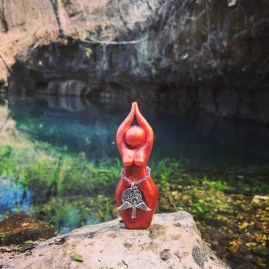 live (they live one mile further away than that). In addition to woodland and meadow, this land has two springs, three creeks, a cave, and ¼ mile of river access. While I have been deeply connected to the land of my birth, the Missouri Ozarks, for a long time, and have written about that connection in multiple
 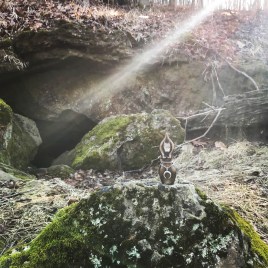 spy the opening to the cave nestled behind several mossy stones. The sun is still on the rise above the tree line and the rays filter through the trees so one ray is pointing directly at the cave entrance. We crawl inside, bumping our heads and scraping our backs as we wiggle into this womb in the earth. Once inside, the chamber enlarges so we can stand up. Unlike other caves we have experienced in this area, the only human signs we find are a single bottle cap, a glass bottle, and two sets of initials carved into a rock. In the dark silence we hear the sound of water dripping steadily. I make my way further into the cave, acutely aware that this is living cave and being careful not to step on the fresh, wet, cervix-shaped beginnings of new stalagmites on the floor. At the back of the cave, I find her. A Madonna-like stone column, glistening with water. In the silence of the cave, I quietly sing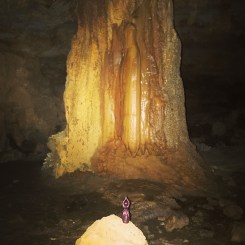
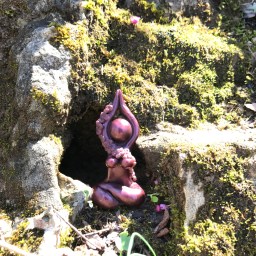
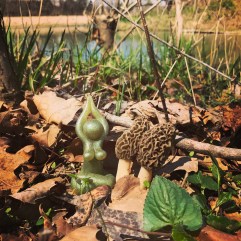 about two weeks in Missouri each spring and considered a delicacy by many). The afternoon suddenly becomes even more rewarding and we stoop and peer through fallen oak, sycamore, and elm leaves looking for the telltale conical form of these forest treats. We quickly discover that we must tune in and “listen” for the mushrooms, so to speak, or we’ll walk right by them, none the wiser. The moment I start thinking about anything else, I stop finding any. Once I settle into my body and the moment and really look at the world again, there another morel will be.
 Molly has been “gathering the women” to circle, sing, celebrate, and share since 2008. She plans and facilitates women’s circles, seasonal retreats and rituals, mother-daughter circles, family ceremonies, and red tent circles in rural Missouri and teaches online courses in
  Last fall, my family took a vacation to Myrtle Beach, South Carolina, where I grew up. As a child, one of my favorite places to visit was Brookgreen Gardens, a wildlife preserve that was once the winter home of Archer and Anna Hyatt Huntington. Anna was a prominent sculptor of the early twentieth century, and decided that part of the property should be sculpture gardens open to the public.






 Feminism and Religion