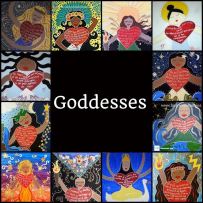
 I’ve shared before that the non-profit my wife and I created, the Holy Women Icons Project, is in the process of creating a small intersectionally ecofeminist retreat center on Hawai’i Island. The Holy Women Icons Project seeks to empower marginalized women by telling the stories of revolutionary holy women through art, writing, and special events.
Both the art and writing side of the project have been a monthly part of Feminism and Religion since 2012 as I feature the story of one of my holy women icons, along with the icon I’ve painted depicting them. As I paint revolutionary holy women from history, scripture, and myth, I also write about their lives; in addition to painting and writing, the bold witness of these women has inspired and grounded many of the retreats I lead in churches, seminaries, women’s and LGBTQ centers. Now the time has come for us to try and fulfill our dream of creating a home for this work, a little off-grid retreat center where people can come on retreat to create, sustain, and empower (by paying to attend or receiving scholarships from grants, but more on that later).
We were thrilled to film the first step of this process—building our family’s “tiny house”—with the television show Tiny House Nation. Since then, we’ve been working tirelessly to get our acre of land ready to build more housing for those on retreat, and to find funding sources to make it possible. Anyone who runs a non-profit or works in sustainable construction knows this is no easy (or affordable) task. We’re realizing that this far-flung dream may take longer than we’d envisioned due to lack of funding. We have some fabulous monthly patrons through Patreon, and we’d surely welcome more tax-deductible patronage or donations! Other than this, though, it’s the scrappy work of my wife and I to try and make this whole intersectionally-ecofeminist-off-grid-Hawai’i-retreat-thing a reality. Continue reading “Holy Women Icons Online Retreats by Angela Yarber”


 Doing a recent talk on pioneering woman writers, I like to do the Before Jane Austen test with my audience. Who can name a single woman writer in the English language before Jane Austen? Alas, because woman have been written out of history to such a large extent, most people come up blank. Then we talk about pioneering Renaissance authors, such as Aemilia Bassano Lanier, the subject of my recent novel, THE DARK LADY’S MASK, or her mentor, Anne Locke, the first person of either sex to write a sonnet sequence in the English language.
 One of the bigger problems with being the only Classics major at a Jesuit university is that all my friends were fairly old men before I had even reached drinking age. Now, they are pretty much gone back to the cradle of the grave, save one, who is on his way to a remote retirement home. As a young woman, my coterie wasn’t a terrible problem for me because some deep part of my psyche had been convinced, since I was about nine years old, that I myself was an old man. I sort of felt at home reading about the Second Punic War and identifying with the sexual ramblings of the naughty old Latin poets, noting between me and my teacher-purveyors of such materials only the occasional, modest differences in skin elasticity and dental sheen.
 Recently when I was feeling low and a little devoid of hope, a friend of mine paid me a fabulous compliment: “Things will get better. You’re a very strong person.” I know it was a real compliment and not an underhanded cutting remark. You may be surprised as to why I am referring at all to the latter. After all, it’s straight forward – having strength and fortitude are admirable qualities and how could one possibly even think otherwise. But you may be equally surprised to know that there are very special circumstances under which the word “strong” gets to acquire extended meanings of: “devoid of feelings,” “someone who needs zero support,” “a social insult.”
 Just last week I was dumbfounded when an acquaintance told me that his philosopher partner calls a woman leading a workshop on labyrinths “a tree hugger.” “What,” I wanted to say, “is wrong with being a tree hugger? Are we not all interdependent in the web of life? Why should we imagine that trees or the cells of trees have no feelings at all?” But the tone of contempt and dismissal in the man’s voice told me that I would only be creating another “fuss,” the kind that can make me persona non grata among the ex-pats in my village.
 In my widely read
  As Po said in “Kung Fu Panda”: “I’m gonna get myself some Inner Peace… Inner piece of what?”
 Another joke that captures this paradox perfectly is:
 Recently at a discussion of Goddess and God in the World, Judith Plaskow and I were asked if the dialogue across religious difference we embody and advocate in our book is a “liberal thing.” Can it, the questioner wondered, occur with those who do not have a liberal view of religion and religious meaning?
 Before he told the story of how his people received the sacred pipe,
  Feminism and Religion