Some Thoughts from Experience by Vanessa Rivera de la Fuente

210

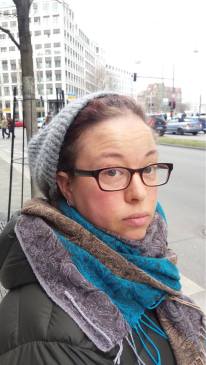
I am a woman, a feminist, a Muslim. These three things are me, they are things that I have become, in that order. One is born with feminine sex, but it is only a biological determinism. I was born female and I have chosen to continue living as a woman. I decided to be and live as a feminist. I felt called to be a Muslim and I chose to listen to that call.

I love to be a woman, even in a world that hates me. The woman that I am, with my way of thinking, acting and feeling, my way of seeing the world and myself, is not a product of my sex, but of the story that I have gone through since I left my mother’s womb. The same goes for all women. Even beings born in the same country, city, year, even those who are sisters of blood, do not have the exact same story.

Continue reading “Some Thoughts from Experience by Vanessa Rivera de la Fuente”

On Chronic Illness and Justice by Ivy Helman

29662350_10155723099993089_8391051315166448776_oFor almost four years, I’ve been living with the long-term effects of an inner ear lesion.  The lesion is long gone but its side effects are not.  Throughout the day, I feel a combination of unsteadiness and sudden, unpredictable sensations of movement.  On better days, the unsteadiness is almost non-existent and the feelings of movement are minimal.  On worse days, I’m troubled with a type of brain fog that makes it hard to concentrate as well as disrupting unpredictable sensations of being on a boat that can’t pick one direction in which to move.  It’s frustrating, tiring and demoralizing.

Summer is the season of worse days.  There is really nothing I can do to feel better.  Even staying well-hydrated and taking it easy often doesn’t steady the boat.  So, instead, I often continue my life as normal.  Then, I lay in bed at night and hope sleep comes soon. Continue reading “On Chronic Illness and Justice by Ivy Helman”

God, Gender Violence and The Male Ego by Vanessa Rivera de la Fuente

maxresdefault

We live in a world in which women are the preferred target of different types of violence: physical, sexual, psychological, economic, symbolic and structural, among others. A type of violence we are not talking so much about is spiritual violence. This can be defined as using a person’s spiritual beliefs to harm, manipulate, dominate or control the person.

Spiritual violence includes, but is not limited to: disallowing the person to follow his or her preferred spiritual or religious tradition; forcing a spiritual or religious path or practice on another; belittling or making fun of a person’s spiritual or religious tradition, beliefs or practices; and, using one’s spiritual or religious position, rituals or practices to manipulate or alienate a person. Continue reading “God, Gender Violence and The Male Ego by Vanessa Rivera de la Fuente”

Celebrating Pride: Honoring the Spiritualities of Queer Holy Women of Color by Angela Yarber

With rainbow colors erupting from even the big box stores, I find my super queer-feminist-self scratching my head at the way Pride has transformed into a capital enterprise. I mean, I’m pretty stoked that the cultural climate seems to be slightly more affirming of queer people, but as queer culture is commodified, I cannot help but think of what is being lost or forgotten. And I want to shout from the rooftops that the rich spiritual history of Pride rests firmly on the shoulders of queer women of color who have marched and meditated, prayed and protested long before rainbow Pride headbands were available at chain stores across the land. It is for this reason that, in honor of Pride Month, the Holy Women Icons Project (HWIP) has launched a 7-Day Online Queer Spirituality Retreat that celebrates seven different queer holy women of color.

HWIP’s 7-Day Online Queer Spirituality Retreat is an opportunity to subversively queer your spirituality, and for the LGBTQ+ community to celebrate our spirituality without having to translate it through the lens of heteronormativity. Open to everyone, the Queer Spirituality Retreat features seven different queer women of color: Pauli Murray, Frida Kahlo, Perpetua and Felicity, the Shulamite, Marsha P Johnson, Guanyin, and Gloria Anzaldúa. Each retreat day takes about 20 minutes and includes an inspirational quote, an icon image, a reflective essay, a guided writing exercise, a ritual exercise, and a closing blessing. The most important part of the retreat is, of course, the revolutionary queer women who make it possible. So, allow me to briefly introduce you to seven queer women of color who should make us all proud…

Continue reading “Celebrating Pride: Honoring the Spiritualities of Queer Holy Women of Color by Angela Yarber”

Implausible, Impossible Hope by Natalie Weaver

With the single exception of a weak moment in my oldest son’s kindergarten year, during which time the grade school manipulated parents into fundraising schemes by dangling socially advantageous perks (such as a reward trip to a water park) for only those children whose parents participated at a high level in the initiatives, I have never subscribed to any magazines.  Nevertheless, I continue to believe, on some core level, that Ed McMahon is even now driving down the street toward me in the white Publisher’s Clearing House van with a check for one million dollars.  The fact that Ed is long deceased seems to have no bearing on my conviction that the great Miracle, complete with balloons and a camera crew, is blazing toward me and just around the corner.  I never play the lottery, and I actually managed to go to Las Vegas once without gambling a single dollar, yet I feel almost daily that some Jackpot Jeep Bonanza Giveaway has my name all over it.

Continue reading “Implausible, Impossible Hope by Natalie Weaver”

My Grandmother is a Gangster… a Spiritual Gangster by Valentina Khan

My grandmother is a gangster… a spiritual gangster

I recently attended a funeral for a relative-in-law. The grassy patch at the cemetery was filled with many familiar faces as well as unfamiliar. My side of the family was asked to come. My father, mother and even teeny tiny little 4 foot 9 grandmother showed up. I emphasize her height because it has nothing to do with her stature… and this is where my story begins.

My grandmother aka “Mama Shamsey” is from my maternal side. She grew up in Tehran, Iran. She was a young bride to a handsome intellectual who was French educated but a deeply spiritual and passionately religious Iranian Shia Muslim. He truly believed people should never discuss politics or religion. He knew how to be open and compassionate with people of differing opinions than his. They married, had 5 children, my mother was the eldest. When she was just entering her tender teenage years, many of her peers were flocking to Europe to be educated in Germany or France. She however had the dream of going to school in America, so in the 70’s this family of 7 made the great migration over to America.

Continue reading “My Grandmother is a Gangster… a Spiritual Gangster by Valentina Khan”

(Not Yet) Elder Reflections by Chris Ash

Four years ago, as I went to touch up my roots with a shade of red I’d been dying my hair since I was 18, I noticed that what had started as a few random strands of gray amidst my natural reddish brown had become streaks of brilliant silver. I began dying my hair red as a style choice, long before I’d ever even thought of going gray. I loved the way my natural hair reddened in the summers, with copper highlights flashing under the beach sunsets. There was never an intention to hide gray or look younger, but there was a time in my thirties when the first few strands of gray seemed to make my darker roots look muddy, like they were dirty instead of graying.

But brilliant streaks of silver? This, I could do. I switched from my usual permanent henna dye to a temporary red to keep my roots touched up while the henna’d hair grew out, and waited. Three years later, all the permanently red hair had grown out, and I was ready to have fun. I went to the stylist, had him bleach out the parts I’d been dying red, and had him color it all with a wild ombre of colors that would look good with silver. My hair was a darkened nebula, silver roots reaching down into four different shades of purples of blues. After each new dye – a brilliant nebula, each time fading over a few months into a soft mix of gray-blues and silver. Even at the end of the fade-out, people still ask me if I just had my hair colored. Every week, the color seems a new shade.

Currently, I’m at the end of a fade out. Honestly, I probably would have colored it a few weeks ago if I weren’t so busy, but at this point my hair is mostly gray with some slight bluish highlights.

And twice in the last week – TWICE! – I’ve been offered the senior discount by well-meaning cashiers.

At 42. Continue reading “(Not Yet) Elder Reflections by Chris Ash”

Creating Women’s Circles that Heal and Enrich Our Lives by Anne Yeomans and the Women’s Well

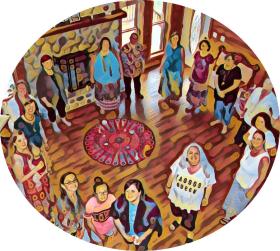
From 1994 until 2012, the Women’s Well, based in Concord, Massachusetts, offered thousands of women the opportunity to participate in women’s circles of all kinds. In the first and second parts of this series, Anne Yeomans, a co-founder of the Women’s Well, and others who co-created the Women’s Well, shared about their experiences with the power and wisdom of the circle and the use of altars and ritual. (Part I and Part II).  This third part, explains the guidelines that the Women’s Well developed for their circles. This post is adapted from the Women’s Well website at www.womenswell.org.

We often used the guidelines in our circles. Sometimes the facilitator or holder of the circle would speak of them and then place them around the circle on printed cards, to remind us of the quality of listening and speaking that we were trying to invite in.

These guidelines were originally drawn from the work of Tom Yeomans who developed a way of working in groups, called the Corona Process. It was an approach to group dialogue that came to him in a dream the night after attending a meeting with the great physicist David Bohn, who at the end of his life became interested in dialogue and world peace. Continue reading “Creating Women’s Circles that Heal and Enrich Our Lives by Anne Yeomans and the Women’s Well”

Meet the Bible Bitches: Interview with Rev. Laura Barclay and Sara Hof

What do you get when you have two ladies, one a Baptist Minister living in KY and one an agnostic living in LA, making jokes and talking about the Bible?  Don’t know?  You get the new and exciting podcast Bible Bitches! 

BB-Banner-white

What do you get when you have two ladies, one a Baptist Minister living in KY and one an agnostic living in LA, making jokes and talking about the Bible?  Don’t know?  You get the new and exciting podcast Bible Bitches!  We hope that you’ll take a moment to check out this new and exciting podcast that explores the F-word in Religion (among many other topics) and read the Q&A below with the creators Rev. Laura Barclay and Sara Hof!  Click here to listen to the podcast (now on episode 5)!

Continue reading “Meet the Bible Bitches: Interview with Rev. Laura Barclay and Sara Hof”

Feminazi as Archetype by Vanessa Rivera de la Fuente


Feminazi.jpg

Feminazi is an image and narrative created by patriarchy to control the liberation and recognition of women as autonomous political subjects, and to serve as a warning to thwart these processes.

It is a label used for male supremacy to name the fearless woman. Fear is a control mechanism used to keep us living in terror of: expressing opinions, gaining weight, walking on the street, being raped, ridiculed, or lonely, not being married, being rejected, or dismissed, having too much cellulite, going to hell, traveling alone, being beaten, believing in ourselves, etc.

Feminazi is a modern myth designed to make us believe that there are good and bad feminists, and that it is possible to exclude and ignore all feminists through labels and stereotypes. A woman’s transition toward liberation can be seen as threatening to others when it is assumed that “someone else” outside the woman herself, has the privilege to define which feminisms are acceptable, or which processes of liberation and searching for autonomy are legitimate, or not.

Continue reading “Feminazi as Archetype by Vanessa Rivera de la Fuente”