Patriarchy As An Integral System of Male Dominance Created at the Intersection of the Control of Women, Private Property, and War, Part 3 by Carol P. Christ

carol p. christ 2002 colorPatriarchy is a system of male dominance, rooted in the ethos of war which legitimates violence, sanctified by religious symbols, in which men dominate women through the control of female sexuality, with the intent of passing property to male heirs, and in which men who are heroes of war are told to kill men, and are permitted to rape women, to seize land and treasures, to exploit resources, and to own or otherwise dominate conquered people.

As the discussion of patriarchy* I began last week and the week before shows, patriarchy is not simply the domination of women by men. Patriarchy is an integral system in which men’s control of women’s sexuality, private property, and war (including violence, conquest, rape, and slavery) each play a part. These different elements are so intertwined that it is impossible to separate one as the cause of the others.  Patriarchy is an integral system of interlocking oppressions, enforced through violence, and legitimated by religions.

The model of patriarchy I have proposed argues that the control of female sexuality is fundamental to the patriarchal system.  This explains why there is so much controversy about the “simple matter” of access to birth control and abortion in the US today. It also explains why so much vicious anger is directed at single mothers by politicians and commentators.  Any woman who dares to control her own sexuality is questioning the foundations of the patriarchal system. Continue reading “Patriarchy As An Integral System of Male Dominance Created at the Intersection of the Control of Women, Private Property, and War, Part 3 by Carol P. Christ”

Patriarchy as a System of Male Dominance Created at the Intersection of the Control of Women, Private Property, and War, Part 1 by Carol P. Christ

carol p. christ 2002 color

Recently feminist scholar Vicki Noble commented that this is the best definition of patriarchy she has read–but she hadn’t read it earlier. I am reposting it now in the hopes that all of you will share it with your social media so that it will be more widely known.

Patriarchy is often defined as a system of male dominance. This definition does not illuminate, but rather obscures, the complex set of factors that function together in the patriarchal system.  We need more complex definition if we are to understand and challenge the the patriarchal system in all of its aspects.

Patriarchy is a system of male dominance, rooted in the ethos of war which legitimates violence, sanctified by religious symbols, in which men dominate women through the control of female sexuality, with the intent of passing property to male heirs, and in which men who are heroes of war are told to kill men, and are permitted to rape women, to seize land and treasures, to exploit resources, and to own or otherwise dominate conquered people.*

Marx and Engels said that the patriarchal family, private property, and the state arose together. Though their understanding of the societies that preceded “patriarchy” was flawed, their intuition that patriarchy is connected to private property and to domination in the name of the state was correct.  It has long seemed to me that patriarchy cannot be separated from war and the kings who take power in the wake of war.  Many years ago I was stunned by Merlin Stone’s allegation that in matrilineal societies there are no illegitimate children, because all children have mothers. Lately, I have been trying to figure out why the Roman Catholic and other churches and the American Republican party are so strongly opposed to women’s right to control our own bodies and are trying to prevent access to birth control and abortion. In the above definition of patriarchy, I bring all of these lines of thought together in a definition which describes the origins of patriarchy and the interconnections between patriarchy, the control of female sexuality, private property, violence, war, conquest, rape in war, and slavery.  Continue reading “Patriarchy as a System of Male Dominance Created at the Intersection of the Control of Women, Private Property, and War, Part 1 by Carol P. Christ”

Feminism and Religion: Where Do I Stand? by Kile Jones

Kile JonesHaving recently become a “regular contributor” to this blog, I feel that my first post should be about how I situate myself and my beliefs in this environment. One of the first things I noticed about this blog, is that is has many Catholic, liberal Protestant, and pagan/nature religion/Goddess-followers who contribute (a journal I edit has an excellent article on Thealogy and worship of the Goddess). There are also a few Buddhist, Mormon, and New-Age contributors. In this eclectic mix, I stick out quite a bit. Not only am I a primarily white (my Abuelita was born in Chihuahua) heterosexual man, but I am also a secular humanist and an atheist. In an earlier post I wrote a piece titled “Reformer, Revolutionary, and Rationalist: Three Types of Feminism,” in which I find myself at home with the cultural critiques of the revolutionary and the logical critiques of the rationalist. As somebody who will be contributing my voice, here is where I am situated. Continue reading “Feminism and Religion: Where Do I Stand? by Kile Jones”

Sustaining Feminist Spiritualities in the Seeming Absence of Community by Elisabeth Schilling

LaChelle Schilling, Sustaining Feminist SpiritualitiesThe spirituality I cultivated during my teens through evangelistic Pentecostal Christianity was based on possession, hierarchy, and exclusivity, although I would not have said that at the time.

As I gradually moved away from that faith community in my mid-20s, no longer wanting to equate a rewarded closeness to God with being set apart from others, I began finding myself participating in quiet conversations with the readings of Thomas Merton, Elaine Pagels, and with poetry by writers such as Olga Broumas.  The words I was drawn to might not have been expressly or consistently religious, but they offered spiritual nourishment in their eroticism, earthiness, and sacred metaphor.

It was also around that time when I decided that feminist theologies were healing in their questions and re-visions of God and concepts of salvation and sin. To understand that being a spiritual and/or religious person could mean being aware of and pursuing my desires and connections to other people instead of being a gatekeeper was redemptive. Continue reading “Sustaining Feminist Spiritualities in the Seeming Absence of Community by Elisabeth Schilling”

Truth and Consequences–This Feminist’s Perspective? by Marcia Mount Shoop

Marcia headshotIn John’s Gospel, Pilate’s response to Jesus’ self-identification as the one who “came into the world to testify to the truth” is a simple question:  “What is truth?”  His question hangs in the air as he moves from that conversation to the throngs he sought to please.  Pilate took the temperature of that crowd to decide Jesus’ fate even though he, himself, found no reason to charge Jesus with a crime.  Pilate asks the question from a position of power—literally holding life and death in the ambivalence and maybe even in the sincerity of his words.

The “t” word has been center stage in our collective conversation of late with Lance Armstrong’s Oprah-event confession  and the Manti Te‘o girlfriend-dying-of-cancer hoax at Notre Dame .   The Internet is abuzz with reactions to both confessional moments.  Lance Armstrong’s confession apparently didn’t play well with the general public.   And people are weighing in about whether Manti Te‘o could really be so naïve or if he just didn’t know how to tell everyone the truth when the story got out of hand.   Continue reading “Truth and Consequences–This Feminist’s Perspective? by Marcia Mount Shoop”

What It’s Like to Be a Woman in the Academy by Linn Marie Tonstad

Linn Marie TonstadLast fall, I was asked to sit in on the women’s pre-doctoral colloquium at the divinity school where I teach. In the course of a wide-ranging lunchtime conversation, the central question to which the students wanted an answer was: “what is it like to be a woman in the academy?” The question took me by surprise at the time – mostly because I’d expected to be asked more nitty-gritty questions about applying to graduate school, writing samples, and personal statements – but it has stayed with me in the weeks since the lunch as I’ve found myself trying out answers from different directions.

The first answer, and perhaps the most obvious one, is this: there is no such thing as being “a [generic] woman” in the academy (or anywhere else). Continue reading “What It’s Like to Be a Woman in the Academy by Linn Marie Tonstad”

Why I am a Mormon Feminist by Emily U.

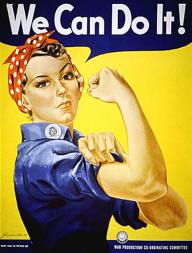
We can do it! RosyI’m not a historian or sociologist, but I’ve noticed something about civilizations.  They always seem to think they are more special than other civilizations.  It’s not important to my purpose here to name names, but so many groups have had a superiority complex of one kind or another that I wonder if a need to feel more special is written into human DNA.

There may be biological explanations for why people draw distinctions and make rankings for each other, but I’m going to speculate about a psychological or spiritual one.  I wonder if this hunger for superiority stems from a lack of security about one’s value as a human being.  The first temptation of Christ started with the words “If thou be the son of God…” and if we are to believe Christ’s temptations were real it means that even Jesus must have, at least momentarily, been able to question his identity.  He was tempted to believe the lie that he was not who he knew himself to be.  We mere mortals experience that temptation not infrequently, and unlike Jesus, we sometimes succumb to it.

One strategy people have for dealing with insecurities about their identity is to artificially elevate themselves above others.  As in, if I’m not special at least I’m more special than (fill in the blank).  This has caused so much pain and injustice.  And regardless of culture, time, or place, women seem to always be on the losing side of this equation. Continue reading “Why I am a Mormon Feminist by Emily U.”

The David Syndrome? By Marcia Mount Shoop

Is it just me, or does anyone else feel like we’re all in Junior High or High School again with the Petraeus scandal?  There is drama at every turn with boundaries crossed and accusations slung across every lunch table there is.

When I was a teenager we didn’t have emails, Facebook , and Twitter (thanks be to God).  We passed notes.  I remember getting a really mean one scrawled in deliberately messy handwriting to maintain anonymity about how annoying I was to the “populace” (yes I remember that word was in there) because I didn’t wear make up and I thought I was “so smart.”

Just like today’s cyber detectives who figured out Paula Broadwell’s identity from the fingerprints we all leave behind in the online lives we lead, I traced this note back to its source.  I did it the old fashioned way—I asked around.  Unfortunately I found out it was from a “friend” and teammate of mine.  When I went to her house and confronted her she admitted it.  Turns out she was envious about a boy.  Little did she know at the time that the boy she wished for was abusive and I was living in my own secret hell.  I remember thinking to myself “you can have him.”   The stakes seemed so high back then—friendships, acceptance, one’s whole sense of self were hopelessly tangled up in tenuous, even dangerous, relationships. Continue reading “The David Syndrome? By Marcia Mount Shoop”

Please Excuse Me for Having a Penis: Taking a Back Seat to Privilege and Power by John Erickson

Male feminists must be aware that we not only engage in an ongoing struggle against sexual and gender inequality, but more importantly an ongoing fight with ourselves.

I have often struggled with that little voice, call it my conscience if you will, that speaks to me during times of distress.  Although I consider myself a proud feminist, I still struggle with aspects of what I call, internalized misogyny, or more aptly defined as a male born characteristic trait that imparts the idea that men are not only dominant but also more powerful than the other 50% of the species.

For many reasons, I believe religion is one of the main culprits of this growing evil, one that we all witnessed throughout this last election cycle.  However, instead of placing blame solely on religion and images of the male Godhead we have to begin deconstructing the sociological consequences these subconscious social, sexual, religious, and gendered norms have on men but more importantly men who identify as feminists. Continue reading “Please Excuse Me for Having a Penis: Taking a Back Seat to Privilege and Power by John Erickson”

That’s Good, Do it Again by Erin Lane

It happens almost every Sunday night. I get a little tickle in my stomach thinking about the week ahead. And all I want to do is call my mom and whine, “Do I have to?” It’s about to be Monday.

The crazy thing is I love my work. But there’s something about what I’ve been calling “the infinite abyss of adulthood” that gets me all turned in on myself every time the week starts anew, the day comes up for air, and the next project begins. I wasn’t until I read Kathleen Norris’s The Cloister Walk that I realized there was a word for my spiritual malaise. It’s what the church fathers and mothers referred to as acedia, a sort of listlessness of the spirit. Norris also attributes this feeling of time’s expanse to our  ”noonday demons.” The sun is high and a warm meal, glass of wine, and good night’s spoon is far off. The road of perseverance appears long and boring and repetitive under the deadpan heat. Continue reading “That’s Good, Do it Again by Erin Lane”