Emergence and Death of the Goddess by Sara Wright

In the beginning, of course, there was no separation; an intimate relationship existed between all humans and the rest of Nature.

The Earth and every living being was considered whole, sacred, animated with soul.

I think of soul as being embodied, that is, living through a body. I think spirit surrounds and interpenetrates each animal/plant being, but soul is born within the individual.

If I am correct, it’s not surprising that the origin of all religions began with humans worshipping birds and mammals because they live through their bodies, and had to be attached to instincts, intellect, intuition, sensing, feeling to survive.  They were also here long before people. In every pre-literate culture, there are stories about animals teaching humans how to forage, deal with health problems, and protect themselves.

Continue reading “Emergence and Death of the Goddess by Sara Wright”
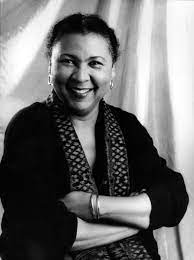
Embodying bell hooks’ theological vision by Liz Cooledge Jenkins

I was recently asked: Who is a theologian you admire? Since I’ve been deeply steeped in the Christian tradition, plenty of Christian theologians could come to mind—Christian theologians, that is, in the sense of humans educated in the Christian theological academy with the theology PhDs to prove it.

 But when I think of theology, these days, I find myself thinking more broadly. Like Kat Armas, who wrote Abuelita Faith as a way of reflecting on and honoring the theological contributions of marginalized women, rather than men who sit in the seats of academic power—and like Sarah Bessey, who writes that theology, at its best, is a field where “everyone gets to play”[1]—I am skeptical of the assumptions Christians often make about who is or isn’t a theologian. And so, when I thought of theologians I look to for wisdom, I thought outside the box. I thought of writer and activist bell hooks.

Continue reading “Embodying bell hooks’ theological vision by Liz Cooledge Jenkins”

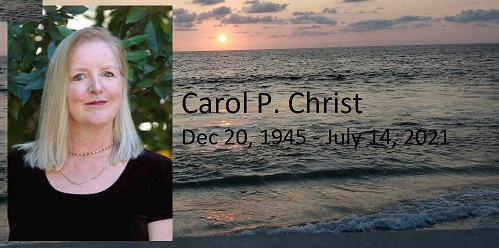
Legacy of Carol P. Christ: Body, Nature, Ancestors

This was originally posted on January 23, 2012

Some years ago, womanist theologian Karen Baker–Fletcher asked about ancestors following a lecture I gave on the body and nature.  I have since come to realize that ancestors are a missing link between the two:  we cannot speak adequately of embodiment and interdependence in the web of life without recognizing the ancestors whose lives made ours possible.  Our mothers quite literally gave us our bodies.  All of our ancestors gave us their genes.  Care and callousness with origins going back longer than conscious memory was imprinted on the psyches of our parents and grandparents and transmitted to us.  All of our ancestors give us connections to place.  While many black people in America can recite oral histories that begin with slavery in the United States, I come from a family where stories of origin for the most part were not valued or told.  Both of my father’s parents lost their fathers when they were very young, and my father, who was raised Catholic at a time when Catholics were discriminated against, preferred to think of our family as “American now.”  Like the hero of the film Lost in America, most members of my family dreamed of “melting right into that pot.” In the process we lost stories we need to help us to understand ourselves and the complex realities that “becoming American” involved.

Continue reading “Legacy of Carol P. Christ: Body, Nature, Ancestors”

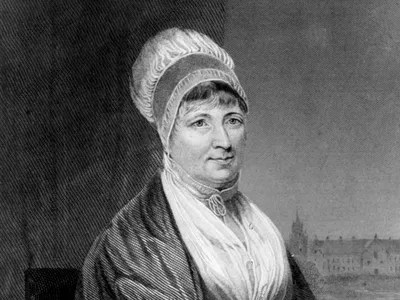
Prison Doors Open: Poetic Justice of Elizabeth Fry by by Margot Elizabeth Van Sluytman/Raven Speaks

Elizabeth Fry, also known as Betsy Fry (1780-1845)

Voices as One
HER glory showers
Tremendous poignancy upon
Our persistent walk. We are
Joined. Siblings in Spirit.
Imbibing the hymn of
Reformation. The song
Of justice. The canticle
Of joy and freedom.
©Margot Van Sluytman

Continue reading “Prison Doors Open: Poetic Justice of Elizabeth Fry by by Margot Elizabeth Van Sluytman/Raven Speaks”

Legacy of Carol P. Christ: Solstice Comes But Once A Year, Now It’s Here!

This was originally posted on December 17, 2012

Actually it comes twice, once in midsummer, the longest day of the year, and once in midwinter, the longest night.  Winter Solstice is also known as the first day of winter.

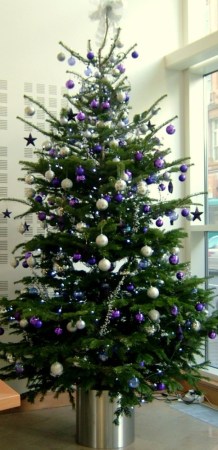
ChristmasTrees20060001

For those of us attuned to the cycles of Mother Earth, Winter Solstice is a time to celebrate the dark and the transformations that come in the dark. Many of the customs associated with Christmas and Hannukah, including candles, Yule logs, and trees decorated with lights were originally associated with Winter Solstice.  The extra pounds put on during winter feasting were insulation against the cold winter nights.

Those who fear that many of the customs of the Christmas season might be pagan are right.  As we learn again to honor our place within the cycles of birth, death, and regeneration, we can return these customs to their roots in the circle of life.

Continue reading “Legacy of Carol P. Christ: Solstice Comes But Once A Year, Now It’s Here!”

Can Feminist Christians Hasten the Advent of Reproductive Liberation? by Elizabeth M. Freese, PhD

Wikimedia Commons, Servite Church in Hungary

The collision of the 2023 Christian liturgical season of Advent with American reproductive politics has been jarring. Feminist religious critique and transformative activism are imperative.

With the Texas Supreme Court decision on a dire abortion case, alongside increasing criminalization of women having miscarriages, we are witnessing the principle of patriarchal dominance of female reproductive capacity and the denigration of women’s full, equal personhood pushed to the extreme. In part, this barbarity is perpetuated by Christianity. Even though this tradition often challenges social systems of injustice, and it does not actually support their hollow theology of “life at conception,” misogynist oppressors have plenty of Christian religiosity to stand on.

Continue reading “Can Feminist Christians Hasten the Advent of Reproductive Liberation? by Elizabeth M. Freese, PhD”

Planting Seeds of Change by Nayeli Delgadillo

There are a lot of things that have led to both feminism and my spiritual path. One could say I am still at the start of my journey at 23 years old, and it may be true. I often meet people older than myself, and they are most surprised by two things; the age that I look versus the age that I am, and in that, the maturity of my thoughts. 

I grew up very much in communion with my family, living in a duplex with my extended family only a few feet away. Every month there is at least one birthday, and we  all come together Saturday, for the party, and Sunday for the recalentado (breakfast or brunch consisting of leftovers). It was on these Sunday’s that we would gather and talk about everything. The adults in the family didn’t keep us kids away from hard conversations, but instead included us. Conversations that included topics of racism, education, politics, science, war, religion etc. Me being the youngest cousin, before my sister was born (we are nine years apart), would always listen in and absorb, absorb, absorb. It wasn’t until middle school, and high school, where I was truly introduced to a more serious history of the world, that these conversations started to really unravel and make sense to me. It was toward this time my cousins were also in high school, or just finishing, and so, the conversations became more lively. I started to understand why we spoke about the things we spoke about, even when it seemed like no one else was. 

Continue reading “Planting Seeds of Change by Nayeli Delgadillo”

Herstory Profiles: The Unknown Female Spy of WWII, Noor Inayat Khan By Anjeanette LeBoeuf

In honor of November being the month dedicated to the remembrance of veterans, our Herstory Profile will be focused on an unsung hero/veteran of WWII, Noor Inayat Khan. Born into an Indian Muslim Royal Family but removed from their ancestral home, Noor spent the majority of her life in Europe. She would answer the call as thousands of others did during the onset of World War II. She would become one of the most successful Spies in Occupied France. Noor would eventually lose her life in the Dachau Concentration Camp. It is only in the last 17 years that Noor’s incredible story and contributions have resurfaced.

Continue reading “Herstory Profiles: The Unknown Female Spy of WWII, Noor Inayat Khan By Anjeanette LeBoeuf”

Wacky Wednesday Weekly Weavers Call by Caryn MacGrandle

My daughter used to love Dr. Seuss’s book Wacky Wednesday.  The premise of the book is that you are supposed to find the things that are off in the picture:  an upside down picture, a tiger instead of a baby in the stroller and steps leading up to a house with no door.  

My daughter was always so excited to find these anomalies: giggling and pointing them out.

‘See, the world makes sense!  But this doesn’t.  And this doesn’t either.’

Continue reading “Wacky Wednesday Weekly Weavers Call by Caryn MacGrandle”

What, Together, We Are by Annelinde Metzner

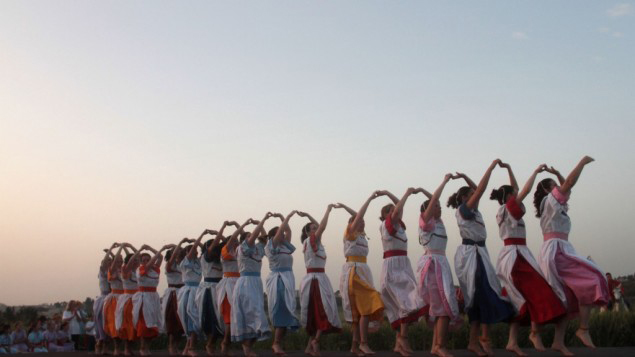
Kibbutz

It seems that the hearts of the whole world, and especially the hearts of women, are grieving now, as war and warmongering take over more and more of the Earth.  Patriarchy rages on, like a monster in its death throes, and we wonder, “will they take us all down with them?”  It is my hope that these poems will help us to keep on keeping on, keep on loving Her.

My grief, my love for the world                                        

I watch the dancer, one arm framing her face,
one hip drawing upward in the belly’s rhythm.
The dance of mature women, Raqs Sharqi
born of the sensuous music of the Middle East.
Her hips pull us into infinity,
an inward-outward shout of beauty and desire.

Continue reading “What, Together, We Are by Annelinde Metzner”