Planting Seeds of Change by Nayeli Delgadillo

There are a lot of things that have led to both feminism and my spiritual path. One could say I am still at the start of my journey at 23 years old, and it may be true. I often meet people older than myself, and they are most surprised by two things; the age that I look versus the age that I am, and in that, the maturity of my thoughts. 

I grew up very much in communion with my family, living in a duplex with my extended family only a few feet away. Every month there is at least one birthday, and we  all come together Saturday, for the party, and Sunday for the recalentado (breakfast or brunch consisting of leftovers). It was on these Sunday’s that we would gather and talk about everything. The adults in the family didn’t keep us kids away from hard conversations, but instead included us. Conversations that included topics of racism, education, politics, science, war, religion etc. Me being the youngest cousin, before my sister was born (we are nine years apart), would always listen in and absorb, absorb, absorb. It wasn’t until middle school, and high school, where I was truly introduced to a more serious history of the world, that these conversations started to really unravel and make sense to me. It was toward this time my cousins were also in high school, or just finishing, and so, the conversations became more lively. I started to understand why we spoke about the things we spoke about, even when it seemed like no one else was. 

Continue reading “Planting Seeds of Change by Nayeli Delgadillo”

Herstory Profiles: The Unknown Female Spy of WWII, Noor Inayat Khan By Anjeanette LeBoeuf

In honor of November being the month dedicated to the remembrance of veterans, our Herstory Profile will be focused on an unsung hero/veteran of WWII, Noor Inayat Khan. Born into an Indian Muslim Royal Family but removed from their ancestral home, Noor spent the majority of her life in Europe. She would answer the call as thousands of others did during the onset of World War II. She would become one of the most successful Spies in Occupied France. Noor would eventually lose her life in the Dachau Concentration Camp. It is only in the last 17 years that Noor’s incredible story and contributions have resurfaced.

Continue reading “Herstory Profiles: The Unknown Female Spy of WWII, Noor Inayat Khan By Anjeanette LeBoeuf”

Wacky Wednesday Weekly Weavers Call by Caryn MacGrandle

My daughter used to love Dr. Seuss’s book Wacky Wednesday.  The premise of the book is that you are supposed to find the things that are off in the picture:  an upside down picture, a tiger instead of a baby in the stroller and steps leading up to a house with no door.  

My daughter was always so excited to find these anomalies: giggling and pointing them out.

‘See, the world makes sense!  But this doesn’t.  And this doesn’t either.’

Continue reading “Wacky Wednesday Weekly Weavers Call by Caryn MacGrandle”

What, Together, We Are by Annelinde Metzner

Kibbutz

It seems that the hearts of the whole world, and especially the hearts of women, are grieving now, as war and warmongering take over more and more of the Earth.  Patriarchy rages on, like a monster in its death throes, and we wonder, “will they take us all down with them?”  It is my hope that these poems will help us to keep on keeping on, keep on loving Her.

My grief, my love for the world                                        

I watch the dancer, one arm framing her face,
one hip drawing upward in the belly’s rhythm.
The dance of mature women, Raqs Sharqi
born of the sensuous music of the Middle East.
Her hips pull us into infinity,
an inward-outward shout of beauty and desire.

Continue reading “What, Together, We Are by Annelinde Metzner”

My Goddess by Mary Gelfand

Birth of a Galaxy, by Willow Arlena, https://www.mysticlifedesign.com/

My Goddess is unconfined
      –unbound
–unlimited
–unrestricted.

My Goddess exists beyond
–the images of Her created by men
–the words describing Her written by men
–the laws coercing Her, enacted by men.

Continue reading “My Goddess by Mary Gelfand”

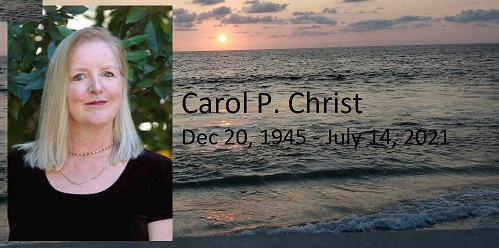
Legacy of Carol P. Christ: As It Might Have Been: Ancestor Stories in the Dreamtime

This was originally posted January 9, 2017

In the middle of the night in waking sleep, I asked my great-great grandmother Annie Corliss to tell me the story of how she met and married James Inglis. This story came through me in a place I have come to call the Dreamtime. The Aboriginal term feels right. As I understand it, this is not a place where the dead speak to the living but rather a space where boundaries blur as the ancestors speak in us.

Annie Corliss’s Story: As It Might Have Been

Continue reading “Legacy of Carol P. Christ: As It Might Have Been: Ancestor Stories in the Dreamtime”

A Maternal Economy: Making the Intangible Tangible by Caryn MacGrandle

Mother Goddess sculpture from Madhya Pradesh or RajasthanIndia, 6th-7th century, in the National Museum of KoreaSeoul

In meditation this morning, it occurred to me how a vital ingredient to the paradigm shift is making the intangible tangible.

I am speaking of the work that you and I do.

I have put nine years of tireless work into my computer app, working daily and spending my personal funds to the tune of about $100,000. With new features that I added this year, the business plan is sound. I just need about ten times the registrants. In other words, I’m 100 feet shy of an 8000 foot mountain. And about to run out of money.

Continue reading “A Maternal Economy: Making the Intangible Tangible by Caryn MacGrandle”

To See Ourselves In Others: Part One by Beth Bartlett

I have felt both a responsibility and a reluctance to write about the escalating conflict in the Middle East.  The situation is so complex and such an unspeakable tragedy – acts of such terror and violence on the part of Hamas toward civilian populations met with even greater violence and repressive measures on the part of Israel toward the people of Gaza. It is a perplexity of the human condition that a people with such a deep history of being displaced and oppressed rather than refusing to oppress in turn, instead engage in the displacement and oppression of others that then erupts into more violence. Both are traumatized peoples acting out of deep pain and woundedness. Thousands have died, more are wounded and displaced, all will carry more trauma into generations to come. The very earth bears the scars of war. In the face of such unspeakable suffering, any kind of analysis feels distancing at a time when what we most need is to let the suffering move us to our depths.

Continue reading “To See Ourselves In Others: Part One by Beth Bartlett”

My Life as a Prayer by Elizabeth Cunningham, book review by Janet Maika’i Rudolph

Our own FAR sister, Elizabeth Cunningham has written her marvelous memoir which came out yesterday. It is titled My Life as a Prayer with the subtitle, A Multifaith Memoir. For those of you who may not know Elizabeth, she wrote regularly for FAR for many years. She is the author the The Wild Mother and the award-winning Maeve Chronicles. Her Chronicles envision the Celtic Mary Magdalen named Maeve. Throughout the four books of the Chronicles, Maeve is filled with vivacious energy and her own life of spirit. The books are Magdalen Rising, The Passion of Mary Magdalen, Bright Dark Madonna and Red-Robed Priestess (which in full disclosure is one of my favorite series of all time.)

In My Life as a Prayer, Elizabeth’s writing is lush and poetic, clever and clarifying, multilayered and depthful.  I hope I can convey all those elements in this short blogpost?

Continue reading “My Life as a Prayer by Elizabeth Cunningham, book review by Janet Maika’i Rudolph”

Crete as the cradle of a culture of peace – Part Two by Laura Shannon

Part One of this article spoke of our collective yearning for peace, and the difficulty of imagining a peaceful world when we are taught to believe that “patriarchy and with it war and domination are universal and inevitable.” (Carol Christ, 2015)

But this is a myth. The peaceful civilisation of Bronze Age Crete lasted two thousand years with no sign of violence, slavery, or war. Most likely matriarchal, matrifocal, and matrilineal, ancient Crete embodied the final flowering of Old Europe. Art and archaeology reveal a life-loving people who honoured the earth, the Goddess, and nature, particularly mountains, caves, and trees. Key values and symbols of this culture of peace survive today in Cretan women’s dances and folk arts including pottery, textiles, baskets, and bread.

Continue reading “Crete as the cradle of a culture of peace – Part Two by Laura Shannon”