Enemy of (H)Islam by Vanessa Rivera de la Fuente

Vanessa Rivera de la Fuente. Misogyny in IslamSo, again, you, the most holy and enlightened man of the mosque have pointed your finger at me to declare, noisy and hysterical, that I am an “Enemy of Islam.” Then you, who preaches and recites best, have gone out there slandering me, “eating my flesh,” devotedly.

“Enemy of Islam.” Well, which Islam? Is there one unique Islam? Why is your Islam, THE Islam? There are so many ways to be Muslim, or, didn’t you know?

You seem to follow the principle “you believe like me or you believe against me,” especially when the discussion is about women. In your narrow view, I am an enemy of Islam because I’m a feminist, radical, progressive woman. I am engaged in interfaith dialogue and in political struggle against discrimination instead of “being at home serving [my] husband as a good Muslimah.” Continue reading “Enemy of (H)Islam by Vanessa Rivera de la Fuente”

Ashes, Sacrifice, and Abundance by Melissa Browning

Melissa BrowningLast year I got my ashes at the airport. As I sat in that airport chapel, I halfheartedly listened to a (mostly terrible) litany that was proclaimed in between announcements for gate changes. I was leaving for another campus interview after having been home for only 24 hours since the previous one. The Christian season of Lent came during a time of stress and chaos in my life. That year, when I contemplated what I might give up for Lent, I could think of nothing. So much had been taken away that I had nothing left to give.
The season of Lent is often linked with the idea of sacrifice. Some people fast, others give up a favorite vice or a favorite food. As a feminist theologian, I spend a great deal of time thinking about the idea of sacrifice. I wonder how women who consider themselves part of Christian churches can be asked to sacrifice when we have already given away too much. Too often, our labor is welcomed but our voices are silenced. As a Baptist theologian and ordained minister who has sojourned in Catholic universities, I’ve felt this in my own tradition and in traditions that are not my own. Continue reading “Ashes, Sacrifice, and Abundance by Melissa Browning”

Relationship, Freedom, Change, and Interdependence in the Web of Life by Carol P. Christ

carol p. christ photo michael bakasMarjorie Suchocki says that feminist theology needs a metaphysics, a coherent world view that can hold together what we might otherwise be seen as a series of unrelated assertions made by feminists. Metaphysics is one of those terms that make most people cringe. If they have any idea at all what the word means, they might categorize metaphysics as the most abstract and out of touch with reality aspect of philosophy. In the Platonic tradition where ideas precede reality, metaphysical truths are revealed by rational contemplation of transcendent principles that precede the world. “I think, therefore, I am,” Descartes said. This notion of metaphysics makes me cringe too.

In process philosophy metaphysics refers to the fact that the world is governed by and expresses certain fundamental principles. This does not mean that ideas are more important than reality. Quite the opposite, metaphysical principles are conclusions reached through paying close attention to the world. Continue reading “Relationship, Freedom, Change, and Interdependence in the Web of Life by Carol P. Christ”

A Women’s Mosque: An Interfaith Space for Feminist Spirituality by Vanessa Rivera de la Fuente

Vanessa Rivera de la Fuente. A Women MosqueIf you thought that all I could do in regards to feminism and religion is challenge Patriarchy and tease around ladies and gentlemen of good temper and better reputation with my corrosive comments, this post may change your mind.

As I said in a previous article, this year I started, with a small group of people, a social project called Imaan, whose goal is centered on inter-faith dialogue and better visibility of the actions and contributions of women in Islam (and religion in general,) plus critical thinking on religion from a feminist and progressive perspective.

As part of the activities of Imaan, we are developing “A Women’s Mosque” project; an initiative that aims to create a meeting place for women and our spirituality. The idea came after a reunion to talk on Islam and inter-faith dialogue with women from different denominations. At one point in the discussion, they asked me about sex segregation in mosques, which led us to a broader reflection on the position of women in the religious space, both material and symbolic, and how uncomfortable we were with that.

We realized that, in a variety of ways, places of worship displace women. Whether they relegate us to separate rooms, or refuse to allow us to speak, limiting our participation to “strictly female” issues such as maternity, caregiving, the role of wife and – of course- clothing, these prohibitions are always from a patriarchal “canonical” perspective.

So we decided to join together to create our own space. Continue reading “A Women’s Mosque: An Interfaith Space for Feminist Spirituality by Vanessa Rivera de la Fuente”

Death with Dignity by Carol P. Christ

Carol Christ in LesbosIn the summer of 1960 when I was 14 years old my much loved grandmother Mae Inglis Christ died of a cancer that affected her brain. The last time I saw my Nannie was shortly after her diagnosis in the early spring. While we were visiting, the cancer affected her back, and she took to her bed. In those days children were not allowed in hospitals. I never saw my grandmother alive again, but my mother told us that our grandmother was hooked up to tubes much longer than she should have been. Mother vowed, “This will never happen to me.” I was driven to the funeral in a limousine with my grandmother’s girlfriends. They spoke about my grandmother’s last days, describing how (because her mind was affected by cancer) my little grandmother had screamed and screamed at them for not visiting–even though they were with her every day. They found my grandmother’s outbursts so traumatic that they said they were relieved to see her looking so peaceful in her coffin. Continue reading “Death with Dignity by Carol P. Christ”

The Ancestors Live in Us by Carol P. Christ

Carol Christ in LesbosOn the recent Goddess Pilgrimage to Crete women had the option of riding up a winding road on a mountainside in the back of a farm truck singing “She’ll Be Comin’ ‘Round the Mountain” or could choose to go with the guard in his closed automobile.

That evening one of the older women who had chosen to ride in the car said, “I saw how much fun you were all having, but I have done that before. This time I was happy to let the rest of you do it.”

“That’s exactly how I feel about death,” I responded. “Some people want to live on after death, but I don’t. I am happy to let others do it. The only thing that would upset me would be if life did not go on after me.” Continue reading “The Ancestors Live in Us by Carol P. Christ”

Anne Hutchinson, America’s First Feminist Theologian: 1591-1643 by Carol P. Christ

Carol Christ in Lesbos“She had rather been a husband than a wife; and a preacher than a hearer; and a magistrate than a subject.” Reverend Hugh Peter of Salem

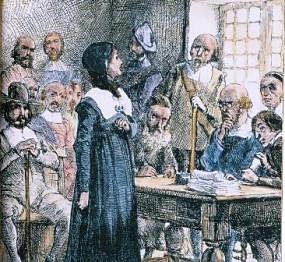
Anne Hutchinson was banished from the Massachusetts Bay Colony for heresy in 1637 and excommunicated from the Puritan Church of Boston in 1638. Her banishment came just three years after she, her husband, and eleven living children arrived in America seeking the freedom to practice their religion as they saw fit. Governor Michael Dukakis pardoned her in 1987. Historian Howard Zinn called her a true American hero.

anne hutchinson trialI managed to get through graduate school in Religious Studies without ever having studied the theology of Anne Hutchinson,* though I vaguely remember references (probably with smirks of disapproval) to the “Antinomian Controversy” which is associated with her name. I recall Anne Hutchinson’s name because of an article published in Feminist Studies in the 1970s, when I had just begun to study women and religion. However it was not until recently that I learned of her place in history through reading American Jezebel by Eve LaPlante.

Hutchinson was accused of theological errors in her trials. The Calvinist doctrine of predestination figured heavily in the accusations. But the real issue at stake was that Anne dared to follow her own inner knowing, to articulate it theologically, and to teach her views against the grain of the Puritan authorities in Boston. Continue reading “Anne Hutchinson, America’s First Feminist Theologian: 1591-1643 by Carol P. Christ”

You Are What You Read by Martha Cecilia Ovadia

10298689_10104523891581853_7256973903379376739_nWhen it comes to my family, I’ve always felt different. One of my earliest memories from when I was really young was being told that I felt things too passionately—that I felt too much. What was never said but was implied was that I felt dissent too much, too often, too vocally. It made people uncomfortable. It made my family uncomfortable. When it came to understanding my faith/religious path, my family and I started diverging early on, never really meeting again—at least not for now.

When I was about five, I remember asking why women could not be priests. My mother brushed it aside and said we could be nuns. She was blind to the inherent misogyny behind the same Church that so many of her female family members had built (we come from a long line of nuns and Jesuits). I thought maybe someday I could be a woman priest. I would change it all. I would be Pope Joan. 

When I was thirteen, I started noticing the wealth involved in the Roman Catholic Church, the opulence of the lived Catholic life. When I asked my parents why the Church did not lead in example and live in poverty using its wealth to actively live the gospel, I was told, “ This wealth is a gift to humanity. It is there for all of us, a patrimony to those who open their hearts.” I wasn’t talking about art, I was talking about the RCC’s gold assets—valued in the billions —but it didn’t matter. I’ve seen my family donate to Church building funds my entire life—buildings that were then sold off to pay for the Church’s offenses later on. Still, I thought if I became more involved, with the “right kind of Catholics”, I would be able to change the Church from within.  Continue reading “You Are What You Read by Martha Cecilia Ovadia”

A Radical Conclusion: We Are Our Own Authorities by Carol P. Christ

Carol Christ in LesbosElisabeth Schussler Fiorenza articulated a widely held tenet of feminist theology when she stated that feminism places a question mark over all inherited texts and traditions. This means that feminists cannot and must not accept any teaching or traditional way of performing religious acts simply because “the Bible [or the Koran or the minister or the priest or the rabbi or the imam or the guru] tells me so.”

Instead, feminists must question every text and tradition and the words of every religious leader to see whether or not they promote the full humanity of women. The implication of this is that we must acknowledge and take responsibility for becoming our own authorities—as individuals and in communities.

A tongue –in-cheek letter that began circulating on the internet in 2000 under the title “Why Can’t I Own a Canadian?” makes the point that even those who claim to be adhering to every “jot and tittle” of the Holy Book are in fact choosing to accept some aspects of tradition while rejecting others. Continue reading “A Radical Conclusion: We Are Our Own Authorities by Carol P. Christ”

Postcolonial Feminist Theology and… Deep Space Nine by Sara Frykenberg

Sara FrykenbergIt’s no secret here that I am a big fan of science-fiction and fantasy. Discussing the NASA Space Program, the shuttle Curiosityvideo gaming and cosplay is fun for me, and I assert that there is transformative and hopeful potential in these kinds of imaginative fictions. I also find that when done well, science fiction offers soci-political critique and encourages us to critically engage our own world without (no pun intended) alienating some part of its audience completely, as many political debates are apt to do. For example, I use a clip from Star Trek: Deep Space Nine (DS9) in my ethics classes to discuss issues of motivation, intention and end result–as these concepts relate to war and violence. (The clip is from the episode In the Pale Moonlight, and you can see it here.) Episodes like this one can be used to refigure issues we struggle with today, projecting them into a future struggle from which we can draw comparisons to our own time.

Recently I have been reading Kwok Pui-lan’s book Postcolonial Imagination & Feminist Theology; at the same time, I have been re-watching some episodes of DS9. Powerfully addressing the ways in which Western theology helps to reinscribe colonial ideology and practice, Pui-lan argues for (and exemplifies) the creation of new, emancipatory, postcolonial feminist theological discourses. Reading these “texts” together, I was struck with how powerfully DS9 illustrates many of the postcolonial politics and tensions Kwok Pui-lan considers in her book. She describes a “contact zone” as “the space of colonial encounters where people of different geographical and historical backgrounds are brought into contact with each other, usually shaped by inequality and conflictual relations.”[i] DS9 explores this place of contact, imagining how the different parties involved are changed by the encounter. Continue reading “Postcolonial Feminist Theology and… Deep Space Nine by Sara Frykenberg”