Feministing Sarah and Hagar by Vanessa Rivera de la Fuente

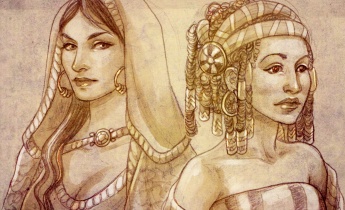
sarah_hagarOne story that has marked my life as a feminist is that of Sarah and Hagar. This is a story of pain and enmity among women under patriarchy that despite its age, is still relevant to illustrate the negative effects of the androcentric socialization. But it can also hold an inspirational feminist reading that leads us towards a reflection on the amazing possibilities of a shift in the way we women look at each other.

Feminism is a political practice, an ethics for living based in an option for women. It is not or should not be a Diploma, a chair where to work from 9:00am to 5:00pm, or an excuse to act from our own privileges against other women. In private and in public, in academia or in the street, in sexual, cultural, intellectual and religious affairs, a feminist is a feminist, without excuses or regrets.

This year I was part of the anthology “Jesus, Muhammad and The Goddess” with an essay called “The Wounded Goddess: The History of Sarah and Hagar From a Feminist Outlook” from which I want to share some excerpts with you, as follows: Continue reading “Feministing Sarah and Hagar by Vanessa Rivera de la Fuente”

A Tale of Two Sisters by Carol P. Christ

When I first returned from my ancestor quest in Germany, I fell ill with a bad cold and cough and had little physical energy. For two weeks I lived in the dreamtime, communicating with the ancestors and trying to make sense of the information about their lives I had discovered. After I got better, I had difficulty returning to daily life. The ancestors wanted to speak through me. Their stories, based on facts, come to me in waking trance.

A happy moment in the life of girl like Agnes
Feeding the ducks

Agnes Lattauer Sweitzer : I was born in Ober-Floerscheim (Hessen Darmstadt) on July 9, 1812. I was the first in a family of five children. Four years after me came Jakob, named after Father, and three years later, Rudolph. It was nice to have brothers, but my dream of a sister came true when Catherina was born a month and a day after my tenth birthday. My mother was busy with Jakob and Rudolph, so I became a second mother to Catherina. I could not nurse her, but I could sing to her and rock her to sleep. I changed her diapers and gave her a bath. It was so wonderful to have a baby to take care of. Three years later little Johanetta was born two days after my thirteenth birthday. Another baby for me and Mother bring up together.  I was in heaven. I was both mother and sister to the little girls. When they got older, I took my little sisters to play by the stream, where they giggled and cooed as we fed the ducks and the geese. In the summer, Mother and I brought them with us to the fields where we hoed and planted, weeded and harvested. They tried to pull weeds with their little fingers. It was my job to keep them from pulling up the plants too. Continue reading “A Tale of Two Sisters by Carol P. Christ”

Islamic Feminism and Heterosexual Dogma by Vanessa Rivera de la Fuente

12065675_170600583286234_3734458453482361154_n
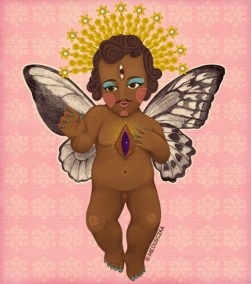
Santa Niña Marica

Reza Aslan says in his book “No God But God” that religions are myths. He explains that “religion” is a set of stories fluctuating between truth and fantasy that serve to explain and answer questions about human fate. Taking this idea as base, I think “religion” is a historical product that enables other mythical stories and must be addressed critically about its truth and meanings.

Patriarchal religious discourses, currently mainstream, have a common element that often is left outside the reading of equality and is part of the myth: Heterosexual belief.

Feminisms in Religions aim at challenging patriarchal readings. However, questioning the nature of God is not enough if we don´t challenge heterosexual belief that may or may not include the idea of a God Father/Male. In Islam, Allah has no sex or gender, is not masculine nor feminine. However, the heterosexual belief exists in the Islamic religious narrative. Continue reading “Islamic Feminism and Heterosexual Dogma by Vanessa Rivera de la Fuente”

“God is Not a Man, God Is Not a White Man” by Carol P. Christ

“The pictures that line the halls speak volumes about the history of racism and sexism and they shape the future in powerful ways.”–Simon Timm

The author of these words recently posted a short video on Youtube entitled “Mirror Mirror on the Wall: The Legacies of Sexism and White Supremacy at Yale Divinity School.”* The video begins with a catchy little ditty with the words, “God is not a man, God is not a white man.” It tracks paintings and photographs of professors and other luminaries in the field of theology on the walls of the Yale Divinity School. By Timm’s count: 99 white males, 6 women, and 3 blacks. The single black woman is counted in both categories.

Continue reading ““God is Not a Man, God Is Not a White Man” by Carol P. Christ”

Declaring a Theological State of Emergency: Trump’s Ignorance Must Not Be Ours by Mary E. Hunt

Mary HuntOn CNN’s State of the Union, Donald Trump reiterated his call to bar Muslim immigration to the U.S. and predicted that his fellow presidential candidates would soon come around to his position.

This prompts me to  declare a theological state of emergency. And I urge religious first responders to step forward.

His anti-Muslim rhetoric has caused Muslims to fear for their lives and well being—and it runs counter to the American Constitution on matters religious, although that does not seem to deter its adherents.

Because the content of these statements is focused on a specific world religion, I believe that scholars and activists of many religions need to step forward in concrete, educational ways.

Theologians must be among the first responders on this one. And we need to start at the beginning since Mr. Trump’s ignorance of the Muslim faith mirrors that of many Americans. “Islam” has become a code word for terrorism. In fact, it is the name of a monotheistic faith tradition based on the Qur’an which is practiced by more than 1.6 billion people, nearly a quarter of the world. Its practitioners are referred to as Muslims.

So our popular pedagogy must begin in order to right the wrongs of misinformation and demagoguery. Just as Christianity and Judaism have many expressions, so too with Islam. It is for Muslims to sort out their internal matters—but it is incumbent on global citizens to inform ourselves so as not to be cowed by the likes of Trump.

For example, a group of Muslims, including feminist journalist Asra Nomani, is calling for a new movement:

“We are Muslims who live in the 21st century. We stand for a respectful, merciful and inclusive interpretation of Islam. We are in a battle for the soul of Islam, and an Islamic renewal must defeat the ideology of Islamism, or politicized Islam, which seeks to create Islamic states, as well as an Islamic caliphate. We seek to reclaim the progressive spirit with which Islam was born in the 7th century to fast forward it into the 21st century. We support the Universal Declaration of Human Rights, which was adopted by United Nations member states in 1948.

We reject interpretations of Islam that call for any violence, social injustice and politicized Islam. Facing the threat of terrorism, intolerance, and social injustice in the name of Islam, we have reflected on how we can transform our communities based on three principles: peace, human rights and secular governance. We are announcing today the formation of an international initiative: the Muslim Reform Movement.”

Do Mr. Trump and the sector of the American public that agrees with him have any such information? I doubt it. Nor do they apparently have much experience with Muslim neighbors who live and work peacefully in virtually every part of the country.

Ignorance of religion is an acute problem in the United States. We have a lack of basic education about religion. Few school districts venture into the topic with their students. So it is not until tertiary education that most American young people have any formal instruction, if then, about religions other than their own. There must be a better way.

I propose that religious professionals, whether educators, pastoral people, or activists, become part of the solution by engaging in a massive, differentiated educational campaign to counter the negative narratives about Islam. This does not mean that anyone need convert to Islam. It is simply that in a democracy we owe one another a fair rendering of our faith traditions. That Mr. Trump’s remarks about Islam have caused such damage already, and could give license for more violence, add urgency to this task.

It is time for community forums where the basics of Islam can be explained in every part of the country. Radio shows, teleconferences, videos, social media posts, religious education classes, community group meetings might usefully focus on the basics of Islam. Simply to demystify the terms and show how ordinary Muslims go about their ordinary law-abiding lives would go a long way toward stemming the current tide.

I do not expect Muslims to educate the rest of us. But those who want to collaborate with other religious first responders are more than welcome. Among feminist colleagues, plans are afoot to launch some modest efforts, but we recognize and respect the need for safety and security for those who have been put in harm’s way by ignorant rhetoric and unconstitutional proposals.

It is non-Muslims who must bear the burden of this education about religion.

Not since the Nazi period has the specter of religiously-based oppression taken on such a heightened profile, with the potential for such devastating results. I believe it is a true emergency for which strong and constructive countermeasures are necessary.

The following is reprinted with permission from Religion Dispatches. Follow RD on Facebook or Twitter for daily updates.”

Mary E. Hunt, Ph.D., is a feminist theologian who is co-founder and co-director of the Women’s Alliance for Theology, Ethics and Ritual (WATER) in Silver Spring, Maryland, USA. A Roman Catholic active in the women-church movement, she lectures and writes on theology and ethics with particular attention to liberation issues.


Announcing A Serpentine Path: Mysteries of the Goddess by Carol P. Christ

carol p. christ photo michael bakas“The serpentine path is the path of life, a snakelike, meandering path, winding in and out, up and down, with no beginning and no end, into the darkness and into the light.”
As the year draws to a close, I am putting the finishing touches on A Serpentine Path: Mysteries of the Goddess. In the spring of 2016 it will be published by the Far Press, founded by Gina Messina-Dysert.  A Serpentine Path is the original title of the memoir of my journey from despair to the joy of life on the first Goddess Pilgrimage to Crete. It was published in 1995 as Odyssey with the Goddess, a title chosen by the publisher.

A Serpentine Path marked a turning point in my life and in my career as a writer. During the time described in my memoir I had fallen into a deep despair, sparked by the end of a marriage, the end of a love affair, and disappointment in my career. Hoping to make a fresh start, I moved to Greece. Not surprisingly, my despair followed me there. Nonetheless, as I would learn, I made the right decision, for as my Greek therapist was to tell me, I needed to learn to live in my body, not my head, and Greece was the place to learn that.

I was at a crossroads in my spiritual quest. I left Christianity for Goddess feminism, yet I felt the Goddess had abandoned me. I had a contract to write the first Goddess thealogy, but as I said in a speech at I gave at Harvard Divinity School just before I made the decision to move to Greece, I was not sure of the meaning of the symbol of the Goddess. Is Goddess a personal being who cares about the world? Or the name we give to the cycles of birth, death, and regeneration in nature? My inability to answer this question led my editors to return draft of my Goddess thealogy with the comment that something was missing. Continue reading “Announcing A Serpentine Path: Mysteries of the Goddess by Carol P. Christ”

Birth and Community by Sara Frykenberg

My daughter Hazel was born on a November afternoon. Just over two weeks old, my own individual role as mother is too young to comment on much here—I am thinking too much and too little about what it means, adjusting to my little one’s schedule, feeling like my boobs are going to fall off from my breastfeeding efforts, and loving in a new way. (It’s amazing how excited one can get about ‘poopy’ after baby has been struggling for days, isn’t it?)

But when I am lying in my bed, sometimes at night, I find myself amazed and grateful for the community it took to bring my daughter into being. I was pregnant but I also had a pregnant community. I labored with community; and what I am learning, is that my motherhood is also a function of community—something, for me, that would not have been possible without the many, many people who supported Hazel and me through the process of new birth. Continue reading “Birth and Community by Sara Frykenberg”

Friendships That Save Lives: For Rita M. Gross 1943-2015, by Carol P. Christ

Carol Eftalou - Michael HonnegerWhen Rita Gross visited me in Lesbos two summers ago, we spent many long hours discussing our lives and work. Rita and I met at the Conference of Women Theologians at Alverno College in June, 1971 when we were young women. We did not know it then, but our lives would continue to be intertwined through our common interests, first in the Women and Religion section of the American Academy of Religion, and then through our work on Goddesses and feminist theology.

When we met, Rita was a convert to Judaism working on her dissertation on Australian Aboriginal women’s religious lives, and I was a Christian about to begin a dissertation on Elie Wiesel’s stories that would lead me to express my own anger at God. Continue reading “Friendships That Save Lives: For Rita M. Gross 1943-2015, by Carol P. Christ”

DO RELIGIONS HAVE AN “ESSENTIAL” “CENTRAL” CORE THAT IS–OR IS NOT–SEXIST? by Carol P. Christ

Carol Eftalou - Michael HonnegerThough often asked, this is the wrong question.  Every statement about the “essential” or “central” teaching of any religion is based on a prior interpretation rooted in a particular standpoint. Thus, the idea that there is a “central” or “essential” core in any religion is not a matter of fact, but rather a matter of interpretation.

In discussions of religions, we often make global statements about our own and other religious traditions, such as: “Christianity is patriarchal to its core,” or alternatively, “The core teaching of Christianity is to love God with all your heart and your neighbor as yourself.” Or: “The true Islam teaches that God is love,” or alternatively, “Islam always teaches the subordination of women.”

These sorts of claims are made from time to time here on Feminism and Religion too. Every global statement that a particular religion “is” or “ is not” oppressive, calls someone to assert the opposite in the comments. I believe that statements about the “true” nature of any religion should should always be qualified. Continue reading “DO RELIGIONS HAVE AN “ESSENTIAL” “CENTRAL” CORE THAT IS–OR IS NOT–SEXIST? by Carol P. Christ”

The Book Is Finished, Now On to Publicizing It by Carol P. Christ

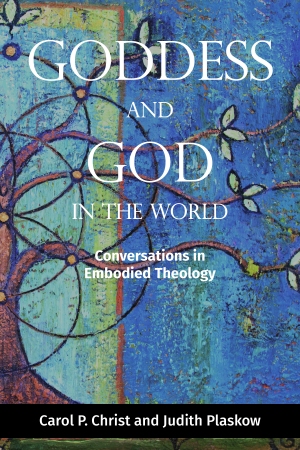
Carol in Crete turquoiseGoddess and God in the World: Conversations in Embodied Theology by Carol P. Christ and Judith Plaskow, forthcoming from Fortress Press in 2016.

In Goddess and God in the World, two leading theologians model a new method of embodied theology, rooted in experience and tested in dialogue. Christ and Plaskow agree that the God who is dead in our time is the transcendent and omnipotent male God of traditional theology. They believe that we must create new understandings of divinity because theologies not only help us to make sense of the world, but also provide guidance as we face the urgent social, political, and environmental issues of our time. In contrast to traditional views, Plaskow and Christ situate divinity in the world and place responsibility for the fate of the world firmly in human hands. They argue for an inclusive monotheism that affirms the unity of being through a plurality of images celebrating diversity and difference. Carol believes Goddess is the intelligent embodied love that is in all being, a personal presence that can inspire us to love the world more deeply. Judith understands God as an impersonal power of creativity, the ground of being that includes both good and evil. Their intense questioning of each other’s views provides an exciting model for theological conversation across difference.
Continue reading “The Book Is Finished, Now On to Publicizing It by Carol P. Christ”