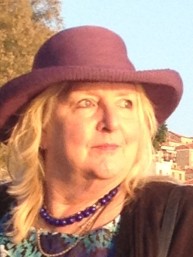
Legacy of Carol P. Christ: LOVING LIFE*

This post was originally published on June 11th, 2012

My religious views have changed over time, but the spirituality I learned from my grandmothers has remained constant. I have been Protestant, Catholic, a lover of Judaism, an admirer of Christian Science, and a Goddess feminist.  I have always loved life.

I was born in Huntington Hospital just before Christmas in 1945 and brought to my grandmother’s home on Old Ranch Road in Arcadia, California.  Peacocks from the adjacent Los Angeles County Arboretum screeched on the roof. There was another baby in the house, my cousin Dee, born a few months earlier.  My mother and her sister were living with their mother. The war was over, and they were anticipating the return of their husbands from the Pacific Front.  My earliest memory, recovered during healing energy work, is visual and visceral. I am lying crossways in a crib next to the other baby. There is a soft breeze. The other baby is kicking its legs, and I am trying to do the same.  I look up and see three faces looking down at us.  Although the faces are blurry in the vision I see, I feel them as female and loving.  I got off to a good start. Continue reading “Legacy of Carol P. Christ: LOVING LIFE*”

Legacy of Carol P. Christ: “AS WE BLESS THE SOURCE OF LIFE, SO WE ARE BLESSED”

This was originally post May 7, 2012

Blessing the Source of Life harks back to the time when shrines were built near springs, the very literal sources of life for plants, animals, and humans.

The prayer “As we bless the Source of Life, so we are blessed,” based on a Hebrew metaphor which refers to a water source and set to music in a Jewish feminist context by Faith Rogow, has become one of the bedrocks of my Goddess practice.

In Minoan Crete, seeds were blessed on the altars of the Goddess and the first fruits of every crop were returned to Her. The ancient Minoans piled their altars high with barley, fruits, nuts, and beans, and poured libations of milk and honey, water and wine, over the offerings they placed on altars. Evidence of these actions is found in the large number of pouring vessels stored near altars.

Continue reading “Legacy of Carol P. Christ: “AS WE BLESS THE SOURCE OF LIFE, SO WE ARE BLESSED””

Legacy of Carol P. Christ: Essentialism Reconsidered

This was originally posted on September 15, 2014

In my Ecofeminism class we have been discussing essentialism because some feminists have alleged that other feminists, particularly ecofeminists and Goddess feminists, are “essentialists.” They argue that essentialist views reinforce traditional stereotypes including those that designate men as rational and women as emotional. I too find essentialism problematic, but I do not agree that Goddess feminism and ecofeminism are intrinsically essentialist.

Goddess feminists and ecofeminists criticize classical dualism: the traditions of thinking that value reason over emotion and feeling, male over female, man over nature. We argued that the western rational tradition sowed the seeds of the environmental crisis when it separated “man” from “nature.”

Goddess feminists and ecofeminists affirm the connections between women and nature in an environmental worldview that acknowledges the interconnection of all beings in the web of life.

Continue reading “Legacy of Carol P. Christ: Essentialism Reconsidered”

Legacy of Carol P. Christ: The Sacred Feminine or Goddess Feminism?

This was originally posted on January 25, 2016

Carol Molivos by Andrea Sarris 2

In recent years “the Sacred Feminine” has become interchangeable with (for some) and preferable to (for others) “Goddess” and “Goddess feminism.” The terms Goddess and feminism, it is sometimes argued, raise hackles: Is Goddess to replace God? And if so why? Does feminism imply an aggressive stance? And if so, against whom or what?

In contrast, the term “sacred feminine” (with or without caps) feels warm and fuzzy, implying love, care, and concern without invoking the G word or even the M(other) word–about which some people have mixed feelings. Advocates of the sacred feminine stand against no one, for men have their “sacred feminine” sides, while women have their “sacred masculine” sides as well.

Nothing lost, and much to be gained. Right? Wrong.

Continue reading “Legacy of Carol P. Christ: The Sacred Feminine or Goddess Feminism?”

In Memoriam – Carol P. Christ by Joyce Zonana

“thea-logy begins in experience” –  Rebirth of the Goddess

It is hard to believe that Carol P. Christ – Karolina as she dubbed herself in her beloved Greece—has been gone for a year. She remains such a vivid presence in my life—in all of our lives. I think of her and draw strength from those thoughts daily, the way so many women say they think of and feel close to their deceased mothers. For Karolina was indeed a mother to me—a nurturing spiritual mother who initiated me into the ways of the Goddess she adored and, whom she so beautifully defined as “the power of intelligent love that is the ground of all being.”

I first met Karolina in June of 1995 on a bare hotel rooftop in Athens. I had just flown there from New Orleans to join the Ariadne Institute’s Goddess Pilgrimage Tour, a leap of faith inspired by my reading the previous year of Weaving the Visions: Patterns in Feminist Spirituality, a pioneering anthology edited by Carol and her long-time friend and collaborator, Judith Plaskow. That book, along with Carol’s Diving Deep and Surfacing and Judith’s Standing Again at Sinai had spoken to me more deeply than anything I had ever read before. I had grown up in a Middle Eastern Orthodox Jewish family. drawn to spirituality, I had never able to find a place for myself in the deeply patriarchal structures of synagogue or even family rituals … Carol and Judith offered me a way in, and I wanted immediately to embark on the paths they were clearing. I wanted to meet them, to know them,  to learn from them, to share with them. Boldly, I decided to join the Pilgrimage, signing up for my first trip overseas trip, the most costly vacation I had ever granted myself. How could I have known that it would transform my life and bless me with a miraculous, deep friendship?

Continue reading “In Memoriam – Carol P. Christ by Joyce Zonana”

Carol P. Christ’s Legacy: Love Divine, All Loves Excelling

This was originally posted on Sept. 9, 2011

In my last blog I wrote that the image of God as a dominating other who enforces his will through violence–found in the Bible and in the Christian tradition up to the present day–is one of the reasons I do not choose to work within the Christian tradition.  To be fair, there is another image of God in Christian tradition that I continue to embrace.  “Love divine, all loves excelling” is the opening line of a well-known hymn by Charles WesleyCharles Hartshorne invoked these words and by implication the melody with which they are sung as expressing the feelings at the heart of the understanding of God that he wrote about in The Divine Relativity.

Love divine, all loves excelling also expresses my understanding of Goddess or as I sometimes write Goddess/God.  Though I am no longer a Christian, but rather an earth-based Goddess feminist, I freely admit that I learned about the love of God while singing in Christian churches.  Hartshorne wrote that he knew the love of God best through the love of his own mother, and I can say that this is true for me as well.  My mother was not perfect, and she did not understand why I wanted to go to graduate school, my feminism, or my adult political views, but I never doubted her love or my grandmothers’ love for me.  (I count myself lucky.  I know others did not have this experience.)  Like Hartshorne, I also learned about the love of God through the world that I always understood to be God’s body.  Running in fields and hills, swimming in the sea, standing under redwood trees, and encountering peacocks in my grandmother’s garden, I felt connected to a power greater than myself.


Continue reading “Carol P. Christ’s Legacy: Love Divine, All Loves Excelling”

Carol P. Christ’s Legacy: “THE OLD RELIGION” OR A “NEW CREATIVE SYNTHESIS”?

Moderator’s Note: Carol Christ died from cancer in July, 2021. Her work continues through her non-profit foundation, the Ariadne Institute for the Study of Myth and Ritual and the Goddess Pilgrimage to Crete. This blog was originally posted June 30, 2014. You can read its original comments here.

Is Goddess feminism an old religion or a new creative synthesis? Can it be both?  Goddess feminism draws on the feminist affirmation of women’s experiences, women’s bodies, and women’s connection to nature; the feminist critique of transcendent male monotheism as the symbolic expression of male domination of women and nature; and 19th and early 20th century discussions of Goddesses and matriarchy.

Most Goddess and other spiritual feminists have experienced Wiccan rituals, which are often simply called Goddess rituals.  For many of us, elements of Wiccan practice strike a chord of knowing, while other aspects seem odd or strange or even just plain weird.  What are the roots of Wiccan ritual?

Continue reading “Carol P. Christ’s Legacy: “THE OLD RELIGION” OR A “NEW CREATIVE SYNTHESIS”?”

An Experience of the Aphrodisia by Olivia Ciaccia

A warm summer sun smiles down upon the British coastline, the low tide reflecting jewels which are wash up and dispersed upon fine sand. A welcome breeze dances around a gathering of Goddess devotees encircling a small bonfire. Amongst them stands a banner and statue depicting and imitating Botticelli’s Venus and bouquets of roses. Just before the sun sets, those gathered lovingly collect these assembled artifacts, holding them aloft, and begin to process barefoot towards the sea.

Aphrodite-Venus’s banner and sculpted face shines in the low afternoon sunlight. As the procession slowly steps, weaves, and dances, towards the sea to the beat of a drum, the sun reaches further behind the hills, casting a long shadow upon the beach. The Goddess’s image dances with them, banner swaying and statue bobbing with the dance of its carrier. By the time the procession reaches the sea, the sun has dipped behind the now black silhouette of the hills bathing the beach ahead in dusky oranges and brilliant blues. At the shoreline, a priestess steps forward and turns the Goddess’s statue to face the procession, which has now fanning out into a semi-circle.

Continue reading “An Experience of the Aphrodisia by Olivia Ciaccia”

Yes, there are Goddesses in the Bible, Part 5 by Janet Maika’i Rudolph


As I wrote my last blog post, the Great Goddess of the Canaanites, Ashera was honored and worshipped (according to the bible) within and through groves of trees. Ashera and El, the “great bull god” were deeply connected. In fact, in Canaanite mythology, El and Ashera were married.

But before delving into their relationship, I would like to start in a different (but connected) direction – the lovely archetype of the morning star and the evening star. The planet Venus, named for her namesake Goddess (or vice versa), is both the planetary vision of the morning star and the evening star. Whether She be Goddess, planet or evening/morning star, when She appears in one form, She embodies them all. Continue reading “Yes, there are Goddesses in the Bible, Part 5 by Janet Maika’i Rudolph”

Yes, There are Goddesses in the Bible by Janet Maika’i Rudolph

“Freud once asserted that mortals are not made to keep secrets;
what they would like to conceal oozes from all their pores.”
Psychoanalyst Theodore Reik[1]

It’s remarkable how much female imagery there is in the Bible hidden within its wording. The more I delve into its passages, the more that I have found these hidden/not so hidden sacred feminine images, even deities. I have begun a project of digging in and rooting out these little gems. When people think about the sacred feminine or female deities in the Bible the most well known is the Shekinah. The Shekinah is a lovely presence. The word means “dwelling” and usually represents “god’s divine presence” or a place where the divine resides.

The problem is that the Shekinah as a feminine essence of the divine is never stated explicitly, it is an interpretation of how the word is used.  I love the concept of the Shekinah but as an essence that upholds the entire weight of the feminine divine in the bible, I find it unsatisfying by itself. Luckily for me, Goddess Shekinah has lots of company. Sometimes they are indeed hiding in plain sight. Sometimes they hide in the translations. The passage I am presenting today has some of both going on. The following is the King James Version of Genesis 49:25. Jacob has been giving blessings to each of his sons and this is part of the blessing he gives to Joseph: Continue reading “Yes, There are Goddesses in the Bible by Janet Maika’i Rudolph”