Winter Solstice: Celebration of the Powers of Fire by Sara Wright

I have a problem with the belief that Winter Solstice is primarily about celebrating ‘the coming of the light.’ This one – sided thinking negates the cross-cultural reality that this is a festival during which candles are lit to light up the night and roaring fires blaze inside and out bringing warmth to all. Winter Solstice is above all else a Festival of Fire.

Fire is an ambiguous element (as all the elements are) carrying both a positive and negative charge. On one level fire brings warmth and light on cold winter nights. On the other hand, fire also incinerates, destroying everything it touches. Approaching a Festival that celebrates the Element of Fire should be done with consciousness and caution.

Continue reading “Winter Solstice: Celebration of the Powers of Fire by Sara Wright”

What, Together, We Are by Annelinde Metzner

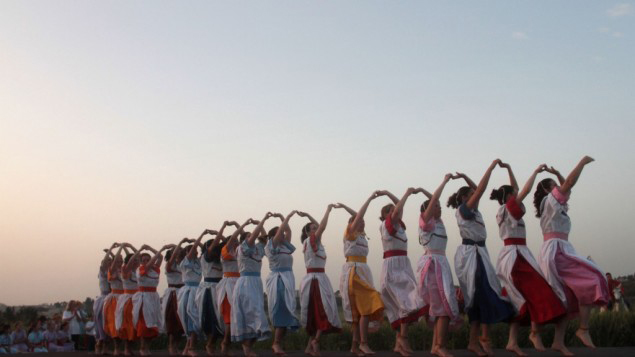
Kibbutz

It seems that the hearts of the whole world, and especially the hearts of women, are grieving now, as war and warmongering take over more and more of the Earth.  Patriarchy rages on, like a monster in its death throes, and we wonder, “will they take us all down with them?”  It is my hope that these poems will help us to keep on keeping on, keep on loving Her.

My grief, my love for the world                                        

I watch the dancer, one arm framing her face,
one hip drawing upward in the belly’s rhythm.
The dance of mature women, Raqs Sharqi
born of the sensuous music of the Middle East.
Her hips pull us into infinity,
an inward-outward shout of beauty and desire.

Continue reading “What, Together, We Are by Annelinde Metzner”

My Pilgrimage to Crete – September 2023, Part 2 by Terry Folks

Part 1 was posted yesterday.

Stage Four – Mentor Appears

Joseph Campbell spoke of ‘mentors’ appearing to help the sojourner, and what Maureen Murdock called the gathering of allies. In my hybrid of these two archetypal journeys, there may be several mentors – human, power animals, divine guides or a combination. She could be a wise elder who helps the heroine prepare for the journey or gives her a gift for later use. In my case the wise elder was my 93 year old mom who became one of my mentors. When I expressed my excitement and fears, she said what she always says when I – one of her seven children – am facing a challenge: “Go get’em Tiger!” She also offered financial support so I could take time away from my psychotherapy practice.

Two other mentors showed up in what Carl Jung called my ‘active imagination’: Carol Christ and Marija Gimbutas. Both have transitioned so my active imagination conjured their support as divine intervention. I reread Carol’s reflections and teachings on the pilgrimage, and watched the videos she made as inspiration. I felt her invitation. I was ready to change.

Continue reading “My Pilgrimage to Crete – September 2023, Part 2 by Terry Folks”

My Goddess by Mary Gelfand

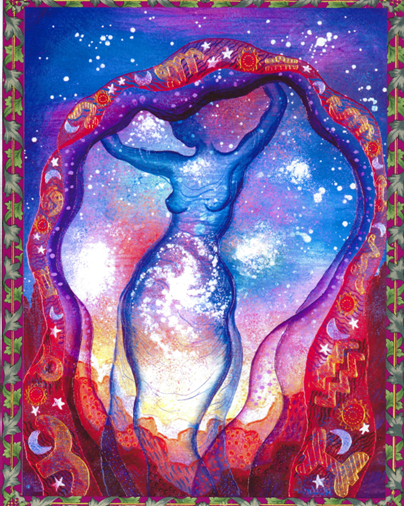
Birth of a Galaxy, by Willow Arlena, https://www.mysticlifedesign.com/

My Goddess is unconfined
      –unbound
–unlimited
–unrestricted.

My Goddess exists beyond
–the images of Her created by men
–the words describing Her written by men
–the laws coercing Her, enacted by men.

Continue reading “My Goddess by Mary Gelfand”

Crete as the cradle of a culture of peace – Part Two by Laura Shannon

Part One of this article spoke of our collective yearning for peace, and the difficulty of imagining a peaceful world when we are taught to believe that “patriarchy and with it war and domination are universal and inevitable.” (Carol Christ, 2015)

But this is a myth. The peaceful civilisation of Bronze Age Crete lasted two thousand years with no sign of violence, slavery, or war. Most likely matriarchal, matrifocal, and matrilineal, ancient Crete embodied the final flowering of Old Europe. Art and archaeology reveal a life-loving people who honoured the earth, the Goddess, and nature, particularly mountains, caves, and trees. Key values and symbols of this culture of peace survive today in Cretan women’s dances and folk arts including pottery, textiles, baskets, and bread.

Continue reading “Crete as the cradle of a culture of peace – Part Two by Laura Shannon”

Crete is the Cradle of a Culture of Peace – Part One by Laura Shannon

These are difficult days. We awaken daily to the ongoing horror of senseless killing. My heart is filled with a yearning for peace. Now is the time to dream of peace, to choose peace, to practice peace – within our selves, with those we love, in our communities and in our world.

But what might a peaceful world look like? It can be hard to even imagine – not only because we live in a world filled with war, but because we have been taught to believe, as Carol Christ explains, that “patriarchy and with it war and domination are universal and inevitable.” However, she goes on, “this is a myth perpetrated by those who do not want to give up the power and privilege the patriarchal system has accorded to them.” War is not inevitable. Peace is possible.

Continue reading “Crete is the Cradle of a Culture of Peace – Part One by Laura Shannon”

A Thealogy of Land and Roots by Kelle ban Dea

I am my Mothers
My Mothers are me
I am the Goddess
the Goddess is within me
As blood
as bone
as the spirals 
of nuclei
as ova
as tears
as breath
I carry my Mothers
as my Daughters will carry me

And the Goddess carries us all

Continue reading “A Thealogy of Land and Roots by Kelle ban Dea”

Women’s Sovereignty and Body Autonomy Beyond Roe v. Wade: Book Review by Beth Bartlett

A Girl God Anthology Edited by Arlene Bailey, Pat Daly, Sharon Smith and Trista Hendren

Women’s Sovereignty and Body Autonomy Beyond Roe v. Wade was not what I was expecting.  Given the title, I thought it would be similar to Robin Marty’s New Handbook for a Post-Roe America – a practical guide for ways to gain access to reproductive care in the wake of the overturning of Roe v. Wade.  Instead, I found, in contributor Mary Saracino’s words, “the howl of ages” – a deeply passionate and spiritual collection of poetry, prose, and visual art expressing  women’s outrage, grief, resistance, and empowerment in response to the U.S. Supreme Court decision of June 2022 denying women the right to abortion care that had been settled law in the U.S. for nearly fifty years.

Continue reading “Women’s Sovereignty and Body Autonomy Beyond Roe v. Wade: Book Review by Beth Bartlett”

Legacy of Carol P. Christ: Is It Essentialist To Speak Of Earth As Our Mother?

This was originally posted on November 25, 2013

The charge of “essentialism” has become equivalent to the “kiss of death” in recent feminist discussions. In this context it is taboo to speak of Mother Earth.  Yet, I would argue there are good reasons for speaking of Mother Earth that do not add up to essentialism. What if the values associated with motherhood are viewed as the highest values? What if the image of Mother Earth encourages all of us to recognize the gift of life and to share the gifts we have been given with others?

For those not familiar with the “essentialism” debate in feminist theory, it might be useful to define “essentialism.”  In philosophy, essentialism is the idea that every “thing” has an “essence” which defines it.  In its pure form, essentialism is a by-product of Platonic “idealism” which states, for example, that the “idea” of table is prior to every actual table and that every actual table is an embodiment of the idea of table.

Continue reading “Legacy of Carol P. Christ: Is It Essentialist To Speak Of Earth As Our Mother?”

The Queen of Heaven Cakes: Asherah and Ishtar by Michelle Cameron

When one nation conquered another in antiquity, vanquished peoples typically switched allegiances to that country’s gods, since those deities were clearly stronger than their own. In my novel, Babylon: A Novel of Jewish Captivity, the prophet Daniel warns against this tendency, so the Judean exiles would remain faithful despite their captivity:

“You may be tempted to slip away from your Hebrew roots. Many of us struggle to remain steadfast to our faith. We are seduced by the lure of the gods of Ishtar and Marduk, Sin, Damkina, and Ea. Their temples overflow with riches and their ways are strange and compelling.

Continue reading “The Queen of Heaven Cakes: Asherah and Ishtar by Michelle Cameron”