From the Archives: Brigid, Archetype of Inspiration and Activation by Stephanie Anderson Ladd

Moderator’s note: This marvelous FAR site has been running for 10 years and has had more than 3,600 posts in that time. There are so many treasures that have been posted in this decade that they tend to get lost in the archives. We are beginning this column so that we can all revisit some of these gems. Today’s blogpost was originally posted February 1, 2014. You can visit it here to see the original comments.

Brigid, Goddess of the Fire, greets us on Brigid’s Day, February 1. She is a Celtic sun goddess whose light burns brightly, illuminating the darkness of the land, of a heavy heart, and the dark night of our soul. With her shining light to guide us, we are lifted out of the Underworld darkness where we tend to descend in Winter, to the light of the World above, teeming with life as Spring begins to unfold her wet wings.

Brigid is a beloved goddess throughout the British Isles, particularly Ireland, where she is seen as the Mother of the Land and Her people. As a feminine archetype, she activates our solar, active nature. Much like the sun rising from below the Earth’s horizon, she urges us to come out of hiding and shine our light on the world. This may be done in a quiet manner, such as sitting by the hearthfire and doing needlework, finding inspiration by a walk in nature and writing a poem, moving about the kitchen making soup, getting busy with an art or craft project, or in big ways by taking on new roles as healers, artists, and leaders and calling others to join us.

Continue reading “From the Archives: Brigid, Archetype of Inspiration and Activation by Stephanie Anderson Ladd”

Carol P. Christ’s Legacy: ON NOT GETTING WHAT WE WANT AND LEARNING TO BE GRATEFUL FOR WHAT WE HAVE

Moderator’s Note: We here at FAR have been so fortunate to work along side Carol Christ for many years. She died from cancer in July, 2021. To honor her legacy, as well as allow as many people as possible to read her thought-provoking and important blogs, we are pleased to offer this new column to highlight her work. We will be picking out special blogs for reposting. This blog was originally posted March 26, 2012. You can read it long with its original comments here. Carol mentions a book she was writing with Judith Plaskow at the time with the working title: God After Feminism. The book was published in 2016 under the title of Goddess and God in the World: Conversations in Embedded Theology. You can find it here.

Many women’s dreams have not been realized. How do we come to terms with this thealogically?

Although I am as neurotic as the next person, I am also really wonderful—intelligent, emotionally available, beautiful (if I do say so myself), sweet, caring, and bold. I love to dance, swim, and think about the meaning of life. I passionately wanted to find someone with whom to share my life. I did everything I could to make that happen—including years of therapy and even giving up my job and moving half way around the world when I felt I had exhausted the possibilities at home.

For much of my adult life I have asked myself: What is wrong with me? Why can’t I find what everybody else has? Even though I knew that there were a lot of other really great women in my generation in my position and even though I knew that many of my friends were with men I wouldn’t chose to be with, I still asked: What is wrong with me?

Continue reading “Carol P. Christ’s Legacy: ON NOT GETTING WHAT WE WANT AND LEARNING TO BE GRATEFUL FOR WHAT WE HAVE”

From the Archives: What Would Durga Do? by Barbara Ardinger

Moderator’s note: This marvelous FAR site has been running for 10 years and has had more than 3,600 posts in that time. There are so many treasures that have been posted in this decade that they tend to get lost in the archives. We have created this column so that we can all revisit some of these gems. Today’s blogpost was originally posted August 2, 2015. You can visit it here to see the original comments.

It’s one of my favorite T-shirts. Every time I wear it, people who know who Durga is comment. So do some people who don’t know who the Hindu goddess is.

“What would Durga do?” is of course an echo of the question What would Jesus Do?

I’ve just done a bit of research and learned that this phrase may come from the Middle Ages, that it was famously used in a sermon in about 1891, and that it became very popular among evangelical Christians during the 1990s. What would Jesus do? I think he’d remind us to pay closer attention to the Sermon on the Mount (Matthew 5, 6, 7), especially the Beatitudes and the Golden Rule: “So whatever you wish that others would do to you, do also to them” (Matt.: 7:12). The Golden Rule is of course given in the other major religions, too. WWJD has also been turned into WWBD—“What would Buddha do?” I think the Buddha would tell us to live more mindfully.

Continue reading “From the Archives: What Would Durga Do? by Barbara Ardinger”

From the Archives: Still Practicing Her Presence By Barbara Ardinger

Moderator’s note: This marvelous FAR site has been running for 10 years and has had more than 3,600 posts in that time. There are so many treasures that have been posted in this decade that they tend to get lost in the archives. We have created this column so that we can all revisit some of these gems. Today’s blogpost was originally posted May 27, 2012. You can visit it here to see the original comments.

In my blog of May 11 about practicing the presence of the Goddess, I explained how Brother Lawrence of the Resurrection inspired me. Many thanks to everyone who read that blog and commented on it. One comment came via email from a friend, who said, “I kept thinking as I read about that expression ‘walking one’s talk.’” But of course. It would be lovely if anyone outside a nunnery or monastery could be as filled with their god or goddess as Brother Lawrence was. Though we try to be as mindful as we can, we obviously don’t always succeed as well as we’d like. But surely it’s better to have a positive intention than a negative one.

So let’s get practical. Instead of filling our heads with what’s been called monkey-chatter, let’s fill ourselves with the Goddess so that our thoughts of Her can go on autopilot. Instead of obsessing over, say, if the Lakers, Packers, or Cardinals are going to win their next whatever-they-play or who’s gonna win this week on Dancing With the Stars, let’s set our minds on the Goddess so our thoughts go to Her when we don’t have to concentrate on some specific, important task at hand.

Continue reading “From the Archives: Still Practicing Her Presence By Barbara Ardinger”

Fireless Altars and Crone Encounters By Barbara Ardinger

We’ve just entered November, the beginning of winter, the season of darkness. Twenty-odd years ago, I led a group of students through the Wheel of the Year in a class I called Practicing the Presence of the Goddess. (I also wrote a book with the same title.

Continue reading “Fireless Altars and Crone Encounters By Barbara Ardinger”

Maternal Gift Economy: Webinar Gifts by Carol P. Christ

In the 1960s and 1970s, American-born Genevieve Vaughan was living in Rome with her husband, philosopher Ferruccio Rossi-Landi, and their three daughters. When Rossi-Landi, using Marxist models, began to write about language as a form of “exchange,” Vaughan was inspired to articulate her alternative theory based on the idea that language was developed and is learned through the gifts of the mother to the child. From that beginning, Vaughn developed an alternative theory of culture based on what she calls the “gift economy.”

We are born into a Gift Economy practiced by those who mother us, enabling us to survive. The economy of exchange, quid pro quo, separates us from each other and makes us adversarial, while gift giving and receiving creates mutuality and trust.

According to Vaughan, the “exchange economy” is based in the gift economy, while at the same time it denies the gifts it has received from mothers and mothering figures and disparages mothers and their work. Mothers rear children who enter into the exchange economy, but these children would not be alive to enter the exchange economy unless they had first been nurtured by the freely given gifts of mother. Vaughan writes that prior to patriarchy, cultures and societies valued the gifts of mothers and were organized around the principle of gift-giving. Vaughan states that gift-giving economies are based in the idea of meeting the needs of others, while exchange economies are focused on the enrichment of the individual self. She believes that re-valuing and re-instating the gift economy is the only path to creating and restoring peace and justice in the world. Continue reading “Maternal Gift Economy: Webinar Gifts by Carol P. Christ”

Altars Everywhere, Part 1 by Carol P. Christ

In a recent blog, Carolyn Boyd invited us to reflect on how our women’s spiritual power is activated through symbols that help us to remember and manifest the “deep well” of our inner knowing. According to historian of religion Mircea Eliade, the sacred and the profane were not separated in premodern cultures because all of life was considered to be sacred. Many in the Women’s Spirituality and Goddess communities have advocated this earlier more wholistic understanding. Although it is not always easy to overcome the dualism between sacred and profane, we attempt to do so.

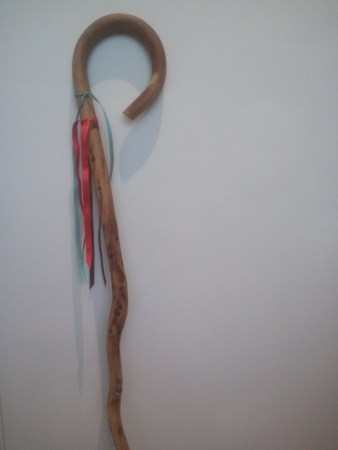
One of the symptoms of my chemotherapy is neurasthenia or partial numbness in my right foot. When it first occurred, I fell three times in my apartment because I was not lifting my foot automatically. I became afraid to move without holding onto the walls or furniture. I resisted my friends’ advice to get a walker, but finally agreed that I needed some form of physical support. I arranged for my friend Eirini Kouraki to have a rubber tip added to the shepherd’s cane I sometimes use walking in the mountains. When she brought it too me, I decorated it with three ribbons I saved from rituals at the Holy Myrtle Tree at the Paliani monastery in Crete. The most recent were brown, the color of the earth, and red, the strong energy I will need to heal. I added a light green-blue ribbon, representing the calm and clear optimism I feel as I face a crisis of life and death. The ribbons remind me of the healing power of the Holy Tree that I have called upon many times, turning a symbol of my infirmity into a symbol of healing and hope.
In the past weeks as my cancer treatment continues, I have been feeling strong enough to finish unpacking (with the help of Vera, my cleaning lady) and organizing my new home in Crete. As I rediscover sacred objects, I create altars. Altars are physical reminders of our spiritual beliefs. Creating and tending them helps to create the embodied knowing that brings the spirit into our daily lives.

The living area of my new apartment has 3 glass shelving units. In one of them, I created a triple altar with images of the Goddess and female power from ancient Crete. Because the apartment is sleek and modern yet welcoming to my antique furniture, I kept the altar minimal.
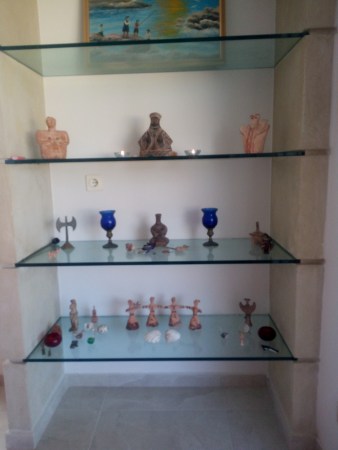
On the top shelf I placed three pre-palatial “pitcher” Goddesses, two with breasts from which liquid pours and one that is holding a water jug from which liquid can also be poured. These images, dated before 2000 BCE, express the Old European insight that the Goddess represents the powers of birth, death, and regeneration in all of life. Though they have human qualities, they are more than human. The Goddess from Malia who sits in the center of this altar has a beaked face and wings and her triangular shape evokes the mountains from which water flows to villages and fields. These images remind me that the Goddess is the Source of Life, provider of gift of life that is our embodied being and the gifts of life—including food and water–that nourish us daily.
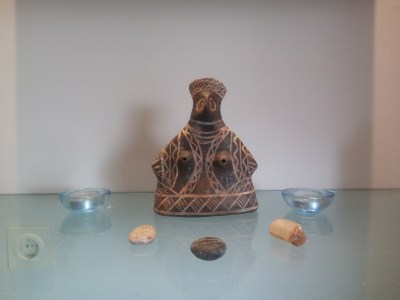
The second shelf holds one of the oldest images from ancient Crete, the Neolithic Goddess from Ierapetra. She is seated on massive buttocks, securely rooted in the earth. Her face is beaked, symbolizing her connection to the birds that fly in the air. Her body is decorated with lines identified by archaeologist Marija Gimbutas as the flowing water that nourishes all of life. Her body too is shaped like the mountain. She represents the never-ending powers of birth, death, and regeneration in all of nature.

In front of the Neolithic Goddess I placed a twig from Paliani with a dark blue ribbon reminding me that my friend Tina Nevans is sending the healing energy of the Blue Buddha to me in her daily meditations, as well as several handsewn triangles holding leaves from the Holy Myrtle tree, and a crystal extracted from the Trapeza Cave, found on the path outside of it. To Her right is a small image of the long-necked turtle Goddess from Myrtos who holds a pitcher recalling women’s daily visits to water sources, and a small copy of a Kamares ware pitcher used to pour libations in the Sacred Centers. To the left are a bronze copy of a labrys, originally the double sacred female triangle transformed into wings and also a happy little bull who reminds us that animals experience the joy of life.
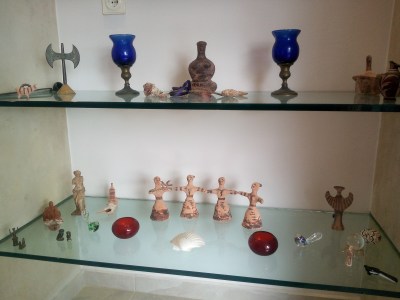
On the lower shelf, copies of dancing women from post-Minoan Paliakastro symbolize the transmission of Old European values of community, lack of hierarchy, and most of all, celebration of the joy of life as Laura Shannon has written. The dancing women are surrounded by images of later Mycenaean Goddesses and of Aphrodite who was worshiped at the Minoan site of Kato Symi in classical times, and a small reproduction of the Neolithic Goddess from Catal Huyuk, who reminds us that Crete was settled c.7000 BCE by farmers from Anatolia.

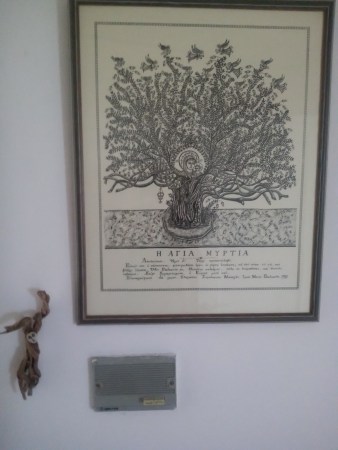
In the hallway I placed a copy of a drawing of the Holy Myrtle Tree of the monastery of Paliani created by one of the nuns. According to the story told, the area where the monastery was later built was burned in a fire but a small myrtle bush survived. It was watered by girls who saw the image of the Panagia (Mary the Mother of Jesus) in its charred branches. So, the monastery which was known as ancient in 668 CE was built. The monastery is a sacred place for the surrounding villages. The sacred tree and the icon of the Panagia in the church are said to have performed many miracles. Below the drawing of the Sacred Myrle Tree is a small image of a face in a twig from tree given to me by German artist Carla Randel.
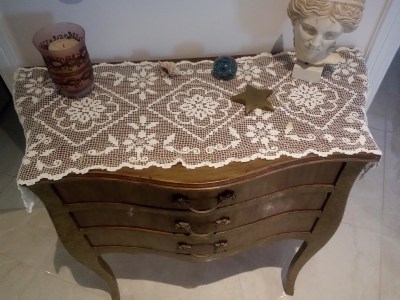
On a small table under the drawing, I placed an image of Aphrodite who was earlier associated with myrtle trees, along with a candle, a star, a blue glass paperweight, and a triton shell, symbolizing Aphrodite as the morning and evening star, and her relation to the sea.
When I light candles in translucent glass holders on the altar with the pitcher Goddesses as the day dawns and in the evening as day turns to night, and when I gaze at my other altars, I remember that I am always surrounded by the nurturing love of the Goddess. This love takes root in my body, and I am inspired to share it with others.

To be continued.

Her Magic in the Stone Circle by Glenys Livingstone

My ancestors built great circles of stones that represented their perception of real time and space, and enabled them to tell time: the stone circles were cosmic calendars. They went to great lengths and detail to get it right. It was obviously very important to them to have the stones of a particular kind, in the right positions according to position of the Sun at different times of the year, and then to celebrate ceremony within it.

I have for decades had a much smaller circle of stones assembled, representing the ‘Wheel of the Year’, as the annual cycle of Earth around Sun is commonly named in Pagan traditions. I have regarded this small circle of stones as a medicine wheel. It is a portable collection, that I can spread out in my living space, or let sit in a small circle on an altar, with a candle/candles in the middle. Each stone (or objects, as some are) represents a particular Seasonal Moment, and is placed in the corresponding direction. I have found this assembled circle to have been an important presence. It makes the year, my everyday sacred journey of Earth around Sun, tangible and visible as a circle, and has been a method of changing my mind, as I am placed in real space and time. My stone wheel has been a method of bringing me home to my indigenous sense of being.  Continue reading “Her Magic in the Stone Circle by Glenys Livingstone”

The Poiesis of Celebrating Earth’s Seasonal Moments by Glenys Livingstone

Amongst Celtic peoples, the capacity to speak poetically was a divine attribute, regarded as a transformative power of the Deity, who was named by those peoples as the Great Goddess Brigid: She was a poet, a Matron of Poetry (along with her capacities of smithcraft and healing). And at Delphi in Greece, the oracular priestesses delivered their prophecies in poetic form: Phemonoe invented the poetic meter, the hexameter. And from Sumeria, humans have the first Western written records of literature, which is poetry written by the High Priestess of Inanna, Enheduanna in approximately 2300 B.C.E.. Poetry has been recognised as a powerful modality: Barbara Mor and Monica Sjoo described “poetic thinking” as an wholistic mode, wherein “paradox and ambiguity … can be felt and synthesized. The most ancient becomes the most modern; for in the holographic universe, each ‘subjective’ part contains the ‘objective’ whole, and chronological time is just one aspect of a simultaneous universe” (The Great Cosmic Mother, 41).

Poetry could be described as an “Earth-centred language”: it has the capacity to hold multivalent aspects of reality, to open to subjective depths, to allow qualitative differences in understanding. Hence it is especially suited to expressing and bringing together a multitude of beings. Cosmologist and evolutionary philosopher Brian Swimme and the late cultural historian/geologian Thomas Berry have called for such a language – the kind of language “until now enjoyed only by our poets and mystics” that may express the “highly differentiated unit”, the organic reality such as Earth is (The Universe Story, 258-259), and such as “Gaia” was understood of old, and in recent scientific theory: that is, Earth is understood as a highly differentiated unity, which any expression must aim to emulate. Continue reading “The Poiesis of Celebrating Earth’s Seasonal Moments by Glenys Livingstone”

Reaching for New Language for the Sacred by Glenys Livingstone

The term ‘PaGaian’, which became the title of my work, was conceived in at least two places on the planet and in the opposite hemispheres within a year of each other, without either inventor being aware of the other’s new expression. It was some time before they found each other … one party in Australia, myself having published a book with PaGaian in the title; and the other party, Rob Blake – in the UK having registered the domain pagaian.org as the term seemed to him to express a cosmology constellating in his mind. The term PaGaian was actually conceived by my partner Taffy Seaborne in late 2003, enabling the book to manifest: heretofore the body of work developed there took six lines to express.

This reaching for a new word, was the reaching for a language, which is a power; to bring together an Earth-based – ‘Pagan’ – spiritual practice indigenous to Western Europe, with recent Western scientific understandings of the planet as a whole living organism – ‘Gaia’ as it has been named, and which by its name acknowledged resonance with ancient Mother Goddess understandings of our Habitat, as an alive sentient being. So, the term ‘PaGaian’ splices together Pagan and Gaian, and it may express a new autochthonic/native context in which humans find themselves: that is, the term may express for some (as it did and does) an indigeneity, a nativity, in these times, of belonging to this Earth, this Cosmos. For myself, the new expression consciously included and centralised female metaphor for sacred practice: that is, practice of relationship with the sacred whole in which we are, and whom I desired to call Mother, and imagine as the Great She. Continue reading “Reaching for New Language for the Sacred by Glenys Livingstone”