Gently nibbling seed
a bear bird’s
hind legs
charcoaled nose
glimpsed
through
shade fogged
windows…
Imagining…
Standing
where you just stood
matter is
frozen light
yours
a golden circlet
emerald star
circling
above us all
a beacon of
Cosmic Light
I weave a
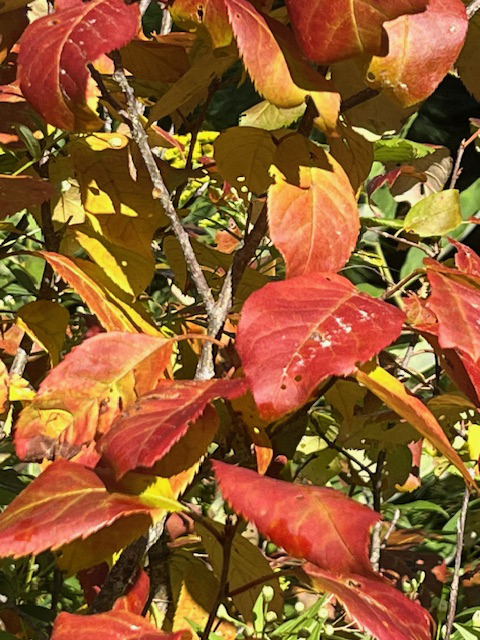
crown of grape leaves
round and
round crafting
Prayers
for body soul –
Your
Protection
and mine…
Standing in your Shadow
One.
Still, Earth’s Keening
keeps us
awake at night.
Tag: herstory
Who Speaks Into Your Life by Michelle Bodle
An occupational hazard for a woman in a religious setting is having people try to claim authority to speak into my life that they simply do not have. Two recent examples were so blatant that they caused me to pause and reflect on the underlying dynamics that led to these unrealistic expectations.
In the first event, I was out with a friend for coffee, and someone from her congregation approached. They wanted to pray for an upcoming service, but then, during the prayer, he started to pray against the “confusion” at our table. His sudden praying against this “confusion” is notable in that it only arose after my colleague introduced me as the lead pastor at a church (not an associate) in a denomination where this particular gentleman’s church broke off. After the prayer ended, he tried to explain his “prophetic gift” and how he arrived at praying against any confusion, which was tied to his own confusion during the prayer. However, the truth was, there wasn’t any, and he thought he had authority, during prayer, to speak into my life in a way that he did not.
Continue reading “Who Speaks Into Your Life by Michelle Bodle”Queering the American Dream by Angela Yarber, Book Review by Janet Maika’i Rudolph

I love stories about journeys or pilgrimages. They are quests that take us out into the world even as we are forced to face our innermost selves. They are sure to be filled with adventure, challenges, and unexpected beauty. Such a journey has the ability to rip apart our world and reform it in new and unexpected ways. Like I said an adventure. Each journey not only affects us personally but changes corners of the world and all the people that it touches. Angela Yarber’s book is one such journey. Reading it changed my world.
Rev Ang traveled with what she calls her “queer little family;” herself, her wife Elizabeth and their toddler son Ru. They set off into the country where they could not take for granted they would be accepted. They knew they might be seen as other and have to face down hatred. It is a vulnerable place to be, and it can be frightening, especially in the backcountry where being queer can be seen as an invitation for violence. That takes even an extra level of courage.
Rev Ang speaks with an honesty that is remarkable.
Continue reading “Queering the American Dream by Angela Yarber, Book Review by Janet Maika’i Rudolph”Sojourner Truth, the photos by Beth Bartlett
Moderator’s Note: We inadvertently left out the photos from Beth’s posts on Sojourner Truth. The photos, all by themselves, pack an emotional punch and so we want to be sure they can be seen. These are Beth’s photos from Sojourner Truth Legacy Plaza in Akron, Ohio
You can see Beth’s posts here. Part 1 and Part 2


Priestesses of the Shtetl? The Jewish Women Spiritual Leaders of Eastern Europe by Annabel Gottfried Cohen
‘Four thousand years ago, in the ancient Near East, women were poets, drummers, scholars, dancers, healers, prophets and keepers of sacred space.’ In The Hebrew Priestess (2015), Rabbi Jill Hammer argues that as the Israelite cult became more centralised, leadership roles were restricted to men and women’s spiritual leadership was gradually repressed. Yet, as Hammer and co-author Taya Shere demonstrate, ‘the remnants of the priestesshood remain for those who seek them out.’ Combining a close reading of biblical and rabbinic texts, alongside other contemporary sources and archaeological evidence, Hammer has identified thirteen models or netivot of feminine Jewish leadership, which she argues persisted, albeit in altered and marginalised forms, into the medieval, early modern and even modern periods. My own research supports these conclusions, suggesting that Hammer’s netivot framework provides a useful lens by which to better understand Jewish women’s traditions that, in a patriarchal culture, have often been marginalised.
Continue reading “Priestesses of the Shtetl? The Jewish Women Spiritual Leaders of Eastern Europe by Annabel Gottfried Cohen”Gift From the Beyond, part 2 by Sara Wright
Part 1 was posted yesterday

My friend Lise sent me some words on the eve of Davey’s birthday (unbeknown to me until the 6th) that reminded me of how often I spoke to him during those months.
“The reason I pray to the dead is I trust their timing. They have all the time in the world, after all, and they also see the big picture and the long story. I pray to the dead because, I admit, how little I know, how little I can understand, and how vast the mystery is of the soul.
Let me circle myself with the living who can hold both, with the dead who can hold it all. We are entangled souls…. We are all praying together, with the flowers, the trees, with all that is.” (I substitute talk for pray because that is what I do)
Continue reading “Gift From the Beyond, part 2 by Sara Wright”Gift From the Beyond, part 1 by Sara Wright
The words came unbidden “go outdoors”. It was dark but I felt my way to the door. I always listen when Nature calls.

I had just re -membered that Davey’s birthday was the next day. ‘Happy birthday Beloved’. My little brother would have been 75. I calculated the years with difficulty imagining what it would have been like if he had lived…
Dead at 21 from a self – inflicted gunshot wound, part of me died with my Gemini Twin. I failed him at the end, turning into a parent who was incapable of being emotionally present to listen to a young boy on the verge of adulthood at a time of desperate need. Instead, I parroted my parents’ script, not having developed one of my own…
”You have everything to live for,” I screamed when Davey tried to tell me that he was tired of living.
I no longer blame myself for my inadequacy, but regrets linger on just the same.
It would be eleven years before I was able to begin grieving. Catapulted out of my body at the time of my brother’s death I felt nothing for years as I self- medicated with alcohol and a dreary round of boyfriends while being unable to be emotionally present for my own young children. To feel one must inhabit a body but mine was overflowing with anguish and abandonment. Too dangerous to go there. Isolated and alone, I huddled in my house in silent torment, an absentee mother following the parental script with children of my own.
Continue reading “Gift From the Beyond, part 1 by Sara Wright”Mayflower Crowning by Sara Wright

I sit under the snowy crabapple as fragile flower petals drift one by one to the ground, covering my hair in white butterflies, soon to become the first mulch of the year. Our Lady is always nourishing new life…
The hum of a thousand bees is deafening – bumblebees – glorious golden rotund bodies swarming from one tree to another with so many relatives – everyone seeking sweet nectar.
The scent is beyond description – intoxicating – a poignant perfume lasting only a few days and keeping me rooted to my bench every single morning to soak in the sweetness under impossible heat. Heavily polluted air is thick and metallic but here I inhale a plethora of fragrances so intense they drown out poisoned air.
Continue reading “Mayflower Crowning by Sara Wright”Processing my experiences of patriarchy has changed my faith for the better by Liz Cooledge Jenkins
As my first book, Nice Churchy Patriarchy, approaches six months of being out there in the world, I find myself reflecting on the journey. The process of unpacking all the ways patriarchy shows up in faith communities—and, in particular, the ways patriarchy has impacted my experience of church—has been a long one, and a winding one. It is no easy path.
How could a person travel this road and have their faith remain unscathed? Or perhaps a better question is this: How could one’s faith remain unchanged? And is this even a desirable goal?
After spending eleven years in “complementarian” (that is, explicitly patriarchal) evangelical church spaces and then two years in evangelical spaces that were egalitarian in theory but still had a long way to go to reach full gender equity—and, especially, after spending four years intentionally reflecting on these experiences and writing about them—I certainly see questions about gender roles and women in leadership differently. But it’s not only that. I see everything differently.
Continue reading “Processing my experiences of patriarchy has changed my faith for the better by Liz Cooledge Jenkins”A Feminist Reading of Saint Wilgefortis by Sofia Meskhidze

The legend of Saint Wilgefortis tells the story of a Christian woman who was martyred for her faith. While there are numerous women martyrs in the Christian tradition, Wilgefortis is distinguished by her gender non-conformity. She is often referred to as female Christ[1] and is almost always depicted with a beard, in a dress, and nailed to a cross. According to the legend, she was a Christian princess from Portugal whose father had promised her to the pagan king of Sicily. Wilgefortis, refusing to marry, prayed all night for God to make her unmarriable and as a result miraculously grew a beard, causing her father’s rage, after which he had her tortured and crucified[2]. The origin of the legend is thought to be the Volto Santo sculpture in Lucca, Italy, one of the most well-known examples of a clothed crucifix[3]. Misinterpretation or not, it is without doubt that the legend spread wide and Wilgefortis was in medieval times venerated almost as much as the Virgin Mary. In fact, this popularity displeased the Catholic Church, who actively discouraged it and even removed Wilgefortis from the official list of saints in 1969[4]. Here I argue for the importance of Wilgefortis to feminist theology, feminist and queer Christians, and her potential as a non-binary/gender non-conforming icon.
Continue reading “A Feminist Reading of Saint Wilgefortis by Sofia Meskhidze”