April is Sikh Awareness month which is incredibly important this year due to what is currently happening in the Punjab by the Indian Nation State. If you haven’t heard about the government shutdown largely targeting Sikhs, you can read here. To keep the focus on the Sikh Community, this post will be focused on the amazing royal turning fierce activist and suffragette – Sophia Duleep Singh.
Yesterday I wrote about the priestess/scribe Enheduanna and her warrior/king father Sargon. I posited their connection to the codification of patriarchy. They did not invent it, as war and the diminution of women had been happening in some circles. I do wonder, however, if they furthered it along to a point of no return.
Another king of the time, Urukagina from circa 2350 bce[1] codified laws under the guise of reformation. Some of his reforms were progressive in that they sought to protect the poorer classes against aristocracy and the priesthood. But they also were clear to let women “know their place.” Here are the translated words from his laws:
“If a woman to a male has spoken . . .[bad] words(?) which exceed (her rank?), onto the teeth of that woman a baked brick shall be smashed, and that brick will be hung at the main gate.”
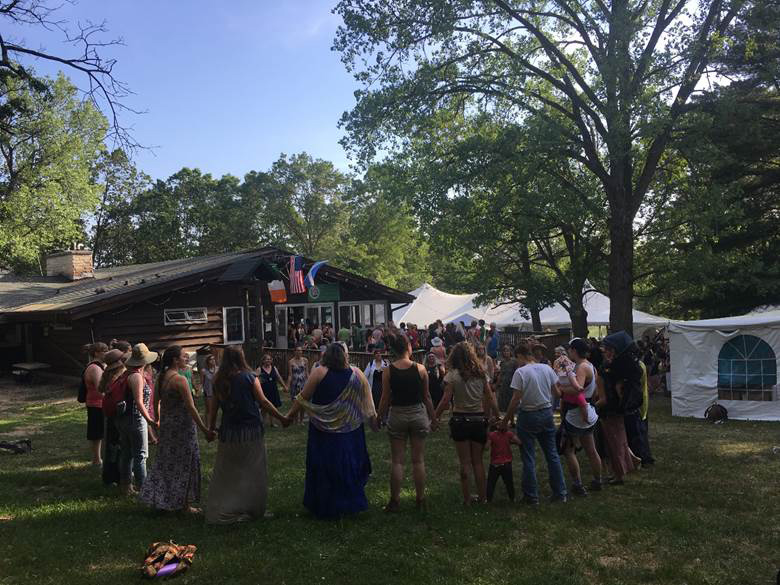
Morning Circle at Midwest Herbal Conference in 2017
In the bathroom at 4am in the morning, I hear the birds start to sing. Instantly, I am transported back to my tent at Midwest Herbal Conference in Wisconsin to the excitement of starting a new day with the feeling of being in nature with fellow conmadres, amazed at the knowledge and wisdom the women around me hold. Watching them go into the forest, bend down to see a plant, put it in their mouths and eat it.
As it is March, and March is a month for me that is always devoted to celebrating my Irish roots and women, my Herstory Profiles will be on a few exemplary women from Ireland: Brigid (Irish Goddess and Catholic Saint), Margaret O’ Carroll of Éile (Paragon of Leadership, Strength, and Compassion), and Mary Robinson (Historic Leader, Activist, and Humanitarian.)
Like most Taylor Swift fans—and anyone who’s tuned into a pop station on the radio recently—I’ve been listening to (and loving) the song Lavender Haze[1] from Swift’s latest album Midnights. The chorus: “I feel the lavender haze creeping up on me / Surreal, I’m damned if I do give a damn what people say / No deal, the 1950s shit they want from me / I just wanna stay in that lavender haze.”
Swift uses the phrase “lavender haze,” as she explains in an Instagram video,[2] to refer to an intense feeling of being in love, complete with an “all-encompassing love glow.” Presumably in contrast with the “1950s shit” people want from the narrator of the song. From the other lyrics, we might assume that this “1950s shit” includes people’s constant barrage of questions about whether or when the narrator is going to become her lover’s bride—because, of course, “The only kind of girl [people] see / is a one night or a wife.” No other options.
Throughout the course of this year my monthly posts are going to spotlight extraordinary women; a FAR Herstory Journey. Our first Herstory profile will be Fannie Lou Hamer (1917-1977): a staunch Civil Rights, Voter Rights Singing Activist, Preacher.
February is “Heart Month.” Presumably the American Heart Association chose February as the month to raise awareness about cardiovascular health because in February we celebrate Valentine’s Day which we observe by the giving and receiving of hearts of all kinds — heart-shaped Valentines, candy, jewelry – symbolic declarations of love, of giving our hearts to one another. Hearts have long been associated with love. When bringing our emotions to the surface, we “wear our hearts on our sleeve.” When speaking our deepest feelings, we “pour our hearts out.” Feelings of tenderness “warm our heart,” and compassion “pulls at our heartstrings.” When grieving, we feel “heartache,” and loss of love renders us “heartbroken.” The French word for heart, coeur, associates hearts with courage. We “take heart;” we “lose heart;” we “hearten.” We can engage in a task “wholeheartedly,” “halfheartedly,” or our “heart’s not in it” at all. We can be “bravehearted,” “lighthearted,” “tenderhearted,” “hardhearted,” or totally “heartless.” That’s a lot for the heart to carry.
Last May I had a vision in the shower. It wasn’t the kind of vision I like to have—where the Goddess and I dance across a meadow with flowers springing up as we pass and cool breezes bringing sweet fragrances. This was the kind of vision I’d rather not have, but probably needed to. This is from my journal.
Something happened during my shower recently that feels relevant. As I stepped into the shower, a phrase thrust itself into my mind: “I was forced to watch them die and it was all my fault.” As I ‘stood’ there with water pouring over my body and that statement vibrating in my brain, it attached itself to a scene where I was the spiritual leader of a community that came under attack. I was forced to watch the women and men who believed in what I taught as they were executed. Many of them were friends and relatives. I was restrained and couldn’t intervene to save them, or join them in execution. Having to witness this was part of my punishment. Instead I was carried to a bigger town, publicly humiliated and beaten, and then executed in some painfully unpleasant way I can’t recall–probably because I don’t want to.
In my recent post ‘Forty Days After Childbirth, Mary Returns to the World,’ I wrote that ‘the woman’s power to bless and protect, as well as to create, is shown in the symbol of her hand.’ We see expressions of this power in the Orthodox Christian icon of the Three-Handed Madonna, whose third hand is over her womb, and the Hamsa, the hand-shaped talisman common to Jewish, Christian, and Islamic traditions. Also known as the Hand of Fatima, Miriam, or Mary, the Hamsa often incorporates eye or vulva motifs, which also offer protection.
Hand, womb, and eye all signify female creative power, personified in the image of Goddess and revered in Neolithic Old Europe. This life-giving principle is expressed in many ways apart from childbearing: as Carol Christ affirms, early technologies of spinning, weaving, pottery, and agriculture, along with Neolithic religion, were most likely invented by women.