
Gloria Naylor: Redirecting the Spotlight, American Woman Writer (1950-2016), part 2 by Maria Dintino

part 1 was posted yesterday

Mama Day
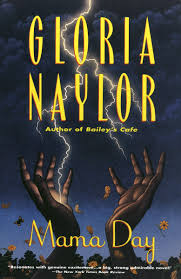
By the time Gloria Naylor wrote her the third novel, Mama Day (1988), she was a master, able to infuse the story with such richness, connection and love that the reader is enveloped in a state of amazement while reading. This spell involves the “spiritual vision, or more accurately, third sight, that empowers Mama Day” (51).

The manifestation of the matriarchal lineage in Mama Day creates a dizzying suspension in time, with dubious connections to the past, tied to current happenings, along with the struggle and hope for the future. Sometimes it is hard to decipher exactly what is going on and you are left to decide for yourself what you see, hear, understand and believe. As the narrator says, “Truth is never fixed”(38).

This novel is set on Willow Springs, a fictional rendition of one of the Sea Islands off the coast of South Carolina, “a uniquely maternal island paradise that defies geographic limits”(38).

Continue reading “Gloria Naylor: Redirecting the Spotlight, American Woman Writer (1950-2016), part 2 by Maria Dintino”
Gloria Naylor: Redirecting the Spotlight, American Woman Writer (1950-2016), part 1 by Maria Dintino

The Gloria Naylor Archive

I am beyond thrilled to learn of The Gloria Naylor Archive!

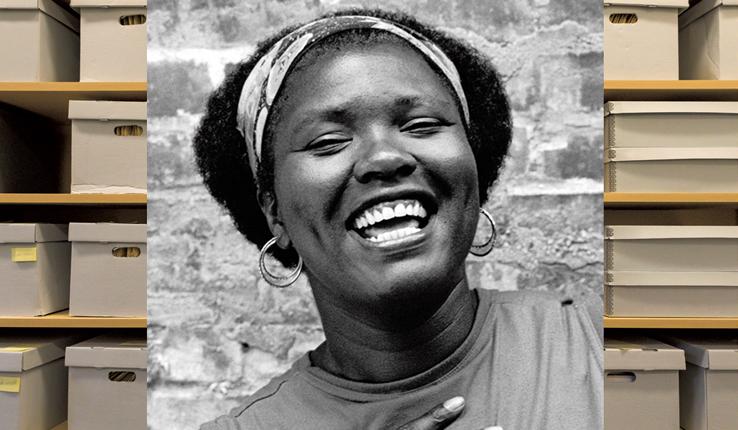
Gloria Naylor with her archival donation at Sacred Heart University. Photo taken by Tracy Deer-Mirek, 2009. (photo from The Gloria Naylor Archive site)

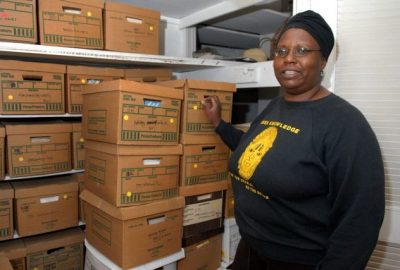
This extensive repository of Naylor’s work has been a joint labor of love, respect, and honor between Sacred Heart University in Fairfield, Connecticut (where Naylor was awarded an honorary degree in 1994) and Lehigh University in Bethlehem, Pennsylvania.

Suzanne Edwards, associate professor of English and director of the Humanities Center at Lehigh, explains:

“It’s this incredible resource, but it was also a resource that I didn’t see people engaging with in scholarship on Naylor. The materials weren’t easily accessible, and Sacred Heart didn’t have the staff or resources to digitize it.”

As a result, Edwards recommended a partnership that would “make the archive more accessible to fans of Naylor’s work, to teachers who are teaching her novels at the college level, on the secondary level, and to scholars who might find it difficult to make a trip to Fairfield”(Hochbein).

The results: a rich and expanding digital archive, as well as an invite to those doing research involving Naylor to schedule an appointment if they would like to engage with materials in person. (Before scheduling a trip, know that the physical materials belonging to the archive are back at Sacred Heart University in Connecticut as of 2023.)

Continue reading “Gloria Naylor: Redirecting the Spotlight, American Woman Writer (1950-2016), part 1 by Maria Dintino”