

part 1 was posted yesterday
Mama Day
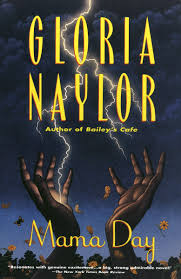
By the time Gloria Naylor wrote her the third novel, Mama Day (1988), she was a master, able to infuse the story with such richness, connection and love that the reader is enveloped in a state of amazement while reading. This spell involves the “spiritual vision, or more accurately, third sight, that empowers Mama Day” (51).
The manifestation of the matriarchal lineage in Mama Day creates a dizzying suspension in time, with dubious connections to the past, tied to current happenings, along with the struggle and hope for the future. Sometimes it is hard to decipher exactly what is going on and you are left to decide for yourself what you see, hear, understand and believe. As the narrator says, “Truth is never fixed”(38).
This novel is set on Willow Springs, a fictional rendition of one of the Sea Islands off the coast of South Carolina, “a uniquely maternal island paradise that defies geographic limits”(38).
Gloria Naylor explains that as a reader, “You choose which side you’re going to come down on. The story’s told from three perspectives. You have to choose which to accept.” She continues,
“We accept the magic of love. And then, from there, I take you to the last frontier. That’s where there are indeed women who can work with nature and create things which have not been documented by institutions of science, but which still do happen. So the book’s an exploration of magic”(Perry 232-33).
Mama Day’s third generation female character, Cocoa, must travel a “journey to wholeness” which requires a dangerous trek deep inside and a bold fight to survive and Mama Day, her great aunt, is the one empowered to guide her through this critical transformation. Ultimately Mama Day’s healing powers are transferred to Cocoa: “A face ready to go in search of answers, so at last there ain’t no need for words as they lock eyes over the distance.”
In her work, The Fiction of Gloria Naylor: Houses and Spaces of Resistance, Maxine Lavon Montgomery says,
“Mama Day thus disrupts colonial beliefs rooted in notions of white patriarchal dominance and works to create another narrative space – a liminal home- where a new subject and text can materialize”(52).
Read the magical Mama Day, please.
The Meanings of a Word
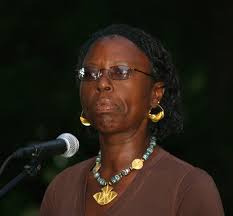
I chose to explore Gloria Naylor because of her essay, The Meanings of a Word(1986). I had used this essay as a model in the first-year writing course I’d taught for years. What we, by naming our project Nasty Women Writers, and others are doing with the misogynistic use of the word nasty reminded me of what Naylor talks about in her essay.
In the second paragraph, Gloria Naylor explains,
“Words themselves are innocuous; it is the consensus that gives them true power.”
When people agree on a word’s meaning and use it accordingly, it wields power. People can alter the meaning of a word by taking possession of it, as Naylor’s community did in the 1950s with the word nigger, transforming its meaning in various contexts, steering this word away from one of utter dehumanization. In the essay, Naylor describes how her extended family seized this word, formerly by consensus one of the most hateful, hurtful words in the English language, and adopted it as one they used among their own community, agreeing upon alternative meanings, meanings they determine for themselves, not ones heaped upon them or leveled against them. And nasty, a word Donald Trump hurled at Hillary Clinton, now by way of new consensus, to many depicts a desirable, courageous trait of speaking the truth.
1996
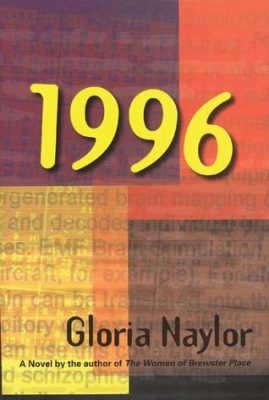
As I continued looking into Gloria Naylor, I questioned where she had gone. She seemed to disappear, without much available about her grand plans of producing her own film and theater adaptations of Mama Day and Bailey’s Cafe (Naylor’s fourth novel). I then discovered 1996 (2005), a fictional memoir Naylor penned describing a horrendous experience of being surveilled by the NSA (National Security Association)
1996 (a play on Orwell’s 1984) is her character’s account of this nightmare, explaining why and how the NSA carried this out. Naylor describes her character writing 1996 in longhand in a public library, the only place where she was free of invasion. Many question how much of what Naylor includes in 1996 happened to her, but what is not in question is the importance of her warning about the frequency and pervasiveness of surveillance activity.
Earlier on Naylor had said, “Bottomline: I need a warm, quiet place to work”(Perry 241), but according to 1996, this was not to be. Every last bit of her character’s (and perhaps her) privacy is invaded and with technology we now know exists. Whatever did actually happen to Naylor seems to have taken a toll. Gloria Naylor died of a heart attack in 2016, at the age of 66.
The mixed reception and debate over this last work of Naylor’s should not overshadow who she was, what she stood for, her accomplishments and what her works offer us well into the 21st century. Her ability to transform others and the world through her work continues, along with Bailey’s Cafe, a vibrant community arts center in Brooklyn, New York
In the words of Naylor, “Not only is your story worth telling, but it can be told in words so painstakingly eloquent that it becomes a song.”
Gloria Naylor is a #Nasty Woman Writer, not to be missed or dismissed.
©Maria Dintino 2024
Works Cited
Hochbein, Kelly. “A More Accessible Archive: Showcasing the Work of Writer Gloria Naylor.” Lehigh News, 28 June 2019.
Montgomery, Maxine Lavon. The Fiction of Gloria Naylor: Houses and Spaces of Resistance. Knoxville: The University of Tennessee Press, 2010.
Perry, Donna. Backtalk: Women Writers Speak Out. Rutgers University Press, 1995.
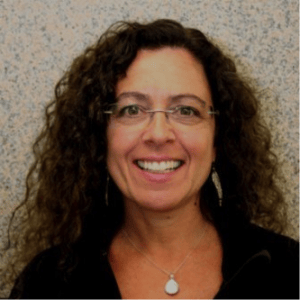
BIO: Maria Dintino has worked in higher education for twenty-six years, the first twenty-three at Keene State College in Keene, NH and the past few years at Flagler College in St Augustine, Florida. While in graduate school, Maria became enamored with the Transcendentalists, especially Henry David Thoreau. Although introduced to Margaret Fuller then, she did not comprehend her undeniable significance until another encounter many years later. It is now clear to Maria that Margaret is destined to claim her rightful place in American herstory and one of Maria’s goals is to help her do so. Maria’s first work of creative nonfiction, The Light Above: A Memoir with Margaret Fuller has been recently published and she is at work on her second book. Contact Maria at mdintino477 at aol.com.
Discover more from Feminism and Religion
Subscribe to get the latest posts sent to your email.

