Legacy of Carol P. Christ: What Does It Mean to Say that All White Feminists Are Racist? (Questions Posed to White Women/Myself about Our Part in the Dialogue with Women of Color)

This post was originally published on Oct. 7th, 2011

Carol P. Christ, a founding mother in the study of Women and Religion and Feminist Theo/a/logy, has been active in anti-racist, anti-poverty, anti-war, feminist, pro-gay and lesbian, anti-nuclear, and environmental causes (in that order) for many years.  All of these issues have informed her teaching, her scholarship, and her politics.

The recent posting of Mary Daly’s letter to Audre Lorde on the Feminism and Religion blog is a correction of a piece of feminist history that is important in its own right and because of the way Lorde’s letter has shaped feminist discourse and politics up to the present day.  Knowledge of the existence of Daly’s letter and the facts surrounding Lorde’s distortion of history has been in the public domain since the 2004 publication of Alexis DeVeaux’s Warrior Poet, but when I searched the internet for a copy of “Mary Daly’s letter to Audre Lorde” a few days ago, what came up was Lorde’s letter to Daly — not Daly’s letter to Lorde.

I often hear younger feminists say that “all white feminists” of the older generations “were racist.” Sometimes Mary Daly is mentioned. Finding the more detailed record about Mary Daly is one step in retelling the history of feminism in a more complex way. 

Continue reading “Legacy of Carol P. Christ: What Does It Mean to Say that All White Feminists Are Racist? (Questions Posed to White Women/Myself about Our Part in the Dialogue with Women of Color)”

Archives from the FAR Founders: Grounding My Love by Xochitl Alvizo

This was originally posted June 6, 2019

I love living in a second-story apartment. Having a view of Los Angeles, of the palm trees, the expansive sky, the distant mountains, and the city lights of downtown, makes life feel bigger, more full of possibilities. In the struggle of transitioning my life back to L.A., the view from my second floor apartment helps make me feel ok in the world. I’m in love with Los Angeles – the land, its topography, its sky, its desertness – and even its traffic. Beside the fact of sometimes being made to arrive late somewhere, I don’t mind being in our famed L.A. gridlocks – I don’t mind being in the slow moving flow of cars. I kind of enjoy being among the thousands of other folks sharing the collective experience of trying to get someplace. Traffic becomes for me a leisurely time when I get to do nothing else but enjoy the city.

Continue reading “Archives from the FAR Founders: Grounding My Love by Xochitl Alvizo”

A Feminist Reading of Saint Wilgefortis by Sofia Meskhidze

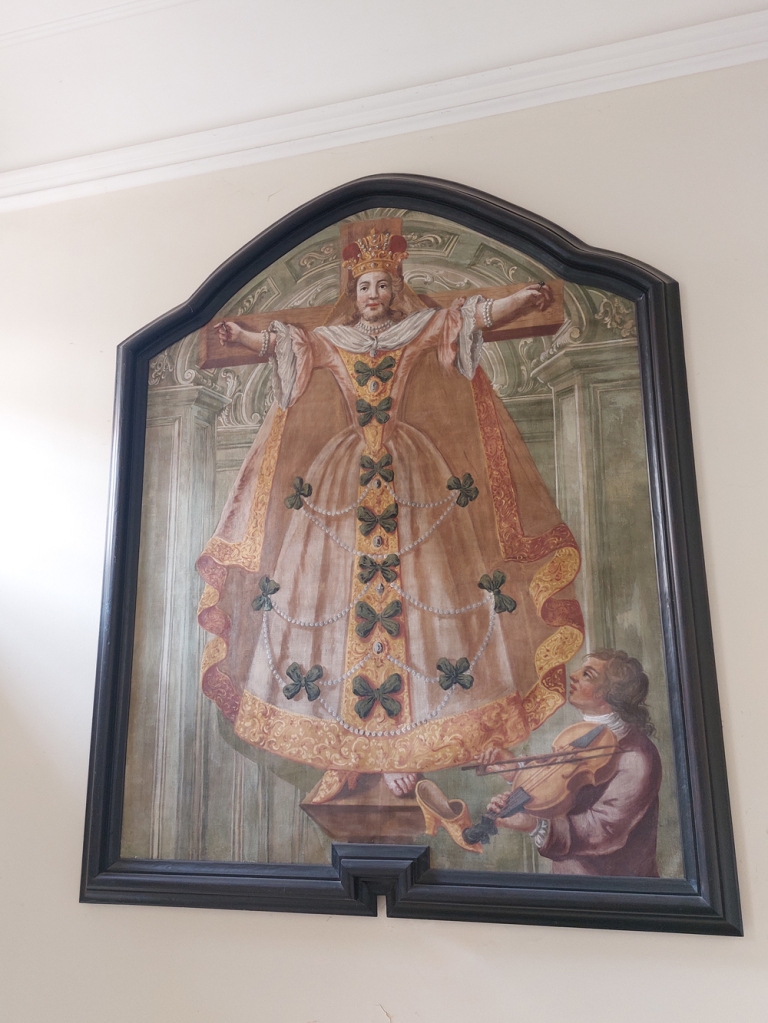
The legend of Saint Wilgefortis tells the story of a Christian woman who was martyred for her faith. While there are numerous women martyrs in the Christian tradition, Wilgefortis is distinguished by her gender non-conformity. She is often referred to as female Christ[1] and is almost always depicted with a beard, in a dress, and nailed to a cross. According to the legend, she was a Christian princess from Portugal whose father had promised her to the pagan king of Sicily. Wilgefortis, refusing to marry, prayed all night for God to make her unmarriable and as a result miraculously grew a beard, causing her father’s rage, after which he had her tortured and crucified[2]. The origin of the legend is thought to be the Volto Santo sculpture in Lucca, Italy, one of the most well-known examples of a clothed crucifix[3]. Misinterpretation or not, it is without doubt that the legend spread wide and Wilgefortis was in medieval times venerated almost as much as the Virgin Mary. In fact, this popularity displeased the Catholic Church, who actively discouraged it and even removed Wilgefortis from the official list of saints in 1969[4]. Here I argue for the importance of Wilgefortis to feminist theology, feminist and queer Christians, and her potential as a non-binary/gender non-conforming icon.

Continue reading “A Feminist Reading of Saint Wilgefortis by Sofia Meskhidze”

From the Archives: Writing: Changing the World and Ourselves. By Ivy Helman

This was originally posted on October 12, 2014

20140903_180423

I still remember the first time I read Mary Daly’s Gyn/Ecology. It awoke something within me. Her use of language, the power of her writing and the ease with which she created new words taught me so much about the world around me and about the way the language, and subsequently its use in writing, shapes lives, choices, abilities and destinies. She also taught me about myself.

I was hooked, but not just on Mary Daly. Shortly after I finished her book, I moved onto other feminists writing about religion like Katie Cannon, Judith Plaskow, Alice Walker, Carol Christ, Rita Gross, Gloria Anzaldua, Audre Lorde, Adrienne Rich, Margaret Farley and Starhawk to name just a few. All of them, in fact every feminist I’ve ever read, has shown me the way in which words have power and how words speak truth to power. Ever since, I’ve wanted to be the kind of writer whose words carry a power that not only affects people but also inspires a more just, more equal, more compassionate and more humane world. In other words, I wanted to be a writer activist.

Continue reading “From the Archives: Writing: Changing the World and Ourselves. By Ivy Helman”

Can Feminist Christians Hasten the Advent of Reproductive Liberation? by Elizabeth M. Freese, PhD

Wikimedia Commons, Servite Church in Hungary

The collision of the 2023 Christian liturgical season of Advent with American reproductive politics has been jarring. Feminist religious critique and transformative activism are imperative.

With the Texas Supreme Court decision on a dire abortion case, alongside increasing criminalization of women having miscarriages, we are witnessing the principle of patriarchal dominance of female reproductive capacity and the denigration of women’s full, equal personhood pushed to the extreme. In part, this barbarity is perpetuated by Christianity. Even though this tradition often challenges social systems of injustice, and it does not actually support their hollow theology of “life at conception,” misogynist oppressors have plenty of Christian religiosity to stand on.

Continue reading “Can Feminist Christians Hasten the Advent of Reproductive Liberation? by Elizabeth M. Freese, PhD”

The Courage to be a Self and a Part by Xochitl Alvizo

I just submitted to the editor the final draft of a chapter I’ve been working on for about two years (no joke). Sometimes when I really care about a subject, it can take me a long time to process, reflect, and write on the subject (I shared a bit about this project on FAR early this year)—but this one might have taken the cake in terms of how slow a process it ended up being. Still, it is now submitted and in the hands of the publishing company, Oxford University Press, for the next step in the process.

This project came about because Meg Stapleton Smith, while she was still a doctoral student working on her Ph.D. and searching the Mary Daly Papers at the archives of Smith College, came across a typed manuscript of a never completed work of Mary Daly’s. The unfinished manuscript, with an introduction and four chapters long, was titled “Catholicism: End or Beginning.” Meg, after discovering the manuscript, took on the task of organizing a group of feminist scholars to read the manuscript and write a chapter in response to be published as an edited collection along with the previously unpublished manuscript. The collection should be coming soon, but here I wanted to share a bit more about my chapter and an overview of what I see as its significance.

Continue reading “The Courage to be a Self and a Part by Xochitl Alvizo”

Remembering “The Burning Times,” Part 1 by Beth Bartlett

I first saw it when looking at their faces while showing The Burning Times in class — the blank stares, the pained expressions, the tears, the looking away. The scenes and sounds of women tortured and burned alive touched something deep and ancient in them.  Here it was — the historical trauma of women.[i]  The lasting impact of historical trauma is experienced by subsequent generations for hundreds of years, manifesting in such things as depression, PTSD, self-destructive behaviors, anger, violence, suicide, and more. As Native LGBTQ activist and writer Chris Stark so eloquently put it: “The experiences of our grandparents and great-grandparents are written into the library of our bodies . . . . My ancestors’ loss and screams are written in me – their pain and murder and rape merged with my own as a child. . . We carry them through time. We remember.”

Continue reading “Remembering “The Burning Times,” Part 1 by Beth Bartlett”

From the Archives: Uppity Women Unite by Barbara Ardinger

This was originally posted on August 2, 2014

I have a poster on my wall: UPPITY WOMEN UNITE. In big, red, capital letters. I don’t remember where I got this poster, but I know I’ve had it since the late 70s or early 80s. I’m sure it comes from the raggedy late 60s, when second-wave feminism got up a head of steam and uppity women began getting our attention. That’s when Betty Friedan said being a proper 50s housewife was like having a mental illness. It’s when Gloria Steinem founded Ms. Magazine, which (oh, horrors!) did not give us recipes or home-making tips and did not tell us how to dress to lure our men into bed. It’s when Mary Daly started giving us a whole new, original take on the English language. Ahhh, yes, those were the good ol’ days. And the bad ol’ days, too, when the Equal Rights Amendment was not ratified.

“Uppity” can be a troublesome word. In the olden days, if someone called you uppity, it means you were inferior to them and weren’t staying in what they thought was your proper place. If you were a black person, for example, and if you didn’t step off the sidewalk when white men were coming, you were uppity. If you were a woman who wanted equal pay for doing the same work a man did, you were uppity. Those women in the 1980 movie, 9 to 5, were majorly uppity. And they won the battle.

Continue reading “From the Archives: Uppity Women Unite by Barbara Ardinger”

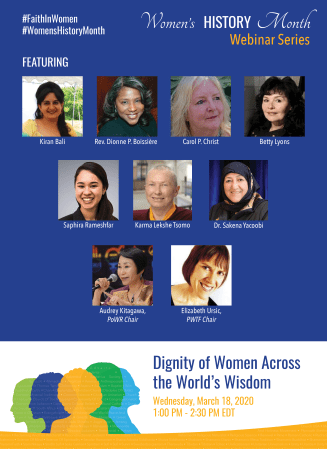
Dignity of Women Across the World’s Wisdom: Parliament of World Religions Webinar by Carol P. Christ

I have been asked to post my contribution to the Parliament of World Religions Webinar: Dignity of Women Across World’s Wisdom. 

I am participating in this discussion as a representative of women who are on a Goddess path. I do not represent any established or newly formed religious or spiritual tradition. Rather I speak for an increasingly large number of women who are seeking alternatives to established traditions that celebrate and legitimate male power as power over or domination. We do not follow leaders or gurus and we place no trust in any sacred texts.

Most of us have grown up in cultures where the most prominent religious traditions feature male Gods, male teachers, and male religious leaders. We agree with Mary Daly who said that when God is male the male is God. In traditions where God is male, male teachers and religious leaders are viewed as reflecting or being in the image of the male divinity. We do not assume that images of God as male are never valid, but we do assert the need for images of God as female.

As I said in my often re-published essay, “Why Women Need the Goddess,” the most important meaning conveyed by the symbol of Goddess as the ultimate creative power in the universe is that female power is legitimate and good. This does not mean that female power is always good, but it clearly undermines the widely held view that female power exercised apart from male control is always evil or bad. This view is reinforced by images of women as evil in religious traditions, for example, Eve seduced by the snake. Continue reading “Dignity of Women Across the World’s Wisdom: Parliament of World Religions Webinar by Carol P. Christ”

Grounding My Love by Xochitl Alvizo

I love living in a second-story apartment. Having a view of Los Angeles, of the palm trees, the expansive sky, the distant mountains, and the city lights of downtown, makes life feel bigger, more full of possibilities. In the struggle of transitioning my life back to L.A., the view from my second floor apartment helps make me feel ok in the world. I’m in love with Los Angeles – the land, its topography, its sky, its desertness – and even its traffic. Beside the fact of sometimes being made to arrive late somewhere, I don’t mind being in our famed L.A. gridlocks – I don’t mind being in the slow moving flow of cars. I kind of enjoy being among the thousands of other folks sharing the collective experience of trying to get someplace. Traffic becomes for me a leisurely time when I get to do nothing else but enjoy the city.

Plus, the freeways – I love them! Have you ever driven on one of L.A.’s sky high on-ramps or carpool lanes? It’s like you get to fly. You get to be up in the sky among the top of the palm trees, with all the other cars and buildings off in the distant view. I would drive somewhere just to get onto one of our sky-high carpool lanes, I swear. Just recently I merged onto the carpool lane of the 110 North from an on-ramp I had not taken before, a magnificently long single-lane on-ramp that took me high up into the air, and I immediately thought, I need to remember this way so that I can drive it again sometime. Continue reading “Grounding My Love by Xochitl Alvizo”