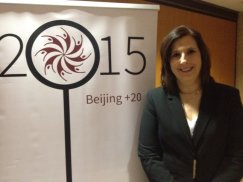
 I had the honor of speaking at the United Nations during the Commission for the Status of Women this past March about the Feminization of Poverty and the Impact on Migrant Mothers. Below is the text of my speech delivered. By posting my speech, it is my hope to use social media to help draw attention to this problem and use our resources to find solutions.
Over the last thirty years, rich countries have grown much richer, and poor countries have become, in absolute and relative terms, poorer. Global inequality in wages are striking and poor countries are turning to the IMF or World Bank for loans, which require “so-called” structural adjustments of devaluing currency, cuts in support for “noncompetitive industries,” and the reduction of public services such as healthcare and food subsidies, which has provided disastrous results for the poor, especially women and children.
The feminization of poverty not only means that more of the world’s poverty is born by women, thanks in large part to globalization of the world economy, but includes a denial of access to fundamental human rights, including health, education, nutritious food, property, representation, etc. Feminized poverty encompasses more than matters of individual suffering – it ensnares a vicious cycle of poverty that impacts their entire family.
Feminization of poverty has no singular cause. The United Nations Development Fund for Women identified 4 key dimensions that indicated a heightened rate of poverty for women:
First is called “the temporal dimension,” which means that women are often the primary caretakers of children and household duties. Women who live in developing nations may also have agricultural or physical responsibilities. With these demands, less time is available to devote to paid employment causing them to earn a smaller income even though they effectively do more work than their male counterparts.
Second is “the valuation dimension” which is defined as unpaid labor that women perform to take care of family members and other household chores. Work that is considered “less than” because formal education or training is not required.
Third, is “The employment segmentation dimension.” Women are natural caretakers and thus corralled into “women’s work”, such as teaching, working with textiles, or domestic servitude that includes caring for children or the elderly.
Finally, “the spatial dimension.” When employment is non-existent or difficult to find, women may have to migrate to other areas to find work temporarily. If a woman has children, she may refuse to take the job and stay to care her family. However, Some opt to leave their families behind, to secure what they consider a better life – a means of support – but this choice often comes a great cost. Continue reading “The Feminization of Poverty: The Impact on Migrant Mothers in the U.S. by Michele Stopera Freyhauf”


 Mother’s Day is coming up on the 8th of May here in Australia and while I don’t agree with the commercialization of it all, I do believe that motherhood, maternal bonds, and the influence of mothers in society should be recognized and celebrated. The essence of this day is so much more than just giving a gift or saying Happy Mother’s Day, it is about truly letting our mums, whether they be maternal or just a mother figure in our life, know how much they are appreciated.
 Once upon time formula companies and complicit medical experts launched a serious campaign to sell more formula, telling a generation of mothers that this product was both superior to breast milk and far better for baby and mother. Some were convinced, others found formula a good alternative to breast milk given their employment status, hormonal changes, their particular baby’s needs,personal choice, difficulty producing their own milk, or the like; and still others chose to breastfeed despite criticism, like my mother-in-law, who received scorn and derision from medical personnel as the only breastfeeding mother in the hospital in which she gave birth in 1970.
 I never liked the metaphorical use of the word “pregnant” as it tended to be used in the academy. Reading the “pregnant phrases,” of mostly men who were “pregnant with thought,” as a student, I felt angry by what I saw as a co-optation of my female potential, and even, a patriarchal ranking of what kinds of “pregnancy” were deemed important or worthy of “serious” consideration.
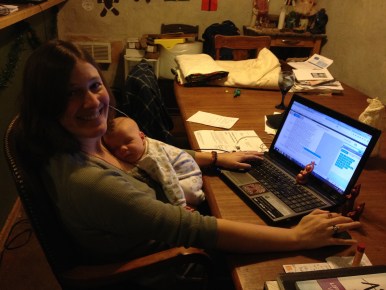 When the wheel of the year turns towards fall, I always feel the call to retreat, to cocoon, to pull away. I also feel the urge for fall de-cluttering—my eyes cast about the house for things to unload, get rid of, to cast away. I also search my calendar for those things which can be eliminated, trimmed down, cut back on. I think it is the inexorable approach of the winter holiday season that prompts this desire to withdraw, as well as the natural rhythm of the earth which so clearly says: let things go, it is almost time to hibernate.
 I sat at the bottom of my stairs exhausted, lost, not knowing what day it was or rather not really caring what day it was. I was the overtired mother, who was still getting the knack of breastfeeding around the clock. Panicking each and every time I heard the baby cry. As soon as I heard his cries, I would think to myself, hurry and grab the boppy, the burb cloth, the iPhone so I could click on the breastfeeding app! Hurry, hurry, hurry….!
 Last Tuesday marked my fourth day home in over two months. I was researching over the summer in Europe. When I was not working, I was climbing up castle ruins or carrying groceries or creatively managing my children’s laundry with very modest facilities at my disposal. Unlike all of my other summer colleagues, I had elected to bring my children with me, so my summer was work intensive in both the professional and parental capacities.
 Feminism and Religion