Navigating Meaning in Unchartered Ways by Natalie Weaver


The ideas that here follow are an effort to organize insights from meditation practice over the past several months.  I submit them to FAR not because they are particularly profound or even well-developed but because I am, as everyone is, navigating meaning in unchartered ways during this epoch.  I find my old truths not only no longer fit; they were imposed, inherited, mind-binding patterns that have caused me damage from which I am ready to heal.  I have discovered that rigorous meditation practice is transforming my experience and understanding in ways that very closely align with the outcomes of feminist deconstruction of patriarchal value norms.  Renewed and serious application of this work, in my opinion, has never been more timely, more universally needed, or more psychically therapeutic. 

~~~~

The teaching of impermanence discloses itself in what might be described imperfectly as both the foreground as well as the deep background of human experience.  It is imperfect to use the terms “foreground” and “background” because these words suggest a stacked-dimensional and binary experience in human life, which is, to say the least, inadequate.  I defer to these terms only for the purposes of suggesting different value experiences that the teaching of impermanence meets along the range of aspects of cognition and self-awareness.  Continue reading “Navigating Meaning in Unchartered Ways by Natalie Weaver”
On This Fourth of July by Natalie Weaver

I woke up this morning with a terrible itch in my mind.  I want to sue the government.  I’m not a lawyer, at least not yet, and I know that governments have sovereign immunity that typically prevents them from being sued.  But, it didn’t and doesn’t seem right that I feel so lied to and unprotected during this pandemic.  What is more, I know I am not deluded.  Either it is bad or it isn’t. Either it is spreading and lethal, or it isn’t.  Either precautions help, or they don’t.  It can’t be that ambiguous from a viral-behavioral perspective.  Government leadership refuses to speak or model a consistent, truthful, and accountable model for the social welfare, leading to such absurd reductions (in Ohio, for example) as that each individual school child can decide whether s/he wants to wear a face-covering this fall.  So, what gives?  Why all the half-, mixed, mis-, and disinformation?

Continue reading “On This Fourth of July by Natalie Weaver”

“Side of the Angels Statement” by Natalie Weaver

As a feminist, I have learned how important it is to limit the scope of my claims to a reasonable space, demarcated by some genuine historical or current investment, connection, or participation.  There are many things in this world about which I passingly feel or think something.  And, even if I think about something quite a bit, if I have nothing but opinion, even an informed one, I find it best to keep to myself.  I therefore tread lightly here.  Nevertheless, I do have some opinions born out of years of studying the relationship between Christianity and slavery, professional risk in dealing with these subjects, and my own different, but very real, history of abuse by which I analogically understand some measure of pain and exploitation.
I am dismayed by the overuse of written, right-side statements of position in times of crisis.  I really feel as though they serve to say something like, “Hey, Everyone, We, the __________  (Church, School, Charity, Business), are on the side of the angels.  We have the right attitude about this thing, and we’re putting it out there publicly so that everyone knows we’re legitimate.  Keep trusting us.” Continue reading ““Side of the Angels Statement” by Natalie Weaver”

Community Immunity by Natalie Weaver and Nathan

My eleven-year-old son, Nathan, a fifth grader, is doing his best to deal with changes the coronavirus pandemic has brought to his life.  Before this time, Nathan’s biggest daily worries have been keeping his school papers organized and staying on top of his sometimes rigorous homework assignments. Nathan has ADHD, which poses certain challenges to his learning and behaviors, making some tasks that have many intermediary steps nearly intolerable for him.  Nathan’s learning is complicated by the fact that, while it has always been apparent that his learning style was different, his teachers and family (including me) have not always had the skills or patience to see Nathan’s exceptional gifts and insights from Nathan’s own point of view.  
While his ADHD is a challenge, Nathan has a more ominous, lurking, daily concern.  Nathan has a life-threatening allergy that has made him keenly aware that every visit to a strange house, every meal at a restaurant, every bakery product, every school treat, every friend’s birthday party, and even touching a doorknob or library book could mean a painful and terrifying hospital experience. Since his allergy was first discovered, Nathan has been keenly aware of dust, germs, and particles.  He washes his hands to a fault, both as a result of ADHD compulsive behaviors and his deep awareness of his vulnerability to invisible, yet deadly particle foes.  Nathan’s allergies also give him extremely sensitive skin, predisposed to eczema, severe rashes, dryness, and splitting, so gloves, soaps, and sanitizers are at once necessities and risks to the largest organ in Nathan’s body. Continue reading “Community Immunity by Natalie Weaver and Nathan”

A Theological Conversation by Natalie Weaver and Valentine

My son asked me to discuss with him the theological problem of the dual natures, i.e., the divine and human natures, coexisting in the person of Jesus.  He asked me to begin by assuming the premises that 1) Jesus was a real, historical person and 2) that Jesus was both human and divine.  The question then became, “Did Jesus know he was God?”

Of course, as a theologian, I was delighted to have this conversation with my son.  It was fascinating to see how his mind worked, to hear him evaluate the strengths and weaknesses of high and low Christologies, to hear how he resolved the question himself, and to have an opportunity to share my own thoughts with a genuinely engaged, truly curious, and attentively listening dialogue partner in the person of my teenage son.  Not too shabby a victory for any parent!

As we talked, he continued to provide context for the question, which began as a classroom debate in his high school theology seminar.  Apparently, the students were tasked with taking some element from their in-class discussion, evaluating it, and then applying it practically by a twofold retrospective reflection in which the students were 1) to identify a specific situation in their life that could have gone better and 2) to share how their insight drawn from class would have made all the difference.  Now, my son expressed a bit of frustration with this assignment because he would have preferred to discuss how today’s insights might help him in the future, rather than to dwell in the past.  As his wheels turned, I left him alone to puzzle out his assignment, with the promise that I eagerly would return in an hour to see what he produced, accompanied by my own essay on the same task.

Continue reading “A Theological Conversation by Natalie Weaver and Valentine”

Fragments of Beauty by Natalie Weaver


Can I empathize with your feeling,
your interest in this?
Be sound, my heart that feels
the beat of yours as my own.
I would like to be human one day.

Let my prayer be not please,
for, I fear I have been
an ungrateful guest,
sojourning pilgrim, refugee.
All this life, all will be,
a lesson in how to say
thank you.

These sides are not sharp antagonisms
that bring to points their points of view
but a pond’s surface under moonlight,
swirling like mercury, beneath which minnows,
fluid, do their works of harmonious disruption.

a city made of music
a city made of dreams
a city made of gardens
a city on a stream

oh, frontier Romana
who passes through the east
this is where my heart was cast
and carried out to deep

Darling, do you know me
Darling, do you see?
this is where I want you
where I long to be

how I yearn to see you
ruddied by the cool
Why were not you by me
then? then before I knew

yet, I trusted have you
trusted I could seek
now and wish to strew my ash
across the Blackest Sea

here to be uncluttered
here un’cumbered flesh
here our single soul to spread
and all the rest dispersed

I have come to you across the distance of years
That you might be redeemed in me
And know covenant by the measure of my love
I will comb your hair and bathe your soul
I will anoint you with my blood
I will mold and fire and decorate
The world beneath your feet
And I will dance until it is done
And broken into sleep


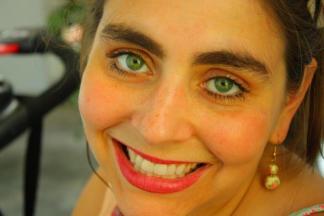
Natalie Kertes Weaver, Ph.D.is Chair and Professor of Religious Studies at Ursuline College in Pepper Pike, Ohio. Natalie’s academic books includeMarriage and Family: A Christian Theological Foundation (Anselm, 2009); Christian Thought and Practice: A Primer (Anselm, 2012); and The Theology of Suffering and Death: An Introduction for Caregivers (Routledge, 2013)Natalie’s most recent book is Made in the Image of God: Intersex and the Revisioning of Theological Anthropology (Wipf & Stock, 2014).  Natalie has also authored two art books: Interior Design: Rooms of a Half-Life and Baby’s First Latin.  Natalie’s areas of interest and expertise include: feminist theology; theology of suffering; theology of the family; religion and violence; and (inter)sex and theology.  Natalie is a married mother of two sons, Valentine and Nathan.  For pleasure, Natalie studies classical Hebrew, poetry, piano, and voice.

Welcome to the New Year by Natalie Weaver

Welcome to the New Year.

One year ago, on New Year’s eve, I buried my father’s ashes.  It was an incredible experience to orchestrate the funeral and burial of the man who begat me.  He was nowhere near a Hallmark greeting card kind of father.  He was complicated and difficult in ways both minor and severe.  Yet, this was the man I called “Dad,” and I was left to deal with the baggage of his life.  I cried in a way I had not cried before and felt a kind of sadness that, when given over to, seemed fathomless.  There is no real answer to grief like that.  I decided that one must just confront it or become it or traverse it.  And, there were things to do, practical things, such as repurposing clothes and rehoming cats, for which no one, I believe, could ever be totally prepared. I did not resent what I had to do; I just did it.  These things were hard for me.

Yet, despite the pain, something in that loss was deeply freeing.  There was no progenitor in the person of my father to come before me now, so there was suddenly no sense (however falsely constructed it may have been to begin with) that someone stood between me and whatever it is that was and is coming at me.  There is no longer even the false perception of a windbreaker, no frontline, no wise man, no one to shield, no guide.  There is just a naked sense of myself in the world, and though others surely came before me and stand around me now, on an existential level, I am not answering to him any longer.

Continue reading “Welcome to the New Year by Natalie Weaver”

In Dreams by Natalie Weaver

I am grateful for dreams.  I don’t know what they are, of course, in any absolute sort of way.  Defining dreaming is as elusive as dreams themselves.  Moreover, I find that understanding dreaming is complicated by the vastly variegated quality one finds in hearing people speak of their experiences of dreaming.  Some say things such as “I can never remember a dream,” while others say they only remember bad dreams.  Some place no stock in dreams at all, while for others they are the numinous truth realms beneath all waking phenomena.  I have spoken with hard-science minded colleagues as well as artists about dreams, who regardless of professional vocation can be utterly untouched by their nighttime journeying.  On just a few occasions have I ever heard people speak of their dreams as definitively shaping their lives in the way that my dreams, or more precisely, in the way that the faculty of dreaming, has impacted my life.

Continue reading “In Dreams by Natalie Weaver”

The Truth About Humans by Natalie Weaver

I have greatly enjoyed an odd little book I read over the summer.  It is Lucy Cooke’s The Truth About Animals (Basic Books, 2018). Cooke takes us through a journey of animal behavior, chronicling the curious narratives that naturalists, philosophers, theologians, and other high-thinking professionals impose on animals to render their behaviors meaningful, moral, and relevant.  Cooke shows us how tempting it has been historically for people to seek and discover confirmation of human values in all those other pairs so happily coupled on Noah’s Ark.

It has often been an important tool for feminists, as with other sets of thinkers, to make these connections as well.  And, as one familiar with the classical charges that women are more inherently corporeal than their spiritual-intellectual male counterparts, and that therefore women are more animal than the more accurately “human” form that their male counterparts represent, I understand the feminist investment in nature.  I appreciate that it involves a sort of ownership and redefinition of the slur; an acceptance of space and place as limited and essentially animal; an awareness of environmental sustainability; a deep sense of connection to the continuum of creaturely being that is the giant ecology of our planet.

Continue reading “The Truth About Humans by Natalie Weaver”

In Remembrance of Conrad Gromada by Natalie Weaver

I opened my email earlier today, July 2, and received news that my beloved, retired colleague, Conrad Gromada, passed away this morning.  My grief was and is giant.  I am here now flooded with memories of the nearly twenty years I had the pleasure of knowing and working with one of the world’s truest gentlemen.  It is appropriate that I take a moment here to acknowledge Dr. Gromada, that I extend my love and condolences to his wife, Annette Gromada, and that I tell this readership about the most pro-woman Catholic man I ever met.

Conrad Gromada worked at Ursuline College during the time I knew him.  I actually remember only sketchily details about his professional life and work outside of my direct experiences with him.  For those memories, other friends, students, colleagues, and loved ones can witness to his excellences.  For my part, I can tell you that this wonderful man used to refer to himself as “blessed among women,” as he worked mostly with female colleagues, administrators, and students.  He spent decades preparing women for work in ministry in the Catholic Church, and he would frequently state that women were the future. Continue reading “In Remembrance of Conrad Gromada by Natalie Weaver”