Moderator’s Note: We here at FAR have been so fortunate to work along side Carol Christ for many years. She died in July this year from cancer. To honor her legacy as well as allow as many people as possible to read her thought-provoking and important blogs we are pleased to offer this new column to highlight her work. We will be picking out special blogs for reposting. This blog was originally posted December 23, 2013. You can read it long with its original comments here
A link to a video of a Crow Uses Plastic Lid to Sled Down Roof Over and Over Again on a mayonnaise-lid sled appeared on my Facebook timeline a few days ago. {moderator’s note: I believe this is the same video that Carol originally posted. The link has been updated since 2013 } For me this crow expresses the “spirit of the season” as aptly as anything I can think of. She brings a smile to my face on a grey and cold morning. She makes me want to climb up on the rooftop and slide down with her. She reminds me that we humans are not alone–we share the world with a vast multitude of other intelligent creatures. She tells me that there is nothing more sacred than the joy of life.
When European scholars began to study Sanskrit they were surprised to discover linguistic similarities between Sanskrit and Greek and Latin. Old Persian was found to be even closer to Sanskrit. Scholars thus began to speak of related groups of Indo-European languages stemming from an earlier language they called Proto-Indo-European.
Tracing the earliest incursions of Indo-European speakers into Europe from the north along the Danube River, Marija Gimbutas hypothesized that the Indo-European homeland was in the steppes north of the Black and Caspian Seas. DNA research has confirmed Gimbutas’ view: Indo-European-speaking men from the Yamnaya cultural group who carried the YDNA gene R1b–which now is the largest YDNA group in Europe–arrived in large numbers about 2500 BCE from a homeland north of the Black and Caspian Seas.
Until now DNA evidence confirming the Indo-European incursion into India has been lacking. Hindu nationalist groups and some scholars have rejected the Indo-European hypothesis because it suggested that Hinduism and by extension “Indian culture” had a “foreign” origin.
In 1929, my grandmother wrote the word “HOME” in resounding letters across the bottom of a photo of a herself and my grandfather, smiling lovingly and confidently, with my infant mother propped in between them on a rattan chair.Within a few years the Great Depression stole that house, rendering them desolate and homeless, cutting a psychic wound so deep that it never healed.
I recently found the photo and thought of our family’s ancestors who, millennia ago in Old Europe, worshipped the Goddess in peaceful, egalitarian societies.Then and there, as in so many cultures outside modern western societies, “home” was a sacred place. As discovered by Marija Gimbutas and others, small statues of the Goddess were frequently found by the ovens inside family dwellings, and temples included rooms for both sanctuaries and workshops for making bread and weaving cloth. Houses and temples were extensions of one another.
If I had been asked to write the words that introduce visitors to the Heraklion Archaeological Museum of Crete to its earliest inhabitants, I would have said something like this:
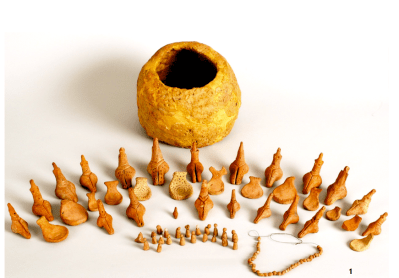
While there is evidence that human beings visited Crete as early as 150,000 years ago, the first permanent settlers arrived from Anatolia in the New Stone Age or Neolithic era, about 9000 years ago, bringing with them the secrets of agriculture and soon afterward learning the techniques of pottery and weaving. As the gatherers of fruits, nuts, and vegetables and as preparers of food in earlier Old Stone Age or Paleolithic cultures, women would have noticed that seeds dropped at a campsite might sprout into plants. Women most likely discovered the secrets of agriculture that enabled people to settle down in the first farming communities of the New Stone Age. As pottery is associated with women’s work of food storage and preparation, and as weaving is women’s work in most traditional cultures, women probably invented these new technologies as well. Each of these inventions was understood to be a mystery of transformation: seed to plant to harvested crop; clay to snake coil to fired pot; wool or flax to thread to spun cloth. The mysteries were passed on from mother to daughter through songs, stories, and rituals. Continue reading “The Heraklion Museum: A Critique of the Neolithic Display by Carol P. Christ”
When I learned about the Navajo Beauty Way, I understood it to be a path in which human beings respect all beings in the web of life and live in harmony with them. But I didn’t understand why this path was called the “Beauty Way.” As a young woman, I knew that my worth was defined by many in terms of my ability to conform to ideals of female beauty promulgated in movies, tv, and advertising. I didn’t believe the Navajos were talking about beauty in that sense, but because of my conditioning, I was not yet able to fully grasp what they might mean by beauty. I would have called the way they were describing a “Way of Harmony” or a “Way of Respect for Life.”
Still, I wondered: why the Beauty Way?
Marija Gimbutas described the societies of Old Europe as peaceful, settled, agricultural, highly artistic, matrifocal and probably matrilineal, and worshipping the Goddess as the power of birth, death, and regeneration in all of life. Though I am impressed with the beauty of the many small works of art Gimbutas reproduced and interpreted in The Language of the Goddess, I sometimes inadvertently omit the words “highly artistic” when repeating in her definition of the culture of Old Europe. I have tended to view the fact that Old Europe was peaceful and matrifocal as more important than the fact that it was highly artistic.Yet this judgment is wrong. In calling the cultures of Old Europe “highly artistic,” Gimbutas was trying to convey her understanding that appreciation of the beauty of life was fundamental within them.
We have been taught that “high” or “great” art is most often monumental in size. The Pyramid of Giza is over 230 meters (756 feet) tall. The Great Sphinx of Giza is 20 meters (66 feet) high. The Parthenon rose to 14 meters (45 feet) and the statue of Athena inside it was 9 to 11 meters (35-40 feet). It is telling that we use the words “high” and “great” (originally measures of size) to describe the value of artistic creations.
Statue of Athena in Parthenon reproduction in Nashville, Tennessee
The purpose of monumental works of art is to diminish the viewer, to make the her feel small, to induce her to bow down, to worship, and to obey a power or powers greater and higher than herself.
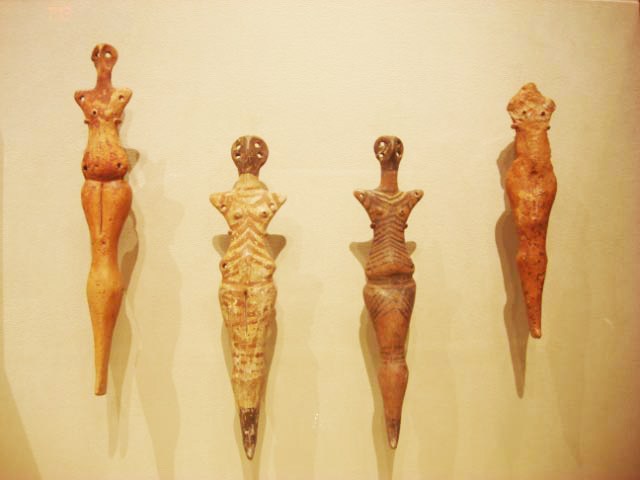
In contrast, the small scale of the art of Old Europe does not diminish anyone or anything. Its purpose is not to make anyone one want to bow down. Instead small works of art make the viewer feel comfortable, welcomed, and part of the beauty of life that is depicted.
Goddesses of Old Europe c. 5000 BCE
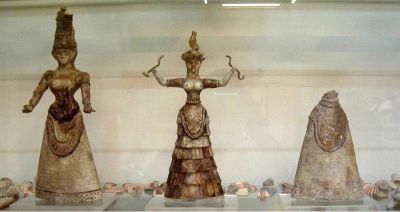
Marija Gimbutas viewed ancient Crete in the Bronze age as the final flowering of the culture of Old Europe. In Crete too, everything is on a small scale. Though the so-called Palaces or Sacred Centers are large, the rooms within them are small. There is not a single room where crowds could have bowed down to a King or Queen. Nor are there images of deities larger than life. The famous Minoan Snake Goddesses are less than 15 inches tall and the well-known pitcher Goddesses are even smaller. Such objects would have been held in hands during rituals or set on low benches in small rooms lit by oil lamps.
Snake Goddesses of Bronze Age Crete c. 1500 BCE
When my friend’s daughter Klia was seven years old, she spent her afternoons collecting stones by the sea. One day I asked her if the stones spoke to her. “Of course,” she replied. “What do they say?” “They say, ‘we are very beautiful.’”
Heart of stones in Lesbos
Klia intuited the meaning of the Beauty Way. It has nothing to do with artificial beauty standards. It has nothing to do with size. It is recognizing beauty everywhere and in everything. When we do so, we walk in beauty, in the grace and joy of life. And yes, the Beauty Way has ethical implications, for no one who truly recognizes beauty could want to harm it. This was understood by the Navajos, the Old Europeans, and the ancient Cretans, and many others. Only we seem to have forgotten. We can remember.
Last winter FAR contributor Glenys Livingstone lovingly and professionally edited all of the interviews for the film on Marija Gimbutas’ life and work, Signs Out of Time, by Donna Read and Starhawk, and posted them on youtube. Though I received a link to my interview from Glenys, I was too busy (or too depressed?) to watch it at the time.
As I watched and listened to my twenty years younger self yesterday, chills went up and down my spine. How, I wondered, did she know so much way back then? Maybe (I thought) she really was drawing on the underground spring described by Marija Gimbutas as bursting forth from time to timε to bring us wisdom from the ancestors of Old Europe.
In the fields of classics and archaeology, Gimbutas’s work is often dismissed as nothing more than a fantasy of a “golden age.” In contrast, scholars of Indo-European languages, Gimbutas’s original specialty, are much more likely to accept the general outlines of her hypothesis. The German linguist and cultural scientist Harald Haarmann is one of them. Continue reading “Was There a “Golden Age” before Patriarchy and War? by Carol P. Christ”
The data came as somewhat of a shock to me. I stumbled across it one day in The Civilization of the Goddess, a mammoth book by the late Lithuanian-American archaeologist Marija Gimbutas about what Gimbutas dubbed “Old Europe” – a culture area in southeastern Neolithic Europe that she maintains was centered around female deity.
Until she had the temerity to suggest that people at some point in the past might have worshipped goddesses rather than gods, Gimbutas had a sterling reputation among academics, even being hired to teach at two of the most prestigious of all American archaeology departments, Harvard’s and UCLA’s. After presenting her goddess theory of Old Europe, however, Gimbutas came under attack by a few powerful male archaeologists, after which her reputation among academics began to plummet (see Spretnak 2011 for a good accounting of Gimbutas’ fall from grace).
Marija Gimbutas
Before I get to the data that so startled me, I need to tell you a bit about archaeologists. Like the members of many academic disciplines, they disagree with each other – sometimes vehemently (and perhaps even somewhat more vehemently than scholars in other disciplines). One thing however they all agree on is this: the higher the quality and quantity of grave goods buried with an individual, the higher that individual’s status in her or his society. Continue reading “When Baby Girls and Old Crones Ruled by Jeri Studebaker”
It has occurred to me that it’s possible that some of the bloggers and readers of this site may not know very much about pagans, so here’s a little New Year’s lesson. The first thing to know is that pagans are almost by definition rebels. That means any generalization anyone may make will almost certainly have a thousand exceptions. You may have heard what Will Rogers wrote in 1932: “I am not a member of any organized political party. I am a Democrat.” Well, the same goes for pagans: many of us joke that we don’t belong to an organized religion. “Pagan,” by the way, is the generic term. Witches, Wiccans, and eclectics (among others, see below) are specific terms. Many of us belong to what are called traditions, which are somewhat analogous to the Protestant denominations. Some traditions are said to go back to the Middle Ages (or further back), but this is generally nonsense. Paganism as it is practiced today is a modern religion looking for (and—voilà! finding!) roots in the ancient and classical pantheons or in Old Europe, where archaeology shows us that the Goddess was worshipped thousands of years before Abraham met his god, ca. 2000 BCE (see Marija Gimbutas’ text for more information on this). Continue reading “Who Are the Pagans? by Barbara Ardinger”


 When European scholars began to study Sanskrit they were surprised to discover linguistic similarities between Sanskrit and Greek and Latin. Old Persian was found to be even closer to Sanskrit. Scholars thus began to speak of related groups of Indo-European languages stemming from an earlier language they called Proto-Indo-European.
 In 1929, my grandmother wrote the word “HOME” in resounding letters across the bottom of a photo of a herself and my grandfather, smiling lovingly and confidently, with my infant mother propped in between them on a rattan chair.
 If I had been asked to write the words that introduce visitors to the
  When I learned about the Navajo Beauty Way, I understood it to be a path in which human beings respect all beings in the web of life and live in harmony with them. But I didn’t understand why this path was called the “Beauty Way.” As a young woman, I knew that my worth was defined by many in terms of my ability to conform to ideals of female beauty promulgated in movies, tv, and advertising. I didn’t believe the Navajos were talking about beauty in that sense, but because of my conditioning, I was not yet able to fully grasp what they might mean by beauty. I would have called the way they were describing a “Way of Harmony” or a “Way of Respect for Life.”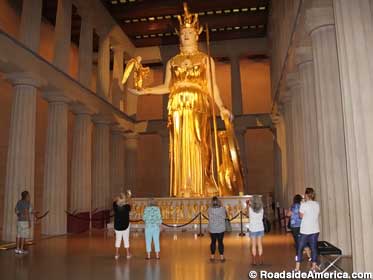

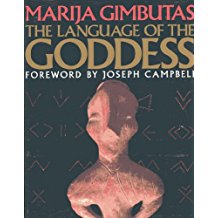 Marija Gimbutas coined the term “Old Europe” c.6500-3500 BCE to describe peaceful, sedentary, artistic, matrifocal, matrilineal and probably matrilocal agricultural societies that worshipped the Goddess as the power of birth, death, and regeneration in all of life.


 Feminism and Religion