

Warning contains images of rape in the history of art portrayed through the pornographic male gaze
 According to the myth, Danae was the only child of the King of Argos who longed for a male heir. After an oracle declared that Danae would indeed bear a son, but that he would kill his grandfather, the King locked his daughter in a tower. Hearing the story, Zeus decided to breach the tower. Transforming himself into a shower of gold, he entered the tower through its roof and raped Danae. When Danae gave birth to Perseus, the King locked them both in a chest and dumped it into the sea. Zeus rescued them, and Perseus went on to behead Medusa, but that is another story.
The myth of the rape of Danae has been a popular subject for male artists from classical times up to the present. It is unclear whether, when they dreamed of “golden showers,” the artists had in mind degrading activities involving pee or whether they thought of sperm as inherently golden, perhaps as the mirror image of golden treasures stolen as the spoils of war. In any case, they were fascinated with the image of golden sperm. In their works, Danae is portrayed as beautiful and rape is normalized. The brutality of the facts–that Danae was locked in a tower by her father, that she was raped while imprisoned, and that her father tried to murder her and her infant son–are overlooked.


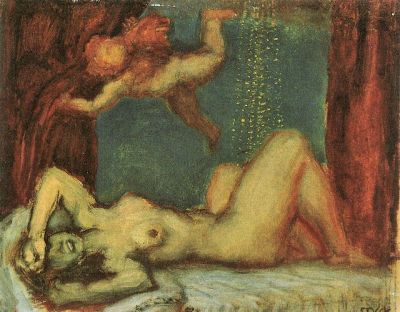

I was little more than a child myself when I began to study images like this in the history of art. I spent countless hours gazing at them in the museums of Europe before I was twenty. I am not sure I even knew what sperm was at the time. Nor had anyone explained to me that rape is always a violent act. Like Danae, I accepted rape: the rape of my innocence, the rape of my mind, the rape of my psyche.
#JustSayNo
Do not accept what you are taught. Do not accept that rape is beautiful. Do not accept that paintings of rape are beautiful. Do not accept rape culture. Do not let anyone tell you that Greek myths are beautiful. Do not let anyone tell you Greek myths are archetypes of the psyche. Question. Question everything.
Also see: https://feminismandreligion.com/2018/12/03/this-is-what-rape-culture-looks-like-then-and-now-by-carol-p-christ/ and https://feminismandreligion.com/2018/12/10/this-is-what-rape-culture-looks-like-in-great-art-by-carol-p-christ/.
Carol P. Christ is an internationally known feminist writer, activist, and educator living in Crete. Carol’s recent book written with Judith Plaskow, Goddess and God in the World: Conversations in Embodied Theology, is on Amazon. A Serpentine Path: Mysteries of the Goddess is on sale for $9.99 on Amazon. Carol has been leading Goddess Pilgrimage to Crete for over twenty years: join her in Crete. Carol’s photo by Michael Honneger.
Listen to Carol’sa-mazing interview with Mary Hynes on CBC’s Tapestry recorded in conjunction with her keynote address to the Parilament of World’s Religions.
 There’s this thing that happens to advocates when the world around us burns with injustice and fury and we shift into what we know, the holding-fighting, fierce-eyed, tender-hearted caring that pours out compassion and links lives with survivors, shedding trails of sweetness as it goes. It’s a professional skillset and personal practice — a vocation, even? — that girds our own hearts with the structure of listening skills, crisis response, and open-ended questions. We wrap ourselves in the safety of our modalities while we float steadily alongside others, occasionally sharing an oar when someone is stuck.
 Seventy-two hours out of every week, I carry a hotline phone. While calls come in waves and some shifts are silent, my everyday and professional lives are peppered with reminders that evil doesn’t just pierce reality through acts of power, control, and violence – it seeps through in discrediting voices and disbelieving questions. It rolls into us off the well-meaning tongues of community members who’d rather protect the status quo than hold people accountable. It wraps its tendrils around us as we walk through each system we are forced to navigate – systems that are not set up to protect our vulnerable hearts and human dignity. Evil powers the backlash wave that tries to knock down every survivor who speaks out about gender, sexual, or intimate partner violence, and it also is in the fear we swallow when we choke down our own stories, press them down deeper, grasping to avoid yet another assault on our integrity, intelligence, and truth.
 Yesterday, Time Magazine announced that its “Person of the Year” for 2017 would be



 Feminism and Religion