A Cave Story by Arianne MacBean

A few years ago, I took a pilgrimage to Crete with the hope of meeting the Great Goddess. I was yearning from something undeniable, proof that would allow me to be a card-carrying believer. Although our group was led to powerful ancient sites where we enacted sincere rituals and dances, each time I failed to feel greeted by Her universal power.

Except once. And I almost missed it.

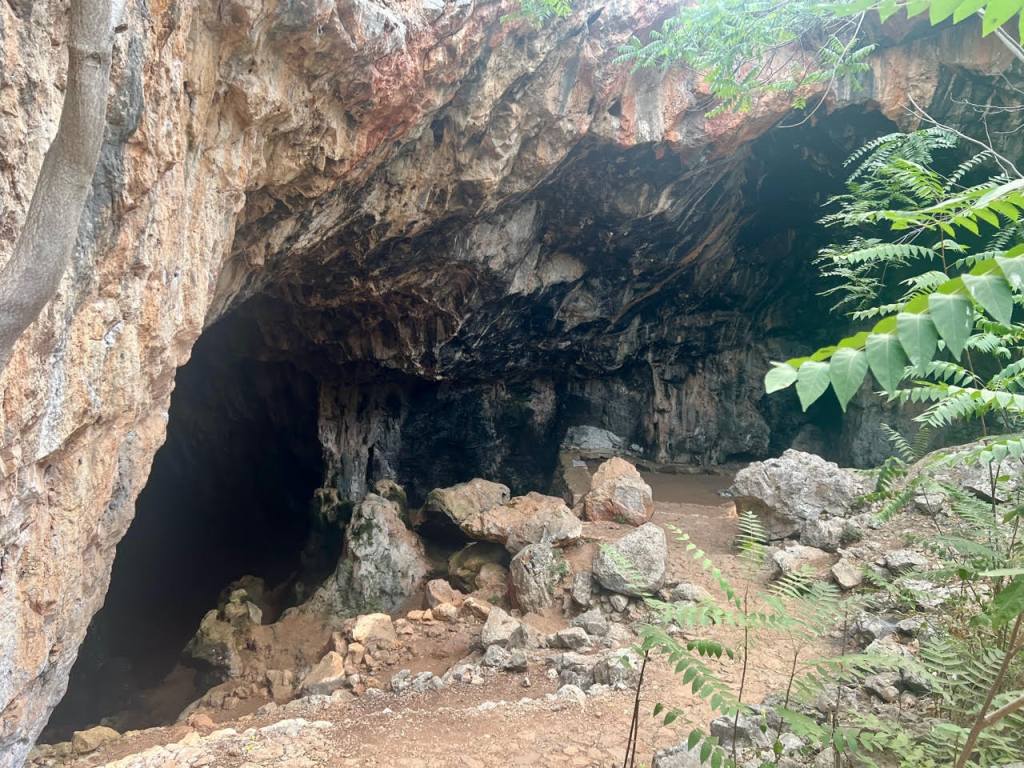
The great cavern, Skotino (Photo by Helen Marie Traglia)

One day, a small but determined group of women took it upon us to co-lead a ritual at Skotino cave, an ancient site used for sacred purposes from the Bronze Age through the Roman era. The collaborative approach to facilitating a ritual was new to us, so we all felt especially ignited and giddy. Before we descended into the depths of the cave, I sang, (something I NEVER do). I had been provided lyrics, but I made up my own melody, which my fellow initiates sang back to me, as a call and response.

Continue reading “A Cave Story by Arianne MacBean”

Veiled by Michelle Wahila

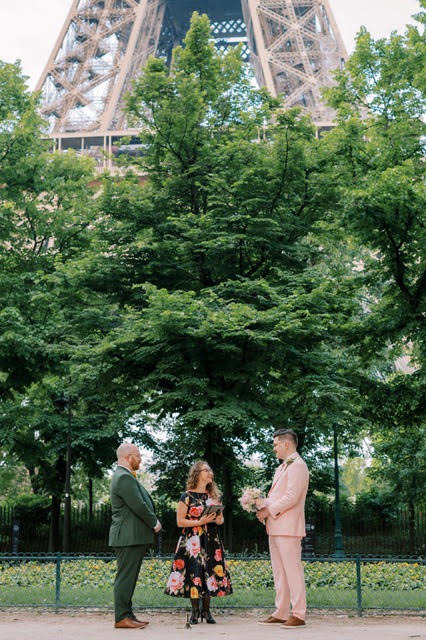
Photos by Paige Gribb Photography
 https://paigegribbphotography.com/

Springtime in Paris brings the magnificence of cherry blossoms, the scent of sweet crêpes, and an influx of tourists eager to capture their own moment of passion on the cobblestone streets of the world’s most romantic city. I may be biased because Paris is my home, but there’s no denying its magic. With its art, history, cuisine, fashion, and architecture, the city offers extraordinary experiences. It’s no wonder so many couples choose to marry in the City of Light.

Years ago, when I entered the wedding industry, I did so reluctantly, only after leaving the one profession I had ever known – ministry. What I didn’t expect was that I would become a bridge for couples navigating the ever-widening gap between love and institutional religion. The so-called “rules” of tradition are often mislabeled as matters of faith but are more accurately named as remnants of the heteropatriarchy. They place enormous pressure on engaged couples. It’s no surprise that many of the eloping couples I meet in Paris have chosen their path simply because it is less stressful than trying to appease tradition, religion, family, or friends (or all of the above).

Continue reading “Veiled by Michelle Wahila”

Navajo  Mountain Way Chant :  Bear as Healer – He Who Frightens Away Illness, part 2 by Sara Wright

Part 1 was posted last week. You can read it here.

The second sand painting used on the sixth night of the Mountain Way Chant is supposed to be a representation of the bears’ home in the Carrizo Mountains. In the center of this painting is a bowl of water covered with black powder. The edge of the bowl is adorned with sunbeams, and external to it are the four sunbeam rafts, on which the Nature Spirits, the Yei stand. There is a close relationship between the Yei and the bears. In the Mountain Way Chant, Talking God, Water Sprinkler (often pictured as a rainbow) Growling God (bear), and Black God are always present.

Bears and Light are related. In the first painting there is light that surrounds the bear and light is present in the form of sundogs that are positioned in each of the four directions. In the second, sunbeams are present in the center and also in each of the four directions providing places for the Yei to stand. It’s very difficult not to draw the conclusion that the light that we are speaking of is also an inner light, and this is consistent with the qualities of healing, insight, and introspection that the Navajos associate with the bear.

Continue reading “Navajo  Mountain Way Chant :  Bear as Healer – He Who Frightens Away Illness, part 2 by Sara Wright”

Love Without Want by Arianne MacBean

I have only felt love without want twice in my life. The first time was when I was invited to my therapist’s funeral. The summons arrived without surprise. Strangely, my therapist and I had talked about it, before dying any time soon was a thing either of us thought would occur. After my own mother had just received her second breast cancer diagnosis, I impulsively asked my therapist during our session, “How will I know if something happens to you? Will someone call?” Someone would call. I was on a list – a list of people to call if my therapist died.

In session, we talked through how her unexpected disappearance might go – playacting for therapeutical reasons, but not knowing we were setting the stage for a true and imminent exit. She asked me if I would like to come to her funeral. There was no hesitation. Yes. I had been seeing her for twelve years. She had gotten me through life, she had gotten me through me. Of course, I wanted to go to her funeral. Then, we talked about what would happen if I died. I asked her if she would come to my funeral. Yes. I asked her if she would give the eulogy. She laughed, “That might be a little weird.” Just two months later, she received her own gut-wrenchingly aggressive cancer diagnosis. We needed no list. She told me herself. The funeral was planned and when it arrived, I sat in the back row not knowing anyone there, listening to stories about a woman I didn’t know but knew. Because as much as I didn’t know anything about her, I knew her so fully through the way she loved me. The funeral invitation, her last selfless gift.

Continue reading “Love Without Want by Arianne MacBean”

Mourning by Beth Bartlett

Grief is the experiencing . . . Mourning is the process,
when we take the grief we have on the inside and express it outside ourselves –
writing, planting, burying, burning, rising up
ceremony, ritual, community[i]

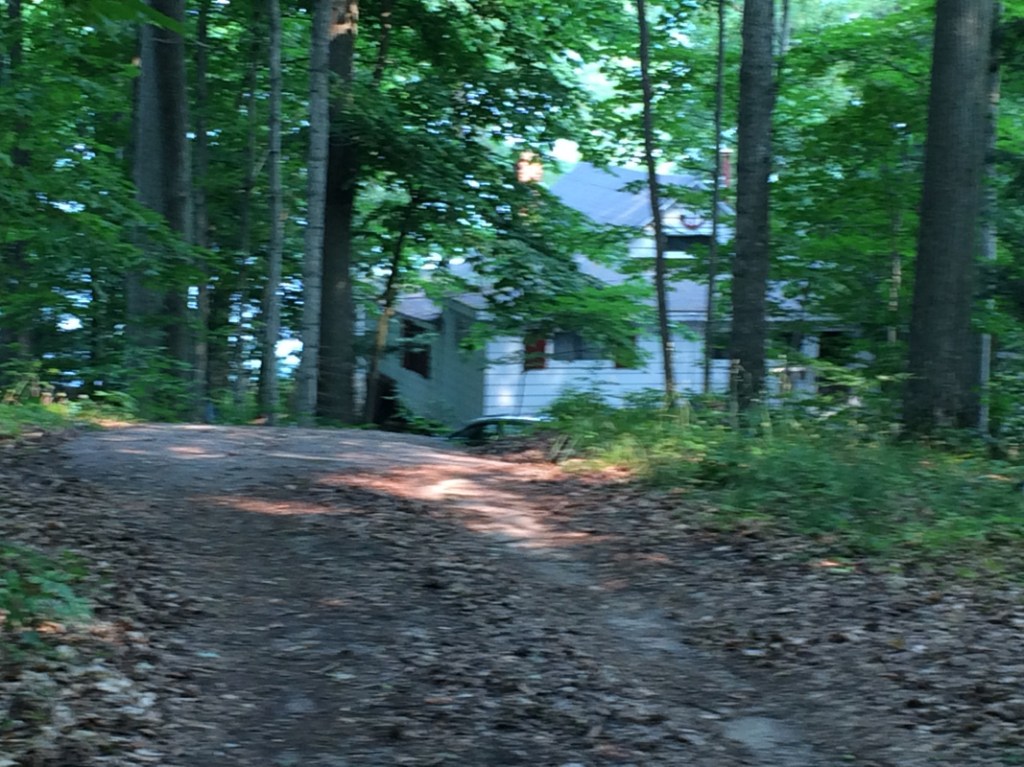
A glimpse of our cottage as I drove away.

“As long as I stayed there, I could keep you with me. . . .” Those words kept repeating in my mind throughout my long drive home from my sister, Jeannie’s, “Celebration of Life” service. I’d stopped midway on my thousand-mile journey at the cabin our family has shared for sixty years.  There I could still feel her presence — on the hillside where we so often sat with our morning cups of tea, or watching the sunset, or chatting away the afternoon; on the dock where we’d lie in the sun or sit late at night and watch the stars come out, or cuddle up in blankets on windy, fall days; in the circle of couches and chairs where we played telephone Pictionary, charades, and CatchPhrase; in the kitchen where we’d cooked and eaten and played card games together; in the bedroom we often shared with a dog between our beds; the road where we’d go for family walks – eight, ten, twelve of us all together, and always two, three, or four dogs; even the driveway where we’d greet and hold each other with great gladness after months of separation, and where we’d hug and say goodbye, and then hug once more because in the back of our minds we’d be wondering if this was the last time.  . . .

Continue reading “Mourning by Beth Bartlett”

Asking For What You Really Want…by Mary Gelfand

As no doubt everyone reading this knows, this election season is full of twists and turns and highly unpredictable.  I struggle daily with ways to manage my stress without destroying my health.

As a practicing Wiccan, my faith does not encourage me to curse or ill-wish anyone, no matter how tempted I may be.  In response to that, I wanted to create something I could do on a daily basis to promote the electoral outcome I desire from a spiritual perspective.  A long-forgotten quote from Rumi provided me with the key to what I want.  “The breeze at dawn has secrets to tell you.  Don’t go back to sleep.  You must ask for what you really want.”

“You must ask for what you really want.”   As a woman reared in the south in the 1950s, I am not really accustomed to asking for what I want.  So Rumi quote liberated me.  I can ask for what I really want as the outcome of this election.  Although I completely support the only feminist candidate, what I really want is a president that embodies certain traits and characteristics that, from my perspective, make a strong and creative leader.  So I’ve created a simple little ritual that anyone can do that gives me a framework to ask for what I really want—to spread my prayers and intentions to the cosmos.

Continue reading “Asking For What You Really Want…by Mary Gelfand”

FRAME THE CHAOS by Esther Nelson

No matter how much we may want absolute control over our own lives and destiny, most of us realize that’s just not possible. Life itself is chaotic—both on a global and individual level. War, famine, drought, earthquakes, tsunamis, pandemics, poverty, sickness, ignorance, disability, divorce, and ultimately death comes calling for everybody living on planet Earth—a planet which will no doubt  eventually die as well. 

How do we maneuver through such dire straits?  Can we make sense of and find meaning in our day-to-day chaotic existence both as members of individual families/communities and as global citizens? Perhaps so, however, it’s impossible to tackle the tumult all at once. Hence, the title of this essay—“Frame the Chaos.”

Thanks to my former colleague Dr. Cliff Edwards for this phrase, gleaned from his reading of Gilles Deleuze, French philosopher (1925-1995). “Chaos is defined not so much by its disorder as by the infinite speed with which every form taking shape in it vanishes.  It is a void that is not nothingness but a virtual, containing all possible.”

Continue reading “FRAME THE CHAOS by Esther Nelson”

From the Archives: Thanksgiving and Service by Sara Frykenberg

This was originally posted on December 3, 2103

Growing up in an evangelical Christian church, I was taught that human beings should serve one another and put others before themselves.  These two different teachings, paired with patriarchal misogyny, have sometimes been very problematic for me.  I tend(ed) to give too much.  Too many demands with which I complied were self-negating (which after all, helped me to make other people more important than myself).  It took me a long time to learn how to appropriately prioritize my own needs, to stop mistaking self-esteem for the”‘sin of pride,” and how to say no when I needed to… Actually, I am still learning some of these lessons.

Conversely, my ritualized service to the church was sometimes confusing, awkward or embarrassing.  I clearly remember having the opportunity to serve as something like an usher during Thanksgiving at our family’s church as a child.  This involved wearing a pilgrim costume, which for me meant finding a Puritan style costume in the church’s closet that fit my overweight childhood frame.  This was not an easy task and left me feeling ashamed.  Later as an adolescent, my youth group asked us to wash one another’s feet as Jesus did for his disciples.  Now, don’t misunderstand me here— I do believe that this ritual has the potential to be very powerful and meaningful for those involved.  However, my teenage self could not identify with the symbolic gesture beyond realizing that:

1)    I thought touching other people’s feet was gross, as was having my dirty feet touched and,
2)    I knew I ‘should’ get something out of the ritual but did not, so I felt spiritually guilty or inadequate.

Overall, I often associated Christian service with guilt, inadequacy, my role as a daughter or woman or my sacrificial duty.

Despite these issues, I usually genuinely enjoy serving others and giving to other people.  I love to host people and care for them.  I like to help.  I even prefer to help.  Serving one another we can express and allow others to express love.  But this past week, one day before Thanksgiving, a dear friend of mine gently challenged me to allow myself to be served or, as she put it, “to give someone else the gift of giving to me.”  Specifically, she was referring to a pending holiday meal for which I expressed my anxiety and frustration with not being allowed to help—which somehow makes me feel like a child.  Even writing this phrase, “makes me feel like a child,” I know that I have touched deeper feelings of helplessness or vulnerability that at some point, I learned to battle with competence and over-achievement.  I do often feel like a child or guilty when other people do for me what I think I could or should do for myself; and my friend’s brief words encouraged me to explore this relationship to being served.

“Service” can sometimes feel uncomfortable for the reasons I mention above, but more so, for its connection to the coercive “servitude” required by existent hierarchies within andro-kyriarchal oppressive systems.  I have been subject to this coercive servitude, and also, its beneficiary.  As a white, middle class, Western woman I have far too much privilege that is contingent upon the forced labor and oppression of other people.  This kind of forced servitude is very wrong; and I am still learning how and where to choose other than to be complicit in this abuse.  But, there have also been many distinctive instances in my life where I have felt reciprocally and undeniably “served” by people around me, without abuse and without manipulation.

Driving to Colorado one summer to see the friend I mentioned above, my two companions and I served one another.  The individual in the back seat was responsible for cutting bagels and spreading cream cheese on them for the driver and navigator, while the navigator held the drink, food or whatever other item that the driver could not.  This may sound like a small thing, but it wasn’t.  I felt taken care of and loved in this small and traveling community.  We also had a safe word that meant, “leave me alone, I’m grumpy” on our long trip.  We made agreements to account for one another’s  discomfort and effort.  We respected one another and cared for each other.

Beginning my work as an adjunct professor, I encountered a great deal of stress and often long and awkward work hours.  Many times I felt like I needed help, but there was nothing I could ask for help with when it came to my job: I needed to grade my own papers, plan my own lectures, and yes, write my own blogs.  My husband has responded by taking care of me in other ways.  He makes me dinner, goes to the store and makes sure I take breaks.  We take turns taking care of one another, and I am grateful for him.

This past week after talking to my friend, I noticed how willing people were to touch me to soothe aching muscles.  I’m not sure how to describe what I felt, but it was like something invisible in certain spaces was suddenly visible.  I also realized that it had been a very long time since I had freely and openly received this touch.  Later during the weekend, a friend came to my house  and she made me dinner!  My husband rubbed my chest after a long night of coughing yesterday because I still haven’t completely rid myself of the smoldering in my lungs.  I was defensive for so long.  Shedding my defender allows me to rediscover all those things for which I am thankful.

Gratefulness is an action.  It can be found in those expressions that return, receive and allow for mutual loving.  I am learning new rituals that help me to remember that this kind of mutual serving and being served is sacred.  In a summer ritual, my friend and I washed one another’s hair instead of our feet.  I am still learning to ask for assistance from the goddess after freeing myself from an abusive omnipotent god, but I am starting to ask.

I am starting to pray again.

BIO: Sara Frykenberg, Ph.D.: Graduate of the women studies in religion program at Claremont Graduate University, Sara’s research considers the way in which process feminist theo/alogies reveal a kind transitory violence present in the liminal space between abusive paradigms and new non-abusive creations: a counter-necessary violence.  In addition to her feminist, theo/alogical and pedagogical pursuits, Sara is also an avid fan of science fiction and fantasy literature, and a level one Kundalini yoga teacher.

The Magic of the Labyrinth by Janet Maika’i Rudolph

Labyrinths are magical. I’ve always been drawn to them. About two years ago, a local Episcopalian Church rebuilt their beautiful outdoor labyrinth and opened it to the public. In concert with them, I have been delighted and honored to offer guided walks there. Doing these walks, both in leading them and in walking myself, have given me the opportunity to reflect deeply on what they mean from many perspectives: historical, personal, spiritual, philosophical, experiential.

When I walk a labyrinth, it feels like I am mirroring the universe while expanding my internal journey. Teresa of Avila agrees with me (or, more accurately, I with her). She wrote, “If we learn to love the earth, we will find labyrinths, gardens, fountains and precious jewels! A whole new world will open itself to us. We will discover what it means to be truly alive.”     


Continue reading “The Magic of the Labyrinth by Janet Maika’i Rudolph”

Carol P Christ’s Legacy: Gratitude and Sharing: Two Fundamental Principles of Goddess Spirituality

Moderator’s Note: Carol Christ died from cancer in July, 2021. Her work continues through her non-profit foundation, the Ariadne Institute for the Study of Myth and Ritual and the Goddess Pilgrimage to Crete. This blog was originally posted February 4 2013. You can read it along with its original comments here.

The more I practice the spirituality of the Goddess, the more I understand that earth-based spiritualities are rooted in two fundamental principles:  gratitude and sharing.  We give thanks to the earth for the gift of life. As we recognize our interdependence and interconnection in the web of life, we are moved to share what has been given to us with others. *

When I first began to lead Goddess Pilgrimages in Crete, I was inspired by a line in Homer to begin a pilgrimage tradition of pouring libations of milk, honey, water, and wine on ancient stones. At first I knew the form, but not its deeper meaning.  It gradually dawned on me as I thought about the large number of pouring vessels in the museums, the altar stones, and the Procession Fresco from Knossos, that an important part of Minoan rituals involved processions in which people offered first fruits back to the Mother whose body had produced them, and poured libations on altars.

Continue reading “Carol P Christ’s Legacy: Gratitude and Sharing: Two Fundamental Principles of Goddess Spirituality”