Unblocking Abundance: A Ritual by Sara Frykenberg

Sara Frykenberg

Rather than release the sadness, heartache and struggle we put into the bowl out into the world, we meditated …to transform what we could of this energy, re-membering the parts of ourselves that had helped to create these blocks and are responsible for transforming them.  We took the transformed energy back into ourselves.

As I have written about many times before, I believe that contemporary Western society operates within a largely abusive paradigm.  I often think of oppression in terms of an abusive cycle.  Theologians like Cater Heyward and Rita Nakashima Brock describe the impact of the theologies that generate such abusiveness, noting how we become smaller to ourselves and smaller to one another.  We do not believe that we are enough, nor are the people or the planet around us ‘enough’ to fill the vacuous alienation that substitutes itself for real relational need in an abusive context.  Judith Shaw wrote eloquently about the environmental impact of conflating need with greed in her Friday post, “Can We Honor Inanna and Her Gifts?”

Shaw writes, “At first glance we appear to be abundant with things, energy, experiences.  But in our mad desire for more and more and always more we neglect the balance of the very earth who provides us with all.”  Many people, particularly in industrialized nations, have been taught to fill the need for a sense of abundance, connection and ‘enough-ness’ with more stuff: more things, more money, more food, more land, etc.  And yet, ironically, this quest for ‘more’ can also prevent us from experiencing the very abundance we seek.  We can create blocks to abundance by trying to fill the vacuum instead of our actual needs: and difficultly, abusive patterns and cycles can prevent us from seeing the difference between the two.  Continue reading “Unblocking Abundance: A Ritual by Sara Frykenberg”

Gratitude and Sharing: Two Fundamental Principles of Goddess Spirituality by Carol P. Christ

carol p. christThe more I practice the spirituality of the Goddess, the more I understand that earth-based spiritualities are rooted in two fundamental principles:  gratitude and sharing.  We give thanks to the earth for the gift of life. As we recognize our interdependence and interconnection in the web of life, we are moved to share what has been given to us with others. *

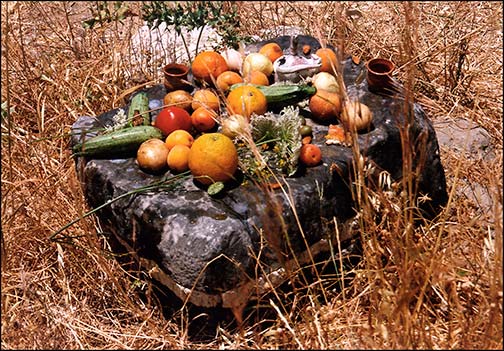
When I first began to lead Goddess Pilgrimages in Crete, I was inspired by a line in Homer to begin a pilgrimage tradition of pouring libations of milk, honey, water, and wine on ancient stones. At first I knew the form, but not its deeper meaning.  It gradually dawned on me as I thought about the large number of pouring vessels in the museums, the altar stones, and the Procession Fresco from Knossos, that an important part of Minoan rituals involved processions in which people offered first fruits back to the Mother whose body had produced them, and poured libations on altars.

kernos stone kay keys

Over twenty years of performing the ritual of pouring libations has convinced me that this was not “a” but “the” central Minoan ritual.  Its purpose is to thank Mother Earth for the bounty She has bestowed on us. Continue reading “Gratitude and Sharing: Two Fundamental Principles of Goddess Spirituality by Carol P. Christ”

Embody the Sacred – Engaging Through the Senses by Deanne Quarrie

The human body is designed to utilize all senses. We, human beings, have drifted away from our natural state through which, at one time, we engaged with all of life through our natural senses, including the intuitive.  This change has come about through our active, stress filled lives in which we seldom slow down to even appreciate what is around us.  We have ignored much of our sensory ability due to a change-over from right brain functioning, which is more imaginative, creative and intuitive, to left brain functioning, which is linear and analytical. Two of our senses are developed out of proportion to the others.  Many people grow up in an environment lacking in exposure to the natural world.  With television, computers and video games we have become residents of an indoor and often sedentary world.

In early civilization, humans and all other animals depended on finely tuned sensory awareness for survival.  We walked the Earth, using those senses for protection, to find food and to move around.  We did not just see and hear our way around but we felt, touched, tasted and smelled in order to survive. Continue reading “Embody the Sacred – Engaging Through the Senses by Deanne Quarrie”

Monthly Highlight: Mary E. Hunt

As a Catholic feminist theologian, activist, teacher, and writer Mary Hunt has made a massive impact in the field of feminism and religion.  Following the completion of her graduate education (MA, Harvard Divinity School, M.Div., Jesuit School of Theology, Ph.D., Graduate Theological Union), Mary recognized a strong need for theological, liturgical, and ethical development by and for women and responded by co-founding WATER (The Women’s Alliance for Theology, Ethics, and Water) in 1983.  Over the last 3+ decades, she has been instrumental in addressing social injustice and creating change in religion and community. Continue reading “Monthly Highlight: Mary E. Hunt”

Hagar – Demoted Servant or Egyptian Princess? By Michele Stopera Freyhauf

A socio-political examination of Genesis 16 explores how ancient myth can influence the story of Hagar and Sarai. Socio-political events could have occurred between the Egyptians and King Solomon that influenced the writing of this text.  According to John Currid in Ancient Egypt and the Old Testament, the Egyptians and Hebrews borrowed many things from each other and because of that, an inter-relatedness exists between the languages as well as cultural and religious practices of both kingdoms (26).  It is this inter-relatedness that I wish to explore and ask the question -was Hagar an Egyptian Princess demoted to a lower position of servitude in order to make a political statement of superiority of the Israelites over the Egyptians?  Or is this a story of conflict between two of Solomon’s wives?  Finally, could this story tell us about events that occurred after Solomon’s death since the Biblical texts from the pre-exilic period began to take shape during the reign of David and Solomon?  This is a very brief exploration of these theories.

In Genesis 16, Hagar and Sarai connect Egypt and Israel in a familial relationship, one rooted in strife.  These two women, an Israelite and an Egyptian, are brought together because of Sarai’s barrenness and need to fulfill the covenantal promise. Because of this, Hagar becomes Abram’s secondary wife.  This is not the only time that marriage between an Israelite and Egyptian occurs in the Old Testament.  Joseph marries and an Egyptian, the daughter of a priest of On (Genesis 41:45).  Solomon also has an Egyptian wife who seems to have some importance because she is mentioned six times in the Old Testament (1 Kings 3:1; 7:8, 9:24; 11:1-2; 2 Chronicles 8:11).

Important is the fact that this passage could be rooted in the writings that emerged in that period that portray family strife.  Savina J. Teubal in Ancient Sisterhood: The Lost Traditions of Hagar and Sarah, states these “andocentric writing and editing” of the biblical narratives portray conflicts between women who “vie for the attention of their husbands or sons” (19).  In this case the story really could be a tale of family strife inspired by two of the wives of Solomon, one of which was Egyptian.

Continue reading “Hagar – Demoted Servant or Egyptian Princess? By Michele Stopera Freyhauf”

Practicing the Presence of the Goddess by Barbara Ardinger

Practicing the presence of the Goddess is a term I invented in the early 1990s when I started teaching a class with that name. It started out as a class where I taught women about the goddesses of the Egyptian, Greek, Roman, and Norse pantheons and gradually turned into lessons on modern paganism, then into a class on creating effective rituals and doing magic, and finally evolved into being in the world—practicing Her presence.

When I wrote about ways of being in the world on April 29, I went past mere existentialism and suggested that benevolence is a good way to be in the world. Be kind to people. Be polite. (Or as kind and polite as it’s possible to be in a world that is markedly unkind and impolite.) What benevolence really is, is one element of what I call practicing the presence of the Goddess. Continue reading “Practicing the Presence of the Goddess by Barbara Ardinger”

The Power of Feminist Rituals by Grace Yia-Hei Kao

“These were very simple rituals and yet they were so powerful.”

Jeanette Stokes’ 25 Years in the Garden is on my bedside table. It’s a book I read several years ago with a small group of feminist Christians when I was living in Blacksburg, Virginia. The following passage from one of her essays got me to thinking back to the 2012 PANAAWTM conference (Pacific, Asian, and North American Asian Women in Theology and Ministry) I had attended just two weeks ago:

“Rituals are part of everyday lives: reading the newspaper, checking the weather, waiting for the mail to come, or talking with a family member at the end of the day. Rituals can also mark the extraordinary events in our lives: the birth of a child, the death of a loved one, a birthday, marriage, anniversary, or divorce” (Stokes, 2002, p. 37).

Continue reading “The Power of Feminist Rituals by Grace Yia-Hei Kao”