Legacy of Carol P. Christ: “It Came Upon a Solstice Morn”

***This was originally posted on December 25, 2017

It came upon a Solstice morn,

that glorious song of old

with angels bending near the earth,

to touch their harps of gold.

“Peace on the earth.

good will to all,”

from heaven’s all glorious realm.

The world in silent stillness waits,

to hear the angels sing.

Continue reading “Legacy of Carol P. Christ: “It Came Upon a Solstice Morn””

From the Archives: Artemis As Artemisia: Ancient Female Spirituality & Modern Medicine by Stuart Dean

This was originally posted on November 29, 2015

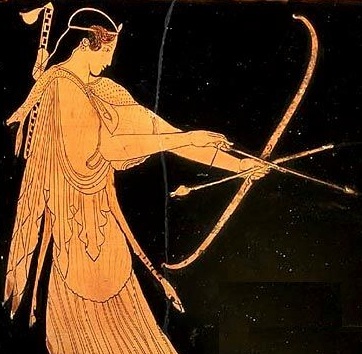
Detail of Artemis from a 5th century BCE Attic Vase

The 2015 Nobel Prize for Medicine was awarded in part to a Chinese woman (Tu) for her identification and isolation to treat malaria of a chemical known as Artemisinin.  The name of that chemical derives from the fact that it is found in varying amounts in the ‘family’ (technically, genus) of plants known as Artemisia.  The name of that family derives from its association with the goddess Artemis.

Because Tu’s work began in China in the 1960s it is understandable that even if she knew this about Artemisia (a term I use to refer to any one plant or all of the plants of that family) it would not have been a ‘careerbuilder’ for her to point it out to those for whom she was working.  It was bad enough that she was a woman.  At that place and time, however, if she had said or done something that could be associated with Western culture her name might not even be known today.


Continue reading “From the Archives: Artemis As Artemisia: Ancient Female Spirituality & Modern Medicine by Stuart Dean”

The Legacy of Carol P. Christ: Sappho Chose Love Not War, What Will You Choose?

This was originally posted on November 12, 2012

We have been taught to speak of war and the heroes of war in hushed tones. We have been told that evil Helen’s choice was the cause of the Trojan war.  2600 years ago Sappho, known as the greatest lyric poet of ancient Greece, spoke truth to power and unmasked the lies told at the beginning of western tradition.

*

In a poem addressed to Anactoria, Sappho writes:

            Some say a cavalry corps
            some say infantry, some, again,
            will maintain that the swift oars
            of our fleet are the finest
            sight on dark earth …

Here, Sappho invokes the heroic tradition celebrated in the epic poems of Homer that shaped the values of ancient Greek culture and all the cultures that followed it, including our own.  This tradition tells us that to serve in a war and to be remembered as a hero is the highest goal to which a man can aspire.  Sappho does not agree:

             …but I say
             that whatever one loves, is.

Continue reading “The Legacy of Carol P. Christ: Sappho Chose Love Not War, What Will You Choose?”

Sappho in a Locrian Mode by Carolyn Lee Boyd

Sappho

The world Sappho envisions in her poetry is one with many lessons for us in the 21st century about how to live. While ancient Greek society, especially in later eras, was deeply misogynistic and women had few rights, Sappho’s words evoke a perspective in which goddesses, especially Aphrodite, are revered and the connection of worshippers to goddesses is intimate, art created by women is celebrated, women’s relationships are central to one’s well being, and love and sensuality are enjoyed.

But words only tell part of the story. Sappho’s poetry was meant to be sung, and while we can’t hear the songs she wrote, I think it is interesting to note that Anne Carson, in her 2003 translation “If Not, Winter” says that Sappho is credited with inventing the Locrian musical mode.  A mode is a scale in which the progression of notes follows a set pattern of whole and half notes. We are all familiar with the major mode that makes music sound happy (Happy Birthday song) and the natural minor mode that we use for sad music (House of the Rising Sun). But there are many other modes, and the Locrian mode is one of them. (just a note: the Locrian mode is the same as the Greek Mixolydian mode and completely different from the modern Mixolydian mode, just to be confusing.)

Continue reading “Sappho in a Locrian Mode by Carolyn Lee Boyd”

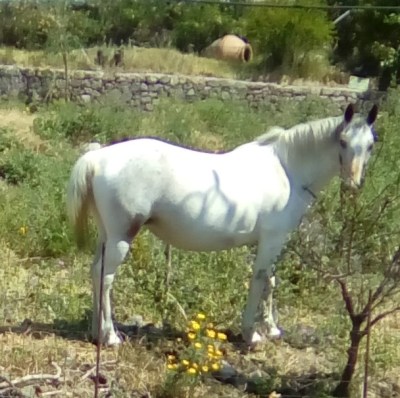
Visions of the Goddess: A White Horse by Carol P. Christ

Imagine my surprise when, a few days ago, I looked out my window to see a dappled horse munching on flowers in the field across the street from my house. In the next days I got used to her being there. I would look for her in the mornings and at odd times during the day. Sometimes she was visible and sometimes she was not. When I could see her, I would open the window and call out, “Hello, white horse, you are very beautiful.” Once or twice she turned her head to look at me and seemed to respond, “Thank you for noticing.”

Many hundreds of years ago, Sappho must have had a similar vision in a field near a grove of trees where she and her students waited for the Goddess to appear, for she wrote: “In meadows where horses have grown sleek among spring flowers, dill scents the air.“ These lines are part of a longer poem addressed to Aphrodite that begins: “Leave Crete and come to us.” In this place, “incense smokes on the altar,” there is a stream, there are apple trees and rose bushes and horses in a field of flowers. Continue reading “Visions of the Goddess: A White Horse by Carol P. Christ”

Sappho’s Poems as an Ethos for Women’s Ritual by Jill Hammer

Photo by: Zac Jaffe

For by my side you put on

many wreaths of roses

and garlands of flowers

around your soft neck


and with precious and royal perfume

you anointed yourself.


On soft beds you satisfied your passion.


And there was no dance

no holy place

from which we were absent.


–Sappho (trans. Julia Dubnoff)


Sappho, the poet from Lesbos (630-570 BCE), was considered one of the greatest poets of her time—one of her epithets was “the tenth Muse.” I discovered the poems of Sappho in my thirties and was utterly captivated.  I had newly embarked on a relationship with a woman and Sappho’s love poetry (though by no means exclusively lesbian) supported the expression of eros between women.  Yet even more than that, Sappho’s poems supported an erotic relationship between self and world—a relationship that included ritual as a form of intimacy.  I’m not a Greek scholar—I experience Sappho’s poems in translation. Yet the translations I read back then were a revelation: a world in which women lived in circle with one another.

Continue reading “Sappho’s Poems as an Ethos for Women’s Ritual by Jill Hammer”

A Matter of Life and Death: The Military or the Green New Deal? by Carol P. Christ

“I have set before you life and death . . .  Choose life.” (Deut. 30:19)

Scientists tell us that an environmental catastrophe which has already begun threatens every aspect of life as we know it on planet earth. The choice could not be clearer. Will we choose life? Or will we choose death?

On March 6, 2019, William Barber and Phyllis Bennis published an opinion piece titled: “If America can find $716 bn for the military, it can fund the Green New Deal.” In it, they note that politicians in both parties are rushing to dismiss the Green New Deal as an unrealistic pipe dream, stating that there simply is no money to fund it. Senator Dianne Feinstein’s response is characteristic of the Democratic Party’s so-called moderate and pro-military wing. As Barber and Bennis report:

When young organizers from the Sunrise Movement recently challenged Senator Dianne Feinstein to support a Green New Deal, she told them “there’s no money to pay for it”. She probably didn’t expect those eight- and 10- and 11-year-old kids to respond immediately: “Yes, there is, there’s tons of money going to the military.”

Feinstein responded condescendingly that the military does “important things” with that money.

Continue reading “A Matter of Life and Death: The Military or the Green New Deal? by Carol P. Christ”

Three Herstorical Divas to Die For by Mary Sharratt

The Urban Dictionary defines a diva as a woman who exudes great style and confidence and expresses her unique personality without letting others define who she should be. In my mind, a diva is a woman who stands in her sovereignty and blazes a trail for other women. We all need to claim our inner diva to truly dance in our power. And if you’re looking for inspiration, I present three herstorical divas to die for.


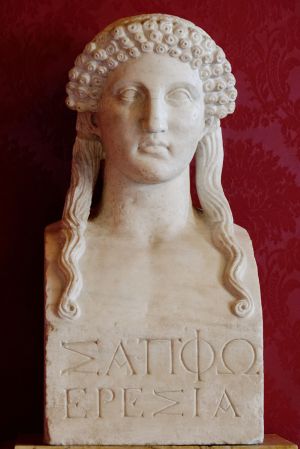
Pompei-Sappho.nocrop.w840.h1330.2x

  1. Sappho ca. 630 – 580 BCE


Sappho of Lesbos wrote the book on love. Literally. Her searing love poetry addressed to other women gave us the word lesbian. She was the first—and the best!—to describe passion as a visceral experience, in which we are seized and transfixed by Aphrodite, Goddess of love. Though much of her work was destroyed by the patriarchal fun police, the fragments of her poetry that survive are timeless, haunting, and utterly true.

What we must remember is that Sappho’s poetry wasn’t just romantic or erotic–it was sacred, each poem a holy offering to Goddess Aphrodite.

Continue reading “Three Herstorical Divas to Die For by Mary Sharratt”

“It Came Upon a Solstice Morn” by Carol P. Christ

It came upon a Solstice morn,

that glorious song of old,

with angels bending near the earth,

to touch their harps of gold.

“Peace on the earth.

good will to all,”

from heaven’s all glorious realm.

The world in silent stillness waits,

to hear the angels sing.


I wake in the dark of Solstice morn.

Mountains shrouded in clouds,

cold wind blowing,

light dawns.


My mother heard

the angels sing,

on Solstice eve,

calling me to life,

her Christmas Carol.


Blessed Mother Always With Us.


Longing for my beloved,

on Solstice morn,

I heard Sappho sing:

Thank you, my dear

You came and you did

well to come: I needed

you. You have made

love blaze up in

my breast–bless you!

Bless you as often

as the hours have

been endless to me

when you were gone.


Cold tiles,

bare feet,

coffee brewing,

elderly dog stirring,

I open the garden door.


And there it is.

Solstice miracle.

Three purple irises.

blooming in the cold.

Life triumphing over death,

every time.
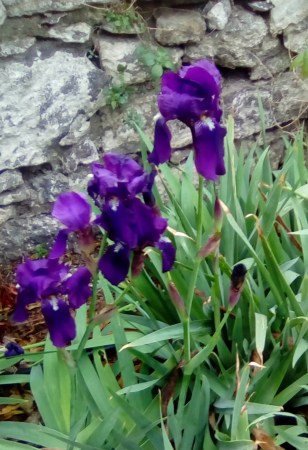
New words to the traditional carol “It Came Upon a Midnight Clear” by Carol P. Christ.

Sappho translated by Mary Barnard.

Thanks to Miriam Robbins Dexter for the digging iris bulbs from her garden for me to plant in mine.

My mother promised my father to name me Susan or Peter but when she heard carolers in the hospital, she changed her mind.


* * *
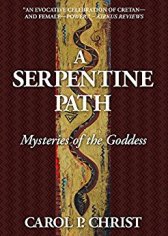
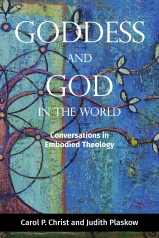
a-serpentine-path-amazon-coverGoddess and God in the World final cover designCarol’s new book written with Judith Plaskow, is  Goddess and God in the World: Conversations in Embodied Theology.

FAR Press recently released A Serpentine Path: Mysteries of the Goddess.

Join Carol  on the life-transforming and mind-blowing Goddess Pilgrimage to Crete. It could change your life! Spring tour filled, sign up now for Fall 2018.

Carol’s photo by Michael Honegger

 

Plato’s Diotima as a Symptom of Psychosis by Stuart Dean

Stuart WordPress photoAs I mentioned in my January 30, 2016 post, Grace Jantzen in Foundations of Violence makes a compelling case that Diotima is a fictional figure.  She does not, however, adequately distinguish her from the poetizing female figures Parmenides and Boethius portray as instructing them in their respective works.  If nothing else, the quality of the poetry of Parmenides and Boethius betrays the influence of a very real woman: Sappho.

By contrast, Plato essentially portrays Diotima as the personification of his philosophy–his metaphysics–and it is hard to believe there was such an ancient Greek woman.  Although the term ‘metaphysics’ derives from a neologism coined in Greek centuries after Plato and Aristotle lived, its meaning (‘beyond’ (meta) the ‘natural,’ or ‘embodied’ world (physics)) appropriately characterizes what Diotima and hence Plato’s philosophy is all about.  A key passage is where she characterizes the most intense love as “gazing at and being with” the beloved, without even the need to “eat or drink.”  That leads her to ask rhetorically whether it would not be best to gaze at what is not “infected” by flesh and blood (Symposium (211 d-e)).

Philosophy, Albrecht Dürer (1502)(Die Bayerische Staatsbiliothek)

Continue reading “Plato’s Diotima as a Symptom of Psychosis by Stuart Dean”