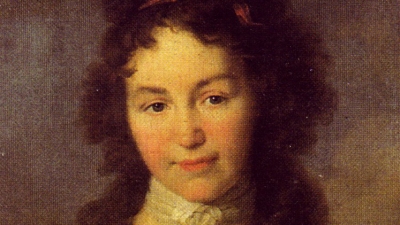
Caroline Schelling on Birth & Death by Stuart Dean

Caroline Schelling

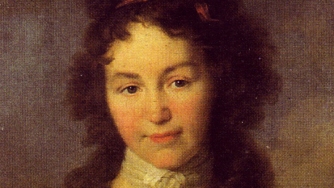
Of the many letters Caroline wrote to her lifelong friend Luise, one of the most intense  (the 57th Letter) dates from seven years after the 4th Letter discussed in my last post.  By then both were married; only a few months earlier Caroline had given birth to her first child (Auguste); though Luise already had children, Caroline knew that one of them was terminally ill.  In the first paragraph Caroline describes how difficult Auguste’s birth was for her; in the second she consoles Luise over the impending death of her child.  She thus subtly parallels birth with death and hence the labor for one with mourning over the other.

Fifteen years later, only a few months after the death of Auguste–the last of her four children to die–Caroline’s generally positive disposition evidenced in the 4th Letter and her experience in grappling with birth and death evidenced in the 57th Letter were being put to the test.  Though she was holding up well, Friedrich Schelling (Friedrich), the man who was to be her third husband, seems to have been suicidal from feeling guilty (rightly or wrongly) for having failed to do enough to cure whatever illness killed Auguste.  Caroline wrote frequently and urgently to him, offering advice and comfort.  In one of those letters (274d) she characterizes the challenge of overcoming grief as a formula to be solved: “(death/pain) x (love/bliss) = (life/peace).”  She terms this one of her ‘primal axioms’ (the “Ursatz”), although she seems playfully to concede to Friedrich that he or perhaps someone else shares responsibility for it. Continue reading “Caroline Schelling on Birth & Death by Stuart Dean”

Caroline Schelling’s 4th Letter by Stuart Dean

Caroline Schelling

Caroline Schelling (‘Caroline’) wrote the fourth letter of hers that survives (the ‘4th Letter’) on October 7, 1778, shortly after she had turned 15, to a girl she met at boarding school who was to become her lifelong friend (Luise).  The intensity of her friendship with Luise is evident already in the 4th Letter, for she tells Luise that in writing to her she “portrays her entire soul.”  What prompted such depth of feeling for this letter relates not just to a significant moment in Caroline’s life but in every person’s life.  In the second paragraph she refers to what was most likely her first sexual relationship.  Given that context, Caroline demonstrates remarkable emotional maturity and intellectual sophistication in how she expresses herself.

She begins by referring to the “sensations of my heart,” telling Luise how she struggles to find “adequate words” to express them.  She is not, she proudly insists, an “enthusiast” who simply gives into feelings, insisting instead on the importance of “going over” (Überlegung) them herself.  Though Caroline was not taught Latin, it seems as if she had been taught the relevance to German of a Latin treatise from the 4th century CE on the method for defining words.  Caroline’s ‘going over’ her feelings before writing Luise is consistent with its methodology: first, to confront the question of whether something even exists (an sit, Existenz) and then determining, to the extent possible, what it is (quid sit, Wesen) and what its qualities are (quale sit, Eigenschaften)–i.e., its relationship to other words (grammar) and hence how it can be communicated.  

This methodology, which is applicable to a wide range of disciplines (e.g., legal argumentation, psychiatric diagnosis), is also analogous to a language theory Charles Segal argued is implicit in what remains of the writings of the 5th century BCE Sicilian Gorgias, a theory Segal related to Sappho’s poetry.  That is relevant, because given the failed sexual relationship about which Caroline writes to Luise, the 4th Letter bears comparison to two poems by Sappho (S. 31 and S. 1) that Caroline surely then knew in translation.  Caroline’s “sensations of my heart” is directly comparable to the palpitations of the heart Sappho refers to in the second stanza of S. 31.  The immediate effects are comparable; Sappho cannot speak and Caroline cannot find “adequate words.”  Though S. 31 appears to break off, S. 1 can be read as a continuation of it.  There Sappho prays for divine intervention (Aphrodite) to deal with a failed sexual relationship; the closing prayer of its final stanza is analogous to the last sentence of the 4th Letter’s first paragraph: “Lord, you who know my heart . . . fulfill no wishes that are not pleasing to you, I am depending on you!” 

In each case it would seem the answer is anticipated to be one that is not heard or read but rather felt in the heart, intuitively understood as the center point of all bodily feelings.  That would be not an abstraction from the senses but an inward intensification of them.  Such intensification becomes the basis for its outward expression not just in words, but in all forms of art.  

Caroline grew up during a time of renewed interest in ancient Greek art and particularly nude sculpture, which rightly can be taken to symbolize the belief in the sacredness of the entire human body (a belief that correlates with heart centeredness).  It is notable that the floruit of such sculpture predates Plato by almost a century and quite literally embodies principles utterly antithetical to his philosophy.  It is also analogous to another art form that predates him and that he disparaged: reciting poetry (whether or not incorporated into a theatrical production).  Poetic recitation requires fully identifying with the poet and poem to such a degree that it can be thought of as internalized sculpting.

The principles underlying sculpture and recitation are thus similar and of general applicability.  Caroline, who enjoyed (and was appreciated for) reciting poetry, makes the point in a review she wrote of a book of essays on artistic appreciation (the “Review”).  To judge art, she says, it is necessary to penetrate “deeply into the meaning and sensibility of both it and its initiator . . . surrendering oneself in quiet reflection to a disposition of loving, receptive observation . . . [to be] transpose[d] . . . into the world of the poet or artist.”  She defends the book’s use of a fictional friar to voice religious reverence for art, effectively equating artistic appreciation with religious devotion, since it is only from feeling the divine within (i.e., internalizing god as the artist) that the divine outside is to be understood.   

This was not something new for Caroline, as is evident from the 4th Letter that was written nearly twenty years before the Review.  Not only does she seem to have internalized Sappho, but the opening line of S. 31 (a man, “equal to the gods”) and the closing line of S. 1 (“my comrade,” the goddess) arguably encouraged her transition in the 4th Letter’s first paragraph from describing her feelings to Luise (psychology) to praying to God (theology).  That transition anticipates the identification of psychology with theology Caroline articulates in the Review.  

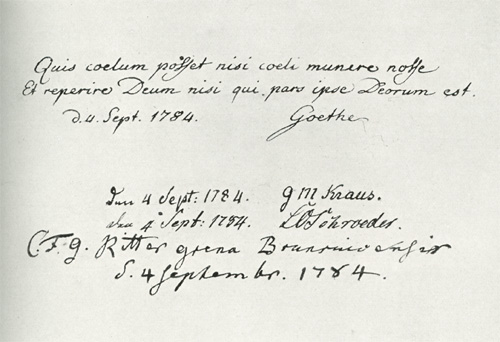
The remote antiquity of this identification and its association with goddess worship to which Sappho attests, as well as the recognition of it by Caroline at such a young age deserve attention, for it has quite a history, especially in German culture.  Goethe quoted two lines of a 1st century CE Latin poem on astrology that essentially echo it in the guestbook atop Mount Brocken on September 4, 1784: who is able to know heaven except by a gift from heaven, who finds god unless a part of the gods is within them.  It is not known when Caroline met Goethe; it has been speculated that he was the father of her first daughter, Auguste, born April 28, 1785.  In August 1784 Caroline was living in a mining town not far from Brocken.

The opening paragraph of an essay published by Caroline’s third husband in 1809, only months before her death, contains a reference to the principle of knowing the god outside from the god within, correctly noting that its connection with Empedocles proves it predates Plato.  In 1936 Heidegger characterized that essay as “one of the most profound works” of Western philosophy.  In my next post(s) I hope to show that its profundity relates to a critique of Plato (and other philosophers) that derives from Caroline and her appreciation of ancient Greek female spirituality, and not to glorifying supermen.

Stuart WordPress photoStuart Dean has a B.A. (Tulane, 1976) and J.D. (Cornell, 1995) and is currently an independent researcher and writer living in New York City.  He has studied, practiced and taught Tai Chi, Yoga and related disciplines for over forty years.  Stuart has a blog on Sappho and the implications of her poetry for understanding the past, present and future: http://studysappho.blogspot.com/

Artemis As Artemisia: Ancient Female Spirituality & Modern Medicine by Stuart Dean

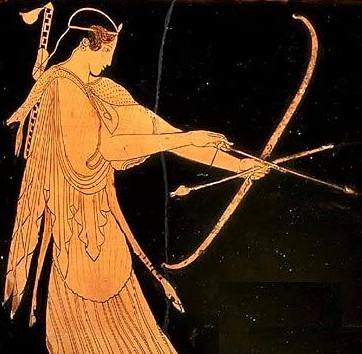
Detail of Artemis from a 5th century BCE Attic Vase
Detail of Artemis from a 5th century BCE Attic Vase  (Museum of Fine Arts (Boston))

The 2015 Nobel Prize for Medicine was awarded in part to a Chinese woman (Tu) for her identification and isolation to treat malaria of a chemical known as Artemisinin.  The name of that chemical derives from the fact that it is found in varying amounts in the ‘family’ (technically, genus) of plants known as Artemisia.  The name of that family derives from its association with the goddess Artemis.

Because Tu’s work began in China in the 1960s it is understandable that even if she knew this about Artemisia (a term I use to refer to any one plant or all of the plants of that family) it would not have been a ‘careerbuilder’ for her to point it out to those for whom she was working.  It was bad enough that she was a woman.  At that place and time, however, if she had said or done something that could be associated with Western culture her name might not even be known today.   

Nevertheless, because those awarding the Nobel Prize are free from discrimination or intimidation, it is startling that in the explanation provided for the award no mention is made of the Western legacy of Artemisia.  To begin with, the very fact that the Prize was being awarded to a woman for a plant named after a goddess should have elicited at a sense of uncanniness that arguably deserved mention.  Be that as it may, the failure to mention that Artemisia has a long history of being used medicinally in the West not only as an insect repellent but also to treat fever–a common symptom of malaria–is simply inexcusable. Continue reading “Artemis As Artemisia: Ancient Female Spirituality & Modern Medicine by Stuart Dean”

Sappho, Frankincense, and Female Spirituality by Stuart Dean

Frankincense

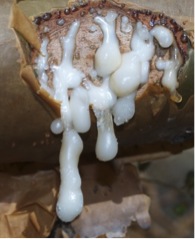
White Howjary Frankincense (photo: Trygve Harris (www.enfleurage.com))

Sappho is the first Greek author to attest to the usage of frankincense.  The word she uses to refer to it (libanos) is what comparative linguists call a ‘loan word,’ in this case from ancient South Arabic (the root meaning of which is ‘white’), the language spoken in the only region in the world still now, as then, where the trees grow that produce the resin that is frankincense (the finest being White Howjary from near Salalah Oman).

This was long before Amazon Same-Day Prime: that frankincense even made it to where Sappho was is astonishing given the thousands of miles of desert terrain that had to be covered.  That fact plus the fact that Sappho chose to use the Arabic word for frankincense suggests it must have been of special importance to her.  How important can be seen in the power she attributes to it.  In one prayer poem (S.2, composite translation and very brief notes here) she completes a stanza by referring to frankincense burning from Aphrodite’s altars; she completes the very next stanza with a reference to ‘sleep falling.’  The parallelism implies a reciprocity: the smoke goes up, the sleep comes down and a stanza later, there is Aphrodite. Continue reading “Sappho, Frankincense, and Female Spirituality by Stuart Dean”

Sappho’s Prescription For A Healthy Heart & the Taoist/Buddhist Concept of Forget (忘)

Stuart WordPress photoA two line fragment of Sappho’s poetry (S.120) reads:

But I am not one to keep venting my anger:
Rather I let some things in my heart go unspoken

Sappho’s word choices here make this as difficult as any of her fragments to appreciate in translation.  Yet, not only do those choices make attribution of this fragment to Sappho secure, they also manifest her importance in an area for which she rarely receives attention: early Greek medical thinking.  One reason her importance in that regard is largely unnoticed is that Western medicine in general has abandoned its own tradition, retaining only the nomenclature and some of the symbolism of early Greek medicine. Continue reading “Sappho’s Prescription For A Healthy Heart & the Taoist/Buddhist Concept of Forget (忘)”

The Sphere: A Symbol of Ancient Greek Female Spirituality by Stuart Dean

Stuart WordPress photoOriginally, in ancient Greek, ‘sphere’ simply meant ‘ball.’  Though its grammatical gender varied, it was primarily a feminine noun.  It is in that sense and with that gender that it bounces into Western literature in the episode of the Odyssey where Nausicaa and her companions are playing catch on a beach (Odyssey 6.100 ff).

Nausicaa is said to be conducting her companions in ‘molpe,’ a curious term that seems to refer to dancing, music and poetry as a single form of performance art.  Authorship (including possibly female authorship) and dates of individual episodes of the Odyssey remain debatable, but both from this episode as well evidence from other sources there is no doubt that in general what Nausicaa and her companions are doing here relates to an actual custom among Greek women that dates back to well before writing was adopted. Furthermore, molpe was spiritually significant.  As the conductor of its performance Nausicaa is compared to Artemis.

The reference to Artemis as one of those who ‘holds heaven’ (Odyssey 6.150), suggests that the sphere with which Nausicaa and her companions are playing may have been intended (at least by the author of this episode) to be a symbol of the celestial sphere.  That suggestion is bolstered by an appeal to what is to be found in the fragments that survive of the poetry of Sappho, who it is readily apparent considered herself as much a musician and choreographer as a poet.  That is to say, whereas Nausicaa may be a fictional persona, with Sappho we have the only direct evidence of any substance directly from an actual woman of what constituted molpe.  From how she refers to a female performer of molpe as goddess-like (S. 96), followed immediately by a comparison of yet another woman’s beauty to that of the moon, as well as other fragments of poems where either the appearance or movement of women in connection with a molpe performance is related to celestial events such as the appearance of a full moon or the movement of the Pleiades, it is clear that for Sappho choreography was in effect applied cosmology (see S. 154 and S. 34 and how it is surely echoed in a much later Latin poem here). Continue reading “The Sphere: A Symbol of Ancient Greek Female Spirituality by Stuart Dean”

The Physician Luke, the Virgin Mary and the Poet Sappho by Stuart Dean

Stuart WordPress photoSince my last contribution to Feminism and Religion my interest in Sappho and her influence has led me to a detailed analysis of Luke 1:27-45 (hereafter, the “Conception Story”).  I want to share two observations from that analysis that I think will be of interest to readers of this blog.  Both relate to the generally agreed upon fact that Luke was a physician and in particular to knowledge he can be assumed to have had of female anatomy based on evidence from approximately contemporaneous sources.

My first observation relates to the fact that Luke lived during a time when the existence of ovaries in women had only recently been discovered and their function correctly understood.  While this had obvious implications for Greek medical theory, it would appear to have affected how Luke himself interpreted the source material he had for the Conception Story and hence how he told that story.  My second observation, based on what is known of Greek gynecology, is that Luke would have correctly understood that although as a medical term ‘virginity’ does refer to the physical fact that sexual intercourse has not occurred, it does not necessarily or even often have an anatomical meaning.  That observation leads directly to investigating whether ‘virgin’ as used by Luke may have a primarily metaphysical rather than physical meaning.

Though in general the ‘glory days’ of Classical Greece belonged to the centuries well before Luke’s time, that is not true of Greek medicine.  Notwithstanding promising origins in a sexual egalitarianism that was in principle consistent with modern medicine, Greek medicine regressed substantially with Aristotle, who introduced the notion that the male’s contribution to reproduction was the active one and the female’s merely the passive provision of the material for its success.  Not only did Aristotle not know of ovaries, even after their discovery it is far from clear when exactly their function was fully understood (the best evidence is about a half century after Luke).  Once that happened, however, Greek medicine moved back towards the sexual egalitarianism of its origins (the ‘two seed theory’ of reproduction), repudiating Aristotle’s theory (the ‘single seed theory’ of reproduction). Continue reading “The Physician Luke, the Virgin Mary and the Poet Sappho by Stuart Dean”

Painting Sappho by Angela Yarber

angela

“Someone, I say, will remember us in the future,” she once wrote.  To my knowledge, she was never dubbed a prophet.  A muse, yes.  A romantic, perhaps.  But never a prophet, rarely holy, and nary an icon.  Until now.   Hailed as one of the best Greek lyric poets, many have tried to forget her, or at least the more provocative elements of her life.  The passionate poet Sappho was born on the island of Lesbos around 620 BCE (sometime between 630-612 BCE).  The word lesbian stems from the place of her birth and her name is the origin of the word sapphic, though most scholars assert that little is known of her actual life and that the majority of her poetry is not autobiographical.  Yet her lyric poetry speaks of love for both sexes and myriad people.

What is more, the idea of homo and heterosexuality are not transhistorical essences, but instead are relatively recent socio-historical constructs. To say that there were strict sexual binaries in the ancient world in which Sappho lived would be an anachronism. Sexuality was much more fluid.  Not surprisingly, many scholars have tried to name and claim male lovers for Sappho, a heteronormative attempt to erase her fluid sexuality, her hope to be remembered in the future dashed, demeaned, forgotten.  In fact, during the Victorian Era, many asserted that Sappho was the headmistress of a girls’ school, another attempt to straighten out her memory, her poetry, her love. Continue reading “Painting Sappho by Angela Yarber”

Jesus, the Woman at the Well, and the Meaning of ‘Man’ by Stuart Dean

 Stuart WordPress photoThe story in the Gospel of John of the encounter Jesus has with a Samaritan woman (hereafter, ‘the Samaritan’) at Jacob’s well (4:7-29) has attracted considerable scholarly attention.  For an overview of some of the interpretive issues raised by it there is a video of a conversation about it between H. W. Attridge and D. L. Bartlett of Yale Divinity School available on Youtube here.  I intend to focus primarily on only four verses, John 4:16-19.

Here is my translation (the underlying Greek and links to interpretive resources can be found here):

16 [Jesus] said: “go tell your ‘man’ and come back here.”
17 The Samaritan answered, “I do not have a ‘man.”’ Jesus said to her “Beautifully you said ‘I do not have a man.’
18 You have had five ‘men,’ and the one whom you have now is not your ‘man.’  You spoke truthfully.”
19 The Samaritan said to him: “Sir, I see you are a wise listener.”

My translation is intended to bring out what I take to be a play on the meaning of the underlying Greek word for man.  Before I explain exactly what the play on meaning is about I want to justify the assumption that there is some sort of play in the first place. Some have argued that the reference to the bride and bridegroom at John 3:29 foreshadows the meeting of Jesus and the Samaritan as a spiritual wedding.  The theme of a spiritual wedding is arguably also foreshadowed in how John starts the book itself, for ‘beginning’ is a feminine noun in Greek and ‘word’ is masculine, making ‘in the beginning was the word’ sexually symbolic; that, in turn, suggests that the well before which Jesus and the Samaritan stand, or the water in it, symbolizes God, or at least the spirit of God. Continue reading “Jesus, the Woman at the Well, and the Meaning of ‘Man’ by Stuart Dean”

Sappho & Early Christianity by Stuart Dean

Stuart WordPress photoGiven modern perceptions of Sappho it is, I am sure, going to seem at a minimum counterintuitive that early Christians would have had an interest in Sappho.  The issue is not helped by the fact that a story about Saint Gregory of Nazianzus ordering the burning of Sappho’s poetry has been frequently repeated both in print and online.  There is no basis for it in any reliable historical source. Mention is first made of it in the Renaissance, possibly as the result of confusing attitudes and policies of later times with those of Gregory’s time.  Whatever the explanation, it is ironic any credence was given to such a story, for not only was Gregory very interested in Sappho in particular, but he was also a keen advocate for appreciating the relevance to Christianity of art and literature generally.  A prominent figure in Eastern Orthodox Christianity, Gregory is not well known to ‘Western’ Christianity, especially among English speaking Christians.  An excellent place to familiarize yourself with him is a brief talk given by John McGuckin, who is a priest, poet and scholar at Columbia University, available on youtube here.

There are a variety of possible explanations for Gregory’s interest in Sappho that relate to both his personal circumstances as well as how Sappho had been received within the Judaeo-Christian tradition in ancient times.  It is worth noting that Gregory was from what is today a region of Turkey occupied by Hittites in very ancient times.  That happens to be an area that Sappho may have had some cultural connection with, for modern linguistic analysis suggests that her name, which does not mean anything in Greek, derives from Hittite or a related ancient Turkish language.  What did ‘Sappho’ mean in Hittite?  ‘Holy one.’  I am basing this on an article by Edwin Brown that is available online here for those who want more granularity. Continue reading “Sappho & Early Christianity by Stuart Dean”