

 Goddesses of art and inspiration, the Muses gave their name to our museums, where they are (or should be) worshipped. I feel a special devotion to them. … The ones I really like, though, are the theatrical Muses—Euterpe, Thalia, Melpomene, and Terpsichore, plus maybe Calliope and Errato. I was a drama major (and possibly a drama queen) in college…. Today, I go to the theater as often as I can.
Although my greatest devotion is to the Great Goddess, who is said to have ten thousand names, I find myself more and more adoring the Muses:
- Clio, “Fame-giver,” ruler of history and shown with an open scroll
- Euterpe, “Joy-giver,” the lyric Muse who plays the flute
- Thalia, famous for her comic mask and wreaths of ivy
- Melpomene, wearer of the tragic mask and vine leaves
- Terpsichore, “Lover of dancing,” who carried a lyre and ruled choral music as well as dance
- Errato, “Awakener of desire,” ruler of erotic poetry
- Polyhymnia, “Many hymns,” shown as the meditating inspirer of hymns
- Urania, “Heavenly,” ruler of astronomy who carries a globe
- Calliope, “Beautiful-voiced,” ruler of epic poetry who carries a tablet and a pen[1]
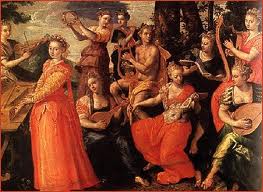 The Muses are the daughters of Mnemosyne, Memory, and were raised on Mount Olympus. I still remember visiting a nice mainstream metaphysical church where one of the members was introducing the speaker. This member kept referring to “MEEnosyne.” Who is that? I kept asking myself, and when the speaker mentioned the Muses, I finally figured it out. Memory’s name is pronounced Neh-MOS-uh-nee. As I wrote in January, 2012 it’s really not wise to insult the divine eardums. I later took the member aside and gave her a lesson in pronunciation, though I could hardly blame her. That “Mnem” will cross your eyes and trip up your tongue.
Goddesses of art and inspiration, the Muses gave their name to our museums, where they are (or should be) worshipped. I feel a special devotion to them. I love history, and though my degrees are all in English, by now I’ve read enough history to have earned at least a bachelor’s degree in the subject. I read the whole Will Durant series, I’ve always got something historical in the pile of books on the other end of the couch, when authors whose books I edit make historical errors, I know enough to correct them. Hooray for Clio and long may she live!
The ones I really like, though, are the theatrical Muses—Euterpe, Thalia, Melpomene, and Terpsichore, plus maybe Calliope and Errato. I was a drama major (and, alas, possibly a drama queen) in college and spent all four years building sets, serving as the light dummy (the person they focus the lights on), doing makeup, building costumes, even stage-managing a few plays. Today, I go to the theater as often as I can. I like comedies, but a friend (whose degree is in classical literature) and I like to go to the Getty Villa in Malibu every fall to see their staging of a classical Greek tragedy in their classical Greek theater. They’re beautifully done.
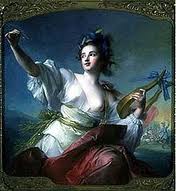
But who do I like best? I guess that has to be Terpsichore. Not because I like ballet, but because I love musical theater, which always has dancing and singing. I’ve seen A Chorus Line. I’ve seen Cats. I’ve seen the revival of West Side Story with its revived Jerome Robbins modern dancing. And a few months ago, I saw George and Ira Gershwins’ Crazy for You (1992), which is based on their Girl Crazy (1930), with songs added from a couple Fred Astaire movies, including A Damsel in Distress (1937), in which George Burns and Gracie Allen dance with Fred. At several points in Crazy for You the stage is filled with tapdancers. As Bobby Child, the hero, says, “Who could ask for anything more?” And, to borrow from an Irving Berlin tune, “Heaven, I’m in heaven” when I see a stage filled with actors singing and tapdancing.
A decade or so ago when I was writing Finding New Goddesses, which is a parody of the Goddess encyclopedias, I was more or less inspired by either Clio or Calliope (more likely, someone pretending to be a real Muse) to “find”—that is, make up—a modern muse. Her name is Mimsy Borogove:
Editor’s note: The following interview was found in a trunk in the attic of an obscure mathematician. The trunk, which was left on the doorstep of the present Editor by a Mysterious Stranger, contains a number of poems written in an outlandish language which the present Editor is determined to translate and publish in multiple volumes (just like some of our favorite mystery writers).
FNG. Ms. Borogove, you say you’re a Muse. Why aren’t you a Goddess like the rest of the Ladies in this book.
Mimsy Borogove. That is Miss Borogove to you. I don’t hold with those modern honorifics.
FNG. So sorry.
Mimsy Borogove. Quite right. I am a Goddess. I am a specialized Goddess. I am made of finer stuff than your every-day deities and I am Privy to the Secrets of the Universe. I know, for example, how slithy the toves actually were, and I saw what the momeraths were doing. No, no, no, don’t ask. Outgrabing does not make a pretty picture. And when a night becomes brillig, well, let’s just say that it’s best to remain indoors with the curtains firmly shut. Many Goddesses are prosaic, donchew know, whilst I am prosodic. I know The Rules.
FNG. What are you the Muse of?
Mimsy Borogove. I rule All The Finer Things In Modern Life. Disco. Limericks. Thick romance novels and made-for-TV movies that run on and on and on. Laugh-In and daytime drama. Astrology. Christian pop rock. Why, you must know that I inspire the lot of them! And, let me modestly admit (though I never like to brag), it is I that was invoked of old by the likes of Virgil and John Milton. Well, let me think a moment. Ah, yes. Here it is.
Of man’s first disobedience, and the fruit of that forbidden tree,
sing o heavenly muse of arms and the man.
Let us sing a somewhat loftier strain and regain the blissful seat,
of goodness so wondrous, sing o Queen of Heaven, o heavenly muse . . . .[2]
I rather like that “heavenly muse” part, don’t you?
FNG. Er…yes. You have an impressive track record. What can you tell us of your history?
Mimsy Borogove. Well, I no longer remember my mother’s name, though She was terribly big and important. I strongly suspect that my father was William F’Buckley. Very attitudinal gentleman, donchew know, and his vocabulary, well, certainly A Notch Above. One has heard, of course, of My nine sisters. They got the famous assignments—tragedy, comedy, the poetries, astronomy, dance. Whatever. I would have done, but Mum was saving me for The Better Things. And here I am now, donchew know, A Modern Muse For The Modern World! Isn’t it Unfortunate that one no longer hears from one’s trashy sisters. Oh, they have those tacky marble statues, and Clio got that award named after her (advertising, what kind of honor is that, I ask you), but I’ve got the Genuine Pizzazz.
FNG. Er, yes. I’ve heard that the word “museum” comes from “muse.” Can you comment on that?
Mimsy Borogove. I can tell you that musea—that’s the proper plural of museum, you realize—that musea preserve the culture of the age. Of all ages. And what is the most enculturated part of a museum? It’s the gift shop. We Muses always keep Our Priorities (and Our Gifts) Quite Firmly In Hand.
FNG. What projects are you currently working on?
Mimsy Borogove. Oh, I’ve quite moved away from the visual arts. These days, I’m looking over e-publishing. Quite the coming thing, what? One seems to have a great deal of time on one’s hands, and e-publishing gives one an entire new generation to hover over. F’Buckley alone knows whom one might inspire!
FNG. Mimsy Borogove, star of stage, screen, and several rather fascinating inner worlds, thank you for your time.
Mimsy Borogove. Delighted, I’m sure.
[1] Patricia Monaghan, The New Book of Goddesses and Heroines (St. Paul: Llewellyn Publications, 1997), 222-23.
[2] Mimsy has confused and conflated Paradise Lost, the Aeneid, and Virgil’s Eclogues. These three works contain invocations to the Muse, to be sure, but we can be certain that Mimsy was not the Muse who inspired Milton and Virgil!
Barbara Ardinger, Ph.D. (www.barbaraardinger.com), is a published author and freelance editor. Her newest book is Secret Lives, a novel about grandmothers who do magic. Her earlier nonfiction books include the daybook Pagan Every Day, Finding New Goddesses (a pun-filled parody of goddess encyclopedias), and Goddess Meditations. When she can get away from the computer, she goes to the theater as often as possible—she loves musical theater and movies in which people sing and dance. She is also an active CERT (Community Emergency Rescue Team) volunteer and a member (and occasional secretary pro-tem) of a neighborhood organization that focuses on code enforcement and safety for citizens. She has been an AIDS emotional support volunteer and a literacy volunteer. She is an active member of the neopagan community and is well known for the rituals she creates and leads.
Discover more from Feminism and Religion
Subscribe to get the latest posts sent to your email.

 Feminism and Religion
Interestingly Terpsichore was often portrayed seated and playing the lyre. She was not the dancer or the dance but the one who created or played the music that inspired the dance and the dancers. A little factoid from wikepedia, my search inspired by your piece.
LikeLike
What a delightful post, Barbara! Thank you for educating modern readers on ancient theater and for sharing your passion for musical theater! Right on, write on, revel on!
LikeLike
Barbara, I’ll never forget how excited I was when I first discovered your website (only last year, and when I was in debilitating emotional pain, too) – and then i remembered that I had a great book on my book shelf by an author with your name and same interests, and of course it was you…and it was your early ‘Womens Rituals and Celebrations’ book…and I opened it up to the Goddess Gotcha pages just by chance(?) and laughed til tears ran down my cheeks… then I started peeking inside your web pages weekly at least.
Your work is so *alive*. And intelligent – and a lotta FUN, too…while being quite scholarly and serious as well. Your work helped bring ME back to life in a new way after my ‘family accident’ as I call it – it gave me a lot of courage to really *see*-see, and to accept more fully, the feminine Truths that I know are real, were laying asleep, dormant, still…yes, even at 56, 57 years old….
Thank you for being YOU, with your in-depth creative spirit always illuminating Truths – lending a realer and richer picture of reality and of love than the Judea-Christian traditions will ever be able to acknowledge – let alone be aware of, even….their being lost in power and control mind-constructs, which weave a terrible web of confusing hate-messages, really – punitive and damning as HELL. ….Like Thomas Paine said, “Belief in a cruel god makes a cruel man”….I will add: it also makes for terrified people…who don’t even know they HAVE terror that was instilled in them through this little black book that everyone is so afraid to really look at for what it’s worth – historically – as a document ….written by god and by ‘His people’….and carried with the authority of apostle Peter and all of Rome and alla the popes and priests and the entire patriarchy…
It is interesting times we live in now – even some of the Buddhists, the younger ones now, are realizing a change must take place in patriarchs – there’s a wonderful young Shambala Buddhist monk from the famous Rinpoche family, who is exposing on the internet the sexual abuses, for instance…and we all now know that this is to be expected, these abuses – in rigid, all-male institutions….that abuses do tend to prevail often enough.
Your work is so powerful, Barbara. It answers the begging questions of why the conventional patriarchal religions are imploding, failing – as one of my hero’s, Red Crow, said.
Blessings all around YOU!
LikeLike